A retrospective analysis of the efficacy of oral venous thromboembolism prophylaxis for patients undergoing minimally invasive direct anterior approach total hip arthroplasty
Abstract
BACKGROUND: Venous thromboembolism (VTE), comprising deep vein thrombosis (DVT) and pulmonary embolism (PE), is a pertinent and preventable complication following total hip arthroplasty (THA). Direct anterior approach (DAA) THA has gained global popularity for its potential benefits; however, the optimal duration of postoperative venous VTE prophylaxis remains controversial. This study aimed to compare the efficacy of two weeks versus four weeks of rivaroxaban as postoperative VTE prophylaxis in patients undergoing minimally invasive DAA THA. METHODS: We conducted a retrospective analysis of the medical records of 526 consecutive patients who underwent elective primary THA via the DAA between 1 January 2017 and 31 December 2022. We compared the incidence of symptomatic and asymptomatic VTE, and the rate of complications associated with VTE prophylaxis within six months postoperatively in patients who received either a two- or four-week course of rivaroxaban as VTE prophylaxis following DAA THA. Duplex venous ultrasound was routinely performed at three weeks for all patients to evaluate for the presence of lower limb DVT. RESULTS: The study included 356 patients who received four weeks of treatment and 170 patients who received two weeks of rivaroxaban for postoperative VTE prophylaxis. The two groups were equally matched for age, sex, comorbidities, and preoperative vTe risk, according to the Caprini score. The overall incidence of VTE was 1% (n = 6) and included three DVTs and three pulmonary emboli (PEs). Of the DVTs detected via duplex venous ultrasound, two were diagnosed as symptomatic DVTs, and one was diagnosed as an asymptomatic DVT. The incidence of VTE was significantly greater in the two-week group than in the four-week group (p = 0.043), and all patients in whom a VTE occurred had a body mass index (BMI) of > 30 kg/m2 and a preoperative Caprini score indicating moderate or high risk. No statistically significant difference was noted in the rate of wound complications (p = 0.40) or the incidence of periprosthetic joint infections between the two cohorts (p = 0.56). CONCLUSION: A four-week course of rivaroxaban demonstrated superior efficacy in reducing the incidence of VTE compared to a two-week regimen in patients undergoing DAA THA. Importantly, the extended duration of rivaroxaban prophylaxis did not result in a significant increase in the rate of complications associated with VTE prophylaxis. These findings underscore the potential benefits of a prolonged rivaroxaban regimen for optimising postoperative VTE prevention, particularly in obese patients and high-risk patients undergoing minimally invasive DAA THA. Level of evidence: 3
total hip arthroplasty; direct anterior approach; venous thromboembolism; rivaroxaban; anterior minimally invasive surgery; AMIS
Introduction
Total hip arthroplasty (THA) is a highly regarded and cost-effective surgical intervention,12-4 Worldwide, the demand for THA is expected to increase significantly in response to the increasing demand for enhanced mobility and quality of life among the ageing population.566,7
Despite the significant utilisation of THA, questions abound regarding surgical technique, including the optimal surgical approach.8,9 Despite the success of conventional approaches, arthroplasty surgeons are constantly exploring new ways to enhance and refine their technique.10,11 The direct anterior approach (DAA) to THA is gaining global popularity due to its minimally invasive nature by utilising internervous and intermuscular planes with the aim of enhancing short-term outcomes while minimising certain risks, such as a reduction in the rate of postoperative dislocations, a lower incidence of deep-seated wound infections, and lower revision rates within the first 12 months postoperatively.12-14 The growing popularity of the DAA is highlighted in a 2021 survey of the American Association of Hip and Knee Surgeons (AAHKS), where Abdel et al. reported that the use of the DAA increased from 12% in 2009 to 45% in 2020.15,16
Worldwide, the overall complication rate associated with THA is 5.5%.1718-22 Medical complications include, and are not limited to, urinary tract infections (UTIs) and respiratory complications.23-26
One of the most devastating sequelae of THA is venous thromboembolic (VTE) phenomena.272828-32
VTE comprises a spectrum of conditions, from asymptomatic deep vein thrombosis (DVT) to life-threatening pulmonary emboli (PEs).3334
The surgical approach utilised for THA may indirectly promote venous stasis and endothelial injury.35-37 During preparation of the femoral canal in both the posterior approach (PA) and lateral approach (LA), the combination of flexion, adduction and external rotation of the femur cause the femoral vein to be compressed, ultimately leading to occlusion of blood flow.3538> 30 kg/m239,40
Since the implementation of thromboprophylaxis strategies, the incidence of VTE in surgical patients has reduced substantially, from 70% to 44%.4142-46 An area of considerable contention revolves around determining the optimal pharmacological agent/s for VTE prophylaxis in patients undergoing THA, with discrepancies arising among major authorities, while considering factors such as cost, clinical effectiveness, susceptibility to bleeding, and wound-related complications.4347
A paucity of literature exists evaluating the incidence of VTE and the diagnosis of asymptomatic DVTs in patients undergoing DAA THA. Therefore, considering the globally increasing demand for DAA THA, the increased risk of VTE after THA, and the controversies surrounding the optimal choice and duration of VTE prophylaxis, the rationale of this study is to compare the efficacy of a two- versus four-week rivaroxaban VTE protocol in patients undergoing minimally invasive DAA THA.
Methods
Study design
This study was a retrospective analysis of 526 consecutive patients over 18 years of age who underwent elective, unilateral primary anterior minimally invasive DAA THA between 1 January 2017 and 31 December 2022, by a single high-volume hip surgeon, in Johannesburg, South Africa. All patients who underwent a THA between 1 January 2017 and 31 December 2019 received a four-week course of oral rivaroxaban as postoperative VTE prophylaxis, while those operated on between 1 January 2020 and 31 December 2022 received two weeks of rivaroxaban. The following patients were excluded from this study: those patients who did not receive postoperative rivaroxaban due to contraindications; patients with a history of VTE or currently undergoing VTE treatment; individuals who underwent THA as a result of trauma, and those who underwent revision THA.
Surgical protocol
A structured protocol was followed for all patients, which included a standardised baseline preoperative medical assessment and optimisation by a fellowship-trained physician. All patients underwent surgery in a single laminar-flow operating theatre under general anaesthesia supplemented by a neuraxial regional block, administered by a single trained anaesthesiologist. A single dose of intravenous antibiotic prophylaxis, adjusted based on the patient's weight, was administered preoperatively, and continued for a duration of 24 hours postoperatively. Cefazolin was the antibiotic utilised, except in cases of penicillin allergy, where clindamycin was the preferred alternative. All patients were placed in a supine position on the operating table, and a cushioned peroneal support was positioned between the legs. The affected leg was securely positioned using a mobile leg positioner under the control of an experienced, trained table operator.
A longitudinal skin incision of 6-10 cm in length was made, located 2-3 cm laterally and parallel to a line connecting the anterior superior iliac spine and Gerdy's tubercle. The underlying perimysium was incised to facilitate access to the interval between the tensor fascia lata and sartorius. The lateral aspect of the rectus femoris was retracted medially to expose the joint capsule. Utilising an anterior capsulotomy, entry into the joint was established. The femoral neck was osteotomised under traction, with due care taken to protect the posterior capsule. Wherever possible, the acetabular labrum was left intact, and the acetabulum was prepared using traditional THA techniques. Preparation of the femur was performed in a position of extension and external rotation to maximise proximal access. Soft tissues were released as needed to ensure sufficient access to the femoral canal while safeguarding ligaments. Femoral broaching was performed utilising AMIS® broaches employing conventional broaching techniques. Uncemented implants with ceramic femoral heads and highly cross-linked polyethylene liners were preferentially used.
Intraoperatively, an intra-articular negative-pressure suction drain was routinely placed and subsequently removed within a 24-hour timeframe. Intermittent pneumatic compression calf pumps were applied immediately postoperatively and utilised until discharge, complemented by twice-daily inpatient physiotherapy sessions that were started as soon as the spinal anaesthetic wore off. On the first day postoperatively, all patients were made to stand and walk a few steps with assistance. Patients were expected to achieve full ambulation with two crutches before being discharged. Upon discharge, which is usually two days postoperatively, patients were prescribed oral thromboprophylaxis in the form of rivaroxaban at a daily dose of 10 mg for either a two- or four-week duration.
Three weeks postoperatively, the surgical incision was evaluated by a clinical associate, and any questionable wounds were reviewed by the primary surgeon. At the same follow-up, a routine lower limb duplex Doppler was performed by a qualified radiologist and sonographer to ascertain the presence of a symptomatic or asymptomatic DVT. If a DVT was clinically suspected, patients were reviewed by a physician, and further investigation followed. Follow-up assessments were conducted by the surgeon at three weeks, six weeks, six months postoperatively, and every Ave years thereafter.
Variables and outcome measures
Preoperatively, the following baseline demographic patient information was captured for all patients: age (years), sex, comorbidities, and BMI (kg/m248495051
Intraoperatively, the following data was collected: the type of anaesthesia and regional neuraxial block administered; surgical duration in minutes from initial incision to completion of the last suture; estimated blood loss in millilitres; and the type of fixation used for both femoral and acetabular components. Perioperative data included: the use of blood products; length of stay (LOS) in days measured from date of admission to date of discharge; and discharge destination, namely home or specialist nursing facility. Postoperatively, follow-ups were conducted at three weeks, six weeks and six months. At subsequent follow-ups, patients were assessed clinically for the presence or absence of a lower limb DVT indicated by pain and swelling of the calf, overlying erythema, and an increased temperature of the affected limb compared to the contralateral side. DVT was also evaluated for at three weeks, as the risk for VTE is highest during the first 10-14 days after THA.52 53
Complications were further classified as intraoperative or postoperative. Medical complications were considered as those related to the patient's baseline and physiological effects of the surgery, including VTE (DVT or PE). Surgical complications were those complications assumed to be directly related to the surgery, including wound complications, infection, peri-prosthetic fractures, and joint dislocation. Complications were also classified temporally as early, occurring < 4 weeks, and late, occurring > 4 weeks after THA.
Data analysis
The study compared the incidence of VTE between two cohorts (rivaroxaban for two weeks versus rivaroxaban for four weeks) based on a series of variables. The two means of these variables were compared using t-tests with statistical significance at p < 0.05. Confidence intervals were calculated at 95% and used in conjunction with the p-values to determine clinical significance. Groups were tested to verify if they met the assumptions of a linear model, including a normal distribution and equal variability. If these assumptions were not met, the Mann-Whitney U test was used to test hypotheses between the two cohorts. The statistical package used was Stata version 17 (2017), Texas, USA.
Results
Demographics
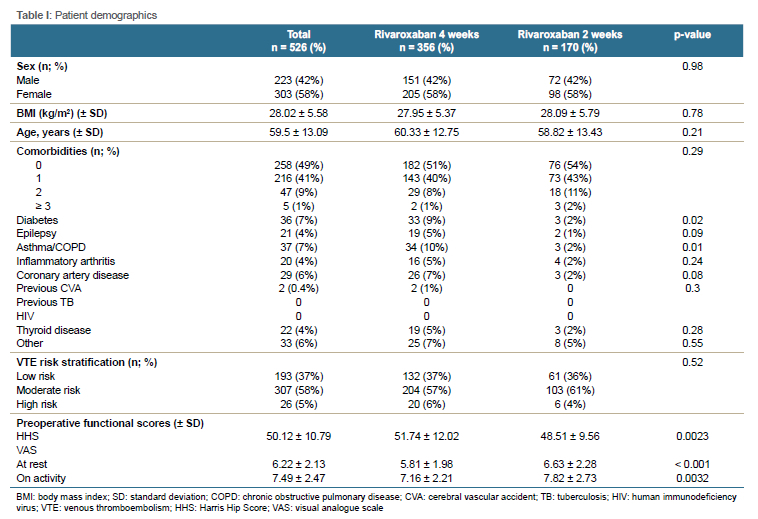
There were 786 suitable patients identified with 526 included in the study (Figure 1). In total, there were 526 patients, of whom 356 (68%) received four weeks and 170 (32%) received two weeks of rivaroxaban postoperatively for VTE prophylaxis. The mean patient age across the entire group was 59.5 ± 13.09 years. The two cohorts were well matched, with no statistically significant differences noted in terms of age (p = 0.21), sex (p = 0.98), or BMI (p = 0.78). Considering all participants, 258 (49%) had no comorbidities, 216 (41%) had at least one comorbidity, and 52 (10%) patients had two or more comorbidities. There were 36 patients (7%), with diabetes mellitus, 37 patients (7%) with asthma, 20 patients (4%) with inflammatory arthritis, 22 patients (4%) with thyroid disease, and 33 patients (6%) with other comorbidities. Overall, 193 (37%) patients were low risk, 307 (58%) patients were moderate risk, and 26 (5%) were high risk for VTE according to the Caprini RAM. Refer to Table I for further demographic details.

Intraoperative findings
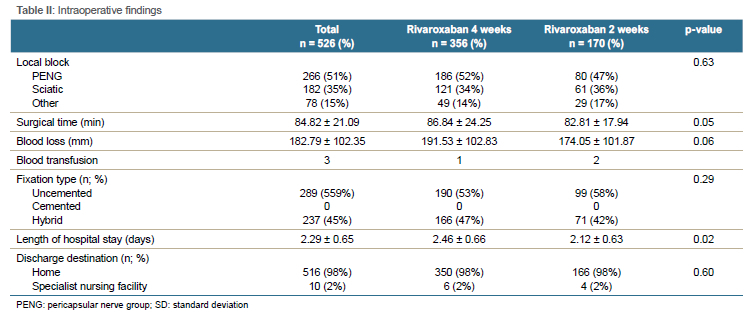
Overall, there were 266 (51%) patients who received pericapsular nerve group block (PENG) and 182 (35%) patients who received a sciatic nerve block. The mean surgical duration was 86.84 ± 24.25 minutes for the four-week rivaroxaban group and 82.81 ± 17.94 for the two-week rivaroxaban group, with no statistically significant difference between the groups (p = 0.054). The average intraoperative blood loss was 191.53 ± 102.83 ml and 174.05 ± 101.87 ml for the four- and two-week groups, respectively (p = 0.06). One patient in the four-week group and two patients in the two-week group required a blood transfusion postoperatively. The mean LOS of the four-week group was 2.46 ± 0.66 days, and the two-week group was 2.12 ± 0.63 days (p < 0.001). Six patients in the four-week group (2%) and four patients in the two-week group (2%) required discharge to a step-down specialist nursing facility (p = 0.60). For further intraoperative details, refer to Table II.
Perioperative complications
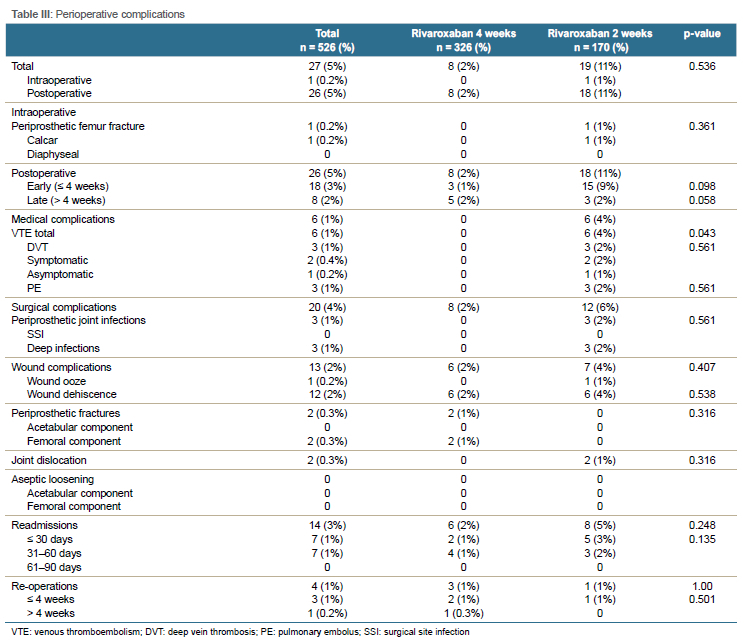
Overall, the perioperative complication rate was 5% (n = 27). The total complication rate was 2% and 11% in the four- and two-week groups, respectively (p = 0.53). In total, there were six VTEs reported (1%). These included three DVTs and three non-fatal PEs. Overall, of the DVTs identified, two were symptomatic and one was asymptomatic. All reported VTE occurred in the two-week group, with no VTEs reported in the four-week group (p = 0.04). Overall, 20 of the complications (4%) were surgical in nature and resulted in 14 readmissions (six in the four-week group [2%] and eight [5%] in the two-week group) and four revisions (three in the four-week group and one in the two-week group).
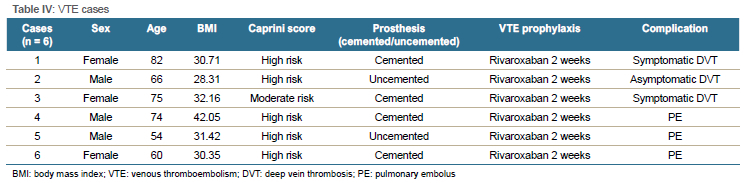
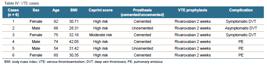
Overall, 13 patients presented with wound complications (2%), six (2%) in the four-week group, and seven (4%) in the two-week group (p = 0.40). In total, of the patients who presented with wound complications, there were three patients (2%) who complicated with a prosthetic joint infection (PJI). All noted PJIs occurred in the two-week rivaroxaban group, with no PJIs diagnosed in the four-week rivaroxaban group (p = 0.56). For further perioperative complications and VTE cases, see Tables III and IV.
IV
Discussion
VTE, encompassing DVT and PE, is a well-recognised and preventable complication following THA, and is associated with significant morbidity and mortality.545554,56 To the authors' knowledge, this is the first South African study evaluating the incidence of VTE and the rate of complications associated with oral VTE prophylaxis in patients undergoing minimally invasive DAA THA. The overall incidence of VTE in this study following minimally invasive DAA THA was 1%. The incidence of DVT and PE was 0.6% and 0.6%, respectively (Table III) The surgical approach utilised for THA directly influences the risk of developing VTE as a result of venous stasis and endothelial injury.35-37 Coveney et al. reviewed 8 885 patients who received combined mechanical and chemical prophylaxis with aspirin for six weeks following elective THA via the PA and reported a VTE incidence of 1.1% and a symptomatic DVT rate of 0.6%.57 35,58 In contrast, a meta-analysis by Chen et al. reported that the rates of VTE after DAA THA were significantly lower than the rates after PA THA (p = 0.02).5928
When analysing international guidelines for VTE prophylaxis in patients undergoing THA, disparities emerge regarding the optimal choice and dosage of pharmacological agents, as well as the ideal recommended duration of thromboprophylaxis.42,44,57 Current guidelines from the American Academy of Orthopaedic Surgeons (AAOS) and American Academy of Chest Physicians (ACCP) recommend either an oral or injectable VTE prophylactic agent for a period of two to four weeks postoperatively in high-risk patients,43,57 while guidelines from the National Institute for Health and Clinical Excellence (NICE) recommend low-molecular-weight heparin (LMWH) for two weeks, followed by aspirin for an additional four weeks, or rivaroxaban for a period of more than two weeks.50,51,59
In this study, we found a statistically significant difference in the incidence of VTE based on the duration of oral thromboprophylaxis (two weeks as opposed to four weeks) (p = 0.043). However, there was no statistically significant difference noted in the rate of complications associated with oral VTE prophylaxis, whether rivaroxaban was given for two weeks or four weeks following DAA THA (p = 0.40). Anderson et al. reviewed 1 804 THA patients who received either rivaroxaban or aspirin as VTE prophylaxis for four weeks post-THA, and reported a VTE incidence of 0.7% in the rivaroxaban group and 0.64% in the aspirin group. This is lower than the incidence of VTE noted in our study; however, higher rates of overt bleeding from the surgical site were noted in the aspirin group compared to those who received rivaroxaban (1.29 versus 0.99%).6061
Frequently cited sequelae associated with VTE prophylaxis include life-threatening bleeding and wound complications, including wound ooze, haematoma formation, and superficial and deep SSIs.62 6263
In this study, the overall rate of wound complications was 2%; wound ooze was reported in 0.2% of patients, while 2% of patients experienced dehiscence of their surgical wound. However, we showed that no statistically significant difference was noted in the rate of wound complications whether the duration of rivaroxaban was two or four weeks postoperatively (p = 0.40) (Table III).
In the present investigation, only two patients in the four-week group and one patient in the two-week group required a postoperative blood transfusion, implying a limited clinical impact (Table III). A meta-analysis by Le et al. found that patients who received rivaroxaban postoperatively required a significantly greater number of blood transfusions than those patients who received aspirin (p < 0.001). However, no difference was noted in the rate of wound complications between the two groups.6465
One of the greatest limitations surrounding the use of rivaroxaban is the cost difference when compared to other oral agents such as aspirin. Wells et al. noted that the monthly cost of rivaroxaban was $24 more per patient per month than that of aspirin. However, the overall cost of clinical events associated with aspirin was noted to be threefold greater than the cost of rivaroxaban ($381 versus $123).666768
All patients in this study underwent a routine lower limb duplex Doppler at three weeks postoperatively; a total of three DVTs were diagnosed, with the overall incidence of DVT being 0.6%. Of the DVTs detected, two were symptomatic in nature, while one was asymptomatic, with no statistically significant difference noted in DVT detection rates between both cohorts (p = 0.560) (Table III.) Globally, the incidence of asymptomatic DVT after THA performed using the PA in THA is reported to range from 11-28%.69,70 In contrast, Itou et al. retrospectively reviewed 162 patients who underwent THA via the anterolateral approach (AL). All patients received LMWH as thromboprophylaxis for a minimum duration of six days and underwent a routine duplex ultrasound on day seven postoperatively. Their findings revealed a DVT incidence of 9.9%, with all identified DVT cases being asymptomatic except for one.71 7243,73,74 In contrast, 40-50% of untreated symptomatic DVTs may progress to PE.4343,57 The low incidence of asymptomatic DVTs in this study may be attributed to the minimally invasive surgical approach, the use of in-hospital mechanical prophylaxis, and early rehabilitation and discharge practice.
In this study of the six patients diagnosed with a VTE, 83% were obese (BMI > 30 kg/m2Table IV). Obesity results in a constant low-grade inflammatory state, an imbalance of fibrinolysis and fibrinogen activity, as well as elevated levels of Von Willebrand factor and factor VII, resulting in an overall prothrombotic state and increased VTE risk.75276> 30 kg/m2277,78 Humphrey et al. reviewed the incidence of VTE in morbidly obese patients taking either DOACs or aspirin as VTE prophylaxis and noted that patients taking DOACs were at a significantly greater risk for developing VTE than those taking aspirin.79
There are limitations to this research. As the dataset was limited to a single, high-volume hip surgeon at a single institution, results may not be replicable in settings without equivalent expertise or resources. In this study, the primary method used for diagnosing DVTs was lower limb duplex Doppler, which may reveal suboptimal results for vessels with a deep anatomical location or small vessels, resulting in a missed diagnosis.
Conclusion
This study shows a four-week course of rivaroxaban postoperatively has superior efficacy in reducing the incidence of VTE compared to a two-week regimen in patients undergoing DAA THA. Importantly, the extended duration of rivaroxaban prophylaxis did not result in a significant increase in the rate of wound complications or bleeding risk associated with VTE prophylaxis. These findings underscore the potential benefits of a prolonged rivaroxaban regimen for optimising postoperative VTE prevention, especially in obese and high-risk patients undergoing minimally invasive DAA THA.
Ethics statement
The authors declare that this submission is in accordance with the principles laid down by the Responsible Research Publication Position Statements as developed at the 2nd World Conference on Research Integrity in Singapore, 2010. Prior to commencement of the study, ethical approval was obtained from the following ethical review board: Human Research Ethics Committee, University of the Witwatersrand (ethics clearance no.: M230838). All procedures were in accordance with the ethical standards of the responsible committee on human experimentation (institutional and national) and with the Helsinki Declaration of 1975, as revised in 2008. Patients included gave informed consent for their data to be collected for research purposes.
Declaration
The authors declare authorship of this article and that they have followed sound scientific research practice. This research is original and does not transgress plagiarism policies.
Author contributions
DBG: first draft preparation, data capture, data analysis, manuscript revision, manuscript preparation
JRTP: study conceptualisation, data capture, first draft preparation, manuscript revision, manuscript preparation
NG: first draft preparation, manuscript revision, manuscript preparation NS: manuscript revision, manuscript preparation
JNC: study conceptualisation, first draft preparation, manuscript revision, manuscript preparation
ORCID
Geldenhuys DB https://orcid.org/0009-0004-3312-7806
Pietrzak JRT https://orcid.org/0000-0001-5694-0016
Goga N https://orcid.org/0009-0006-2825-8865
Sikhauli N https://orcid.org/0000-0002-0862-8615
References
-
1. Okafor L, Chen AF. Patient satisfaction and total hip arthroplasty: a review. Arthroplasty. 2019;1(1). https://doi.org/10.1186/s42836-019-0007-3
» https://doi.org/10.1186/s42836-019-0007-3 -
2. Pivec R, Johnson AJ, Mears SC, Mont MA. Hip arthroplasty. Lancet. 2012;380(9855):1768-77. https://doi.org/10.1016/S0140-6736(12)60607-2
» https://doi.org/10.1016/S0140-6736(12)60607-2 -
3. Fujita T, Hamai S, Shiomoto K, et al. Analysis of factors influencing patient satisfaction after total hip arthroplasty in a Japanese cohort: the significant effect of postoperative physical activity. J Phys Ther Sci. 2022;34(2):76-84. https://doi.org/10.1589/jpts.34.76
» https://doi.org/10.1589/jpts.34.76 -
4. Taunton MJ, Trousdale RT, Sierra RJ, et al. John Charnley Award: Randomized clinical trial of direct anterior and miniposterior approach THA: which provides better functional recovery? Clin Orthop Relat Res. 2018;476(2):216-29. https://doi.org/10.1007/s11999.0000000000000112
» https://doi.org/10.1007/s11999.0000000000000112 -
5. Kremers HM, Larson DR, Crowson CS, et al. Prevalence of total hip and knee replacement in the United States. J Bone Joint Surg Am. 2014;97(17):1386-97. https://doi.org/10.2106/JBJS.N.01141
» https://doi.org/10.2106/JBJS.N.01141 -
6. Pabinger C, Lothaller H, Portner N, Geissler A. Projections of hip arthroplasty in OECD countries up to 2050. HIP International. 2018;28(5):498-506. https://doi.org/10.1177/1120700018757940
» https://doi.org/10.1177/1120700018757940 -
7. Kurtz S, Ong K, Lau E, et al. Projections of primary and revision hip and knee arthroplasty in the United States from 2005 to 2030. JBJS - Series A. 2007;89(4):780-85. https://doi.org/10.2106/JBJS.F.00222
» https://doi.org/10.2106/JBJS.F.00222 -
8. Higgins BT, Barlow DR, Heagerty NE, Lin TJ. Anterior vs. posterior approach for total hip arthroplasty, a systematic review and meta-analysis. J Arthroplasty. 2015;30(3):419-34. https://doi.org/10.1016/j.arth.2014.10.020
» https://doi.org/10.1016/j.arth.2014.10.020 -
9. Meermans G, Konan S, Das R, et al. The direct anterior approach in total hip arthroplasty. Bone Joint J. 2017;99-B(6):732-40. https://doi.org/10.1302/0301-620X.99B6.38053
» https://doi.org/10.1302/0301-620X.99B6.38053 -
10. Blom AW, Hunt LP, Matharu GS, et al. The effect of surgical approach in total hip replacement on outcomes: an analysis of 723,904 elective operations from the National Joint Registry for England, Wales, Northern Ireland and the Isle of Man. BMC Med. 2020;18(1):242. https://doi.org/10.1186/s12916-020-01672-0
» https://doi.org/10.1186/s12916-020-01672-0 -
11. Zimmerer A, Steinhaus M, Sickmüller E, et al. Pain and rehabilitation after total hip arthroplasty are approach dependent: a multisurgeon, single-center, prospective cohort study. Arch Orthop Trauma Surg. 2022;142(11):3075-82. https://doi.org/10.1007/s00402-021-03921-0
» https://doi.org/10.1007/s00402-021-03921-0 -
12. Fontalis A, Epinette JA, Thaler M, et al. Advances and innovations in total hip arthroplasty. SICOT J. 2021;7. https://doi.org/10.1051/sicotj/2021025
» https://doi.org/10.1051/sicotj/2021025 -
13. Pietrzak JRT, Maharaj Z, Cakic JN. Good long-term outcomes for direct anterior approach total hip arthroplasty in South Africa. J Orthop. 2020;22:352-57. https://doi.org/10.1016/j.jor.2020.08.014
» https://doi.org/10.1016/j.jor.2020.08.014 -
14. Barton KI, Steiner NJ, Boldt KR, et al. Major complications after total hip arthroplasty with the direct anterior approach at a high-volume Ontario tertiary care centre. Can J Surg. 2023;66(6):E596-E601. https://doi.org/10.1503/cjs.005223
» https://doi.org/10.1503/cjs.005223 -
15. Abdel MP, Meneghini RM, Berry DJ. Current practice trends in primary hip and knee arthroplasties among members of the American Association of Hip and Knee Surgeons: an update during the COVID-19 pandemic. J Arthroplasty. 2021;36(7S):S40-S44.e3. https://doi.org/10.1016/j.arth.2021.01.080
» https://doi.org/10.1016/j.arth.2021.01.080 -
16. Patel NN, Shah JA, Erens GA. Current trends in clinical practice for the direct anterior approach total hip arthroplasty. J Arthroplasty. 2019;34(9):1987-93.e3. https://doi.org/10.1016/j.arth.2019.04.025
» https://doi.org/10.1016/j.arth.2019.04.025 -
17. Heo SM, Harris I, Naylor J, Lewin AM. Complications to 6 months following total hip or knee arthroplasty: Observations from an Australian clinical outcomes registry. BMC Musculoskelet Disord. 2020;21(1):1-11. https://doi.org/10.1186/s12891-020-03612-8
» https://doi.org/10.1186/s12891-020-03612-8 -
18. Probert N, Andersson AG, Magnuson A, et al. Surgical-site infection after hip fracture surgery: preoperative full-body disinfection compared to local disinfection of the surgical site - a population-based observational cohort study. Eur Geriatr Med. 2022;13(5):1089-97. https://doi.org/10.1007/s41999-022-00640-6
» https://doi.org/10.1007/s41999-022-00640-6 -
19. Liu X, Dong Z, Li J, et al. Factors affecting the incidence of surgical site infection after geriatric hip fracture surgery: a retrospective multicenter study. J Orthop Surg Res. 2019;14(1):382. https://doi.org/10.1186/s13018-019-1449-6
» https://doi.org/10.1186/s13018-019-1449-6 -
20. Hasija R, Kelly JJ, Shah N V, et al. Nerve injuries associated with total hip arthroplasty. J Clin Orthop Trauma. 2018;9(1):81-86. https://doi.org/10.1016/jjcot.2017.10.011
» https://doi.org/10.1016/jjcot.2017.10.011 -
21. Song JH, Park JW, Lee YK, et al. Management of blood loss in hip arthroplasty: Korean Hip Society Current Consensus. Hip Pelvis. 2017;29(2):81-90. https://doi.org/10.5371/hp.2017.29.2.81
» https://doi.org/10.5371/hp.2017.29.2.81 -
22. Komnos GA, Manrique J, Foltz C, et al. Transfusion rates in total hip arthroplasty are lower in patients with direct anterior approach. Arch Bone Jt Surg. 2021;9(6):659-64. https://doi.org/10.22038/ABJS.2021.50237.2497
» https://doi.org/10.22038/ABJS.2021.50237.2497 -
23. Alvarez AP, Demzik AL, Alvi HM, et al. Risk factors for postoperative urinary tract infections in patients undergoing total joint arthroplasty. Adv Orthop. 2016;2016:7268985. https://doi.org/10.1155/2016/7268985
» https://doi.org/10.1155/2016/7268985 -
24. Rasouli MR, Maltenfort MG, Purtill JJ, et al. Has the rate of in-hospital infections after total joint arthroplasty decreased? Clin Orthop Relat Res. 2013;471(10):3102-11. https://doi.org/10.1007/s11999-013-2949-z
» https://doi.org/10.1007/s11999-013-2949-z -
25. Sabaté S, Mazo V, Canet J. Predicting postoperative pulmonary complications: implications for outcomes and costs. Curr Opin Anaesthesiol. 2014;27(2):201-209. https://doi.org/10.1097/ACO.0000000000000045
» https://doi.org/10.1097/ACO.0000000000000045 -
26. Song K, Rong Z, Yang X, et al. Early pulmonary complications following total knee arthroplasty under general anesthesia: a prospective cohort study using CT scan. Biomed Res Int. 2016;2016:4062043. https://doi.org/10.1155/2016/4062043
» https://doi.org/10.1155/2016/4062043 -
27. Lieberman J, Bear J. Venous thromboembolism in total hip arthroplasty BT - Diagnosis and management of hip disease: biological bases of clinical care. In: Aaron RK, ed. Springer International Publishing; 2015:273-88. https://doi.org/10.1007/978-3-319-19905-4_13
» https://doi.org/10.1007/978-3-319-19905-4_13 -
28. Santana DC, Emara AK, Orr MN, et al. An update on venous thromboembolism rates and prophylaxis in hip and knee arthroplasty in 2020. Medicina (Kaunas). 2020;56(9). https://doi.org/10.3390/medicina56090416
» https://doi.org/10.3390/medicina56090416 -
29. Shahi A, Bradbury TL, Guild GN 3rd, et al. What are the incidence and risk factors of in-hospital mortality after venous thromboembolism events in total hip and knee arthroplasty patients? Arthroplast Today. 2018;4(3):343-47. https://doi.org/10.1016/j.artd.2018.02.014
» https://doi.org/10.1016/j.artd.2018.02.014 -
30. Zuin M, Picariello C, Badin A, et al. Economic burden of venous thromboembolism: Are novel oral anticoagulants the possible solution? Int J Cardiol. 2016;220:551-52. https://doi.org/10.1016/j.ijcard.2016.06.312
» https://doi.org/10.1016/j.ijcard.2016.06.312 -
31. Grosse SD. Incidence-based cost estimates require population-based incidence data. A critique of Mahan et al. Thromb Haemost. 2012;107(1): 192-95. https://doi.org/10.1160/TH11-09-0666
» https://doi.org/10.1160/TH11-09-0666 -
32. Farmakis IT, Barco S, Mavromanoli AC, et al. Cost-of-illness analysis of long-term health care resource use and disease burden in patients with pulmonary embolism: insights from the PREFER in VTE Registry. J Am Heart Assoc. 2022;11(20):e027514. https://doi.org/10.1161/JAHA.122.027514
» https://doi.org/10.1161/JAHA.122.027514 -
33. Heit JA. Epidemiology of venous thromboembolism. Nat Rev Cardiol. 2015;12(8):464-74. https://doi.org/10.1038/nrcardio.2015.83
» https://doi.org/10.1038/nrcardio.2015.83 -
34. Stone J, Hangge P, Albadawi H, et al. Deep vein thrombosis: pathogenesis, diagnosis, and medical management. Cardiovasc Diagn Ther. 2017;7(Suppl 3):S276-S284. https://doi.org/10.21037/cdt.2017.09.01
» https://doi.org/10.21037/cdt.2017.09.01 -
35. Kawano T, Kijima H, Yamada S, et al. A comparison of the incidences of venous thromboembolism after total hip arthroplasty between the direct anterior approach and the direct lateral approach, especially in the early period after introduction of the direct anterior approach. Adv Orthop. 2020 Jun 3;2020:4649207. https://doi.org/10.1155/2020/4649207
» https://doi.org/10.1155/2020/4649207 -
36. Zeng GJ, Xu S, Pang HN. Incidence of deep vein thrombosis and pulmonary embolism in Asian patients after direct anterior total hip arthroplasty. J Orthop. 2020;21(August):528-31. https://doi.org/10.1016/j.jor.2020.08.027
» https://doi.org/10.1016/j.jor.2020.08.027 -
37. Ang JJM, Onggo JR, Stokes CM, Ambikaipalan A. Comparing direct anterior approach versus posterior approach or lateral approach in total hip arthroplasty: a systematic review and meta-analysis. Eur J Orthop Surg Traumatol. Published online 2023. https://doi.org/10.1007/s00590-023-03528-8
» https://doi.org/10.1007/s00590-023-03528-8 -
38. Mednick RE, Alvi HM, Morgan CE, et al. Femoral vein blood flow during a total hip arthroplasty using a modified Heuter approach. J Arthroplasty. 2015;30(5):786-89. https://doi.org/10.1016/j.arth.2014.12.015
» https://doi.org/10.1016/j.arth.2014.12.015 -
39. Zhang Zh, Shen B, Yang J, et al. Risk factors for venous thromboembolism of total hip arthroplasty and total knee arthroplasty: a systematic review of evidences in ten years. BMC Musculoskelet Disord. 2015;16:24. https://doi.org/10.1186/s12891-015-0470-0
» https://doi.org/10.1186/s12891-015-0470-0 -
40. Yu X, Wu Y, Ning R. The deep vein thrombosis of lower limb after total hip arthroplasty: what should we care. BMC Musculoskelet Disord. 2021;22(1):1-6. https://doi.org/10.1186/s12891-021-04417-z
» https://doi.org/10.1186/s12891-021-04417-z -
41. Samama CM, Ravaud P, Parent F, et al. Epidemiology of venous thromboembolism after lower limb arthroplasty: the FOTO study. J Thromb Haemost. 2007;5(12):2360-67. https://doi.org/10.1111/j.1538-7836.2007.02779.x
» https://doi.org/10.1111/j.1538-7836.2007.02779.x -
42. Matharu GS, Blom AW, Board T, Whitehouse MR. Does the publication of NICE guidelines for venous thromboembolism chemical prophylaxis influence the prescribing patterns of UK hip and knee surgeons? Ann R Coll Surg Engl. 2022;104(3):195-201. https://doi.org/10.1308/rcsann.2021.0157
» https://doi.org/10.1308/rcsann.2021.0157 -
43. Falck-Ytter Y, Francis CW, Johanson NA, et al. Prevention of VTE in orthopedic surgery patients: Antithrombotic Therapy and Prevention of Thrombosis, 9th ed: American College of Chest Physicians Evidence-Based Clinical Practice Guidelines. Chest. 2012;141(2 Suppl):e278S-e325S. https://doi.org/10.1378/chest.11-2404
» https://doi.org/10.1378/chest.11-2404 - 44. National Institute for Health and Care Excellence (NICE). Venous thromboembolism in over 16s: Reducing the risk of hospital-acquired deep vein thrombosis or pulmonary embolism. NICE Guidance. 2018;2(March):44.
-
45. Jacobs J, Mont M, Bozic K, et al. American Academy of Orthopaedic Surgeons Clinical Practice Guideline on: Preventing venous thromboembolic disease in patients undergoing elective hip and knee arthroplasty. J Bone Joint Surg Am. 2012;94:746-47. https://doi.org/10.2106/JBJS.9408.ebo746
» https://doi.org/10.2106/JBJS.9408.ebo746 - 46. Kessler CM. Prevention and management of venous thromboembolism. Clin Adv Hematol Oncol. 2011;9(1):9-11.
-
47. Huang Z, Xu X, Xu D, et al. Efficacy of 11 anticoagulants for the prevention of venous thromboembolism after total hip or knee arthroplasty: A systematic review and network meta-analysis. Medicine. 2023;102(2):e32635. https://doi.org/10.1097/MD.0000000000032635
» https://doi.org/10.1097/MD.0000000000032635 -
48. Cronin M, Dengler N, Krauss ES, et al. Completion of the updated Caprini Risk Assessment Model (2013 Version). Clin Appl Thromb Hemost. 2019;25:1076029619838052. https://doi.org/10.1177/1076029619838052
» https://doi.org/10.1177/1076029619838052 -
49. Bilgi K, Muthusamy A, Subair M, et al. Assessing the risk for development of venous thromboembolism (VTE) in surgical patients using adapted Caprini scoring system. Int J Surg. 2016;30:68-73. https://doi.org/10.1016/j.ijsu.2016.04.030
» https://doi.org/10.1016/j.ijsu.2016.04.030 -
50. Kumar P, Sen R, Aggarwal S, et al. Reliability of modified Harris Hip Score as a tool for outcome evaluation of total hip replacements in Indian population. J Clin Orthop Trauma. 2019;10(1):128-30. https://doi.org/10.1016/jjcot.2017.11.019
» https://doi.org/10.1016/jjcot.2017.11.019 -
51. Alghadir AH, Anwer S, Iqbal A, Iqbal ZA. Test-retest reliability, validity, and minimum detectable change of visual analog, numerical rating, and verbal rating scales for measurement of osteoarthritic knee pain. J Pain Res. 2018;11:851-56. https://doi.org/10.2147/JPR.S158847
» https://doi.org/10.2147/JPR.S158847 -
52. Yu X, Wu Y, Ning R. The deep vein thrombosis of lower limb after total hip arthroplasty: what should we care. BMC Musculoskelet Disord. 2021;22(1):547. https://doi.org/10.1186/s12891-021-04417-z
» https://doi.org/10.1186/s12891-021-04417-z - 53. Kearon C, Julian J, Math M, et al. Noninvasive diagnosis for deep venous thrombosis. Ann Intern Med 1998;128:663-77.
- 54. Lieberman JR, Bell JA. Venous thromboembolic prophylaxis after total hip and knee arthroplasty. JBJS. 2021;103(16).
-
55. Odeh K, Doran J, Yu S, et al. Risk-stratified venous thromboembolism prophylaxis after total joint arthroplasty: aspirin and sequential pneumatic compression devices vs aggressive chemoprophylaxis. J Arthroplasty. 2016;31(9 Suppl):78-82. https://doi.org/10.1016/j.arth.2016.01.065
» https://doi.org/10.1016/j.arth.2016.01.065 -
56. Kahn SR, Shivakumar S. What's new in VTE risk and prevention in orthopedic surgery. Res Pract Thromb Haemost. 2020;4(3):366-76. https://doi.org/10.1002/rth2.12323
» https://doi.org/10.1002/rth2.12323 -
57. Coveney EI, Hutton C, Patel N, et al. Incidence of symptomatic venous thromboembolism (VTE) in 8,885 elective total hip arthroplasty patients receiving post-operative aspirin VTE prophylaxis. Cureus. 2023;15(3):e36464. https://doi.org/10.7759/cureus.36464
» ):e36464. https://doi.org/10.7759/cureus.36464 -
58. Siljander MP, Whaley JD, Koueiter DM, et al. Length of stay, discharge disposition, and 90-day complications and revisions following primary total hip arthroplasty: a comparison of the direct anterior, posterolateral, and direct superior approaches. J Arthroplasty. 2020;35(6):1658-61. https://doi.org/10.10164.arth.2020.01.082
» https://doi.org/10.10164.arth.2020.01.082 -
59. Chen W, Sun JN, Zhang Y, et al. Direct anterior versus posterolateral approaches for clinical outcomes after total hip arthroplasty : a systematic review and meta-analysis. J Orthop Surg Res. 2020 Jun 23;15(1):231. https://doi.org/10.1186/s13018-020-01747-x
» https://doi.org/10.1186/s13018-020-01747-x -
60. Anderson DR, Dunbar M, Murnaghan J, et al. Aspirin or rivaroxaban for VTE prophylaxis after hip or knee arthroplasty. New Engl J Med. 2018;378(8):699-707. https://doi.org/10.1056/nejmoa1712746
» https://doi.org/10.1056/nejmoa1712746 -
61. Eikelboom JW, Quinlan DJ, Douketis JD. Extended-duration prophylaxis against venous thromboembolism after total hip or knee replacement: a meta-analysis of the randomised trials. Lancet. 2001;358(9275):9-15. https://doi.org/10.1016/S0140-6736(00)05249-1
» https://doi.org/10.1016/S0140-6736(00)05249-1 -
62. Todd F, Yeomans D, Whitehouse MR, Matharu GS. Does venous thromboembolism prophylaxis affect the risk of venous thromboembolism and adverse events following primary hip and knee replacement? A retrospective cohort study. J Orthop. 2021;25:301-304. https://doi.org/10.1016/jjor.2021.05.030
» https://doi.org/10.1016/jjor.2021.05.030 -
63. Fallaha MA, Radha S, Patel S. Safety and efficacy of a new thromboprophylaxis regiment for total knee and total hip replacement: a retrospective cohort study in 265 patients. Patient Saf Surg. 2018;12(1):22. https://doi.org/10.1186/s13037-018-0169-x
» https://doi.org/10.1186/s13037-018-0169-x -
64. Le G, Yang C, Zhang M, et al. Efficacy and safety of aspirin and rivaroxaban for venous thromboembolism prophylaxis after total hip or knee arthroplasty: A protocol for meta-analysis. Medicine. 2020;99(49):e23055. https://doi.org/10.1097/MD.0000000000023055
» https://doi.org/10.1097/MD.0000000000023055 -
65. Bala A, Huddleston JI, Goodman SB, et al. Venous thromboembolism prophylaxis after TKA: aspirin, warfarin, enoxaparin, or factor Xa inhibitors? Clin Orthop Relat Res. 2017;475(9):2205-13. https://doi.org/10.1007/s11999-017-5394-6
» https://doi.org/10.1007/s11999-017-5394-6 -
66. Wells PS, Prins MH, Beyer-Westendorf J, et al. Health-care cost impact of continued anticoagulation with rivaroxaban vs aspirin for prevention of recurrent symptomatic VTE in the EINSTEIN-CHOICE trial population. Chest. 2018;154(6):1371-78. https://doi.org/10.1016/j.chest.2018.08.1059
» https://doi.org/10.1016/j.chest.2018.08.1059 -
67. Abutorabi A, Haj Ahmadi M, Bagheri Faradonbeh S, et al. Cost-effectiveness rivaroxaban versus enoxaparin for prevention of venous thromboembolism after knee replacement surgery in Iran. Med J Islam Repub Iran. 2023;37:20. https://doi.org/10.47176/mjiri.37.20
» https://doi.org/10.47176/mjiri.37.20 -
68. Heisen M, Treur MJ, Heemstra HE, et al. Cost-effectiveness analysis of rivaroxaban for treatment and secondary prevention of venous thromboembolism in the Netherlands. J Med Econ. 2017;20(8):813-24. https://doi.org/10.1080/13696998.2017.1331912
» https://doi.org/10.1080/13696998.2017.1331912 -
69. Abe K, Yuda S, Yasui K, et al. Soleal vein dilatation assessed by ultrasonography is an independent predictor for deep vein thrombosis after major orthopedic surgery. J Cardiol. 2017;69(5):756-62. https://doi.org/10.1016/jjjcc.2016.07.004
» https://doi.org/10.1016/jjjcc.2016.07.004 -
70. Kim YH, Park JW, Kim JS. Chemical thromboprophylaxis is not necessary to reduce risk of thromboembolism with tranexamic acid after total hip arthroplasty. J Arthroplasty. 2017;32(2):641-44. https://doi.org/10.1016/j.arth.2016.07.048
» https://doi.org/10.1016/j.arth.2016.07.048 -
71. Itou J, Munakata Y, Kuramitsu Y, et al. Incidence and distribution of deep vein thrombosis following total hip arthroplasty using an anterolateral supine approach. Orthop Res Rev. 2023;15:199-205. https://doi.org/10.2147/ORR.S430145
» https://doi.org/10.2147/ORR.S430145 -
72. Quinlan DJ, Eikelboom JW, Dahl OE, et al. Association between asymptomatic deep vein thrombosis detected by venography and symptomatic venous thromboembolism in patients undergoing elective hip or knee surgery. JTH. 2007;5(7):1438-43. https://doi.org/10.1111/j.1538-7836.2007.02571.x
» https://doi.org/10.1111/j.1538-7836.2007.02571.x -
73. Shimabukuro N, Mo M, Hashiyama N, et al. Clinical course of asymptomatic isolated distal deep vein thrombosis of the leg: a single-institution study. Ann Vasc Dis. 2019;12(4):487-92. https://doi.org/10.3400/avd.oa.19-00128
» https://doi.org/10.3400/avd.oa.19-00128 -
74. Chelliah N, Chellathurai A, Raju BP. Comparison of colour Doppler ultrasonography and indirect computed tomography venography for the diagnosis of deep venous thrombosis in patients with suspected pulmonary thromboembolism at a tertiary care centre in Chennai , Tamil Nadu , India. Published online 2023. https://doi.org/10.7860/JCDR/2023/61885.17627
» https://doi.org/10.7860/JCDR/2023/61885.17627 -
75. Akrivou D, Perlepe G, Kirgou P, et al. Pathophysiological aspects of aging in venous thromboembolism: an update. Medicina (Kaunas). 2022;58(8). https://doi.org/10.3390/medicina58081078
» https://doi.org/10.3390/medicina58081078 -
76. Aggarwal VA, Sambandam S, Wukich D. The Impact of obesity on total hip arthroplasty outcomes: a retrospective matched cohort study. Cureus. 2022;14(7):e27450. https://doi.org/10.7759/cureus.27450
» https://doi.org/10.7759/cureus.27450 -
77. White RH, Gettner S, Newman JM, et al. Predictors of rehospitalization for symptomatic venous thromboembolism after total hip arthroplasty. N Engl J Med. 2000;343(24):1758-64. https://doi.org/10.1056/NEJM200012143432403
» https://doi.org/10.1056/NEJM200012143432403 -
78. Mantilla CB, Horlocker TT, Schroeder DR, et al. Risk factors for clinically relevant pulmonary embolism and deep venous thrombosis in patients undergoing primary hip or knee arthroplasty. Anesthesiology. 2003;99(3):552-60; discussion 5A. https://doi.org/10.1097/00000542-200309000-00009
» https://doi.org/10.1097/00000542-200309000-00009 -
79. Humphrey TJ, O'Brien TD, Melnic CM, et al. Morbidly obese patients undergoing primary total joint arthroplasty may experience higher rates of venous thromboembolism when prescribed direct oral anticoagulants vs aspirin. J Arthroplasty. 2022;37(6):1189-97. https://doi.org/10.1016/j.arth.2022.01.089
» https://doi.org/10.1016/j.arth.2022.01.089
Accepted: August 2024
Published: March 2025
Editor: Dr Chris Snyckers, private practice, Pretoria, South Africa
Funding: No funding was received for this study.
Conflict of interest: The authors declare they have no conflicts of interest that are directly or indirectly related to the research.