The Internet: selecting relevant orthopaedic knowledge and managing it on your personal computer
Introduction
The rapid expansion of the Internet and ubiquity of broadband connections is vastly improving our access to knowledge and how we search for orthopaedic information. Not only are a significant proportion of articles online as text, but a few minutes' browsing will also locate videos of operative technique. Podcast lectures and blogs are available at the click of the mouse.
Until recently if you did not personally subscribe to a variety of journals, a trip to the medical library was usually necessary to find an article, or verify a fact for research. As a Web-enabled doctor today, you are able to download most of this information from the comfort of your office or study.
This article will guide you as to the most effective way to search for and download an article using your web browser and an Internet connection. There is a plethora of information online so the searcher will have to be savvy to avoid frustrations such as password-protected sites, pay sites and references of dubious authenticity.
Characteristics of a quality orthopaedic website
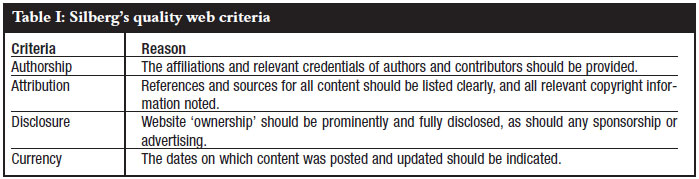
Many orthopaedic sites are of poor quality. Besides sloppy presentation, there may be untruths or bias towards a product or technique. This may be due to conflicts of interest, the site commercially driven towards selling a product, or to advertise a practice. Others sites exist for patient education rather than for the orthopaedic surgeon. How does the orthopaedic surgeon recognise a quality site with reliable information?
Quality orthopaedic sites should be controlled by a webmaster who is at least an orthopaedic surgeon, andpreferably also known as an author of peer-reviewed journal articles. Popular sites of value to the academic are often large and have appreciable running costs; do not begrudge the fact that you may have to pay to gain access. As with paper journals the cost of running a large website, of several thousand pages, may have to be offset by sponsorship or subscriptions by the users.
Of the many orthopaedic websites the following are comprehensive, of a good standard, and particularly useful to the postgraduate who is studying orthopaedics.
Popular academic orthopaedic sites
Of the thousands of orthopaedic websites available, only a few are dedicated to academic orthopaedic surgery. The rest are either commercial or are for patient education.
1. Orthogate
2 32. Orthoteers:
43. Wheeless Textbook.
54. Intute:
65. Book and journal publishers. Major publishers, including such sites as the Journal of Bone and Joint Surgery7
Passive methods: Receiving new knowledge by mail
It is not always necessary to actively search for information. If you know what type of orthopaedic information interests you, the patient orthopaedic surgeon can have it sent to his mailbox or his mail aggregator program. There are two methods to arrange this: joining a mailing list, or subscribing to a feed.
Mailing lists
Subscribing to a mailing list allows orthopaedic surgeons to keep abreast of their topics of interest. They will receive regular emails on their chosen fields of interest and can also become active by replying to the thread thus making themselves a member of a discussion group. The downside of a mailing list is that all mail, not just the headlines, is sent to your mailbox. This can result in a large volume of post to sift through.
The quality of the mailing list is even more difficult to assess than that of a webpage. McLauchlan,89
RSS feeds
Another method of receiving mail or blogs is through subscribing to an RSS feed. RSS stands for 'really simple syndication' and overcomes the biggest problem of mail lists, which is the volume of unwanted information and its concomitant waste of bandwidth.
By joining a feed, the subscriber may selectively download the articles he is interested in. The feed initially sends headlines only to the subscriber. This is done on a regular basis (hourly for news feeds, but weekly or monthly for most orthopaedic feeds). These are selected by clicking on the headline which will download the full text (blog), or audio talk (podcast). Most modern web browsers allow the user to join a feed, but, in addition, there are many specialised RSS aggregator programs such as FeedReader1011
Advantages of an RSS feed over a website
12• Users can be notified of new content without having to actively check for it.
• Content updates can be sourced from many modalities (news, journals, portals and PubMed) can be tracked and easily managed in one central location.
• No time is wasted navigating complex sites.
There are many excellent text-based and podcast feeds available on orthopaedic topics. Orthopaedic Web Links13
Video podcasts or vodcasts have an important role in the education of a practical profession such as ours. Many excellent videos of operative technique on the Internet, including the video library maintained by the Journal of Bone and Joint Surgery14
Once you have found useful information, it is useful to keep a link to it on your computer. Commonly this is done by adding a 'bookmark' in your favourite web browser or other program linking descriptive text to the web address. URLs (Uniform Resource Locator - the 'link' in a hypertext document), as a method of accessing articles, suffer from a number of disadvantages.
Problems with URLs
• They are often not persistent, i.e. the target document can be deleted or moved to another site.15
• The linked copy may be in another format, e.g. the user may be looking for a print or PDF format while the linked version is HTML (Hypertext Markup Language).
The International DOI Foundation (IDF) has developed a form of reference linking that aims to overcome some of these difficulties. The Digital Object Identifier (DOI) identifies a digital object. It is a number or series of symbols that uniquely identifies a particular publication and will link the user to the document's current location on the Web. The DOI website16
Using DOI names as identifiers makes managing intellectual property in a networked environment much easier and more convenient.
These days many electronic journals and even web 'reprints', downloadable from the publishers, include the document's DOI number. This array of letters and digits can be entered into the search box at www.doi.org and it will link to the source document at the publisher's site.
The user thus does not have to know the address of the institution that hosts this document. This may not be much of a problem with a well-known journal publishing house but (the DOI System) is a major advantage when looking for a thesis or other paper without a known publisher. Over time even previously financially sound publishers may disappear, or cease to have a web address by either selling copyright to a rival publisher or other party. This third party will now host the electronic archives of the defunct journal. An identifier persistently refers to a content item regardless of its physical location or ownership, even if either is transferred to another publisher.17
The DOI is becoming ubiquitous. In recent years many popular magazines such as the New Scientist have begun to quote the DOI number in parentheses as a reference rather than the classical formal listing of title, author and journal as a footnote to the article. An interested reader can thus easily consult the relevant online source with minimal effort.
Another use for DOI numbers is in hypertext web documents. A link can be made using the DOI rather than (directly) to a website. The link is more likely to survive changes and deletions to the site or address you intend to quote if it links via doi.org whose professionals are dedicated to maintaining valid links. To make a link, use the format http://dx.doi.org/[doi-number]; once you click on this hyperlink you will be directed to the correct document, usually at the journal publisher's site.
Archive sites
A reliable way to find scholarly articles is to visit an archive site. These respected sites such as PubMed and Medline1819
PubMed is an archive of biomedical and life sciences journal literature at the US National Institutes of Health. PubMed is well supported by all major publishers. A search from the PubMed website will link the user to most of the orthopaedic (and other biomedical) literature ever published. Currently most journals have an online presence, and will be referenced by PubMed. In many cases only the abstract of an article and not the full text will be available. PubMed maintains links to the actual publisher's site where the full version of the article can be read, albeit often - only after paying a fee.
Cost considerations
Many publishers now have digitalised their entire paper archives and these can be accessed online. The Journal of Bone and Joint Surgery, for example has PDF (Portable Document Format file) copies available from the date of first publication in 1948.20
These articles need to be paid for; publishers are often for profit commercial organisations and will expect to extract a fee for these. After searching for and finding the article, the user typically will be allowed to read the abstract for free, but is then required to pay $30 or more to download the PDF or full text version of the article.
There are more cost-effective ways of legitimately obtaining these articles. Journals you personally subscribe to will allow you to login on their website and download whatever is available, after signing up using your subscription number. If you are a member of an academic library they probably already have subscriptions to many popular orthopaedic journals. This right of access to the full text versions is also transferred to you as a member. It is not necessary visit the library in order to exercise this right; all that is necessary is access to the Internet from a university computer. Many publisher's sites take note of the referrer's unique IP (Internet Protocol address, a field in the HTM header sent with every packet of online communication from your computer), and if this packet comes from a subscribing academic institution, the remote host computer will sign the user in automatically and honour him or her with the privileges of a paid subscriber.
Many universities also allow students and staff to log on to their library site from outside the university. After verifying the user via login passwords, he or she is then allowed to log into publishers' sites to which the university has subscription rights. Licence agreements pay a role here: some publishers do not allow away from campus access, but most do.
A university also has finite means and, most likely, does not have subscriptions to all orthopaedic journals. If you still cannot get the full text of your reference free online, consider asking the librarian for an inter-library loan. In many cases all that will have to be paid for is the cost of photocopying the article. Ironically, because of licence agreements, the paper version may be more freely available for inter-lending than a digital copy. This is because libraries are bound by treaties on inter-library loans. The conference on fair use (CONFU)21
If you need the copy for teaching purposes, for example to distribute to a class, your university may already own a blanket copyright agreement. For example, Stellenbosch University pays a levy to the Dynamic Artistic and Literary Rights Organisation (DALRO22
Free journal sites/open access repositories
Many are concerned by the fact that commercial publishers make their profit from selling articles generated from research funded by public money. To counter this commercialisation, many Open Access (OA) electronic resources have been established. There is an advantage to the author too in using OA journals. Alma Swan23
Below is a selection of the better-known OA sites.
• BioMed Central24
• Directory of Open Access Journals25Acta Orthopaedica and Orthopaedic Research and Reviews.
• Free Medical Journals.com26
Reference manager software
The personal computer (PC) will generate many useful links and downloads from your academic quest for knowledge. Reference managers allow the user to create order with this data.
These handy programs allow the user to compile a reference of articles read, even if the user does not wish to become an author. The software allows a user to download a citation with a few clicks of the mouse, and keep a database of the downloaded reference. Links to a copy of the PDF (or any other file) you download to your own PC can be added including a field for graphics. There is a field allowing the user to add his or her notes and annotations. Many citation managers interface with popular word processors such as MS Word, and can automatically add and maintain a list of references as a footnote to the article. The program will correctly order the articles and keep the style of the references uniform and in accordance with that wanted from a selection of well-known journals. Alternatively the writer's own style can be formatted.
There are many commercial reference manager programs such as EndNote27282930
Example:
Reference 15 in BibTex format:
@article
author = {Priscilla Caplan, William Arms},
title = {Reference linking for journal articles},
journal = {D-Lib Magazine},
volume = {5},
number = {7/8},
year = {1999}
}
This formatted paragraph of text needs to be copied from the host site and merely pasted into your BibTex-compatible browser.
The commercial reference managers are even more automatic. The host site's software will allow the user to 'download to citation manager'. Once the manager type is selected, the reference is downloaded in a format such as RIS31Research Information Systems ). This file can either be saved to disk on the user's machine or will activate your citation manager automatically to include the reference in its library - as 'RIS' will be a file type associated by your operating system with your favourite citation manager. The whole process is thus semiautomatic and you can, with minimal effort, build up a large and ordered library of the articles you have read. Most reference managers also allow you to link to a local, on disk, copy you might have saved from your web search.
Search engines
Popular search engines such as Google323334
Wootton35
Another distraction is spam and illegal advertising from pharmaceutical vendors.3637
What distinguishes a good from a bad search engine? Simpson38
In addition there are many specialised medical search sites, such as:
• Intute6
• Scirius39
• Google Scholar - a selective search engine dedicated to academic articles.
With this service, the full text is weighed, as is the author and the publication in which the article appears. It is ranked according to how often the article has been cited. Although the list is often old, the article is more likely to be peer reviewed. It may also come from libraries, theses and other academic sources such as conference proceedings. Scholar often leads the user to sites requiring 'paid for' subscriptions. Although there is a feature linking you to your local library site for a full test version, Google Scholar does not know whether your library is subscribed or not.
Conclusion
The Internet has changed the way we deal with and acquire knowledge. Not only is more information available, but you can effectively store and reference on your own PC. Search engines that can index the entire Internet and produce a search results in microseconds are both a boon and a curse as they have difficulty in distinguishing pearls of wisdom from pornography. The advent of search engines dedicated to scholarly work and archival sites such as PubMed has helped to improve the quality of their results for the academic.
It is still up to the individual to verify the quality of the information returned from such searches. All these sophisticated searches do is filter out some of the dirt. Spam producers and unscrupulous businesspeople will always be able to keep ahead of these efforts.
A practical knowledge of how to obtain copies of references not available directly through your web connection to your Internet provider is necessary. Use your local medical libraries' online service and if this fails ask for an old-fashioned inter-library loan on paper!
Online information is growing in quantity but is much shorter-lived than the paper documents it replaces. The life span of information on a hard disk is unknown,3040Hypertext Markup Language); the hyperlinks themselves. Online references are liable to 'link rot', and vendor obsolescence. Services such as PubMed and other archival sites are helping keep references pointing towards viable sites. The DOI initiative promises to grow and provide a system of valid links to much more scholarly output than just formal journal articles.
The Internet will continue to evolve. Orthopaedic websites will proliferate and search engines will become more attuned to the needs of the academic searcher. On the other hand spam producers and con artists will continue to keep abreast of these developments. While the future of publishing will undoubtedly be more web-based, the orthopaedic surgeon will always have to exercise judgment before accepting all online information as gospel truth.
References
Reference linking
- 1. Silberg WM, Lundberg GD, Musacchio RA. Assessing, controlling, and assuring the quality of medical information on the Internet: Caveant Lector et Viewor - Let the Reader and Viewer Beware. JAMA 1997;277(15):1244-45.
-
2. Orthogate: http://www.orthogate.org/.
» http://www.orthogate.org/ - 3. Oliver CW. Trauma and orthopaedic surgery on the internet. J Bone Joint Surg Br 1999;81-B(1):3-6.
-
4. James Carmichael DA. Orthoteers, http://www.orthoteers.org/.
» http://www.orthoteers.org/ -
5. Wheeless CR. Wheeless Textbook of Orthopaedics, http://www.wheelessonline.com/.
» http://www.wheelessonline.com/ -
6. Intute search engine: http://www.intute.ac.uk.
» http://www.intute.ac.uk -
7. Journal of Bone and Joint - American: http://www.ejbjs.org.
» http://www.ejbjs.org -
8. George J McLauchlan, Mike Cadogan, Oliver CW. Assessment of an orthopaedic mailing list, http://www.rcsed.ac.uk/journal/vol44_1/4410040.htm.
» http://www.rcsed.ac.uk/journal/vol44_1/4410040.htm -
9. Orthopod mailing list: http://groups.google.com/group/orthopod.
» http://groups.google.com/group/orthopod -
10. FeedReader: http://www.feedreader.com/.
» http://www.feedreader.com/ -
11. SharpReader: http://www.sharpreader.net/.
» http://www.sharpreader.net/ -
12. Advantages of a RSS feed: http://www.orthogate.org/workshops/software/using-google-reader-and-rss-feeds.html.
» http://www.orthogate.org/workshops/software/using-google-reader-and-rss-feeds.html -
13. Orthopaedic Web Links: http://www.orthopaedicweblinks.com/sitemap.html.
» http://www.orthopaedicweblinks.com/sitemap.html -
14. JBJS Video Library: http://www2.ejbjs.org/misc/vid_archive.dtl. JBJS video library.
» http://www2.ejbjs.org/misc/vid_archive.dtl - 15. Priscilla Caplan WA. Reference linking for journal articles. D-Lib Magazine 1999;5(7/8).
-
16. Digital Object Identifier: http://www.doi.org/.
» http://www.doi.org/ - 17. Rosenblatt W. The digital object identifier: The dilemma of copyright protection online. Journal of elecronic publishing 1997;3(2).
- 18. Rozental TD, Lonner JH, Parekh SG. The Internet as a Communication Tool for Academic Orthopaedic Surgery Departments in the United States. J Bone Joint Surg Am 2001;83(7):987-91.
-
19. PubMed information: http://www.ncbi.nlm.nih.gov/pmc/about/intro.html.
» http://www.ncbi.nlm.nih.gov/pmc/about/intro.html - 20. Scott J. Journal of Bone and Joint Surgery online 1948 to 2006. J Bone Joint Surg Br 2006;88-B(1):1-.
-
21. Interlibrary loans: http://www.copyright.com/Services/copyrightoncampus/content/ill.html.
» http://www.copyright.com/Services/copyrightoncampus/content/ill.html - 22. Golladay GJ, Kirschenbaum IH, Matthews LS, Biermann JS. Current Concepts Review - Internet Resources for Orthopaedic Surgeons. J Bone Joint Surg Am 1998; 80(10):1525-32.
-
23. Swan A. The Open Access citation advantage: Studies and results to date : http://eprints.ecs.soton.ac.uk/18516/, 2010.
» http://eprints.ecs.soton.ac.uk/18516/ -
24. BioMed Central: http://www.biomedcentral.com/.
» http://www.biomedcentral.com/ -
25. Directory of Open Access Journals: http://www.doaj.org/.
» http://www.doaj.org/ -
26. Free Medical Journals.com: http://www.freemedicaljournals.com/.
» http://www.freemedicaljournals.com/ -
27. EndNote: http://www.endnote.com/.
» http://www.endnote.com/ -
28. ProCite: http://www.procite.com/.
» http://www.procite.com/ - 29. Beredjiklian PK, Bozentka DJ, Steinberg DR, Bernstein J. Evaluating the source and content of orthopaedic information on the Internet : The Case of Carpal Tunnel Syndrome. J Bone Joint Surg Am 2000;82(11):1540.
- 30. Simonite T, LePage M. Now we know it... New Scientist 2010;January 30 2010:36-39.
-
31. RIS File format: http://en.wikipedia.org/wiki/RIS.
» http://en.wikipedia.org/wiki/RIS -
32. Google Search Engine: http://google.co.za.
» http://google.co.za -
33. Bing search engine: http://www.bing.com.
» http://www.bing.com -
34. Yahoo Search Engine: http://www.yahoo.co.za.
» http://www.yahoo.co.za - 35. Wootton JC. New generation search engines. J Womens Health Gend Based Med 2000;9(1):79-80.
- 36. Siva N. Search engines continue to advertise rogue online pharmacies. BMJ 2009;339(aug27_3):b3457-.
-
37. Google Scholar: http://www.scholar.co.za.
» http://www.scholar.co.za - 38. Simpson P, Oliver CW. Searching the Internet for orthopaedic knowledge. J Bone Joint Surg Br 2004;86-B(8):1105-07.
-
39. Scirius: http://www.scirius.com
» http://www.scirius.com - 40. Iraci J. 'The relative stabilities of optical disc formats'. Restaurator: international journal for the preservation of library and archival material 2005;26(No 2):134 - 50.
Note from the Editor:
-
Note from the Editor:
Dr ICM Robertson
Department Orthopaedic Surgery
Private Bag X3 Tygerberg Hospital Parow Valley 7505
Tel: (021) 938-5458 (work); (021) 976-5765 (home) Fax: (021) 975-6866
Email: