Freedman-Bernstein musculoskeletal competence testing of South African intern doctors: is there a difference between health science faculties?
Abstract
BACKGROUND: Basic competency in musculoskeletal medicine is necessary for all graduating doctors due to the growing burden of disease. Globally and nationally research has shown deficiencies in musculoskeletal knowledge according to the Freedman-Bernstein test. In South Africa, different health science faculties show different approaches to training; this article considers if any of these demonstrate adequate training and whether significant differences exist between the faculties' results. The aim of the study is to determine whether there are significant differences between musculoskeletal learning outcomes between graduates from different health science facultiesMETHODS: A multi-centre, cross-sectional study was performed in which medical interns completed the Freedman-Bernstein test after graduation and prior to commencing their formal two-month block in orthopaedics. Data was then analysed to determine whether significant differences existed between the test scores of the eight health science faculties' graduatesRESULTS: A total of 259 completed tests were analysed. The mean score was 46% (range 4-88%, 95% CI 44-48%), and 244 of the 259 interns failed the test (94% failure rate). The lowest and highest mean scores, by health science faculty, was 34% (95% CI 28-40%) and 60% (95% CI 55-64%) respectively. An ANOVA test indicated statistically significant differences between test scores of the different health science faculties (p<0.001CONCLUSION: We have demonstrated competency scores consistent with previous literature from South Africa and shown that there are statistically significant differences between the health science faculties based on Freedman-Bernstein test scores. This evidence suggests differing levels of musculoskeletal knowledge attained at health science faculties in South Africa, and no improvement in undergraduate education in the last decadeLevel of evidence: Level 4
musculoskeletal; competence; Freedman-Bernstein; undergraduate training
Introduction
The prevalence and cost of treating musculoskeletal disease have increased dramatically over the last several decades.1,2 Musculoskeletal pathology also accounts for a substantial proportion of the global burden of disease.34
With this increasing burden of disease, basic competence in the management of musculoskeletal conditions should be considered an essential prerequisite for graduating South African medical students. Deficiencies have been highlighted in the ability of junior doctors to manage this musculoskeletal burden. Naidoo showed the poor quality of orthopaedic referrals to a tertiary hospital in KwaZulu-Natal. Basic principles of acute orthopaedic intervention were shown to be lacking, including splinting, analgesia and the handling of compound fractures.563
Globally, deficiencies in musculoskeletal training and knowledge have also been highlighted. In 1998 Freedman and Bernstein designed and validated a musculoskeletal competency test.77 8-11 Dachs et al. showed that deficiencies in undergraduate musculoskeletal training were evident when 72 of the 79 interns (91%) from South African health science faculties failed the Freedman-Bernstein test.12et al. showing only 2% of training time (four to six weeks) dedicated to musculoskeletal medicine in South African health science faculties,137,14,15
South African universities differ with regard to curricular approach (systems approach/problem-based learning/mixed), programme length, entrance criteria, resources, setting (rural/urban) and teaching methods.16-18 The common goal is to create competent doctors to serve our population. The aim of this study was to determine whether the different faculties' training programmes resulted in different levels of musculoskeletal knowledge.
Methods
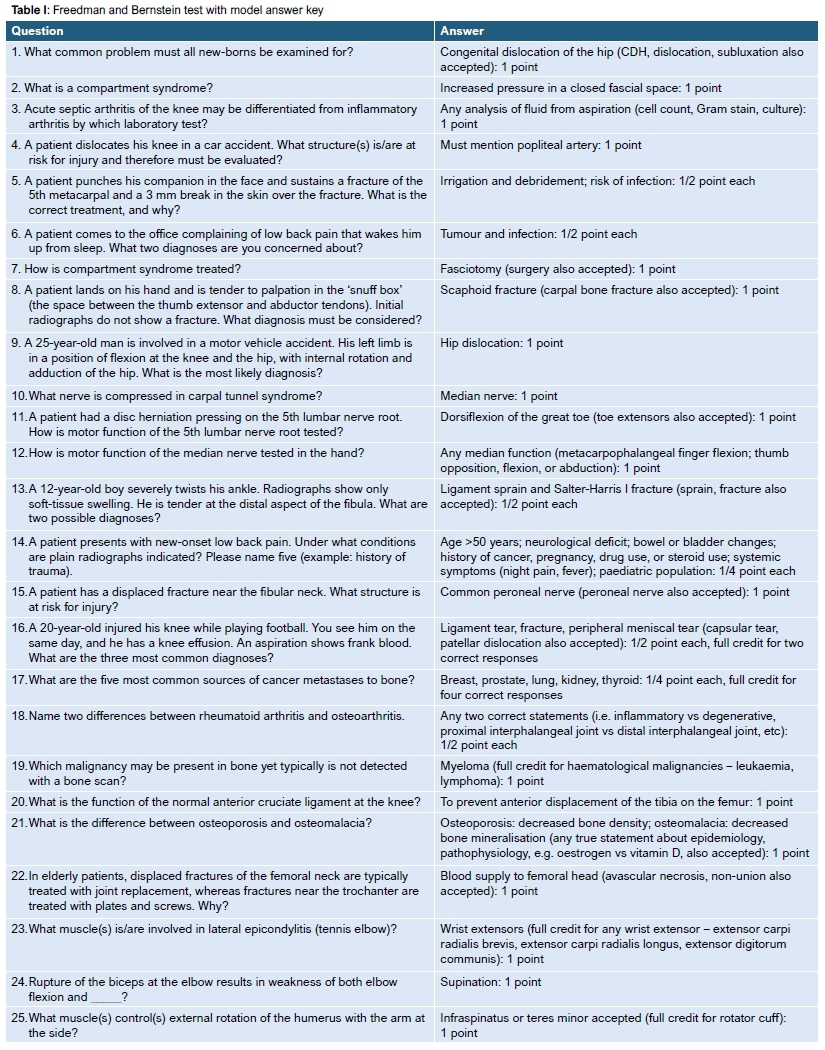
A multi-centre cross-sectional study was performed by administering the Freedman-Bernstein musculoskeletal competence test to qualified South African intern doctors prior to starting their formal orthopaedic rotation, with the aim of testing knowledge acquired as an undergraduate. Interns were enrolled at Frere Hospital over a three-year period from January 2017 to January 2020 by the author and co-author after their orthopaedic block orientation session. Similarly, interns were also enrolled in January 2020 from other training hospitals in Gauteng, KwaZulu-Natal and the Eastern Cape. This was done to increase sample size and overcome selection bias. Intern doctors are allocated to hospitals by the national intern allocation process and we obtained representation from all health science faculties at each site. Invigilators were recruited from other centres by approaching the intern curator and orthopaedic head of department and arranging with a consultant or registrar to act as an invigilator. After a verbal informed consent, all tests were administered under invigilated examination conditions with no time limit. The tests were anonymous and voluntary, asking only for health science faculty name and year of qualification. Only graduates from South Africa's eight health science faculties were enrolled. The population consisted of first- and second-year interns. Once the tests were completed, and invigilators had couriered their tests to East London, they were marked by the author with the validated scoring system and answer key published in Freedman and Bernstein's original article (Table I), and results were recorded on Excel data sheet tables. The pass mark of 70% was chosen as suggested by the chairs of internal medicine for our study.7
Results
Combined test analysis
A total of 262 intern doctors completed tests; three of the doctors had graduated from international medical schools and were excluded. Of the 259 included tests, 203 were from Frere Hospital and 56 were from the other centres. The mean score for the 259 interns was 46% (95% CI 44-48%). Only 15 out of 259 interns (6%) achieved a score of 70% or more and therefore showed basic competence in the test, thus demonstrating a 94% failure rate.
Comparison between health science faculties
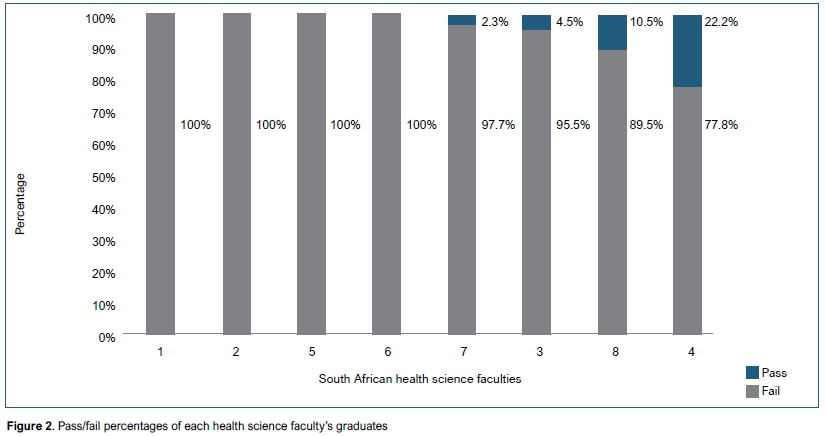
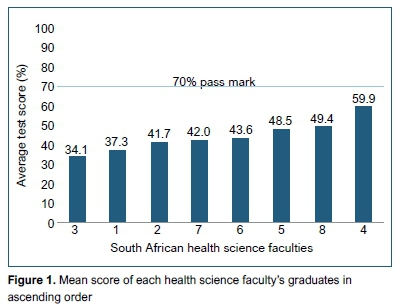
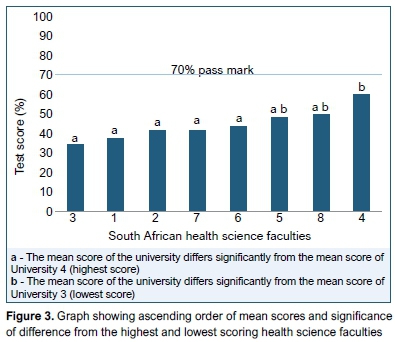
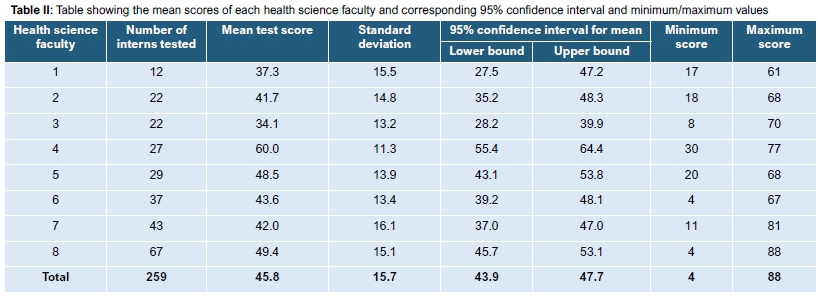
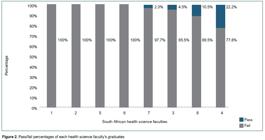
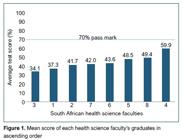
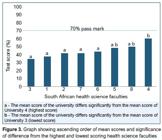
The health science faculties were anonymised by numbering them 1 to 8 in order of ascending sample sizes. Sample sizes ranged from 12 interns to 67 interns. The mean percentage of each health science faculty's graduate group was then calculated (Table II, Figure 1). The lowest performing health science faculty group mean was 34% (95% CI 28-40%) and the highest 60% (95% CI 55 -64%). In terms of failure rates, half of the health science faculties recorded 100% failure rates. Of the health science faculties that recorded passing scores by graduates, the pass rate ranged from 2% to 22% (Figure 2). The ANOVA revealed a statistically significant difference between health science graduate groups (p<0.001). The post hoc tests and Bonferroni correction do an additional 28 comparisons of the health science faculties against one another to check for significance. University 4 had a mean score significantly higher than each of the other seven faculties and health science faculty 3 had a significantly lower mean than each of the top three performing faculties (Figure 3).
Discussion
The results of our study show that there has not been a demonstrable improvement in musculoskeletal competence among graduates from our health science faculties from previous literature. Our mean score of 46% (95% CI 44-48%) and failure rate of 94% are consistent with the work of Dachs et al., ten years ago, of 45% (95% CI 42-48%) and 91% respectively.127,8,10 Furthermore, only half of our health science faculties managed to produce graduates who could pass the Freedman-Bernstein test.
The primary aim of our study was to determine whether significant differences existed between the musculoskeletal knowledge of health science faculty graduates. We have shown that statistically significant differences exist, with a difference between highest and lowest averages reaching 25%. Of the interns who passed the test, 13 out of 15 (87%) came from the top two health science faculties in our study.
The recently published Academy of Science of South Africa (ASSAf) report suggests that core competencies need to be developed by regulatory bodies, and that competency-based education should be subscribed to by health science faculties.19 1720
We therefore performed a comparison of the training programmes with the highest and lowest mean scores to investigate possible reasons for these significant differences. We conducted telephonic interviews with the two lowest scoring health science faculties (mean scores 34% and 37%) and the two highest scoring faculties (60% and 49%) to obtain details on their undergraduate orthopaedic training programmes and look for similarities and differences which could possibly account for differences in their test scores. All four of these faculties generally followed a similar structure of exposing students to theoretical training in the preclinical years, followed by clinical rotations in orthopaedics at training hospitals. The faculty with the highest mean value and pass rate was interestingly a five-year programme. There were small differences in total musculoskeletal training time in the clinical years between the four faculties, all consisting of between four to six weeks, either running concurrently or divided up between the last three years of study. The preclinical musculoskeletal exposure time differed between faculties. The top two performing faculties, which both had traditional teaching models, had longer formal preclinical rotations; one consisted of a six-week consecutive block, the other a full year of regular dissection-based anatomy training and didactic lectures, more in keeping with the recommendations of Woolf et al.21et al.'s article.223,23 The ASSAF report supports this method by emphasising the need for adequate assessment tools to be incorporated into the syllabus that will guide the development of core competencies and are essential to enable best training practices to be developed.19
With regard to time dedicated to musculoskeletal training, the literature shows that increasing training time does not always result in improved competency scores.22et al. suggested that the ideal musculoskeletal training programme should consist of 12 weeks of clinical time and sufficient non-clinical background given before that.21
South Africa's universities differ with regard to setting, resources, demographics, training time, entrance criteria for students and curricular approach.16-18 Some subscribe to a problem-based learning approach, others a more traditional systems approach or a hybrid version of the two.1817
There are limitations to our study. Even though we tried to get a true representation of South African health science faculty graduates by our multi-centred approach and large sample size, there exists the possibility that our sample is not a true representation of the graduate population of the faculty. Bias may have been introduced by the fact that interns select their hospitals of choice and therefore the sample is not truly random. We recruited interns over three years and the possibility exists that changes to the curriculum may have occurred during this time, which could affect our results. Nearly half of our intern sample was obtained from new interns in January 2020; we did not feel a sub-group analysis was necessary to show similarity between these groups. Our tests were administered under invigilated conditions to eliminate cheating, but the result obtained could be biased by interns having been previously exposed to the test questions. Our sample was a mixture of first and second year interns which may have caused bias by the fact that first years were more recently trained and second years may have gained knowledge in other blocks; however, we do not think this would have altered our result. The Freedman-Bernstein test, although validated to test basic musculoskeletal competence, does not assess clinical skills and confidence, which are other aspects of competence that also need due consideration, perhaps in further studies.
Conclusion
Our study has confirmed that undergraduate training in South Africa continues to produce graduates without the necessary basic musculoskeletal knowledge to deal with the rising burden of disease. We have furthermore provided evidence that statistically significant differences exist between the undergraduate training programmes. We feel this evidence strengthens the argument for inter-institutional collaboration to reform and standardise musculoskeletal curricula.
Acknowledgements
We would like to thank Dr Pieter Maré, Dr Jason du Plessis, Dr Jason van Heerden and Dr Jaco Viljoen who enthusiastically identified interns at their institutions and helped in printing, obtaining consent, administering the tests and then couriering the test papers to us. Statistical analysis by Mrs Marike Cockeran, MSc Statistics, North-West University, Potchefstroom, South Africa.
Ethics statement
The authors declare that this submission is in accordance with the principles laid down by the Responsible Research Publication Position Statements as developed at the 2nd World Conference on Research Integrity in Singapore, 2010. Study approval was obtained from the Walter Sisulu University Faculty of Health Sciences Postgraduate Education, Training, Research and Ethics Unit: protocol number 072/2019. Informed consent was obtained from all individual participants included in the study. All procedures were in accordance with the ethical standards of the responsible committee on human experimentation (institutional and national) and with the Helsinki Declaration of 1975, as revised in 2008.
Declaration
The authors declare authorship of this article and that they have followed sound scientific research practice. This research is original and does not transgress plagiarism policies.
Author contributions
KPC contributed to the conceptualisation, design, data collection, data analysis and manuscript preparation.
NWG contributed to conceptualisation, design, data collection, manuscript preparation and supervised the study.
ORCID
Coetzee KP https://orcid.org/0000-0003-0261-4447
Gibson NW https://orcid.org/0000-0003-1546-8485
References
-
1. Global Alliance for Musculoskeletal Health [Interntet]. Available from: http://bjdonline.org/ [Accessed 21 January 2020).
» http://bjdonline.org/ -
2. Day CS, Ho P. Progress of medical school musculoskeletal education in the 21st century. J Am Acad Orthop Surg. 2016;24:762-68. https://doi.org/10.5435/JAAOS-D-15-00577.
» https://doi.org/10.5435/JAAOS-D-15-00577 -
3. Kalraiya A, Buddhdev P. The TROJAN project: creating a customized international orthopedic training program for junior doctors. Orthop Rev (Pavia). 2015;7:6-9. https://doi.org/10.4081/or.2015.5750.
» https://doi.org/10.4081/or.2015.5750 - 4. Parker R, Jelsma J. The prevalence and functional impact of musculoskeletal conditions amongst clients of a primary health care facility in an under-resourced area of Cape Town. BMC Musculoskelet Disord. 2010;11:2.
- 5. Naidoo ND. An evaluation of the quality of orthopaedic trauma referrals to a regional hospital. SA Orthop J. 2009;8(1):66-69.
-
6. Nkabinde TC, Ross A, Reid S, Nkwanyana NM. Internship training adequately prepares South African medical graduates for community service - with exceptions. SAMJ. 2013;103:930-34. https://doi.org/10.7196/SAMJ.6702.
» https://doi.org/10.7196/SAMJ.6702 -
7. Freedman KB, Bernstein J. The adequacy of medical school education in musculoskeletal medicine. J Bone Jt Surg. 1998;80:1421-27. https://doi.org/10.2106/00004623-199810000-00003.
» https://doi.org/10.2106/00004623-199810000-00003 -
8. Al-Nammari SS, Pengas I, Asopa V, Jawad A, Rafferty M, Ramachandran M. The inadequacy of musculoskeletal knowledge in graduating medical students in the United Kingdom. J Bone Jt Surg. 2013;107:1-10. https://doi.org/10.2106/JBJS.E01083.
» https://doi.org/10.2106/JBJS.E01083 -
9. Al-Nammari SS, James BK, Ramachandran M. The inadequacy of musculoskeletal knowledge after foundation training in the United Kingdom. J Bone Joint Surg Br. 2009;91-B:1413-18. https://doi.org/10.1302/0301-620x.91b11.22445.
» https://doi.org/10.1302/0301-620x.91b11.22445 -
10. Tamrakar R, Basnyat S, Gyawali B, et al. Adequacy of undergraduate orthopedic training at a Nepalese Medical Academy. Med J Shree Birendra Hosp. 2017;15:13-18. https://doi.org/10.3126/mjsbh.v15i2.16112.
» https://doi.org/10.3126/mjsbh.v15i2.16112 -
11. Day CS, Yeh AC, Franko O, Ramirez M, Krupat E. Musculoskeletal medicine: An assessment of the attitudes and knowledge of medical students at Harvard medical school. Acad Med. 2007;82:452-57. https://doi.org/10.1097/ACM.0b013e31803ea860.
» https://doi.org/10.1097/ACM.0b013e31803ea860 - 12. Dachs R, Roche S, Vrettos B, Macintyre K, Walters J. Assessment of undergraduate orthopaedic training at medical schools in South Africa. SA Orthop J. 2010;9(4):33-37.
- 13. Dachs R, Roche S, Vrettos B, et al. Assessing musculoskeletal training in South Africa. SA Orthop J. 2014;13(3):57-63.
-
14. Bhatnagar A, Vadhel M, Sethuraman V. Inadequacy of musculoskeletal knowledge among undergraduate medical students. J Orthop Trauma Rehabil. 2015;19:34-38. https://doi.org/10.1016/j.jotr.2014.03.003.
» https://doi.org/10.1016/j.jotr.2014.03.003 - 15. Williams JR. The teaching of trauma and orthopaedic surgery to the undergraduate in the United Kingdom. J Bone Joint Surg Br. 2000;82:627-28.
-
16. Burch VC, Sikakana C, Gunston GD, Whittle SR, Murdoch-Eaton D. Pre-university education curriculum reform and the generic learning skills of medical school entrants: lessons learned from South Africa. Educ Heal. 2018;29:1-8. https://doi.org/10.4103/efh.EfH.
» https://doi.org/10.4103/efh.EfH - 17. Botha GC. The status of curriculum mapping of undergraduate medical programmes in South Africa [dissertation] Stellenbosch University; 2016.
- 18. Seggie JL. MBChB curriculum modernisation in South Africa -growing doctors for Africa. African J Heal Prof Educ. 2010;2:8-14.
- 19. Academy of Science of South Africa. Consensus study report: Reconceptualising health professions education in South Africa. 2018.
-
20. Marais L, Dunn R. Teaching and training in orthopaedics. SA Orthop J. 2017;16(4):15-19. https://doi.org/10.17159/2309-8309/2017/v16n4a1.
» https://doi.org/10.17159/2309-8309/2017/v16n4a1 -
21. Woolf AD, Walsh NE, Akesson K. Global core recommendations for a musculoskeletal undergraduate curriculum. Ann Rheum Dis. 2004;63:517-24. https://doi.org/10.1136/ard.2003.016071.
» https://doi.org/10.1136/ard.2003.016071 - 22. Weiss K, Curry E, Matzkin E. Assessment of medical school musculoskeletal education. Am J Orthop. 2015;44:E64-67.
- 23. Vermaak D, Potgieter J. The evaluation of a new general trauma course with an orthopaedic focus. SA Orthop J. 2012;11(2):68-71.
Dr Kaylem Paul Coetzee
Department of Orthopaedic Surgery, Frere Hospital
Amalinda Main Rd, Amalinda, East London, 5247
tel: (043) 709 2000; email:

Accepted: March 2020
Published: August 2020
Funding: The study was funded by a Discovery research grant.
Conflict of interest: Both authors declare no conflicts of interest with regard to this study.