Do socioeconomic and demographic factors influence treatment outcomes in patients with idiopathic clubfoot in the Western Cape?
Abstract
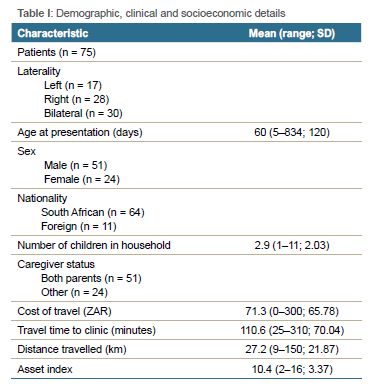
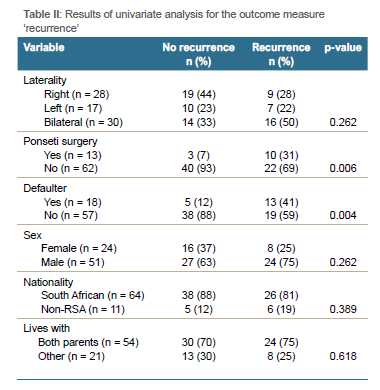
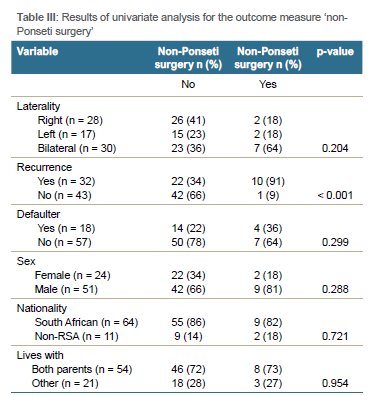
BACKGROUND: Idiopathic clubfoot is a common congenital birth defect with a global incidence of 1.2 per 1 000 births. The Ponseti method is the gold standard of treatment for clubfoot and is reproducible and relatively cost effective, making it applicable to low- and middle-income countries (LMICs) such as South Africa. Studies from other LMICs demonstrated that certain socioeconomic and demographic factors influence treatment outcomes in children with clubfoot. Financial circumstances, transportation, waiting times and understanding of treatment were among the common barriers identified in these studies. Our study aims to assess the relationship between demographic and socioeconomic factors and treatment outcomes in patients treated for idiopathic clubfoot in South Africa. METHODS: A retrospective analysis of prospectively collected data was performed for patients with idiopathic clubfoot presenting to our clubfoot clinic from 1 May 2020 to 30 April 2022. Failure of treatment was defined as the need for repeat casting or tenotomy, or extensive soft tissue surgery. Data was collected on demographic variables such as age and sex; treatment variables such as number of casts, tenotomies and relapse; and socioeconomic variables including the Demographic and Health Surveys (DHS) wealth index, and transport-related variables. The relationship between the tested variables and treatment failure was analysed. RESULTS: Seventy-five patients, of whom 51 (68%) were male, were included. The average age at presentation was 60 days (5-834 days). Of the variables examined, defaulter status (p = 0.006) and age at first presentation (p = 0.03) were associated with failure of treatment. Of the socioeconomic variables, 'travel time' was weakly associated with treatment failure but did not reach statistical significance in the multivariate analysis. CONCLUSION: In contrast to the findings of several studies performed in other LMICs, socioeconomic and demographic factors do not appear to influence treatment outcomes of idiopathic clubfoot treated with the Ponseti method in our setting. Level of evidence: 3
clubfoot; congenital talipes equinovarus; Ponseti method; socioeconomic; demographic; treatment outcomes