Do socioeconomic and demographic factors influence treatment outcomes in patients with idiopathic clubfoot in the Western Cape?
Abstract
BACKGROUND: Idiopathic clubfoot is a common congenital birth defect with a global incidence of 1.2 per 1 000 births. The Ponseti method is the gold standard of treatment for clubfoot and is reproducible and relatively cost effective, making it applicable to low- and middle-income countries (LMICs) such as South Africa. Studies from other LMICs demonstrated that certain socioeconomic and demographic factors influence treatment outcomes in children with clubfoot. Financial circumstances, transportation, waiting times and understanding of treatment were among the common barriers identified in these studies. Our study aims to assess the relationship between demographic and socioeconomic factors and treatment outcomes in patients treated for idiopathic clubfoot in South Africa. METHODS: A retrospective analysis of prospectively collected data was performed for patients with idiopathic clubfoot presenting to our clubfoot clinic from 1 May 2020 to 30 April 2022. Failure of treatment was defined as the need for repeat casting or tenotomy, or extensive soft tissue surgery. Data was collected on demographic variables such as age and sex; treatment variables such as number of casts, tenotomies and relapse; and socioeconomic variables including the Demographic and Health Surveys (DHS) wealth index, and transport-related variables. The relationship between the tested variables and treatment failure was analysed. RESULTS: Seventy-five patients, of whom 51 (68%) were male, were included. The average age at presentation was 60 days (5-834 days). Of the variables examined, defaulter status (p = 0.006) and age at first presentation (p = 0.03) were associated with failure of treatment. Of the socioeconomic variables, 'travel time' was weakly associated with treatment failure but did not reach statistical significance in the multivariate analysis. CONCLUSION: In contrast to the findings of several studies performed in other LMICs, socioeconomic and demographic factors do not appear to influence treatment outcomes of idiopathic clubfoot treated with the Ponseti method in our setting. Level of evidence: 3
clubfoot; congenital talipes equinovarus; Ponseti method; socioeconomic; demographic; treatment outcomes
Introduction
Idiopathic clubfoot, also known as congenital talipes equinovarus, is one of the most common musculoskeletal congenital birth defects, accounting for 80% of all patients diagnosed with congenital clubfoot.123
When treated inadequately, patients often have residual deformities which can lead to chronic pain and limit function.4
Disability can cause hardship for patients and affected families, create social obstacles, decrease patient mobility, threaten patient productivity, and decrease the chances of patients to progress to live as independent adults.5
The Ponseti method has become the gold standard of treatment for idiopathic clubfoot 6
It is estimated that approximately 80% of children born with clubfoot each year reside in LMICs.7,8 There is, however, very little data regarding barriers to treatment and the socioeconomic factors that may influence treatment outcomes of patients diagnosed with idiopathic clubfoot in South Africa.
Intrapersonal factors, such as carer income, travel cost, income lost because of taking time off work, and interpersonal factors such as paternal involvement, were all found to be potential barriers to clubfoot treatment in LMICs in Africa, Asia, and South America.9
Methods
Following approval from the institutional research ethics committee, we performed a retrospective analysis of prospectively collected data captured on a national clubfoot database.
We included patients who presented to our orthopaedic hospital's clubfoot clinic from 1 May 2020 to 30 April 2022. Only patients diagnosed with idiopathic clubfoot were included. Patients with syndromic or neurological clubfoot were excluded, as well as those who transferred out after receiving initial management at our clubfoot clinic.
As surrogate markers for treatment failure, we determined the incidence of recurrence (either repeat tenotomy or repeat casting) and the need for extensive soft tissue releases that are not considered part of the Ponseti method (non-Ponseti surgery). For the purpose of this study, an Achilles tenotomy or open Achilles tendon lengthening in older children, and a tibialis anterior tendon transfer were classified as Ponseti surgery. Any other surgeries such as a posterolateral and posteromedial release were classified as non-Ponseti surgery. These procedures are comprehensively described elsewhere.
We collected data on demographic variables (age at presentation, laterality of the clubfoot, sex and nationality) and socioeconomic variables (Demographic and Health Surveys [DHS] wealth index,10
The DHS wealth index uses several variables such as education, employment and access to amenities to calculate a score, where 0-5 indicates a low socioeconomic status, 6-12 a medium and > 12 a high socioeconomic status.
Clinical variables collected were the initial and total number of casts applied, whether an Achilles tenotomy was performed and how many times, and whether the patient required surgery, either Ponseti or non-Ponseti. We also collected data on patient defaulter status; patients who missed more than two clinic follow-ups were considered to have defaulted.
Statistical analyses
All analyses were conducted in SPSS version 28, with the threshold for statistical significance set at p = 0.05. Data are reported as means and standard deviation for continuous variables, and as frequencies and proportions for categorical variables.
Univariate analyses (independent sample t-tests, one-way ANOVAs, Pearson's correlations and chi-squared analyses) were conducted to determine predictors of total casts, recurrence, tenotomy, and non-Ponseti surgery. Predictors found to be significant were entered into regression models for the multivariate analysis.
Results
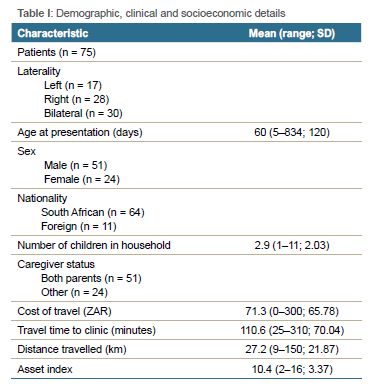
Seventy-five patients were included in our study. Presenting demographic and socioeconomic data is summarised in Table I.
The mean age at presentation to the clubfoot clinic was 60 days (SD = 120). The mean number of initial casts applied was 6.5 (SD = 3), and 32 patients (43%) had one or more Achilles teno-tomies.
Recurrence
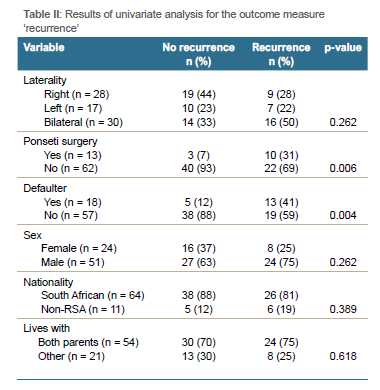
In the univariate analysis, Ponseti surgery (p = 0.006), initial and total number of casts (p = < 0.001), number of tenotomies (p = 0.001) and defaulter status (p = 0.004) were significantly associated with the incidence of recurrence. (Table II) Of these variables, only Ponseti surgery (OR = 0.16, p = 0.012) and defaulter status (OR = 0.18, p = 0.006) remained statistically significant in the multivariate analysis.
Non-Ponseti surgery
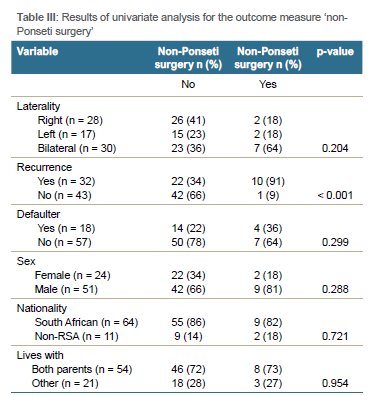
In the univariate analysis, the number of initial casts (p = 0.003), age at first presentation (p < 0.001) and time spent travelling to the clinic (p = 0.041) were significantly associated with the need for non-Ponseti surgery (Table III). In the multivariate analysis, only number of initial casts (OR = 1.66, p = 0.019) and age at first presentation (OR = 1.02, p = 0.030) remained statistically significant predictors for non-Ponseti surgery.
Discussion
The aim of this study was to determine whether demographic and socioeconomic factors played a role in the treatment outcomes of patients born with idiopathic clubfoot, and if so, what these factors were. Our study was conducted at a dedicated clubfoot clinic in Cape Town, South Africa.
The mean number of casts used to achieve correction in our cohort was 8.13. Comparatively, Chu et al. found a mean of 5.1 casts used to achieve correction in their study reviewing the correlation between clubfoot classification and Ponseti cast treatment.1112
Alam et al. reviewed the barriers that caregivers face during the treatment of clubfoot in Bangladesh. They listed four main barriers: financial circumstances, transportation, waiting times and understanding of treatment.1314
Kazibwe & Struthers reviewed barriers to treatment experienced by parents of children with clubfoot in Uganda. They found a significant association between compliance to clubfoot treatment and distance travelled to clinic and transport cost.1516
We used the DHS wealth index to determine the overall socioeconomic status of patients attending our clubfoot clinic. No study that we found looked specifically at the relationship between treatment failure in idiopathic clubfoot and socioeconomic status as determined by a validated score. Bent et al.14
Dobbs et al. conducted a similar study with 51 patients, comparing patient characteristics and demographic variables with treatment outcomes. Of all the variables investigated by them, they found that only the educational level of the parents and noncompliance was associated with clubfoot recurrence.1718 19
A study by Poudel et al. investigating factors which affect compliance to clubfoot treatment in India found a statistically significant relationship between age and sex and the number of clinic appointments missed.2021
Another demographic factor that we had assessed was the number of children in each household where our patients were living. We found no significant relationship between the number of children per household and treatment failure. In contrast, Pigeolet et al., found that the number of children in a household does have significant relationship with the risk of treatment defaulting. They specifically found an increased risk of defaulting in households with more than four children.22
In a scoping review evaluating the impact of socioeconomic factors affecting clubfoot treatment relapse and non-compliance in LMICs, also by Pigeolet et al., Ave significant associations were identified, namely, relapse and living below the poverty line; relapse and caregivers with a lack of financial support; relapse and transport cost, non-compliance and travel distance of more than 9 km; and lastly, dropout and travel times to clinic of 6-12 hours.23
There are several limitations to our study. Although data was prospectively and systematically collected, multiple healthcare providers completed the data collection forms, thereby compromising the consistency of assessment and accuracy of presenting data. Our cohort was relatively small, and our study was set in an urban area with relatively good healthcare facilities and support, potentially rendering our findings less applicable to other low- and middle-income settings. Furthermore, the relationship between treatment failure and caregiver social support as well caregiver insight and understanding should have been investigated in greater detail, as these two factors have been shown in previous literature to affect treatment outcomes.
Conclusion
We did not And a significant relationship between the investigated socioeconomic or demographic variables and treatment outcomes of patients with idiopathic clubfoot in our setting. Of all the variables examined, only time spent travelling to the clinic was weakly associated with the need for non-Ponseti surgery. This is in contrast with several studies performed in other LMICs. Multicentre studies, including sites in more rural areas, may shed more light on the barriers to clubfoot treatment in South Africa.
Ethics statement
The authors declare that this submission is in accordance with the principles laid down by the Responsible Research Publication Position Statements as developed at the 2nd World Conference on Research Integrity in Singapore, 2010.
Prior to commencement of the study, ethical approval was obtained from the Faculty of Health Sciences, University of Cape Town Human Research Ethics Committee (R014/2019). All procedures were in accordance with the ethical standards of the responsible committee on human experimentation (institutional and national) and with the Helsinki Declaration of 1975, as revised in 2008.
Consent was obtained from patients' parents/legal guardians for their data to be entered into the registry.
Declaration
The authors declare authorship of this article and that they have followed sound scientific research practice. This research is original and does not transgress plagiarism policies.
Author contributions
WG: data collection, first draft preparation and manuscript preparation
AH: study conceptualisation, design, data analysis, first draft preparation and manuscript preparation
ORCID
Horn A https://orcid.org/0000-0002-4159-6520
Gamieldien W https://orcid.org/0009-0009-8590-1150
References
- 1. Dobbs MB, Gurnett CA. Genetics of clubfoot. J Paediatr Orthop. 2012;21(1):7-9.
- 2. Cummings RJ, Davidson RS, Armstrong PF, Lehman WB. Congenital clubfoot. J Bone Joint Surg Am. 2002 Feb;84(2):290-308.
- 3. Wallander H, Hovelius L, Michaelson K. Incidence of congenital clubfoot in Sweden. Acta Orthop. 2006 Dec;77(6):847-52.
- 4. Johnson JE, Fortney TA, Luk PC, et al. Late effects of clubfoot deformity in adolescent and young adult patients whose initial treatment was an extensive soft tissue release. J Am Acad Orthop Surg Glob Res Rev. 2020 May;4(5):e19. 00126.
-
5. Grimes CE, Holmer H, Maraka J, et al. Cost-effectiveness of club-foot treatment in low-income and middle-income countries by the Ponseti method. BMJ Global Health. 2016;1:e000023. https://doi.org/10.1136/bmjgh-2015-000023
» https://doi.org/10.1136/bmjgh-2015-000023 - 6. Radler C. The Ponseti method for the treatment of congenital club foot: review of the current literature and treatment recommendations. Int Orthop. 2013;37:1747-53.
- 7. Smith T, Rotenberg S, Lavy C. The global birth prevalence of clubfoot: a systemic review and meta-analysis. eClinicalMedicine. 2023 Sep;63.
-
8. Pinto D, Agrawal A, Agrawal A, et al. Factors causing dropout from treatment during the Ponseti method of clubfoot management: the caregivers' perspective. J Foot Ankle Surg. 2022;61(4):730-34. https://doi.org/10.1053/j.jfas.2021.11.014
» https://doi.org/10.1053/j.jfas.2021.11.014 - 9. Drew S, Lavy C, Gooberman-Hill R. What factors affect patient access and engagement with clubfoot treatment in low- and middle-income countries? A meta-synthesis using a social ecological model. Trop Med Int Health. 2016;21(5):570-89.
- 10. Rutstein SO, Johnson K. The DHS Wealth Index. DHS Comparative Reports No. 6. Calverton, Maryland: ORC Macro; 2004.
- 11. Chu A, Labar AS, Sala DA, et al. Clubfoot classification: correlation with Ponseti cast treatment. J Pediatr Orthop. 2010;30(7):695-99.
- 12. Khurana A, Singh AK, Joshi N, et al. Can the age of initiation of Ponseti casting predict the number of casts, duration of treatment, and overall outcomes? A prospective cohort study. J Foot Ankle Surg (Asia-Pacific). 2025;12(1).
- 13. Alam Z, Haque M, Bhuiyan R, et al. Barriers faced by parents during treatment of children with clubfoot deformity. MOJ Orthop Rheumatol. 2014;1(2):22-26.
- 14. Bent MA, Jhun M, Beltran V, et al. Social disadvantage and transportation insecurity in clubfoot clinic. J Pediatr Orthop. 2025 Feb 1;45(2):e143-e147.
- 15. Kazibwe H, Struthers P. Barriers experienced by parents of children with clubfoot deformity attending specialised clinics in Uganda. Trop Doct. 2009;39:15-18.
-
16. Western Cape Government. Non-emergency patient transport makes comprehensive health care possible. Available from: https://www.westerncape.gov.za/health-wellness/node/1232
» https://www.westerncape.gov.za/health-wellness/node/1232 -
17. Dobbs MB, Rudzki JR, Purcell DB, et al. Factors predictive of outcome after use of the Ponseti method for the treatment of idiopathic clubfeet. J Bone Joint Surg Am. 2004;86(1):22-27. https://doi.org/10.2106/00004623-200401000-00005
» https://doi.org/10.2106/00004623-200401000-00005 -
18. Asuquo JE, Okokon EO, Lasebikan OA, et al. Assessment of treatment outcomes in the management of club foot using the Ponseti technique: a cross-sectional study. Afr J Paediatr Surg. 2023;21(2):85-89. https://doi.org/10.4103/ajps.ajps_115_22
» https://doi.org/10.4103/ajps.ajps_115_22 - 19. Dar RA, Rashid M, Bhat MR, et al. Factors affecting outcome after the use of the Ponseti method for the management of idiopathic clubfoot: a retrospective study in an orthopaedic referral institute. Acta Orthop Belg. 2016;82:705-709.
- 20. Poudel RR, Kumar VS, Tiwari V, et al. Factors affecting compliance to hospital visit among clubfoot patients: a cross-sectional study from a tertiary referral clubfoot clinic in the developing country. J Orthop Surg. 2019;27(1):1-4.
-
21. United Nations Development Programme. Gender Inequality Index. Human Development Reports. Available from: https://hdr.undp.org/data-center/thematic-composite-indices/gender-inequality-index
» https://hdr.undp.org/data-center/thematic-composite-indices/gender-inequality-index - 22. Pigeolet M, Kucchal T, Hey MT, et al. Exploring the distribution of risk factors for drop-out from Ponseti treatment across Bangladesh using geospatial cluster analysis. Geospat Health. 2023;18:1174.
- 23. Pigeolet M, Vital A, Daoud HA, et al. The impact of socioeconomic factors on parental non-adherence to the Ponseti protocol for clubfoot treatment in low- and middle-income countries: a scoping review. eClinicalMedicine. 2022;48:101448.
Accepted: October 2025
Published: August 2026
Editor: Dr Greg Firth, Royal London Hospital, London, England
Funding: No funding was received for this study.
Conflict of interest: The authors declare they have no conflicts of interest that are directly or indirectly related to the research.