The cost of convenience: initial costs to the state healthcare system of orthopaedic injuries in uninsured delivery motorcyclists in Cape Town
Abstract
BACKGROUND: Since the COVID-19 pandemic, there has been a reported increase in the number of delivery motorcyclists on South African roads with a resultant increase in trauma from accidents noted anecdotally in South African state hospitals. Our primary aim was to estimate the costs to the state healthcare system of the initial orthopaedic surgical management of uninsured motorcyclists involved in delivery-related accidents. The secondary aim was to describe the demographics and orthopaedic injury patterns seen in these delivery motorcyclists. METHODS: A prospective consecutive case series was gathered from all the hospitals draining a regional health district over the course of one year. Medical records as well as data gathered from an interview on admission were assessed to establish demographic and injury data. Theatre invoices and clinical records were used to generate cost estimates. RESULTS: Forty-four young male delivery motorcyclists who sustained a total of 57 injuries requiring orthopaedic surgical intervention were included in the study. Injuries were predominantly fractures of the femur and tibia, consistent with the described mechanism of injury. The mean cost of admission, imaging, implants and orthopaedic surgery was R52 061 per injured driver (interquartile range [IQR]: R32 088-R109 644; range: R14 796-R348 894). In total, R3.99 million was spent on the initial orthopaedic surgical management of these 44 drivers. CONCLUSION: Delivery motorcyclists are predominantly young males without major medical comorbidities who typically sustain injuries to the lower limbs consistent with being struck by another vehicle. Their initial orthopaedic surgical management is costly and resource intensive. We suggest further efforts to legislate with respect to mandatory insurance policies and safety strategies for this vulnerable group of patients. Further research into the associated costs of these injuries is needed. Level of evidence: 4
delivery motorcyclist; motorcycle accident; state healthcare; economic cost; trauma
Introduction
Traffic accidents place an enormous burden on the economy of South Africa and other developing countries.1-3 Motorcycle accidents, in particular, have been shown to have a higher rate of injury, and a higher cost of treatment, than other types of motor vehicle accidents.45 677,8
During the COVID-19 pandemic, an increase in the number of delivery motorcyclists on the roads of South Africa, as well as internationally, was reported.9,10 Many of these delivery motorcyclists have no formal employment contract which would provide them with recourse to claim under the Compensation for Occupational Injuries and Diseases Act in the event of an accident.11
Delivery motorcyclists are incentivised to work long hours and in adverse weather and visibility conditions by the very nature of their job.1213,14 It has been reported that many South African delivery motorcyclists are not utilising adequate safety equipment such as helmets or other appropriate protective clothing.1015-17 Additionally, international studies investigating risk factors for delivery motorcyclist accidents highlighted the influence of adverse weather conditions, poor visibility, road surface quality, the size of the company employing the driver, and vehicle-related mechanical failures as independent risk factors for accidents.16,18 An additional factor particular to working for a mobile phone application (app)-based service is that the motorcyclist has to pay attention to their phone while driving for either directions or messages from the recipient of the delivery. This type of distraction has been shown to significantly increase the risk (odds ratio = 23.24) for being involved in a safety critical event such as a crash, near crash or unintentional crossing of a solid lane line.1920
Motorcycle accidents occurring in delivery motorcyclists have a direct economic effect due to lost productivity from a young and economically active demographic as well as a burden to the state in medical expenses which would have been claimed from the occupational injury Compensation Fund in employees with formal contracts.11,12
Methods
We hypothesised that delivery motorcyclists were contributing to a significant increase in patient admission numbers and cost to hospital orthopaedic departments in our local healthcare system. We also aimed to identify patterns and demographics in this population group. We performed a prospective consecutive case series study at all the state funded hospitals draining the southern and western subdistricts of the Cape Town metropole: New Somerset, Victoria, Groote Schuur and Mitchells Plain District hospitals. Ethical approval was obtained from the human research ethics council at the University of Cape Town and the study was registered on the National Health Research Database.
Data collection
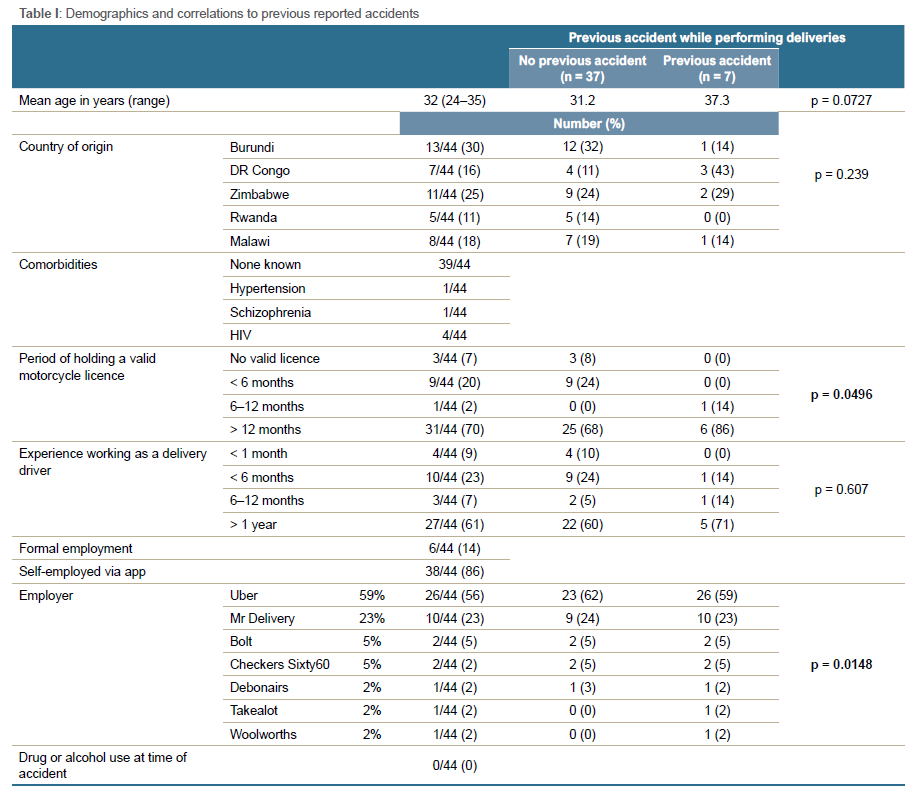
The study was conducted over a one-year (12 months) period between June 2022 and June 2023. Epidemiological and clinical data pertaining to orthopaedic injuries was gathered from patient medical records, and a data collection form filled in by the admitting clinician. Orthopaedic injuries were classified anatomically and according to the AO fracture classification, and all orthopaedic surgical procedures or interventions were accounted for. Demographic data is summarised in Table I.
Inclusion and exclusion criteria
All motorcycle drivers over the age of 18 years involved in an accident while performing delivery work for any company were included if their injuries required emergency admission and orthopaedic surgery.
Motorcyclists not actively performing delivery work at the time of injury were excluded. Delivery motorcyclists treated with conservative non-operative measures were not included as the goal of our study was to determine the cost of initial surgical management. Delivery motorcyclists who died on scene or before having surgery were excluded. Non-orthopaedic injuries were not included or accounted for. Chronic injuries sustained during delivery motorcycle work were not included. Readmissions due to surgical complications were not included.
Cost estimates
The cost of theatre time was calculated using an estimate per minute based on a publication by Samuel et al. for the South African context, and the value of R33.77/min from the short-term model presented in this paper was used for our estimates.21
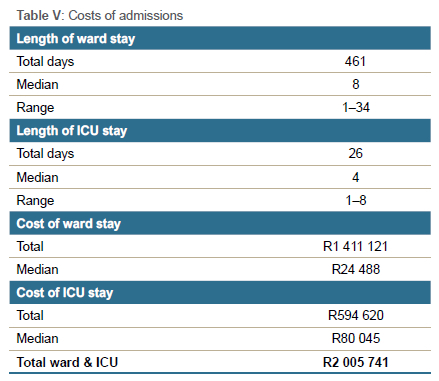
Hospital length of stay in the ward or intensive care unit (ICU) was calculated from patient records and patient admission data. The cost of ward stay was calculated using the mean figure for daily ward cost per patient (the patient day equivalent) from the relevant hospital's financial departments during that year. The cost of an ICU stay was calculated using a daily estimate figure from a South African central hospital ICU.22
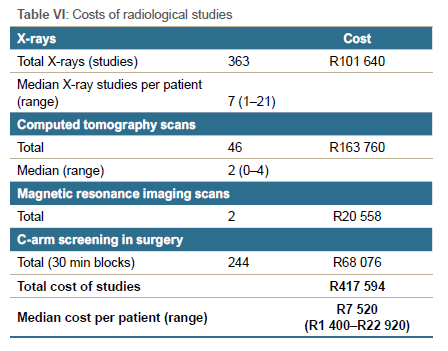
Radiological imaging costs per patient were audited and a median cost calculated based on total imaging. Imaging costs were determined by using the relevant value from the latest uniform patient fee schedule for each investigation, as well as the cost per 30-minute block to have a radiographer available for fluoroscopic imaging in theatre. Micro-costing analysis was not performed, and patients' outpatient follow-up costs were not calculated. We included all the cost of all orthopaedic surgical events occurring in each patient within the initial admission if there were multiple surgeries.
Statistical analysis
Data was reported using mean and standard deviations for normally distributed data or the median with the appropriate interquartile ranges (IQR) for non-parametric data. Data distribution was assessed using the Shapiro-Wilk test with level or significance set for a p-value of < 0.05. Further analysis of correlations between variables was performed using Fisher's exact test and the t-test. Statistical tests were performed on the R data analysis software v4.3.1.
Results
A total of 44 delivery motorcyclists with 57 injuries requiring orthopaedic surgery were captured by the study over a period of one year.
Demographics
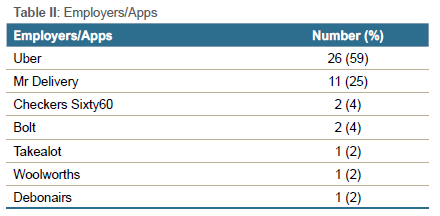
All patients identified as male with a mean age of 32 years and were classed as either I or II on the physical status classification system of the American Society of Anesthesiologists (ASA) with no known comorbidities or a single, well-controlled comorbidity. All patients were foreign nationals. Seven patients reported having had a previous motorcycle accident and three admitted to having no legal motorcycle licence. Four patients had less than one month working experience at the time of the accident. Patients were predominantly self-employed (38 of 44; 86%) by means of an app, with more than half of them reporting using the Uber app predominantly (see Table II). None of the patients admitted to being under the influence of drugs or alcohol at the time of the accident.
Delivery motorcyclists who had held a licence for more than a year were significantly more likely to report having had a previous accident (see Table I). The correlation between employer/app and previous accident was expected due to the very high proportion of the delivery motorcyclists who utilised the Uber app.
Comparison of patients who were classified as polytraumas to other groups did not yield any significant differences. Furthermore, no significant correlation was found between the length of experience working as a delivery driver and previous accidents.
Injury patterns
All delivery motorcyclists, except one, reported that their motorcycle was struck by another vehicle. The remaining driver reported falling from his motorcycle. No drivers reported losing control of the motorcycle to be the cause of the accident.
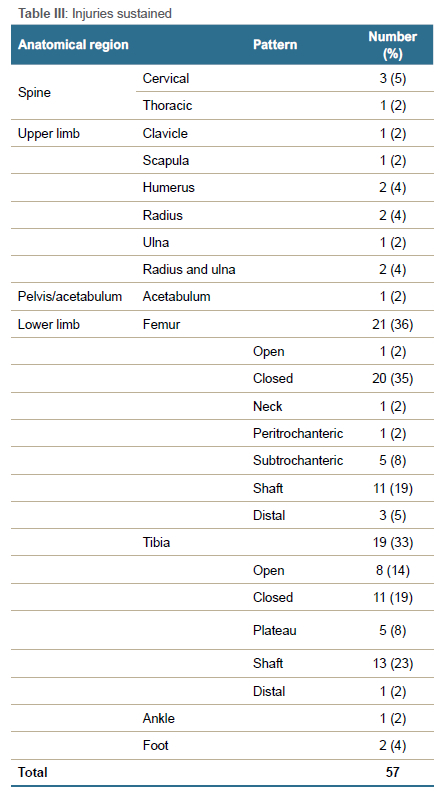
In terms of injury severity, 29% of our patients were classified as polytrauma patients with an injury severity score (ISS) of more than 15 or with an abbreviated injury score (AIS) of > 3 in more than two systems on admission; and 13% of the patients required admission to an ICU. The most common pattern of injury was to the lower limb, with femur fractures (21 of the 57 injuries; 36%) followed by tibial fractures (14 of 57; 24%) of which (nine of 57; 6%) were open fractures (eight of which were tibia fractures and one open femur fracture). Upper limb injuries constituted 18% of the injuries sustained. The remaining 9% of injuries were sustained to the spine or pelvic girdle. For a detailed overview, refer to Table III.
Costs
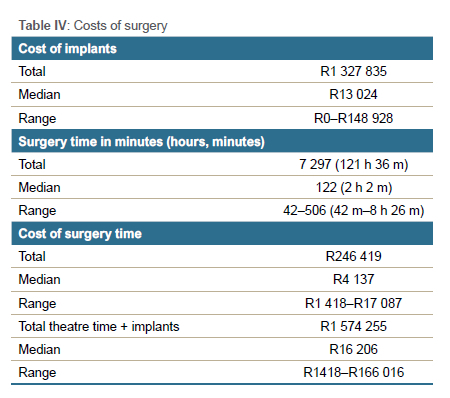
The median cost of surgery time and orthopaedic implants for each injured delivery motorcyclist was R52 061 (Table IV). The median cost of stay in a general orthopaedic ward was R24 488, with a median length of stay of eight days admission in a general ward. The median length of stay for those patients who had to be admitted to ICU was four days at a median cost of R80 045 (Table V). Radiological studies including plain radiographs, computed tomography (CT) scans, intraoperative fluoroscopic screening and magnetic resonance imaging (MRI) came to a median of R7 520 per patient (Table VI). A median of seven sets of X-rays and two CT scans were performed per patient during the course of their treatment. Only two MRI scans were performed. An estimated R417 594 was spent on imaging in total.
In total, over the course of one year, the cost of the orthopaedic surgical treatment for these 57 injuries in these 44 delivery motorcyclists in the state healthcare setting, was an estimated R3.99 million, at a median cost of R52 061 (IQR: R32 088-R109 644; range: R14 796-R348 894) per injured delivery motorcyclist. The total cost to the state would also include emergency department and other medical specialty treatment as well as outpatient care, which were not accounted for in this study and which would make the cost even more significant.
The number of delivery motorcyclists captured by the study likely underrepresents the total number injured during this period. Additional patients could have been missed at the time of their admission if their status as a delivery motorcyclist was not specified at the time of injury. Delivery motorcyclists who died on the scene or prior to receiving surgery were not captured. Delivery motorcyclists who were treated for their uncomplicated extremity fractures, such as closed ankle and distal radius fractures non-operatively were not included as the resources were too difficult to quantify. A further follow-up study on these patients is recommended to fully assess the impact of this health burden.
The cost of theatre time estimate was based on a value which did not account for the cost of surgical and anaesthetic staff in the operating room - only nursing staff and asset depreciation costs. Both the ICU cost estimate and the theatre time estimate were based on papers which were written more than two years ago, and the values were not adjusted for inflation due to the complexity of the calculations and likely inaccuracy. The cost estimate was based only on the cost to the orthopaedic services - cost of treatment of other systemic injuries such as head injuries or intra-abdominal pathology were not included or assessed. The cost of the initial treatment and evaluation of these patients in the emergency centre was not calculated or taken into account.
As a result of these limitations, the cost estimates in this study are likely an underestimation of the true amounts.
Discussion
All delivery motorcyclists in our study were males under the age of 35 years with very few medical comorbidities. In keeping with reports from other sources, all of the delivery motorcyclists we admitted were foreign nationals.12,23 The predominant mechanism of injury described by patients in our study was in keeping with the injury patterns we observed. Drivers of a motorcycle struck from the side by another vehicle would be expected to sustain long bone fractures of the leg on the impact side, and the high-energy nature of the injury often leads to open fractures.2416,18
Despite the limitations of our study, we have shown that injured delivery motorcyclists are increasing the trauma and cost burden to the state orthopaedic services. These injuries are resulting in costly investigations and surgical procedures, which divert even more theatre time and resources away from other orthopaedic services, such as elective surgery. Further research is needed into the cost burden to other inpatient and outpatient services, as well as studies investigating the long-term functional impact that the injuries are having on these patients.
Comparison to the recent study in the South African context published by Thikhathali and Ngcelwane examining the cost of road traffic injuries on the orthopaedic services in another tertiary hospital setting, showed a slightly higher average implant cost per patient in their cohort, which is likely due to the cost of using new external fixators in their facility.5
We feel that further action needs to be taken in terms of legislation regarding the protection and insurance of this vulnerable demographic. Systems which limit the working hours and protect delivery motorcyclists from the risks posed by night-time driving and adverse weather conditions might prevent some of these injuries. Appropriate issue of protective equipment and helmets should be mandatory as there is strong evidence supporting the role of these in injury prevention.252316,17,26
Conclusion
Delivery motorcyclists in South Africa have added an increasing burden to the cost of the state orthopaedic services. These patients are young healthy males who are sustaining high-energy injuries typical of motorcycle/motorcar accidents and requiring costly investigations and orthopaedic surgeries. Changes to legislation mandating insurance against injury, further training or testing, and protecting the working conditions of these delivery motorcyclists, would be likely to decrease the severity of this health burden in a time when the state healthcare sector is staggering under the cost of the health burden in our country.
Ethics statement
The authors declare that this submission is in accordance with the principles laid down by the Responsible Research Publication Position Statements as developed at the 2nd World Conference on Research Integrity in Singapore, 2010.
Prior to the commencement of the study, ethical approval was obtained from the following ethical review board: University of Cape Town - Human Research Ethics Committee 188/2022.
All procedures were in accordance with the ethical standards of the responsible committee on human experimentation (institutional and national) and with the Helsinki Declaration of 1975, as revised in 2008. Informed consent was obtained from all patients for being included in the study.
Consent was obtained from patients for the use of clinical photographs, and these images were adequately anonymised.
Declaration
The authors declare authorship of this article and that they have followed sound scientific research practice. This research is original and does not transgress plagiarism policies.
Author contributions
JMW: data capture, Data analysis, first draft preparation, manuscript preparation, manuscript revision
SWK: data capture, data analysis, manuscript preparation, manuscript revision
FL: study design, manuscript revision, data capture
MS: study conceptualisation, study proposal, study design
ORCID
Ward JM https://orcid.org/0000-0002-6831-3535
Klopper SW https://orcld.org/0000-0002-8756-0769
Louw F https://orcld.org/0000-0002-0542-3497
Schmieschek MHT https://orcld.org/0000-0001-8726-4647
References
- 1. Olukonga A. Cost analysis of road traffic crashes in South Africa. Inj Control Saf Promot. 2004;11(1):59-62.
- 2. Wesson HKH, Boikhutso N, Bachani AM, et al. The cost of injury and trauma care in low-and middle-income countries: a review of economic evidence. Health Policy Plan. 2014;29(6):795-808.
- 3. Parkinson F, Kent SJW, Aldous C, et al. The hospital cost of road traffic accidents at a South African regional trauma centre: a micro-costing study. Injury. 2014;45(1):342-45.
- 4. Pincus D, Wasserstein D, Nathens AB, et al. Direct medical costs of motorcycle crashes in Ontario. CMAJ. 2017;189(46):1410-15.
- 5. Thikhathali ND, Ngcelwane MV. The burden of road traffic accident-related trauma to orthopaedic healthcare and resource utilisation at a South African tertiary hospital: a cost analysis study. SA Orthop J. 2022;21(4):217-22.
-
6. Road Traffic Management Corporation. State of Road Safety in South Africa 'January 2022 to December 2022'. 2022. https://www.rtmc.co.za/images/rtmc/docs/traffic_reports/calendar/2022-State_of_Road_Safety_Report.pdf (date last accessed 19 July 2024).
» https://www.rtmc.co.za/images/rtmc/docs/traffic_reports/calendar/2022-State_of_Road_Safety_Report.pdf -
7. Jonker H. Motorcycle Safety Institute - crash report data. 2019. https://www.msi.org.za/crash-reports/ (date last accessed 19 July 2024)
» https://www.msi.org.za/crash-reports/ -
8. Statistics South Africa. Road Transport Accident Deaths in South Africa 2007-2019. 2024. https://www.statssa.gov.za/publications/Report-03-09-07/Report-03-09-072019.pdf (date last accessed 19 July 2024).
» https://www.statssa.gov.za/publications/Report-03-09-07/Report-03-09-072019.pdf - 9. Moon D, Jang JH, Cho JS, et al. Changes in incidence and severity of commercial motorcycle accidents due to the use of delivery service platforms in Korea: a retrospective cohort study. J Trauma Inj. 2023;36(2):121-27.
-
10. Harrisburg K, Asher-Schapiro A. Risks for South Africa's food couriers surge during the pandemic. 2021. https://www.context.news/socioeconomic-inclusion/long-read/risks-for-south-africas-food-couriers-surge-during-the-pandemic?utm_source=news-trust&utm_medium=redirect&utm_campaign=context&utm_content=article (date last accessed 19 July 2024).
» https://www.context.news/socioeconomic-inclusion/long-read/risks-for-south-africas-food-couriers-surge-during-the-pandemic?utm_source=news-trust&utm_medium=redirect&utm_campaign=context&utm_content=article -
11. South African Government. Compensation for Occupational Injuries and Diseases Act 130 of 1993. 1993. https://www.gov.za/documents/compensation-occupational-injuries-and-diseases-act (date last accessed 19 July 2024).
» https://www.gov.za/documents/compensation-occupational-injuries-and-diseases-act -
12. Webster E, Masikane F. 'I just want to survive.' 2021. https://www.wits.ac.za/media/wits-university/faculties-and-schools/commerce-law-and-management/research-entities/scis/documents/I_just_want_to_survive.pdf (date last accessed 19 July 2024).
» https://www.wits.ac.za/media/wits-university/faculties-and-schools/commerce-law-and-management/research-entities/scis/documents/I_just_want_to_survive.pdf - 13. Shin DS, Byun JH, Jeong BY. Crashes and traffic signal violations caused by commercial motorcycle couriers. Saf Health Work. 2019;10(2):213-18.
- 14. Chung Y, Song TJ, Yoon BJ. Injury severity in delivery motorcycle to vehicle crashes in the Seoul metropolitan area. Accid Anal Prev. 2014;62:79-86.
- 15. Lin M-R, Chang S-H, Pai L, Keyl PM. A longitudinal study of risk factors for motorcycle crashes among junior college students in Taiwan. Accid Anal Prev. 2003;35:243-52.
- 16. Konlan KD, Hayford L. Factors associated with motorcycle-related road traffic crashes in Africa, a scoping review from 2016 to 2022. BMC Public Health 2022;22(1).
- 17. Matheka DM, Omar FA, Kipsaina C, Witte J. Road traffic injuries in Kenya: a survey of commercial motorcycle drivers. Pan Afr Med J. 2015;21.
- 18. Lin MR, Kraus JF. A review of risk factors and patterns of motorcycle injuries. Accid Anal Prev. 2009;41(4):710-22.
-
19. Olson RL, Hanowski RJ, Hickman JS, Bocanegra J. Driver distraction in commercial vehicle operations. 2009. https://rosap.ntl.bts.gov/view/dot/17715/dot_17715_DS1.pdf (date last accessed 19 July 2024).
» https://rosap.ntl.bts.gov/view/dot/17715/dot_17715_DS1.pdf - 20. Glele Ahanhanzo Y, Gaffan N, Kpozehouen A, et al. Unmatchability of mobile phone and handlebar: predictors among professional motorcyclists at Cotonou (Benin). J Public Health Epidemiol. 2019;11(9):195-200.
- 21. Samuel JP, Reed A. The costing of operating theatre time in a secondary-level state sector hospital: a quantitative observational study. SA Med J. 2021;111(6):595-600.
- 22. Mahomed S, Mahomed OH. Cost of intensive care services at a central hospital in South Africa. SA Med J. 2019;109(1):35-39.
-
23. No authors listed. Delivery Motorcyclists Road Safety Project South Africa. 2024. https://www.arrivealive.mobi/delivery-motorcyclists-road-safety-project-south-africa (date last accessed 19 July 2024).
» https://www.arrivealive.mobi/delivery-motorcyclists-road-safety-project-south-africa - 24. Parreira JG, Gregorut F, Giannini Perlingeiro JA, et al. Comparative analysis of injuries observed in motorcycle riders involved in traffic accidents and victims of other blunt trauma mechanisms. Rev Ass Méd Brasil (English Edition) 2012;58(1):76-81.
- 25. Araujo M, Illanes E, Chapman E, Rodrigues E. Effectiveness of interventions to prevent motorcycle injuries: systematic review of the literature. Int J Inj Contr Saf Promot. 2017;24(3):406-22.
- 26. Salvarani CP, Colli BO, Júnior CGC. Impact of a program for the prevention of traffic accidents in a southern Brazilian city: a model for implementation in a developing country. Surg Neurol. 2009;72(1):6-13.
Accepted: July 2024
Published: November 2024
Funding: No funding was received for this study.
Conflict of interest: The authors declare they have no conflicts of interest that are directly or indirectly related to the research.
* Corresponding author: