Current concepts in thrower's shoulder: a South African perspective
Abstract
The overhead throw is a fundamental movement utilised in numerous sports for a variety of reasons such as pitching in baseball, fielding in cricket, and passing or shooting in water polo. In the throwing athlete, the delicate balance of an external rotation gain (ERG) with a reciprocal glenohumeral internal rotation deficit (GIRD) while maintaining a 180° rotational arc is known as the thrower's paradox, described in baseball pitchers. This narrative review aimed to evaluate research findings and clinical experiences for two popular South African sports, namely cricket and water polo, to determine if these throwing athletes possess similar musculoskeletal and throwing characteristics classically described for baseball pitchers. Cricket and water polo players displayed distinctly different musculoskeletal characteristics to baseball pitchers. Cricketers did not present with the shoulder ERG frequently identified in throwing athletes, while water polo players did not demonstrate the decrease in internal rotation range commonly seen in throwers. A decreased external to internal rotation strength ratio (ER:IR) is a common risk factor in baseball pitchers. Cricketers and water polo players maintained a normal ER:IR ratio but presented with a decrease in both internal and external rotation strength. Finally, both cricketers and water polo players present with a downwardly rotated scapula at rest, which is contrary to previous findings in throwers. Water polo players had a significantly greater upward scapula rotation angle at 90°, which refutes subacromial internal impingement as a mechanism of injury in this group of overhead throwing athletes. Further differences are demonstrated in the throwing biomechanics of both sports, with cricketers using less shoulder external rotation and thoracolumbar range of motion while throwing compared to pitchers. Limited evidence found that water polo players use greater shoulder elevation than baseball pitchers or cricketers during shooting. While the literature documenting the types of shoulder pathology for cricketers and water polo players are scarce, there is clinical evidence that the different throwing athletes may present with a broad spectrum of shoulder injuries. In clinical practice, these insights can be used to enhance both the clinical assessment and management of overhead athletes. Level of evidence: 4
shoulder; throwing; biomechanics; musculoskeletal; risk factors; sports medicine
Introduction
The overhead throw is a fundamental movement utilised in numerous sports for a variety of reasons such as pitching in baseball,1,2 fielding in cricket,3,4 and passing or shooting in water polo5,6 and handball.7
Recent studies undertaken in South Africa investigating the kinematics and kinetics of the overhead throw in cricket,4,8 as well as the musculoskeletal profiles of cricket910,11 highlight distinct differences which challenge the applicability of the thrower's paradox described for baseball pitchers to other overhead throwing sports. To facilitate clinicians involved in the treatment of throwing shoulder injuries, this article explores the musculoskeletal profile, injury and associated risk factors, as well as the overhead throwing biomechanics of cricket and water polo athletes within a South African context.
To throw efficiently with speed and accuracy, the sequential coordination and harmonious muscular activation of the entire kinetic chain is required. Extant literature has determined that the legs generate 50-55% of the energy required to throw, providing humeral rotational velocity in excess of 7 000°/s and a resultant ball speed of approximately 136.8 km/h.22 4,8 Consequently, the overhead throw has been described 'as one of the fastest athletic gestures'.12139,14,15
The significant external rotation (ER) of the shoulder,122,4,8 This musculoskeletal reaction is regarded as the 'essential lesion' which contributes to:
• An acquired loss of glenohumeral internal rotation, referred to as GIRD (where D stands for deficit): GIRD is defined as a difference in internal rotation (IR) range of movement (ROM) of greater than 18-20° between the dominant and non-dominant sides16
• Shifting the glenohumeral (GH) contact point posterosuperiorly, thus allowing for better clearance between the greater tuberosity and glenoid rim
• A reduced cam effect where the anterior capsule is no longer tightened by the humeral head12
The latter may further be enhanced by humeral retroversion.17,18 Subsequently, the anterior capsule is subject to pseudo-lengthening as opposed to a truly increased laxity.121912,20 Immense uncertainty exists around when the thrower's paradox shifts from adaptative to pathological.
Musculoskeletal profile of the throwing athlete
While an increase in throwing shoulder external rotation range of motion (ER ROM) has been consistently associated with increased throwing velocity in baseball,21-23 the benefits of the ERG with regard to loads on the shoulder joint have more recently been demonstrated.2424,25 Further, an asymmetry in the ER ROM of baseball pitchers with the greater ER ROM on the dominant side has also been associated with a decrease in joint torque and shoulder injury.26,27
Cricketers do not present with the thrower's paradox.99
Water polo players are a more complex overhead throwing athlete as they are both a swimmer and a thrower. In addition, throwing and shooting are undertaken without the stable base afforded to land-based sports. Water polo players present consistently with a dominant ERG.28-30 Elite water polo players have a unilateral GIRD - a decrease in IR ROM similar to baseball players - but have a bilateral increase in ER ROM frequently observed in swimmers. 30 10,11,29 (which would indicate that this acquired deficit in IR occurs later in water polo players than baseball pitchers).
GIRD does appear to be linked to shoulder pathology in overhead athletes, although it is unclear if it is a direct cause of injury.1616
Typically, baseball pitchers display an increased IR strength with no concomitant increase in ER strength and hence a lowered ER:IR ratio.24,31 Elite cricketers were found to have substantially reduced GH rotational strength for both IR and ER when compared to other overhead athletes,19,32 and without significant asymmetry between sides with regard to rotational strength, and hence maintained ER:IR ratio.3233919,32
In adolescent water polo players in South Africa, studies report a range of findings in rotational strength. Jameson identified a general weakness in IR and ER with a maintained ER:IR ratio, 11 101010,11,34-36 This further confirms a developing understanding that not all overhead athletes display the characteristics described for the classic thrower's shoulder.
Adequate upward scapular rotation (USR) has been shown to be important in preventing injury and maintaining optimal function of the upper extremity kinetic chain.37,38 Traditionally overhead athletes have greater USR, and those athletes with less USR at 45° and 90° were more likely to develop shoulder pain.39,40
While baseball pitchers hold the dominant scapula in a small degree of upward rotation at rest,199 10,11,32,41,42 While the scapula position from rest to 90° is different for cricketers and baseball pitchers, both athletes had a similar degree of upward rotation at 120° of abduction.19,32 Currently, the implications of these differences on both injury and performance are not clear.
Different to baseball norms, adolescent water polo players present with a downwardly rotated scapula at rest, which again achieves a similar angle of USR by 120°.10,11 In a study evaluating injury risk factors in adolescent water polo players, injured players presented with an increased USR at all stages of upward rotation, but significantly greater USR at 90° of shoulder abduction,11
There is significant variation in the musculoskeletal structural adaptations between throwing athletes in different sports, and the classic thrower's paradox is not an appropriate gold standard to apply to all throwers.
Biomechanics
Historically, the kinematic and kinetic analysis of overhead throwing has been conducted in baseball pitching,2,43,44 with recent advancements in cricket4,8 and water polo.45-47 These latter studies challenge the philosophy that all throwing is performed in a similar manner by highlighting the distinct differences found in the fundamental demands of each sport.
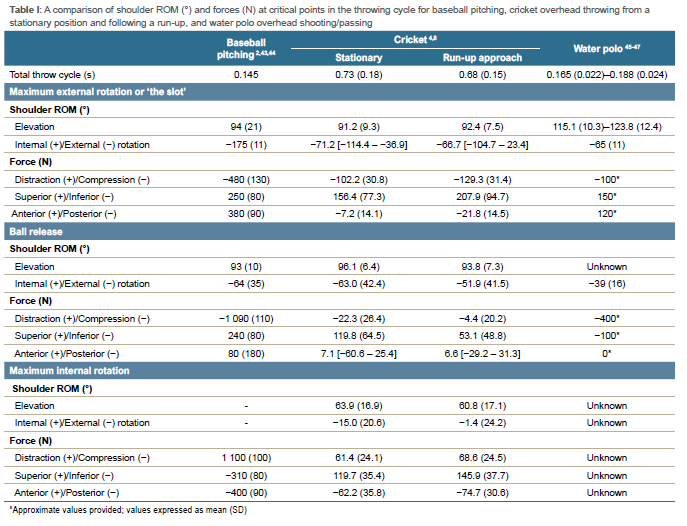
In baseball, the luxury of time affords pitchers the opportunity to move through six distinct phases of throwing from a stationary position including the wind-up, stride, cocking, acceleration, deceleration and follow-through, during which the shoulder moves rapidly from a position of elevation and hyper-ER ('the slot') into maximum IR.2,43,44 Consequently, the significant forces acting about the shoulder change from anterosuperiorly with compression at 'the slot' to posteroinferiorly with substantial distraction at maximum IR.2,43,44
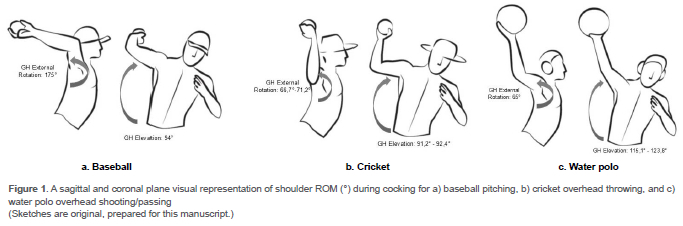
In contrast to the static baseball pitch, cricket fielding requires the player to approach the ball from various angles and return it to the stumps as quickly as possible to limit the number of runs scored by the opposition or effect a run-out.32324,8 found that cricketers threw with comparatively less shoulder ER and thoracolumbar flexion than baseball pitchers, and tended towards a sidearm (90-100° shoulder elevation48Table I). Further, the cricketing shoulder is subject to a posterosuperior directed force throughout the throwing motion, as opposed to the anterosuperior to posteroinferior forces observed during baseball pitching,2,43,44 highlighting the potential development of an 'essential lesion'.483,4,8 combined with documented RC weakness,32
The overhead pass and/or shot in water polo is also time-constrained and is performed off an unstable base. To compensate for the lack of hip and trunk power obtained easily during land-based throwing, water polo players utilise an egg-beater kick.6,45-47 This motion elevates the torso out of the water, allowing the shoulder to extend, abduct and externally rotate, so that the ball is positioned high above and behind the head during the preparation or backswing phase of throwing. Cocking is characterised by horizontal abduction of the shoulder which then accelerates into IR and adduction during the forward swing. The latter phase is initiated by flexion of the hyperextended trunk to facilitate ball release speed. The throwing shoulder continues to decelerate and follow through in the direction of ball release.6,45-47 While sparse, it is evident in the extant literature on the kinematic and kinetic analysis of overhead throwing in water polo that players utilise far greater shoulder elevation than both the land-based baseball pitchers and cricket fielders at cocking (Figure 1, Table I), which may enable greater height out of the water to allow for arm clearance and additional leverage to generate throwing velocity. Water polo players present with an anterior shoulder force akin to baseball pitchers. This suggests that both baseball pitchers and water polo players may orientate themselves in greater thoracic rotation towards the throwing arm with increased horizontal abduction of the shoulder; as opposed to cricketers who are potentially more forward facing at this phase of the overhead throw. Finally, water polo players appear to release the ball with the greatest degree of shoulder IR (Figure 1) which may contribute to the substantial inferiorly directed force observed during arm deceleration with concurrent shoulder compression at ball release, potentially increasing the risk of injury to the shoulder labrum.
Injury profile of throwers
While there is clearly a difference between musculoskeletal profile and biomechanics in different throwing sports, it remains unclear whether these changes are represented in the types of pathology observed in the shoulders of these athletes. An additional confounder in the injury profile of water polo players is the contact nature of this throwing sport, which may result in acute labral and RC tears along with the more frequently reported overuse-type injuries.49
Despite considerable research and resultant interventions, shoulder injuries still account for 21-35% of all injuries sustained in professional baseball players.50,51 Superior labral anteroposterior (SLAP) tears, caused by the peel-back mechanism of the biceps as described by Burkhart et al.,375250,51
The most common shoulder injuries reported in literature for cricketers are of the RC musculature and tendons.53,54 In cricket players, an increased supraspinatus tendon thickness on ultrasound scan greater than 5.85 mm, in the dominant limb, has been identified as a predictor of an in-season injury.32,55 This thickened RC tendon may be the result of a chronic overload of this tendon and may represent both a mechanism and source of pain among cricketers.
Shoulder injuries have been found to account for between 15 and 36% of all injuries in elite junior Australian and English cricketers, respectively; and 23-36% of all injuries in elite senior English cricketers.56-58 In female cricketers, the shoulder is the most frequently injured anatomical site (3.7-31.4%).59-61 In South Africa, shoulder injuries in elite South African cricketers have been reported in 18% of players over a single season at a rate of 0.19 injuries per player per year, and an annual injury prevalence of 1.1%.3232
Roche presented a spectrum of shoulder injuries in an instructional course lecture (2019) seen over a three-year period of documented shoulder pathology seen in professional and semi-professional cricketers.6262
Shoulder injuries in water polo players are reported in 24-51% of athletes.6364,65 The forceful and repetitive nature of swimming and overhead throwing in water polo can cause microtrauma in the RC muscles which may lead to RC impingement, tendinopathy or RC muscle tears.64,66 SLAP lesions are found in water polo players as the superior labrum is placed under high distractive forces during the cocking and acceleration phase of throwing when the shoulder is abducted and externally rotated, and may lead to impingement of the labrum between the head of the humerus and the glenoid rim.64
An MRI study of water polo players demonstrated changes suggestive of internal impingement presenting as posterosuperior glenoid erosions, osteochondral defects, posterosuperior labral damage, and partial articular-sided RC tears.676863
An increasing incidence of adolescent, school level, water polo athletes was observed in clinical practice. These patients presented with a diverse spectrum of shoulder pathology with a different pattern and distribution of injury when compared to reports from baseball literature.49
The athletes that we commonly see participating in throwing sports in South Africa are water polo and cricket players; and less commonly those doing javelin, discus, shot put, netball and baseball. These sports all involve throwing projectiles of different weights and dimensions in different environments. A broad spectrum of pathology should be kept in mind when assessing the injured throwing athlete. Cricketers and water polo players share some typical pathologies with baseball pitchers but there are significant differences that clinicians must be aware of.
Conclusion and clinical implications
To facilitate clinicians involved in the treatment of throwing shoulder injuries, this article has explored the musculoskeletal profile, throwing biomechanics and injury profile of cricket and water polo athletes within a South African context using baseball literature as a reference. The nature of a narrative review may provide guidelines and suggestions but does not provide evidence at the level of a systematic review. Future research should be aimed at increasing the body of knowledge of these throwing sports to allow for a more robust review.
The following key points were identified:
• There is significant variation of musculoskeletal structural adaptations between throwing athletes; and the classic thrower's paradox is insufficient as a gold standard to apply to all throwers. Each overhead throwing athlete presents with a unique 'thrower's paradox'. Assumptions cannot be made with regard to musculoskeletal features of throwers, the examination, diagnosis or management of these patients. Generic treatment programmes cannot be applied across all throwing sports.
• The maintenance of total GH rotational ROM is imperative irrespective of ERG or GIRD. Clinical assessment of these parameters provides insight into the potential pathomechanics of shoulder injury in throwers.
• Shoulder rotational strength, both internal and external, differs between sporting codes. Assessing rotational strength provides insight into the pathomechanics and rehabilitation focus required in managing thrower's shoulder.
• Differences in scapula control - cricketers displayed a decreased scapular rotation and water polo players increased scapular rotation - may increase the load on the RC. Therefore, appropriate assessment of the scapula biomechanics, particularly USR between 90-120°, provides valuable insight.
• There is a lack of good quality studies reporting on the specific pathologies within the broader throwing population. Clinical observation reports a broad spectrum of pathology which extends far beyond the classic RC and labral injuries classically reported. Clinical awareness of this spectrum of injury may guide diagnosis and management.
Ethics statement
The authors declare that this submission is in accordance with the principles laid down by the Responsible Research Publication Position Statements as developed at the 2nd World Conference on Research Integrity in Singapore, 2010. Ethics approval was not obtained (review article).
Declaration
The authors declare authorship of this article and that they have followed sound scientific research practice. This research is original and does not transgress plagiarism policies.
Author contributions
JG: study conceptualisation, first draft preparation, manuscript revision MD: study conceptualisation, first draft preparation, manuscript revision SJLR: study conceptualisation, first draft contribution, manuscript revision LR: study conceptualisation, first draft contribution, manuscript revision JPdP: study conceptualisation, first draft contribution, manuscript revision CA: study conceptualisation, first draft contribution, manuscript revision
ORCID
Gray J https://orcid.org/0009-0008-4337-7410
Dutton M https://orcid.org/0000-0002-8433-2947
Roche SJL https://orcid.org/0000-0002-5695-2751
Rajah L https://orcid.org/0009-0007-1153-8673
du Plessis JP https://orcid.org/0000-0001-6469-7765
References
-
1. Chu SK, Jayabalan P, Kibler WB, Press J. The kinetic chain revisited: new concepts on throwing mechanics and injury. PM & R: the journal of injury, function, and rehabilitation. Mar 2016;8(3 Suppl):S69-77. https://doi.org/10.1016/j.pmrj.2015.11.015
» https://doi.org/10.1016/j.pmrj.2015.11.015 -
2. Weber AE, Kontaxis A, O'Brien SJ, Bedi A. The biomechanics of throwing: simplified and cogent. Sports Med Arthrosc Rev. Jun 2014;22(2):72-79. https://doi.org/10.1097/jsa.0000000000000019
» https://doi.org/10.1097/jsa.0000000000000019 -
3. Dutton M, Gray J, Divekar N, et al. Overhead throwing biomechanics in cricketers: the effect of a run-up approach. Eur J Sport Sci. Nov 2022;22(11):1686-94. https://doi.org/10.1080/17461391.2021.1979103
» https://doi.org/10.1080/17461391.2021.1979103 -
4. Dutton M, Gray J, Prins D, et al. Overhead throwing in cricketers: A biomechanical description and playing level considerations. J Sports Sci. 2020;38(10):1096-104. https://doi.org/10.1080/02640414.2020.1741973
» https://doi.org/10.1080/02640414.2020.1741973 -
5. Yaghoubi M, Esfehani MM, Hosseini HA, et al. Comparative electromyography analysis of the upper extremity between inexperienced and elite water polo players during an overhead shot. J Appl Biomech. Apr 2015;31(2):79-87. https://doi.org/10.1123/jab.2014-0068
» https://doi.org/10.1123/jab.2014-0068 -
6. Yaghoubi M, Moghadam A, Khalilzadeh MA, Shultz SP. Electromyographic analysis of the upper extremity in water polo players during water polo shots. Int Biomech. 2014/01/01 2014;1(1):15-20. https://doi.org/10.1080/23335432.2014.976591
» https://doi.org/10.1080/23335432.2014.976591 -
7. Skejo SD, Moller M, Bencke J, Sorensen H. Shoulder kinematics and kinetics of team handball throwing: A scoping review. Hum Mov Sci. Apr 2019;64:203-12. https://doi.org/10.1016/j.humov.2019.02.006
» https://doi.org/10.1016/j.humov.2019.02.006 -
8. Dutton M, Tam N, Divekar N, et al. The association between gird and overhead throwing biomechanics in cricket. J Biomech. Sep 20 2021;126:110658. https://doi.org/10.1016/j.jbiomech.2021.110658
» https://doi.org/10.1016/j.jbiomech.2021.110658 -
9. Dutton M, Tam N, Brown JC, Gray J. The cricketer's shoulder: Not a classic throwing shoulder. Phys Ther Sport. May 2019;37:120-127. https://doi.org/10.1016/j.ptsp.2019.03.014
» https://doi.org/10.1016/j.ptsp.2019.03.014 - 10. Tully P. Risk factors associated with non-specific shoulder pain in male adolescent water polo players. 2022. Master's thesis, University of Cape Town, South Africa.
- 11. Jameson Y. Identifying risk factors contributing to the development of shoulder pain and injury in male, adolescent water polo players. 2020. Master's thesis, University of Cape Town, South Africa.
-
12. Medina G, Bartolozzi AR, 3rd, Spencer JA, Morgan C. The thrower's shoulder. JBJS Rev. Mar 18 2022;10(3). https://doi.org/10.2106/JBJS.RVW.21.00194
» https://doi.org/10.2106/JBJS.RVW.21.00194 -
13. Chalmers PN, Wimmer MA, Verma NN, et al. The relationship between pitching mechanics and injury: a review of current concepts. Sports Health. May/Jun 2017;9(3):216-21. https://doi.org/10.1177/1941738116686545
» https://doi.org/10.1177/1941738116686545 -
14. Mountjoy M, Miller J, Junge A. Analysis of water polo injuries during 8904 player matches at FINA World Championships and Olympic games to make the sport safer. Br J Sports Med. Jan 2019;53(1):25-31. https://doi.org/10.1136/bjsports-2018-099349
» https://doi.org/10.1136/bjsports-2018-099349 -
15. Li X, Zhou H, Williams P, et al. The epidemiology of single season musculoskeletal injuries in professional baseball. Orthop Rev. Feb 22 2013;5(1):e3. https://doi.org/10.4081/or.2013.e3
» https://doi.org/10.4081/or.2013.e3 -
16. Johnson JE, Fullmer JA, Nielsen CM, et al. Glenohumeral internal rotation deficit and injuries: a systematic review and meta-analysis. Orthop J Sports Med. May 2018;6(5):2325967118773322. https://doi.org/10.1177/2325967118773322
» https://doi.org/10.1177/2325967118773322 -
17. Yamamoto N Itoi E, Minagawa H, et al. Why is the humeral retroversion of throwing athletes greater in dominant shoulders than in nondominant shoulders? J Shoulder Elbow Surg. 2006;15(5). https://doi.org/10.10164.jse.2005.06.009
» https://doi.org/10.10164.jse.2005.06.009 -
18. Sabick MB, Kim YK, Torry MR, et al. Biomechanics of the shoulder in youth baseball pitchers: implications for the development of proximal humeral epiphysiolysis and humeral retrotorsion. Am J Sports Med. Nov 2005;33(11):1716-22. https://doi.org/10.1177/0363546505275347
» https://doi.org/10.1177/0363546505275347 - 19. Downar JM, Sauers EL. Clinical measures of shoulder mobility in the professional baseball player. J Athl Train. Mar 2005;40(1):23-29.
-
20. Morgan CD, Burkhart SS, Palmeri M, Gillespie M. Type II SLAP lesions: three subtypes and their relationships to superior instability and rotator cuff tears. Arthroscopy. Sep 1998;14(6):553-65. https://doi.org/10.1016/s0749-8063(98)70049-0
» https://doi.org/10.1016/s0749-8063(98)70049-0 -
21. Reinold MM, Macrina LC, Fleisig GS, et al. Effect of a 6-week weighted baseball throwing program on pitch velocity, pitching arm biomechanics, passive range of motion, and injury rates. Sports Health. Jul-Aug 2018;10(4):327-33. https://doi.org/10.1177/1941738118779909
» https://doi.org/10.1177/1941738118779909 -
22. Keller RA MN, Mehran N, Moutzouros V. Pitching speed and glenohumeral adaptation in high school pitchers. Orthopedics. 2015;38(8). https://doi.org/10.3928/01477447-20150804-52
» https://doi.org/10.3928/01477447-20150804-52 -
23. Werner SL, Suri M, Guido JA, Jr., et al. Relationships between ball velocity and throwing mechanics in collegiate baseball pitchers. J Shoulder Elbow Surg. Nov-Dec 2008;17(6):905-908. https://doi.org/10.1016/j.jse.2008.04.002
» https://doi.org/10.1016/j.jse.2008.04.002 -
24. Trunt A SD, Adams LW, Skelley NW, MacFadden LN. Clinical shoulder measurements related to joint loads in collegiate pitchers. JSES Rev Reports, Tech. 2023;3(1). https://doi.org/10.1016/j.xrrt.2022.09.004
» https://doi.org/10.1016/j.xrrt.2022.09.004 -
25. Hurd WJ, Kaufman KR. Glenohumeral rotational motion and strength and baseball pitching biomechanics. J Athl Train. 2012;47(3):247-56. https://doi.org/10.4085/1062-6050-473.10
» https://doi.org/10.4085/1062-6050-473.10 -
26. Stokes H, Eaton K, Zheng NN. Shoulder external rotational properties during physical examination are associated with injury that requires surgery and shoulder joint loading during baseball pitching. Am J Sports Med. Nov 2021;49(13):3647-55. https://doi.org/10.1177/03635465211039850
» https://doi.org/10.1177/03635465211039850 -
27. Wilk KE, Macrina LC, Fleisig GS, et al. Deficits in Glenohumeral Passive Range of Motion Increase Risk of Shoulder Injury in Professional Baseball Pitchers: A Prospective Study. Am J Sports Med. Oct 2015;43(10):2379-85. https://doi.org/10.1177/0363546515594380
» https://doi.org/10.1177/0363546515594380 -
28. Hams A, Evans K, Adams R, et al. Epidemiology of shoulder injury in sub-elite level water polo players. Phys Ther Sport. Jan 2019;35:127-32. https://doi.org/10.1016/j.ptsp.2018.12.001
» https://doi.org/10.1016/j.ptsp.2018.12.001 -
29. Witwer A, Sauers E. Clinical measures of shoulder mobility in college water-polo players. J Sport Rehabil. 01 Feb. 2006 2006;15(1):45-57. https://doi.org/10.1123/jsr.15.1.45
» https://doi.org/10.1123/jsr.15.1.45 -
30. Elliott J. Shoulder pain and flexibility in élite water polo players. Physiotherapy. 1993/10/10/ 1993;79(10):693-97. https://doi.org/10.1016/S0031-9406(10)60004-1
» https://doi.org/10.1016/S0031-9406(10)60004-1 -
31. Ellenbecker TS, Mattalino AJ. Concentric isokinetic shoulder internal and external rotation strength in professional baseball pitchers. J Orthop Sports Phys Ther. May 1997;25(5):323-28. https://doi.org/10.2519/jospt.1997.25.5.323
» https://doi.org/10.2519/jospt.1997.25.5.323 -
32. Dutton M, Tam N, Gray J. Incidence and impact of time loss and non-time-loss shoulder injury in elite South African cricketers: A one-season, prospective cohort study. J Sci Med Sport. 2019/11/01/ 2019;22(11):1200-205. https://doi.org/10.10164.jsams.2019.05.006
» https://doi.org/10.10164.jsams.2019.05.006 -
33. Amin NH, Ryan J, Fening SD, et al. The relationship between glenohumeral internal rotational deficits, total range of motion, and shoulder strength in professional baseball pitchers. J Am Acad Orthop Surg. Dec 2015;23(12):789-96. https://doi.org/10.5435/jaaos-d-15-00292
» https://doi.org/10.5435/jaaos-d-15-00292 -
34. Tsekouras YE, Kavouras SA, Campagna A, et al. The anthropometrical and physiological characteristics of elite water polo players. Eur J Appl Physiol. Sep 2005;95(1):35-41. https://doi.org/10.1007/s00421-005-1388-2
» https://doi.org/10.1007/s00421-005-1388-2 -
35. McMaster WC, Long SC, Caiozzo VJ. Isokinetic torque imbalances in the rotator cuff of the elite water polo player. Am J Sports Med. Jan-Feb 1991;19(1):72-75. https://doi.org/10.1177/036354659101900112
» https://doi.org/10.1177/036354659101900112 - 36. Bloomfield J, Blanksby BA, Ackland TR, Allison GT. The influence of strength training on overhead throwing velocity of elite water polo players. Australian J Sci Med Sport. 1990;22(3):63-67.
-
37. Burkhart SS, Morgan CD, Kibler WB. The disabled throwing shoulder: spectrum of pathology Part I: pathoanatomy and biomechanics. Arthroscopy. Apr 2003;19(4):404-20. https://doi.org/10.1053/jars.2003.50128
» https://doi.org/10.1053/jars.2003.50128 - 38. Ludewig PM, Cook TM. Alterations in shoulder kinematics and associated muscle activity in people with symptoms of shoulder impingement. Phys Ther. Mar 2000;80(3):276-91.
-
39. Struyf F, Nijs J, Meeus M, et al. Does scapular positioning predict shoulder pain in recreational overhead athletes? Int J Sports Med. Jan 2014;35(1):75-82. https://doi.org/10.1055/s-0033-1343409
» https://doi.org/10.1055/s-0033-1343409 -
40. Su KP, Johnson MP, Gracely EJ, Karduna AR. Scapular rotation in swimmers with and without impingement syndrome: practice effects. Med Sci Sports Exerc. Jul 2004;36(7):1117-23. https://doi.org/10.1249/01.mss.0000131955.55786.1a
» https://doi.org/10.1249/01.mss.0000131955.55786.1a -
41. Hosseinimehr SH, Anbarian M, Norasteh AA, et al. The comparison of scapular upward rotation and scapulohumeral rhythm between dominant and non-dominant shoulder in male overhead athletes and non-athletes. Man Ther. Dec 2015;20(6):758-62. https://doi.org/10.1016/j.math.2015.02.010
» https://doi.org/10.1016/j.math.2015.02.010 -
42. Thomas SJ, Swanik CB, Higginson JS, et al. A bilateral comparison of posterior capsule thickness and its correlation with glenohumeral range of motion and scapular upward rotation in collegiate baseball players. J Shoulder Elbow Surg. Jul 2011;20(5):708-16. https://doi.org/10.1016/j.jse.2010.08.031
» https://doi.org/10.1016/j.jse.2010.08.031 -
43. Fleisig GS, Andrews JR, Dillman CJ, Escamilla RF. Kinetics of baseball pitching with implications about injury mechanisms. Am J Sports Med. Mar-Apr 1995;23(2):233-39. https://doi.org/10.1177/036354659502300218
» https://doi.org/10.1177/036354659502300218 -
44. Fleisig GS, Barrentine SW, Zheng N, et al. Kinematic and kinetic comparison of baseball pitching among various levels of development. J Biomech. Dec 1999;32(12):1371-75. https://doi.org/10.1016/s0021-9290(99)00127-x
» https://doi.org/10.1016/s0021-9290(99)00127-x - 45. Melchiorri G, Viero V, Triossi T, et al. Water polo throwing velocity and kinematics: differences between competitive levels in male players. J Sports Med Phys Fit. Nov 2015;55(11):1265-71.
-
46. Feltner ME, Nelson ST. Three-dimensional kinematics of the throwing arm during the penalty throw in water polo. J Appl Biomech. 01 Aug. 1996 1996;12(3):359-82. https://doi.org/10.1123/jab.12.3.359
» https://doi.org/10.1123/jab.12.3.359 -
47. Feltner ME, Taylor G. Three-dimensional kinetics of the shoulder, elbow, and wrist during a penalty throw in water polo. J Appl Biomech. 01 Aug. 1997 1997;13(3):347-72. https://doi.org/10.1123/jab.13.3.347
» https://doi.org/10.1123/jab.13.3.347 - 48. Whiteley R. Baseball throwing mechanics as they relate to pathology and performance - a review. J Sports Sci Med. 2007;6(1):1-20.
- 49. Roche S, du Plessis JP. Overhead Injuries in the young athlete presented at: 13th Combined Congress Meeting of the Orthopaedic Associations (COMOC); 11-15 April 2016 Cape Town; South Africa.
-
50. Maier J, Oak SR, Soloff L, et al. Management of common upper extremity injuries in throwing athletes: a critical review of current outcomes. JSES reviews, reports, and techniques. Nov 2021;1(4):295-300. https://doi.org/10.1016/j.xrrt.2021.08.007
» https://doi.org/10.1016/j.xrrt.2021.08.007 -
51. Braun S, Kokmeyer D, Millett PJ. Shoulder injuries in the throwing athlete. J Bone Joint Surg Am. Apr 2009;91(4):966-78. https://doi.org/10.2106/jbjsh.01341
» https://doi.org/10.2106/jbjsh.01341 -
52. Andrews JR EJ, Jordan SE. Partial-rotator cuff tears in throwing athletes. Oper Tech Sports Med. 2021;29(1). https://doi.org/10.1016/j.otsm.2021.150799
» https://doi.org/10.1016/j.otsm.2021.150799 -
53. Stretch RA. Cricket injuries: a longitudinal study of the nature of injuries to South African cricketers. Br J Sports Med. Jun 2003;37(3):250-53; discussion 253. https://doi.org/10.1136/bjsm.37.3.250
» https://doi.org/10.1136/bjsm.37.3.250 -
54. Orchard J, James T, Alcott E, et al. Injuries in Australian cricket at first class level 1995/1996 to 2000/2001. Br J Sports Med. Aug 2002;36(4):270-74; discussion 275. https://doi.org/10.1136/bjsm.36.4.270
» https://doi.org/10.1136/bjsm.36.4.270 -
55. Ahmed S, Brown J, Gray J. Predictors of throwing performance in amateur male cricketers: A musculoskeletal approach. Eur J Sport Sci. Aug 2021;21(8):1119-28. https://doi.org/10.1080/17461391.2020.1819434
» https://doi.org/10.1080/17461391.2020.1819434 -
56. Green RA, Taylor NF, Watson L, Ardern C. Altered scapula position in elite young cricketers with shoulder problems. J Sci Med Sport. Jan 2013;16(1):22-27. https://doi.org/10.1016/j.jsams.2012.05.017
» https://doi.org/10.1016/j.jsams.2012.05.017 -
57. Ranson C, Gregory PL. Shoulder injury in professional cricketers. Phys Ther Sport. Feb 2008;9(1):34-39. https://doi.org/10.10164.ptsp.2007.08.001
» https://doi.org/10.10164.ptsp.2007.08.001 -
58. Giles K, Musa I. A survey of glenohumeral joint rotational range and non-specific shoulder pain in elite cricketers. Phys Ther Sport. Aug 2008;9(3):109-16. https://doi.org/10.1016/j.ptsp.2008.03.002
» https://doi.org/10.1016/j.ptsp.2008.03.002 -
59. Jacobs J, Olivier B, Dawood M, Perera NKP. Prevalence and incidence of injuries among female cricket players: a systematic review and meta-analysis. JBI evidence synthesis. Jul 1 2022;20(7):1741-90. https://doi.org/10.11124/jbies-21-00120
» https://doi.org/10.11124/jbies-21-00120 -
60. Jacobs J OB, Dawood M, Perera NKP. Prevalence and Incidence of Injuries among female cricket players: a systematic review and meta-analyses. JBI Evidence Synthesis. 2021. https://doi.org/10.11124/JBIES-21-00120
» https://doi.org/10.11124/JBIES-21-00120 - 61. Cowan C. The prevalence of injuries in women's cricket and its relationship to training practices and physical conditioning [dissertation]. Stellenbosch: Stellenbosch University; 2006.
- 62. Roche S. Instructional Course Lecture: Shoulder injuries in cricketers. 65th South African Orthopaedic Congress; 2-6 Sept 2019; Durban; South Africa.
-
63. Miller AH, Evans K, Adams R, et al. Shoulder injury in water polo: A systematic review of incidence and intrinsic risk factors. J Sci Med Sport. Apr 2018;21(4):368-77. https://doi.org/10.1016/j.jsams.2017.08.015
» https://doi.org/10.1016/j.jsams.2017.08.015 -
64. Seroyer ST, Nho SJ, Bach BR, Jr., et al. Shoulder pain in the overhead throwing athlete. Sports Health. Mar 2009;1(2):108-20. https://doi.org/10.1177/1941738108331199
» https://doi.org/10.1177/1941738108331199 - 65. Franić M, Ivković A, Rudić R. Injuries in water polo. Croat Med J. Jun 2007;48(3):281-88.
-
66. Webster MJ, Morris ME, Galna B. Shoulder pain in water polo: a systematic review of the literature. J Sci Med Sport. Jan 2009;12(1):3-11. https://doi.org/10.10164.jsams.2007.05.014
» https://doi.org/10.10164.jsams.2007.05.014 - 67. Giombini A, Rossi F, Pettrone FA, Dragoni S. Posterosuperior glenoid rim impingement as a cause of shoulder pain in top level water polo players. J Sports Med Phys Fit. Dec 1997;37(4):273-78.
-
68. Klein M TI, Warschkow R, et al. Specific shoulder pathoanatomy in semiprofessional water polo players. Orthop J Sport Med. 2014;2(5). https://doi.org/10.1177/2325967114531213
» https://doi.org/10.1177/2325967114531213
Accepted: August 2024
Published: August 2025
Editor: Dr Sean Pretorius, Stellenbosch University, Cape Town, South Africa
Funding: No funding was received for this study.
Conflict of interest: The authors declare they have no conflicts of interest that are directly or indirectly related to the research.