Ethical musing about the allocation of scarce resources, renal transplants and commercialisation
Introduction
As I write, this week's Sunday papers were again replete with the ongoing saga and commentary on the subject of kidney transplants performed in Durban, Johannesburg and Cape Town, where the donors were poor South Americans, unrelated to the wealthy Israeli recipients. Some eminent doctors have been charged with illegal activities; another is said to have fled the country to avoid prosecution and plea bargains have apparently been entered into, to provide the state with evidence. It is not only private specialists who are reflected negatively - the country's largest private hospital group, Netcare, has paid an admission of guilt fine and at least two academic institutions are receiving bad press.
In all of this, the medical profession is tarnished and the public are rightly offended and indignant. This issue has been dragging on for years and produced a commentary in the SAMJ back in 2005.1sub judice. Good ethics has been described as beginning where the law ends.2
The distribution of scarce resources
Rationing of scarce medical resources evokes profound responses from those who would access these resources and those who would distribute the resources. On the one hand, autonomous libertarians will argue that people with more financial resources have the right to purchase better health care than poor people, while group utilitarians will argue for a more equitable distribution of communal clinical resources. The difficulty arises in finding the common ground.
In the discussions that follow, I have mostly tried to use examples regarding kidney donation by living donors. The living donors constitute three distinct groups: directed donation to a loved one or friend; non-directed donation to the general pool (this is the usual situation in cadaver donation); and directed donation to a stranger (as in the kidneys for sale above).
Persad et al have suggested eight simple ethical principles that govern the allocation of resources.3
Lotteries:
If resource allocation is decided by lottery, it makes the assumption that all potential recipients have an equal right to the resources. This is ethically attractive but in clinical medicine few would argue that all are equal. Applied to renal transplant this would, at the flip of a coin, as soon give the kidney to a 90 year old with dementia as a 25-year-old athlete. Lottery can be included in resource allocation systems to decide between equal or nearly-equal potential recipients.
First come, first served:
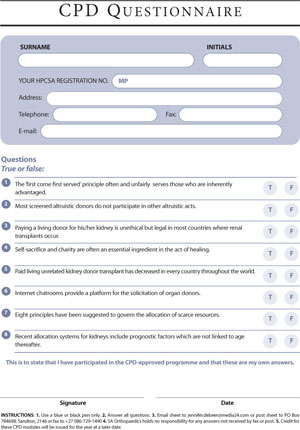
Historically, the main principle in existing systems of kidney allocation emphasise that the longer a person has waited for a kidney, the more priority he/she has to receive one. On the face of it, this sounds very fair but in truth, those who are inherently advantaged may often and unfairly get to the front of the queue. This may be apparent but often may covertly reflect their wealth, education or social status. Sickest first:
This principle seems intuitively obvious - we need to rescue the patient before it is too late. However, this implies that those in the queue who are 'less sick' will get their turn soon enough. The queue for repair of correctable congenital heart disease in Gauteng public hospitals is one such scenario that seems to have gone wrong. This long queue stays about the same length because of 'attrition' (a euphemism for death). Children are bumped to the front of the queue when they deteriorate clinically, thus decreasing elective surgery in favour of emergencies with the inevitable poor effect on prognosis.
Youngest first:
This principle favours those who have had 'less life' than others in the queue. It counters the otherwise almost inevitable bias towards well-off adults. Apart from the obvious technical issues in renal transplant, not everybody, however, would favour very young babies above, say, adolescents or young adults.4
Saving the most lives:
In the context of live kidney donation, this principle does not apply.
Life-years saved:
More recent allocation systems for kidneys include prognostic factors which are then linked to age so as to maximise the potential life-years gained for each donated organ. Apart from life years, it seems prudent that the system should consider the quality of that life.5
Instrument value:
This rather obscure term relates the prioritisation of recipients who will likely demonstrate more usefulness in the future. Generally the principle seeks not to suggest they are more valuable in themselves but to prioritise them to benefit others.
Reciprocity:
The allocation using this principle looks backwards and attempts to reward previous exemplary behaviour or actions. Examples may include actions such as previous organ donation or behaviour such as previous adherence to a healthy lifestyle.
Combining principles and complex rationing systems
There seems to be widespread support for the development of better processes in organ allocation and complex arguments have been made for the introduction of new systems.57,8 The very nature of ethical debate is that absolute answers are uncommon but this should not allow us to shy away from improving equity for our patients.
So far I have concentrated on some of the current ethical literature that deals with the debate around multiprinciple allocation systems in scarce resource situations. This is a far cry from the kidneys-for-sale scandal that provoked this article.
Altruism and commercialism in kidney donation by strangers
When a complete stranger, alive and well, offers to 'donate' a kidney to a patient in end-stage renal failure, there seems to be only two possible motivations - altruism or financial gain. In both cases, there are serious ethical issues which arise.
Altruistic kidney donation by strangers
"We are all here on earth to help others; what on earth the others are here for I don't know"~ WH Auden
Donation of a kidney produces massive potential benefit for the recipient and no reciprocal physical gain for the donor. On the contrary, the donor suffers substantial discomfort and disruption with a small but significant chance of serious complications or even death. These facts give rise to scepticism with regard to the motives and psychological stability of altruistic donors who choose to donate a kidney to a recipient with whom they have neither a genetic nor an emotional relationship. Apparently altruistic donors may conceal 'unhealthy' motives including compensation, atonement, self-promotion or even masochism. Careful assessment of potential donors and their psychosocial motives may therefore be important.
Most screened altruistic kidney donors participate in other less exacting altruistic acts, such as blood donations and voluntary work and give as their reason for donation "wanting to help someone".9
There remain some concerns regarding the use of altruistic live donors as a source of kidneys. A new phenomenon has been the proliferation of internet chat-rooms and websites used for organ donor solicitation. These may be abused to the detriment of donors.10
Commercialism in kidney transplants and in general
Financial compensation of living organ donors is not only considered unethical but is illegal in most countries where renal transplant occurs. In 2008, involved professionals met in Turkey to propose controls to limit or prevent organ trafficking, transplant commercialism and transplant tourism.111213
Why is it necessary to make a fuss about the commercialisation of medical care? Haven't doctors always been compensated financially for their efforts? We all need to eat and educate our children. It is true, historically, that doctors have always earned a living practising in SA, but there have been major changes in the way they have earned and especially in the amounts they have earned. In the distant past, the solo practising general practitioner charged his patients directly, often informally cross-subsidising within his practice. He (or rarely she) lived in or near the community he served. In fact, he was usually an integral part of the community. He lived well, in a house on the hill (from where he practised) but he never became really wealthy. His children went to the local school.
Enter the next phase. Medical insurance arrived on the scene and the amount of money in the medical care market skyrocketed. Guaranteed payment by a third party intervened between the doctor and his patient. Imaginative billing became an art form. Huge advances occurred in diagnosis and treatment. Pharmaceutical companies blossomed, were listed and made millions for their shareholders. Private hospitals sprung up everywhere and soon were owned by wealthy business corporations. Doctors saw the changes and were willingly swept up in the whirlwind. They specialised as that was where the money was to be found.
They formed group practices and had subsidised rooms in private hospitals. The unscrupulous amongst them took kickbacks and integrated their practices into the system. The doctor no longer knew his patients and their families. He now lived in a mansion in the north (or south in Cape Town). His children went to the best private schools. His colleagues in academic or state employ became disgruntled with their lot and embraced RWOPS with enthusiasm. Academic health science faculties saw the gap and contract research blossomed. Greed prevailed.
It is not only in SA that these changes have occurred. Joseph Fins commenting on US practice1415
References
- 1. Bass D. Kidneys for cash and egg safaris - can we allow 'transplant tourism' to flourish in South Africa. South African Medical Journal 2005:95(1):42-45.
- 2. Annas GJ. 1993. Standard of Care: The Law of American Bioethics. New York: Oxford University Press.
- 3. Persad G, Wertheimer A, Emanuel E. Principles for allocation of scarce medical interventions. Lancet 2009:373(9661):423-31.
- 4. Janvier A, Bauer K, Lantos J. Are newborns morally different from older children? Theoretical Medicine & Bioethics 2007:28:413-425.
- 5. Kerstein S, Bognar G. Complete lives in the balance. The American Journal of Bioethics 2010:10(4):37-45
- 6. Reese P, Caplan A, Bloom R, et al. How should we use age to ration health care? Lessons learnt from the case of kidney transplantation. Journal of the American Geriatric Society 2010:58:1980-1986
- 7. Menzel P. Complete lives, short lives and the challenge of legitimacy. The American Journal of Bioethics 2010:10(4):50-52
- 8. Sayeed S. Assessing the modified youngest-first principle and the idea of non-persons at the bedside: A clinical perspective. The American Journal of Bioethics 2010:10(4):52-54
- 9. Massey E, Kranenburg L, Zuidema W, et al. Encouraging psychological outcomes after altruistic donation to a stranger. American Journal of Transplantation 2010:10:1445-1452
-
10. Neidich E, Neidich A, Cooper J, et al. The ethical complexities of online organ solicitation via donor patient websites: avoiding the 'beauty contest'. American Journal of Transplantation 2011 Sep 22. doi:10.1111/j. 1600-6143.2011.03765.X
» https://doi.org/doi:10.1111/j. 1600-6143.2011.03765.X - 11. Editorial. The declaration of Istanbul on organ trafficking and transplant tourism. Nephrology Dialysis Transplantation 2008:23:33753380
- 12. Delmonico F. The implications of Istanbul Declaration on organ trafficking and transplant tourism. Current Opinion in Organ Transplantation 2009:14:116-119
- 13. Rizvi A, Naqvi A, Zafar N, et al. Regulated compensated donation in Pakistan and Iran. Current Opinion in Organ Transplantation 2009:14:124-128
- 14. Fins J. Commercialism in the clinic: Finding balance in medical professionalism. Cambridge Quarterly of Healthcare Ethics 2007:16:425432
- 15. Kant I. Foundations of the Metaphysics of Morals. Beck LW, trans. New York. Macmillan:1985:53