
 The Belshazzar syndrome: A conceptual or theological metaphor rooted in the biblical story of King Belshazzar of Babylon.'
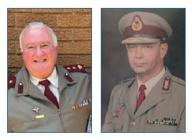
Author: GenMaj (Dr) Tony DippenaarI; Compiled by: Col (ProfDr) Theo le RouxII,
IVeteran
IIRetired from the South African Military Health Service [SAMHS]) Department of Orthopaedics University of Pretoria Pretoria South Africa
'The moving finger writes, and having writ moves on
Nor all thy Piety nor wit shall lure it back
To cancel half a line
- Omar Kayam
One could wonder what on earth this quotation has to do with the practice of Medicine, but it actually has great relevance, especially in the Intensive Care setting.
It frequently happens that patients with some dire condition in the natural course of events land in ICU. After all, that is the 'raison d'etre' for the ICU. Many of these cases do not have a single serious condition, but often have many comorbidities, either directly related to the primary crisis, or pre-existing, which obviously complicates matters considerably. It is an established fact that patients with three or more significant problems do not do well, despite admission to ICU, and have a considerable risk of either dying or having a permanent significant disability.
This highlights one of the first important lessons for the medical profession, i.e. 'you can't win them all', which is the crux of this article. What is required both ethically and in Law, of a practitioner?
Quite simply put, to do your best under the specific circumstances. And as we all know, our best is frequently not enough.
What criteria must one use to achieve the 'best' outcome? Again, simply put, have you done your best, and is that best in the best interests of the patient?
Let us look at two case studies that actually happened.
Case 1
An 89-year-old woman develops pain between her shoulder blades, rapid onset. On the way to hospital, she becomes severely short of breath, collapses, and requires CPR en route. Once stabilised, she is admitted to ICU via casualty. Chest X-ray shows uniform bilateral 'glazing' of both lung fields, especially basally.
Surgeons who were initially consulted because of the suspicion of a possibly leaking thoracic aneurysm decide that she has a viral pneumonia. The next morning upon request by next of kin, she is seen by a physician and found to have a posterior cardiac infarct. In due course her BP starts to fall, requiring IV adrenaline. Then her urinary output drops drastically, whereupon she is dialysed.
Eventually she dies after a week on dialysis.
Comment
Viral pneumonia does not have such a rapid onset.
The X-ray was in fact pulmonary oedema, and admittedly with that infallible instrument the retrospectoscope, and the physicians should have been involved sooner - but whether that would have made any real difference to the eventual outcome is debatable.
In the author's opinion, it was justified to do everything up to giving adrenaline, but then to dialise?
Case 2
An 84-year-old man has a fall, but does not sustain any obvious injury. He says that he fell on a prior occasion some two weeks before, again without injury. After the second fall, he said he fell because his right leg was 'stupid', meaning that it did not feel as if it was doing what he wanted it to. He was on hydroxycarbamide for chronic myeloid leukaemia, and previously had a platelet count of some 50 000. Detailed clinical exam on two occasions was essentially normal. He was referred for scan, which revealed a subdural bleed, which could only be operated the next day, as his platelets were again very low. On the third postop day he had a convulsion, was rescanned, which showed the haematoma had re-accumulated, and redrained. He was ventilated in ICU, and in due course developed a ventilation-induced lung injury, and a Clostridium difficile gut infection. In order to maintain his BP, adrenaline was given. Renal shutdown followed, for which he was dialysed. He died three days later.
CommentWith the wisdom of hindsight, the history of two falls, thrombocytopenia and a 'stupid leg', was enough to send a signal - he should have been scanned at once. Again, how much difference would this have made in the longer term? Perhaps, even probably, very little. The point is that in this respect his management was not optimal. The cause of his subdural was not direct cranial trauma, but a deceleration injury, with tearing of bridging veins, and coupled to his thrombocytopenia, continued leak and accumulation. Once his BP became unstable, one was confronted with what must be regarded as the 'ghastly triad' - advanced age, comorbidity, and progressive deterioration.
From these two cases it must be apparent that the medical profession is loath to recognise the futility of continued intervention, for understandable reasons:
• Their commitment to 'save life and limb'
• Reluctance to admit failure
• Inadequate clinical judgement
• Reluctance to be open and frank with the immediate family
• Waiting for the family to ask them to stop further support
• The threat of legal repercussions, especially now that there is an overdone tendency to sue
• When to stand back
This remains a mix of delicate clinical judgement, ethics and morality. In essence though, the moment to reconsider whether to continue or to stand back and allow nature to take its course, is when the ghastly triad becomes apparent. Then is the time to consult with a senior, and preferably independent colleague, and reach a decision by consensus. Before doing so, it is mandatory to discuss the situation openly with the family. Tell them that the situation is very grave, and that you are going to consult. During this consultation, besides discussing what options remain, two questions need to be answered:
• What are the chances of survival in the short term?
• In the event of survival, what will the likely quality of life be?
When the answer is that survival is highly unlikely, and probably more important, that the quality of life would be a burden on both the patient and the family, then the time has arrived to decide to render only that required to keep the patient comfortable mentally and physically. Having decided that, in the author's opinion, it is wrong to ask the family for permission to stand back, because then you are passing the buck, and expecting them to take an objective decision in an emotionally laden situation, about a matter of which they know little, and possibly saddling them with a burden of guilt - 'What if we had just carried on for a few more days?'
'As I told you, we have consulted and discussed the situation in depth, and collectively we are unanimously of the opinion that further efforts are not going to achieve anything, and have therefore decided to do nothing more than to keep him/her comfortable.'
Be prepared to answer questions, many of which will be difficult, e.g.:
• 'Are you sure?
• 'Can't we try for just a few days more?'
• 'We would like another opinion.'
It is ironic that often the family, despite their layman's position, often are the first to see the writing on the wall, and to pose the question of continued effort. Should this happen, and considering the prospects of survival and quality of life, they must be given honest answers. An appropriate response would be that you will consult on the matter, and inform them in due course, as outlined.
Once again, you have removed the onus of painful decision from them.
Read the writing on the wall - it is often plain to see, and does not need a soothsayer for interpretation.
* Corresponding author:
