Late-onset Blount's disease
Abstract
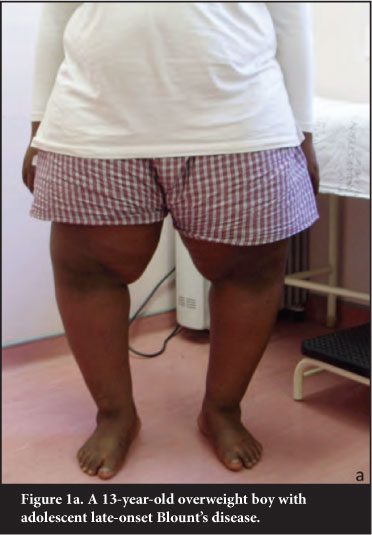
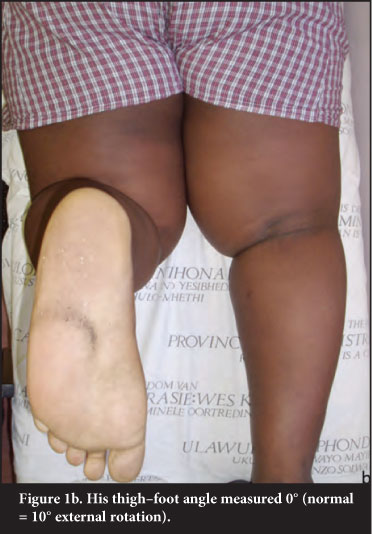
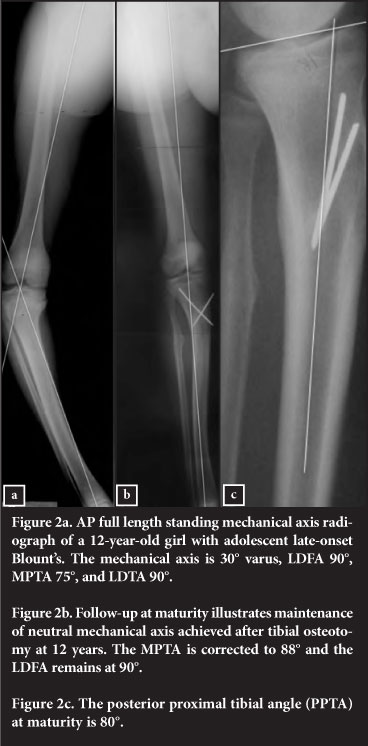
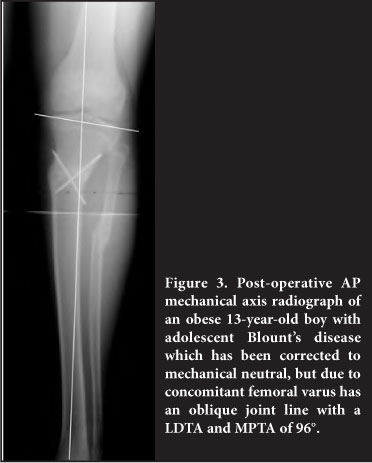
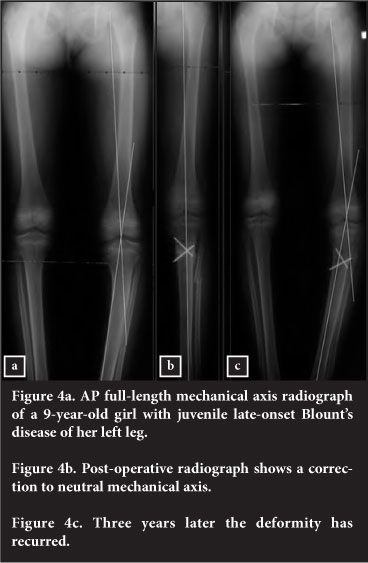
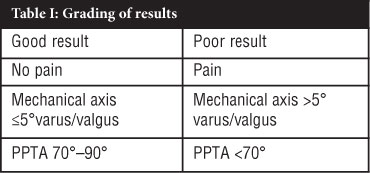
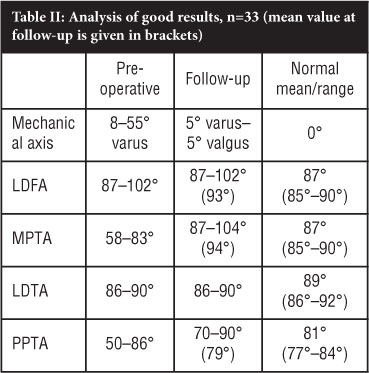
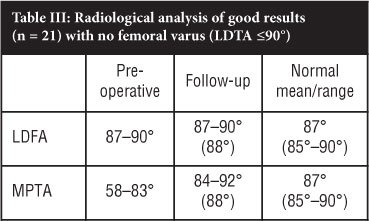
BACKGROUND: Late-onset Blount's disease is subdivided by age at onset into juvenile (4-10 years) and adolescent (≥ llyears). Recent literature recommends the use of external fixation with gradual correction of tibial varus and simultaneous correction of associated femoral varus. METHODS: We retrospectively reviewed 36 patients (43 knees) treated from 1990-2005. Of the 36 patients, 22 were female and 61.1% were obese. Seventeen knees were in juvenile and 26 in adolescent patients. Pre-operatively and at follow-up patients were assessed clinically and radiographically. Pre-operative mechanical axis ranged from 8-55° varus. Seventeen of the 43 knees (39.5%) had femoral varus (lateral distal femoral angle >90°, range 94°-102°). Surgery involved a tibial barrel-vault osteotomy, acutely correcting the overall mechanical axis, internal tibial torsion and procurvatum. Fixation was with Steinmann pins and plaster. RESULTS: At a mean follow-up of 4 years (38 knees to maturity), 33 knees (76.7%) had a good result. In three juvenile knees the varus recurred after initial correction to 0-4° valgus. Joint line obliquity ranged from 4°-12°. CONCLUSION: Tibial osteotomy alone with limited internal fixation can achieve good results in late-onset Blount's. In juvenile knees overcorrection to 5-10° mechanical valgus accommodates recurrence secondary to persistent growth inhibition.
Late-onset Blount's; limited internal fixation
 Thumbnail
 Thumbnail
 Thumbnail
 Thumbnail
 Thumbnail