Amputation rate following tibia fractures with associated popliteal artery injuries
Abstract
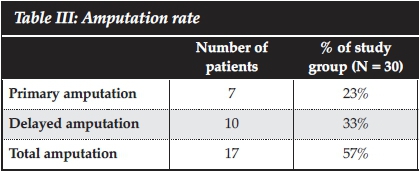
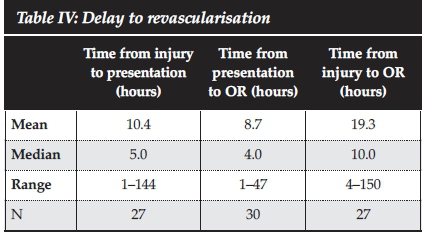
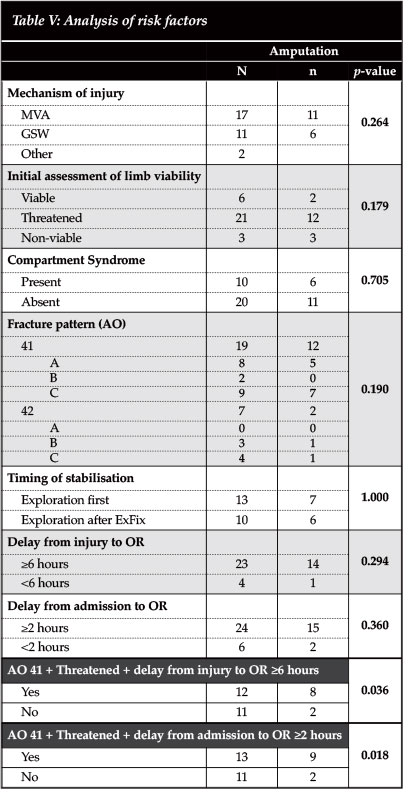
BACKGROUND: Patients with fractures or dislocation about the knee are at increased risk of vascular injury and subsequent limb loss. Our objectives were to: a) determine the amputation rate; and b) identify risk factors in patients with proximal tibial and diaphyseal fractures and associated popliteal artery injuries. METHODS: We conducted a retrospective case-control study of 30 patients with popliteal artery injuries with ipsilateral tibia fractures at a level 1 trauma centre. Primary and delayed amputation rates were determined. Risk factors tested for significance (Fischer's Exact) included: mechanism of injury, limb viability, compartment syndrome, fracture pattern, surgical sequence, and time delay from injury or presentation to revascularisation. RESULTS: Primary amputation was performed in seven and delayed in ten patients (overall rate 57%). The 'miserable triad' of a proximal tibia fracture (OTA 41) with signs of threatened viability, and delay to revascularisation > 6 hours from injury or >2 hours from presentation was predictive of amputation (p = 0.036 and p = 0.018 respectively), and almost quadrupled the amputation rate. CONCLUSIONS: We should aim to intervene within 6 hours following injury or 2 hours following presentation to reduce the risk of amputation. This provides a target for trauma teams even with uncertain time of injury.
vascular injury; tibia fracture; amputation
 Thumbnail