The management of postoperative pain after musculoskeletal surgery - a narrative review
Abstract
Cost-effective care amidst the rapidly rising cost of medical services necessitates the implementation of a standardised multimodal analgesia plan to aid patient care. This review aims to address the physiology and pharmacological management of postoperative pain following musculoskeletal surgery.
multimodal analgesia; musculoskeletal pain; postoperative management
Introduction
The healthcare environment functions on cost-effective care, and the rapidly rising cost of medical services is fast becoming a major consideration in patient management.1
The pathophysiology of musculoskeletal pain
No discussion of the treatment of pain is complete without a review of the physiology of nociception.
Ascending tracts
Whenever an injury occurs, peripheral nociceptors are activated.2 34
Descending tracts
The purpose of the descending pathways is in modulation of pain. Neurons from the higher centres as well as projections from the
spinothalamic tract connect to the peri-aqueduct grey matter (PAG - with noradrenaline as transmitter) and from there to the nucleus raphe magnus (NRM - with serotonin as transmitter). From here, it proceeds down via the ipsilateral inhibitory dorsolateral columns to synapse with the substantia gelatinosa to accomplish three objectives: i) block transmission of nociceptive stimuli via the primary neurons, ii) direct inhibition of dorsal horn cells and iii) activate inhibitory dorsal horn neurons.
Each step of neurotransmission can be accessed and modified by the use of pharmacological agents in the management of pain.
Muscle pain
Besides the normal pain pathways, muscle pain is commonly associated with both abnormal muscle tension and trigger points.5
Understanding myofascial pain relates to these two concepts of trigger points and muscle tension (the product of viscoelastic tone and contractile activity). Viscoelastic tone is the elastic stiffness (related to the distance the contractile elements move) and viscoelastic stiffness (effect of velocity on the contractile elements) in the absence of electromyographic activity. Contractile activity is the sum of three elements: contracture (muscle activity independent of electromyographic action), electrogenic spasm (pathological contractions arising from electrical activity in the alpha motor neurons and endplates) and electrogenic stiffness (muscle tension derived from normal electrogenic muscle contracture in individuals who are not relaxed).
Trigger points are taut bands of muscle fibres producing pain in specific designated zones in a muscle group and can be identified as active or latent trigger points.
Other physiological mechanisms contributing to muscle pain may include (but is not limited to) increased metabolism and/or decreased perfusion in the muscle fibres contributing to ischaemia, peripheral and central sensitisation, autonomic hyperactivity as well as psychological influences.
Since pain after muscle injury is transmitted via the same pathways as other somatic pain, the altered sensory and sympathetic excitability due to the secreted peptides sensitise nociceptive receptor thresholds in a process called peripheral sensitisation. This is experienced as spontaneous pain and tenderness after injury. Further repetitive stimulation of second and higher order neurons may contribute to the development of central sensitisation. It has been shown that muscle injury contributes the major portion of summation of the central sensitisation process. Central sensitisation is implicated in chronic muscle pain syndromes and development of referred pain.
Deep tissue pain does not have the plethora of scientific literature as seen with cutaneous pain models. Patients often describe it as a poorly localised, deep cramp-like pain. The convergent afferent inputs from skin, joints and viscera to the spinothalamic and other ascending tracts cause misinterpretation of information having their origin in A6 and C fibres, resulting in referred pain. Hyperalgesia is much more likely to occur in smaller muscles or groups. It should be considered that a specific pain syndrome may have multiple origins (TMD may be myofascial or arthrogenic in origin).3
Perioperative pain management
It is safe to say that multimodal analgesia (MMA) has become the norm at most institutions. The multimodal approach consists of the use of different analgesia medication to target different receptors along the pain pathway167
The advantage of MMA is that it standardises treatment across an institution based on current best practice while allowing flexibility for individual tailoring according to specific patient needs (e.g. allergies).
Regional analgesic techniques
There are many advantages to employing techniques before or during the procedure that can be continued into the postoperative period. Regional anaesthesia by means of nerve blocks is the first part of this approach. By interrupting the conduction of noxious stimuli, most of the debilitating effects of pain are averted before the damage begins.
Regional analgesia benefits many physiological processes, including respiration, bowel function, coagulation and the hormonal stress response.89101112
For musculoskeletal surgery, upper and lower limb surgery is eminently suited for regional analgesia and can decrease reliance on opioids tremendously. The addition of dexamethasone or dexmedetomidine has been shown to increase the duration of nerve blocks considerably.13,14 Prolonging regional analgesia by continuous peripheral block by means of indwelling catheter is another option. It is safe if staff is trained to manage it and if the resources to maintain staffing is available. Although the addition of some adjuvants to nerve blocks have been shown to cause nerve damage in animal models, this has not been seen in human studies.15
Local anaesthesia infiltration into wound edges has been shown to be of benefit in caesarean section and laparoscopic cholecystectomy.1617 18
Intravenous lignocaine plays a role in MMA protocols at many institutions practicing according to the enhanced recovery after surgery (ERAS) guidelines. Recovery of bowel function, decreased opioid use and increased analgesia are seen after spinal surgery where intravenous (IV) lignocaine was part of the MMA protocol.19,20 The mechanism of action is thought to be that lignocaine attenuates the effect of a number of pro-inflammatory mediators.
The most obvious postoperative advantage of the use of regional nerve blocks are that mobilisation of the operated limb may commence within hours of the procedure.21
Permanent incapacity due to neurological injury is the main fear in preventing the use of regional techniques in the perioperative period. Yet, permanent nerve damage after peripheral nerve block is extremely rare.222324
Systemic non-opioid analgesics
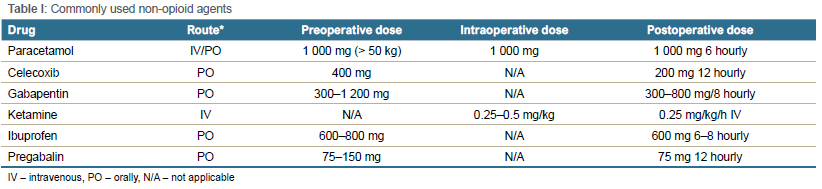
Systemic non-opioid analgesics remain the cornerstone of any MMA protocol. The opioid side effect profile is avoided and the effectiveness of these agents allow for faster mobilisation and rehabilitation. Table I summarises the commonly used non-opioid analgesic agents.
Paracetamol
Paracetamol is included in most MMA protocols because of its impressive safety profile (unless when administered in overdose), its cost and its opioid-sparing effect.2526
Paracetamol does not decrease tissue inflammation and is therefore not a classic NSAID.272, which is then converted by POX to the stable PGH2 - the precursor to other prostaglandins (PG), leukotrienes and thromboxane. Paracetamol acts as a reducing agent on the POX site, decreasing the oxidising of COX needed for PG production. The peroxide dependant COX inhibition explains why paracetamol has a differential activity in the brain (where peroxide is low) and in the periphery (where peroxide levels are high due to cellular destruction). A second mechanism may be its direct inhibition on the COX-3 (thought to be a COX-1 splice variant) isoenzyme, which is present in the central nervous system (CNS).28 4
Nonsteroidal anti-inflammatory drugs
NSAIDs are the most frequently used pharmacological agents in the treatment of postoperative musculoskeletal pain. Their ability to inhibit COX, thereby interrupting the peripheral production of PGs from arachidonic acid, makes them suitable as analgesic drugs. PGs sensitise peripheral nociceptors so that even a small stimulus will now produce adequate pain impulse propagation to the CNS.29 2-specific inhibitors were touted to be safer in that it circumvents the gastric mucosa erosion, potential renal impairment and platelet inhibition caused by inhibition of PG production via COX1, but the increased incidence of cardiac thrombotic events associated with long-term use has tempered its use (apart from patients with gastric ulcer disease).302 inhibitors are contra-indicated in patients with an allergy to sulphas.313233
The predominant site of action for NSAIDs are peripheral, so unsurprisingly, topical administration of this group of drugs are very effective.34-36 NSAIDs have specific anti-nociceptive effects on painful conditions that involve muscles.37
Gabapentinoids
Gabapentin and pregabalin is often included in MMA protocols. Developed as anticonvulsants, these agents exert their effect by interaction with the a2 δ subunit in the voltage-gated Ca++ channel and thus decreasing glutamate release in peripheral and central neurons.3839,40
N-methyl-D aspartate antagonists
Ketamine and magnesium have received much attention as adjuvants in MMA protocols. As antagonists at the N-methyl-D aspartate (NMDA) receptor, the analgesic effects of these agents are mediated via inhibition of glutamate enabled Ca++ influx into neurons in the brain and spinal cord. Ketamine has the potential for psychomimetic effects (hallucinations), although this side effect is not reported in pain literature.414243
Alpha-2 agonists
Dexmedetomidine and clonidine have been investigated as part of MMA protocols. These agents act as agonists on a2 receptors in peripheral and central neuronal connections. Dexmedetomidine is an ideal opioid replacement agents since it has no respiratory depression effects. A number of studies have shown benefit in the use of dexmedetomidine as part of patient-controlled analgesia, decreasing reliance on opioids for pain relief while providing analgesia on par with opioids.44
Systemic opioids
Opioids have been the mainstay of postoperative analgesia for various reasons; including, simplicity of use, predictability and clinical familiarity. The presence of opioid receptors in the periphery is well documented but the efficacy of opioids are still attributed to actions within the CNS. Recently, the opioid epidemic and heightened awareness of opioid side effects have shifted the focus away from opioids. Although the updated World Health Organization (WHO) ladder for pain management reserve opioids for moderate to severe pain, or where more simple analgesics have failed, it cannot be eliminated completely from an MMA plan for procedures like hip or knee arthroplasty.45
Oral opioid preparations include hydrocodone and oxycodone -both available in a variety of combination preparations. Tramadol is a binary analgesic in that it possesses both opioid and non-opioid-related mechanisms of action. It binds to mu receptor with an affinity of about 1/6 000 of morphine, but also acts as serotonin and noradrenaline reuptake inhibitors. The total analgesic effect is due to the summation of these effects.4647
Skeletal muscle relaxants
Muscle relaxants are classified into two groups: antispastics (dantrolene and baclofen) and antispasmodics (benzodiazepines, cyclobenzaprine, tizanidine, carisoprodol). The mechanism of action of antispasmodics (apart from benzodiazepines) is not fully understood - central NMDA blockade has been suggested for cyclobenzaprine, while tizanidine had a2 agonist properties. There is precious little evidence to suggest the efficacy of any of the antispasmodics in acute settings, but cyclobenzaprine has been incorporated in a few MMA protocols as a preoperative adjuvant.48
Studies has shown cyclobenzaprine to be an effective adjuvant in the management of acute lower back pain49,50 while being the least sedative of all the muscle relaxants. There is however a notable paucity in evidence for its efficacy in the acute postoperative setting (apart from incorporation into preoperative MMA protocols). Since it is structurally related to tricyclic antidepressants, its side effect profile and contra-indications are similar to these agents.
Facing the challenge
The implementation of clinical guidelines can go a long way to standardise practice. These guidelines should follow established evidence-based strategies to be able to champion this burden.
1. Care must be patient-centred. It needs to speak to the specific patient context, and allow shared decision making and effective communication.
2. Assessment of psycho-social factors are important.
3. A physical exam including complete neurological exam with assessment of mobility and muscle strength is important.
4. Patients should be educated and informed about their condition and available management options.
Conclusion
The need for postoperative analgesia following musculoskeletal surgery is a given. Although the ideal pharmacological management programme is not quite established, a multidisciplinary multimodal analgesia plan may go a long way in making the surgical experience far more satisfying for the patient.
ORCID
JM Dippenaar https://orcld.org/0000-0002-2338-2975
References
-
1. Schwenk ES, Mariano ER. Designing the ideal perioperative pain management plan starts with multimodal analgesia. Korean J Anesthesiol. 2018;71(5):345-52. https://doi.org/10.4097/kja.d.18.00217.
» https://doi.org/10.4097/kja.d.18.00217 -
2. Steeds CE. The anatomy and physiology of pain. Surgery. 2009;27(11):508-11. https://doi.org/10.1016/j.mpsur.2009.10.013.
» https://doi.org/10.1016/j.mpsur.2009.10.013 -
3. Perl ER. Pain mechanisms: a commentary on concepts and issues. Prog Neurobiol. 2011;94:20-38. https://doi.org/10.1016/j.pneurobio.2011.03.001.
» https://doi.org/10.1016/j.pneurobio.2011.03.001 -
4. Yoshino A, Okamoto Y, Onada K, et al. Sadness enhances the experience of pain via neural activation in the anterior cingulate cortex and amygdala: an fMRI study. Neuroimage. 2010;50:1194-201. https://doi.org/10.1016/j.neuroimage.2009.11.079.
» https://doi.org/10.1016/j.neuroimage.2009.11.079 -
5. Cohen SP, Mullings R, Abdi S, Warltier DC. The pharmacologic treatment of muscle pain. Anesthesiology. 2004;101(2):495-526. https://doi.org/10.1097/00000542-200408000-00032.
» https://doi.org/10.1097/00000542-200408000-00032 -
6. Welchek CM, Mastrangelo L, Sinatra RS, Martinez R. Qualitative and quantitative assessment of pain. In: Acute pain management. Sinatra RS, De Leon-Cassasola OA, Ginsberg B, Viscusi ER, editors. New York: Cambridge University Press; 2009. p. 147-71. https://doi.org/10.1017/CBO9780511576706.013.
» https://doi.org/10.1017/CBO9780511576706.013 -
7. Kehlet H, Dahl JB. The value of "multimodal" or "balanced analgesia" in postoperative pain treatment. Anesth Analg. 1993;77:1048-56. https://doi.org/10.1213/00000539-199311000-00030.
» https://doi.org/10.1213/00000539-199311000-00030 -
8. Popping DM, Elia N, Marret E, Remy C, Tramer MR. Protective effects of epidural analgesia on pulmonary complications after abdominal and thoracic surgery: a meta-analysis. Arch Surg. 2008;143:990-9. https://doi.org/10.1001/archsurg.143.10.990.
» https://doi.org/10.1001/archsurg.143.10.990 -
9. Bar-Yosef S, Melamed R, Page GG, et al. Attenuation of the tumor promoting effect of surgery by spinal blockade in rats. Anesthesiology. 2001;94:1066-73. https://doi.org/10.1097/00000542-200106000-00022.
» https://doi.org/10.1097/00000542-200106000-00022 -
10. Exadaktylos AK, Buggy DJ, Moriarty DC, et al. Can anesthetic technique for primary breast cancer surgery affect recurrence or metastasis? Anesthesiology. 2006;105:660-4. https://doi.org/10.1097/00000542-200610000-00008.
» https://doi.org/10.1097/00000542-200610000-00008 -
11. Biki B, Mascha E, Moriarty DC, et al. Anesthetic technique for radical prostatectomy surgery affects cancer recurrence: a retrospective analysis. Anesthesiology. 2008;109:180-7. https://doi.org/10.1097/ALN.0b013e31817f5b73.
» https://doi.org/10.1097/ALN.0b013e31817f5b73 -
12. Christopherson R, James KE, Tableman M, et al. Long-term survival after colon cancer surgery: a variation associated with choice of anesthesia. Anesth Analg. 2008;107:325-32. https://doi.org/10.1213/ane.0b013e3181770f55.
» https://doi.org/10.1213/ane.0b013e3181770f55 -
13. Kirkham KR, Jacot-Guillarmod A, Albrecht E. Optimal dose of perineural dexamethasone to prolong analgesia after brachial plexus blockade: a systematic review and meta-analysis. Anesth Analg. 2018;126:270-9. https://doi.org/10.1213/ANE.0000000000002488.
» https://doi.org/10.1213/ANE.0000000000002488 -
14. Rahangdale R, Kendall MC, McCarthy RJ, et al. The effects of perineural versus intravenous dexamethasone on sciatic nerve blockade outcomes: a randomized, double-blind, placebo-controlled study. Anesth Analg. 2014;118:1113-9. https://doi.org/10.1213/ANE.0000000000000137.
» https://doi.org/10.1213/ANE.0000000000000137 -
15. De Oliveira GS, Castro Alves LJ, Nader A, et al. Perineural dexamethasone to improve postoperative analgesia with peripheral nerve blocks: a meta-analysis of randomized controlled trials. Pain Res Treat. 2014;2014:179029. https://doi.org/10.1155/2014/179029.
» https://doi.org/10.1155/2014/179029 -
16. Adesope O, Ituk U, Habib AS. Local anaesthetic wound infiltration for post Caesarean section analgesia: a systematic review and meta-analysis. Eur J Anaesthesiol. 2016;33:731-42. https://doi.org/10.1097/EJA.0000000000000462.
» https://doi.org/10.1097/EJA.0000000000000462 -
17. Kampitak W, Tanavalee A, Ngarmukos S, et al. Does adductor canal block have a synergistic effect with local infiltration analgesia for enhancing ambulation and improving analgesia after total knee arthroplasty? Knee Surg Relat Res. 2018;30:133-41. https://doi.org/10.5792/ksrr.17.088.
» https://doi.org/10.5792/ksrr.17.088 -
18. Kim TW, Park SJ, Lim SH, et al. Which analgesic mixture is appropriate for peri-articular injection after total knee arthroplasty? Prospective, randomized, double-blind study. Knee Surg Sports Traumatol Arthrosc. 2015;23:838-45. https://doi.org/10.1007/s00167-014-3366-x.
» https://doi.org/10.1007/s00167-014-3366-x -
19. Weibel S, Jokinen J, Pace NL, et al. Efficacy and safety of intravenous lidocaine for postoperative analgesia and recovery after surgery: a systematic review with trial sequential analysis. Br J Anaesth. 2016;116:770-83. https://doi.org/10.1093/bja/aew101.
» https://doi.org/10.1093/bja/aew101 -
20. Farag E, Ghobrial M, Sessler DI, et al. Effect of perioperative intravenous lidocaine administration on pain, opioid consumption, and quality of life after complex spine surgery. Anesthesiology. 2013;119:932-40. https://doi.org/10.1097/ALN.0b013e318297d4a5.
» https://doi.org/10.1097/ALN.0b013e318297d4a5 -
21. Kehlet H, Wilmore DW. Multimodal strategies to improve surgical outcome. Am J Surg. 2002;183:630-41. https://doi.org/10.1016/S0002-9610(02)00866-8.
» https://doi.org/10.1016/S0002-9610(02)00866-8 -
22. Capdevila X, Pirat P, Bringuier S, et al. Continuous peripheral nerve blocks in hospital wards after orthopaedic surgery: a multicenter prospective analysis of the quality of postoperative analgesia and complications in 1,416 patients. Anesthesiology. 2005;103:1035-45. https://doi.org/10.1097/00000542-200511000-00018.
» https://doi.org/10.1097/00000542-200511000-00018 -
23. Brull R, McCartney CJ, Chan VW, El-Beheiry H. Neurological complications after regional anesthesia: contemporary estimates of risk. Anesth Analg. 2007;104:965-74. https://doi.org/10.1213/01.ane.0000258740.17193.ec.
» https://doi.org/10.1213/01.ane.0000258740.17193.ec -
24. Popping DM, Zahn PK, Van Aken HK, et al. Effectiveness and safety of postoperative pain management: a survey of 18 925 consecutive patients between 1998 and 2006 (2nd revision) - a database analysis of prospectively raised data. Br J Anaesth. 2008;101:832-40. https://doi.org/10.1093/bja/aen300.
» https://doi.org/10.1093/bja/aen300 -
25. Charma VS, Mehta V. Paracetamol: mechanisms and updates. Cont Educ Anaesth Crit Care Pain. 2014;14(4):153-8. https://doi.org/10.1093/bjaceaccp/mkt049.
» https://doi.org/10.1093/bjaceaccp/mkt049 -
26. Jibril F, Sharaby S, Mohamed A, Wilby KJ. Intravenous versus oral acetaminophen for pain: systematic review of current evidence to support clinical decision-making. Can J Hosp Pharm. 2015;68:238-47. https://doi.org/10.4212/cjhp.v68i3.1458.
» https://doi.org/10.4212/cjhp.v68i3.1458 -
27. Smith HS. Potential analgesic mechanism of acetaminophen. Pain Physician. 2009;12:269-80. https://doi.org/10.36076/ppj.2009/12/269.
» https://doi.org/10.36076/ppj.2009/12/269 -
28. Bertolini A, Ferrari A, Ottani A, et al. Paracetamol: new vistas of an old drug. CNS Drug Rev. 2006;12:250-75. https://doi.org/10.1111/j.1527-3458.2006.00250.x.
» https://doi.org/10.1111/j.1527-3458.2006.00250.x -
29. Simon LS. Biologic effects of nonsteroidal anti-inflammatory drugs. Curr Opin Rheumatol. 1997;9:178-82. https://doi.org/10.1097/00002281-199705000-00002.
» https://doi.org/10.1097/00002281-199705000-00002 -
30. Nusmeier NA, Whelton AA, Brown MT. Complications of the COX 2 parecoxib and valdecoxib after cardiac surgery. N Eng J Med. 2005;352:1081-9. https://doi.org/10.1056/NEJMoa050330.
» https://doi.org/10.1056/NEJMoa050330 -
31. Shi S, Klotz U. Clinical use and pharmacological properties of selective COX-2 inhibitors. Eur J Clin Pharmacol. 2008;64(3):233-52. https://doi.org/10.1007/s00228-007-0400-7.
» https://doi.org/10.1007/s00228-007-0400-7 -
32. Gobble RM, Hoang HL, Kachniarz B, Orgill DP. Ketorolac does not increase perioperative bleeding: a meta-analysis of randomized controlled trials. Plast Reconstr Surg. 2014;133:741-55. https://doi.org/10.1097/01.prs.0000438459.60474.b5.
» https://doi.org/10.1097/01.prs.0000438459.60474.b5 -
33. Al Farii H, Farahdel L, Frazer A, Salimi A, Bernstein M. The effect of NSAIDs on post fracture bone healing: a meta-analysis of randomized controlled trials. OTA Int. 2021;4(2):e092. https://doi.org/10.1097/OI9.0000000000000092.
» https://doi.org/10.1097/OI9.0000000000000092 -
34. Baixauli F, Ingles F, Alcantara P, et al. Percutaneous treatment of acute soft tissue lesions with naproxen gel and ketoprofen gel. J Int Med Res. 1990;18:372-8. https://doi.org/10.1177/030006059001800505.
» https://doi.org/10.1177/030006059001800505 -
35. Patel RK, Leswell PF. Comparison of ketoprofen, piroxicam, and diclofenac gels in the treatment of acute soft-tissue injury in general practice. General Practice Study Group. Clin Ther. 1996;18:497-507. https://doi.org/10.1016/S0149-2918(96)80031-2.
» https://doi.org/10.1016/S0149-2918(96)80031-2 - 36. Svennson P, Houe L, Arendt-Nielsen L. Effect of systemic versus topical nonsteroidal anti-inflammatory drugs on post-exercise jaw-muscle soreness: a placebo-controlled study. J Orofac Pain. 1997;11:353-62.
- 37. Affaitati G, Vecchiet F, Lerza R, et al. Effects of topical diclofenac (DHEP plaster) on skin, subcutis and muscle pain thresholds in subjects without spontaneous pain. Drugs Exp Clin Res. 2001;27:69-76.
-
38. Jensen TS, Backonja MM, Jimenez SH. New perspectives on the management of diabetic peripheral neuropathic pain. Diab Vasc Dis Res. 2006;3:108-19. https://doi.org/10.3132/dvdr.2006.013.
» https://doi.org/10.3132/dvdr.2006.013 -
39. Hurley RW, Cohen SP, Williams KA, Rowlingson AJ, Wu CL. The analgesic effects of perioperative gabapentin on postoperative pain: a meta-analysis. Reg Anesth Pain Med. 2006;31:237-47. https://doi.org/10.10164.rapm.2006.01.005.
» https://doi.org/10.10164.rapm.2006.01.005 -
40. Dong J, Li W, Wang Y. The effect of pregabalin on acute postoperative pain in patients undergoing total knee arthroplasty: a meta-analysis. Int J Surg. 2016;34:148-60. https://doi.org/10.1016/j.ijsu.2016.08.521.
» https://doi.org/10.1016/j.ijsu.2016.08.521 -
41. Bell RF, Dahl JB, Moore RA, Kalso E. Peri-operative ketamine for acute post-operative pain: a quantitative and qualitative systematic review (Cochrane review). Acta Anaesthesiol Scand. 2005;49:1405-28. https://doi.org/10.1111/j.1399-6576.2005.00814.x.
» https://doi.org/10.1111/j.1399-6576.2005.00814.x -
42. Schwenk ES, Viscusi ER, Buvanendran A, et al. Consensus guidelines on the use of intravenous ketamine infusions for acute pain management from the American Society of Regional Anesthesia and Pain Medicine, the American Academy of Pain Medicine, and the American Society of Anesthesiologists. Reg Anesth Pain Med. 2018;43:456-66. https://doi.org/10.1097/AAP.0000000000000806.
» https://doi.org/10.1097/AAP.0000000000000806 - 43. Murphy JD, Paskaradevan J, Eisler LL, et al. Analgesic efficacy of continuous intravenous magnesium infusion as an adjuvant to morphine for postoperative analgesia: a systematic review and meta-analysis. Middle East J Anaesthesiol. 2013;22:11-20.
-
44. Kweon D, Koo Y, Lee S, et al. Postoperative infusion of a low dose of dexmedetomidine reduces intravenous consumption of sufentanil in patient-controlled analgesia. Korean J Anesthesiol. 2018;71(3):226-31. https://doi.org/10.4097/kja.d18.27056.
» https://doi.org/10.4097/kja.d18.27056 -
45. Memtsoudis SG, Poeran J, Zubizarreta N, et al. Association of multimodal pain management strategies with perioperative outcomes and resource utilization: a population-based study. Anesthesiology. 2018;128:891-902. https://doi.org/10.1097/ALN.0000000000002132.
» https://doi.org/10.1097/ALN.0000000000002132 - 46. Raffa RB, Friderichs E, Reimann W, et al. Complementary and synergistic antinociceptive interaction between the enantiomers of tramadol. J Pharmacol Exp Ther. 1993;267:331-40.
-
47. Sun EC, Darnall BD, Baker LC, Mackey S. Incidence of and risk factors for chronic opioid use among opioid-naive patients in the postoperative period. JAMA Intern Med. 2016;176:1286-93. https://doi.org/10.1001/jamainternmed.2016.3298.
» https://doi.org/10.1001/jamainternmed.2016.3298 -
48. Bhatia A, Buvanendran A. Anesthesia and postoperative pain control-multimodal anesthesia protocol. J Spine Surg. 2019;5(Suppl 2):S160-5. https://doi.org/10.21037/jss.2019.09.33.
» https://doi.org/10.21037/jss.2019.09.33 -
49. Toth P, Urtis J. Commonly used muscle relaxant therapies for acute low back pain: a review of carisoprodol, cyclobenzaprine hydrochloride, and metaxalone. Clin Ther. 2004;26(9):1355-67. https://doi.org/10.1016/j.clinthera.2004.09.008.
» https://doi.org/10.1016/j.clinthera.2004.09.008 -
50. Browning R, Jackson J, O'Malley P. Cyclobenzaprine and Back pain: a meta-analysis. Arch Intern Med. 2001;161(13):1613-20. https://doi.org/10.1001/archinte.161.13.1613.
» https://doi.org/10.1001/archinte.161.13.1613 -
51. Lin I, Wiles L, Waller R, et al. What does best practice care for musculoskeletal pain look like? Eleven consistent recommendations from high-quality clinical practice guidelines: systematic review. Br J Sports Med. 2020;54:79-86. https://doi.org/10.1136/bjsports-2018-099878.
» https://doi.org/10.1136/bjsports-2018-099878
Funding: No funding was received for this study.
Conflict of interest: The author declares no conflict of interest.