Susceptibility and molecular characterisation of Cutibacterium acnes from patients with bone and joint infection samples in South Africa
Abstract
BACKGROUND: Cutibacterium acnes is a commensal on healthy human skin but can cause infections such as biofilm-associated prostheses/hardware infections. There is no published South African data on the susceptibility and phylogeny of C. acnes causing bone and joint infection. Empiric treatment, guided mainly by international data, shows high clindamycin resistance in C. acnes. Clindamycin would be a helpful oral treatment option due to its bioavailability and good bone penetration. The study aims to assess the susceptibility profiles of C. acnes isolates sent to the laboratory from prosthetic joint infection (PJI) patients in South Africa to guide antimicrobial therapy. The molecular characterisation seeks to assess the genetic similarity between the isolated strains and to determine which phylotypes predominate in bone and joint infections METHODS: A retrospective analysis of antibiotic susceptibility profiles was performed for all intraoperative, periprosthetic samples from patients with PJI, fracture-related infection and post-rotator cuff repair sent routinely to Lancet Laboratories in Cape Town from January 2022 to May 2024. Only sample sets where C. acnes was isolated on two or more samples were analysed. One organism for each set of samples was used for the phylogenetic analysis. Single Locus Sequence Typing (SLST) was used to perform phylotyping on the viable C. acnes isolates RESULTS: Thirty-one C. acnes isolates (one per set of samples) were identified. There was 100% (31/31) susceptibility to vancomycin, piperacillin-tazobactam, and penicillin; 81% (25/31) susceptibility to meropenem; and 87% (27/31) susceptibility to clindamycin. Of the 12 typed strains, all showed a high degree of genetic similarity CONCLUSION: These data show 100% susceptibility to the intravenous agents vancomycin, penicillin and piperacillin-tazobactam, and a high degree of susceptibility to clindamycin, which can be taken orally. This finding indicates that local susceptibility data is essential in guiding treatment strategies for South African populations. The local phylogeny indicates that strains share a common evolutionary history LEVEL OF EVIDENCE: 4
Cutibacterium acnes; prosthetic joint infection; phylogeny; antimicrobial resistance
Introduction
Prosthetic joint infection (PJI) is a growing concern due to the rising number of arthroplasty surgeries.123
PJI following primary arthroplasty rates vary: shoulder/hip ~ 0.5-1%, knee ~ 2%. Infections occur early (< 4 weeks), delayed (3-12 months), or late (> 1 year).1,4,5 The organisms causing PJI differ based on when the infection occurs post-arthroplasty. Staphylococcus aureus and coagulase-negative staphylococci predominate and are responsible for about 50-60% of all PJIs. S. aureus and Gram-negative bacilli are more common in early-onset infections due to the increased virulence of these organisms, which can result from wound infection post-surgery. This is followed by coagulase-negative staphylococci and polymicrobial infections likely to be introduced during surgery. Delayed onset infections are often due to less virulent organisms, such as coagulase-negative staphylococci, streptococci and enterococci, and are frequently introduced during surgery. Late-onset infection is usually due to haematogenous spread to the prosthesis, such as S. aureus, streptococci or Candida species. Less commonly, anaerobic organisms that are relatively avirulent, such as Cutibacterium acnes, can cause late-onset PJI.1C. acnes is also the most common anaerobe causing PJI.6
C. acnes, formerly known as Propionibacterium acnes, are anaerobic-aerotolerant Gram-positive bacilli that reside in the hair follicles and sebaceous glands of the normal human skin, particularly in the upper body, and are most typically the cause of acne vulgaris.7C. acnes is thus commonly associated with prosthetic shoulder infections due to the proximity to a high number of sebaceous follicles.76
It is considered an opportunistic pathogen and has gained increased recognition as a cause of prosthetic joint (particularly in upper limb/shoulder cases), endovascular device and cerebrospinal shunt infection, as it readily forms biofilm on these devices.8C. acnes as between 0 and 15% of patients (due to diagnostic challenges), as more recent studies show rates of 1.9-89%. C. acnes was also the most prevalent organism causing deep site infection following rotator cuff injury in 51% of patients.9
C. acnes PJI cases typically manifest as chronic pain or subtle inflammation, mimicking aseptic loosening. These patients often do not present with a fever or raised inflammatory markers and are less likely to have a sinus tract.1
For diagnosing a PJI, sampling should be performed with a patient off antibiotics for at least two weeks to avoid false negative culture results.10111,12
C. acnes organisms are slow growing. Hence, clinical laboratories must ensure that samples from periprosthetic sites are cultured for 14 days.10C. acnes isolates. Isolates are classified as susceptible or resistant according to breakpoints set by the Clinical Laboratory Standards Institute (CLSI) or the European Committee on Antimicrobial Susceptibility Testing (EUCAST). EUCAST breakpoints exist for vancomycin, benzylpenicillin, amoxycillin, ampicillin, ampicillin-sulbactam, amoxicillin-clavulanic acid, cefotaxime, ceftriaxone, ertapenem, linezolid, piperacillin-tazobactam, meropenem and clindamycin.13C. acnes susceptibility. For vancomycin, only an epidemiological cut-off value (ECV) is available.1414
Regarding C. acnes resistance, there is worldwide emergence of resistance to tetracyclines, lincosamides and macrolides due to the widespread use of oral and topical agents to treat acne vulgaris.15C. acnes vary geographically. In North America, resistance is around 10%, while in Europe it is about 8%.1617,18 Crane et al. found that 28 C. acnes intraoperative isolates from the shoulder showed varying clindamycin susceptibility and reported drug-sensitive isolates for amoxicillin, moxifloxacin, ertapenem and vancomycin in vitro.19
Antimicrobial susceptibility testing in cutibacteria is crucial for guiding oral antibiotic therapy in PJIs and other bone and joint infections. However, limited data exists due to factors like the submission of a single tissue specimen, which makes it difficult to distinguish between a skin contaminant and infection. South Africa lacks a local antibiogram, forcing reliance on international guidelines if testing is not available or when the organism is non-viable for susceptibility testing.1
Specific C. acnes phylogenetic types exhibit a propensity for biofilm formation and are frequently implicated in device-associated infection. Examining their molecular and epidemiological characteristics can clarify their role as pathogens versus skin commensals. El Sayed et al. suggest a new definition of infection or culture contamination, depending on whether the C. acnes belonged to a distinct or similar sequence types (ST). The classical criteria used to diagnose PJI does not encompass how complex the microbiological diagnosis is, with a specific histological presentation. Classical polymorphonuclear neutrophil infiltration can be absent in C. acnes infection. Substantial plasmacytic infiltration was reported with C. acnes in 71.4% of patients at the reference centre of bone and joint infections in Lyon, France.20
C. acnes was historically divided into six phylogenetic groups/phylotypes according to recA or tly PCR/sequencing method typing: IA1, IA2, IB, IC, II and III. A more recent method to perform molecular typing of C. acnes isolates is Single Locus Sequence Typing (SLST). SLST is a fast and inexpensive molecular typing method for C. acnes.212222et al. recommend that SLST be the standard reference typing method for C. acnes due to its ability to discriminate isolates better.21
The different phylotypes are associated with various clinical conditions and have clinical relevance. Type IA1 is predominantly found in skin, and phylotype IA2 is involved in moderate to severe acne. Types IB and II are often associated with blood, soft tissue, and medical device-related infections. Type III is frequently found on the skin of the lower trunk and has been associated with spinal disc infections.2222et al. analysed genotypes of C. acnes in PJI cases. Their results showed five H1 types, two A1, one C1, one D1 as well as one type K1, a new K type and one type F4. The SLST type H1 was the most abundant type (66.7%) in PJI relapse cases.22
This study aims to assess the antibiotic susceptibility profiles and perform molecular characterisation of C. acnes isolates submitted to the laboratory from confirmed PJI/FRI patients in South Africa to guide oral antimicrobial therapy. The molecular characterisation aims to assess the genetic similarity between the isolated strains and determine if the phylotypes predominating in PJI infections sent to the laboratory during this study represent those typically associated with prosthetic devices reported elsewhere.
Methods
The first part of the study is a laboratory-based descriptive analysis of the susceptibility of C. acnes in patients with PJI/FRI/RCR. Samples were submitted to Lancet Laboratories from private sector hospitals in the Western Cape province of South Africa based on the clinician's clinical suspicion of a PJI/FRI/RCR. This may include patients who had previous arthroplasty in other geographical regions of South Africa and were subsequently referred to a unit specialising in bone and joint infection in Cape Town, Western Cape. All sample sets that had C. acnes isolated on two or more periprosthetic tissues from patients with suspected PJI, FRI and post-RCR (as indicated on the laboratory request form) during the study period of January 2022 to May 2024 were included in the study. Clinicians are provided with sample guides that inform doctors on correct sampling techniques and samples collection, which includes guidance on taking synovial fluid in blood culture bottles, as well as at six tissue samples with separate forceps/scalpels to avoid contamination in separate broth bottles.
Samples included tissue, bone received in thioglycolate transport broth or standard laboratory sterile containers, where six tissue/bone samples were collected intraoperatively. No blood culture bottles (with synovial fluid) or implants/prosthetic samples for sonication were received. Following routine laboratory protocol, turbid broths indicative of microbial growth were subcultured, and according to Corvec et al., thioglycolate broth was routinely subcultured onto agar plates, despite presence of turbidity in the case of C. acnes.23
As per standard laboratory procedures, susceptibility testing was performed on one isolate per set of C. acnes isolates. For susceptibility testing, fastidious anaerobic agar supplemented with 5% defibrinated horse blood (FAA-HB) was used. The inoculum was standardised to a 1.0 McFarland turbidity, and plates were incubated anaerobically at 35-37℃ for up to 14 days. Antibiotic susceptibility testing was performed using the Kirby-Bauer disk diffusion method for benzylpenicillin disc 1 unit, meropenem disc 10 µg, piperacillin-tazobactam 30/6 µg disc, and clindamycin 2 µg disc. Additionally, a gradient diffusion method was employed to determine the vancomycin minimum inhibitory concentration (MIC) within a range of 0.016-256 µg/ml. Zone diameters were interpreted using EUCAST criteria for all antibiotics except vancomycin, for which the ECV from CLSI was applied. Basic data analysis was conducted to calculate the percentage of isolates susceptible to each antibiotic tested.
For the second part of the study, phylogenetic analysis was performed on C. acnes isolates stored by the laboratory. One isolate per set of samples was included in the analysis. DNA was extracted from viable isolates using the MagnaPure extraction platform (Roche Diagnostics, Rotkreuz, Switzerland). Phylogenetic typing was then conducted using the SLST method described by Kilian et al.24http://medbac.dk/slst/pacnes), which currently contains 143 STs. Phylogenetic trees were constructed using the Neighbor-Joining method, and evolutionary analyses were conducted in MEGA11 software.25
Samples and cultures were anonymised using laboratory request numbers to maintain patient confidentiality, and ethics approval was obtained.
Results
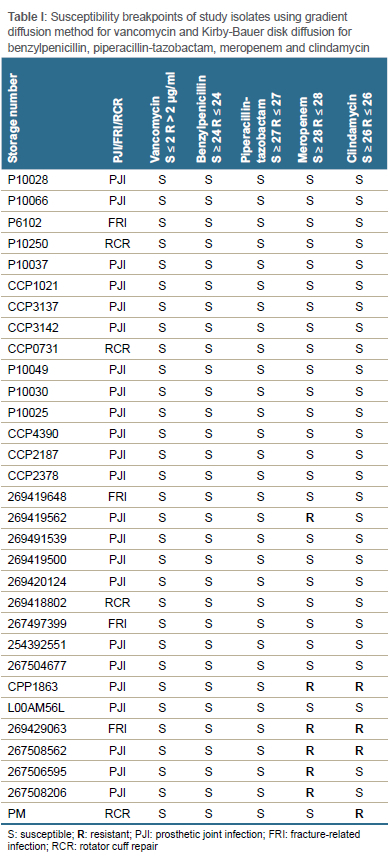
There were 31 sets of intraoperative/peri-prosthetic tissue samples that cultured at least two or more C. acnes isolates: 23 prosthetic joint samples, four FRI samples and four samples from RCR. Drug susceptibility testing was performed on a single isolate from each C. acnes set. The analysis of susceptibility as well as information on whether sample is from a PJI, FRI or RCR is listed in Table I. There was 100% (31/31) susceptibility to vancomycin, piperacillin-tazobactam and penicillin. Six isolates were resistant to meropenem, thus 81% (25/31) were susceptible to meropenem. There were four isolates resistant to clindamycin, thus 87% of the isolates were susceptible (27/31) to clindamycin.
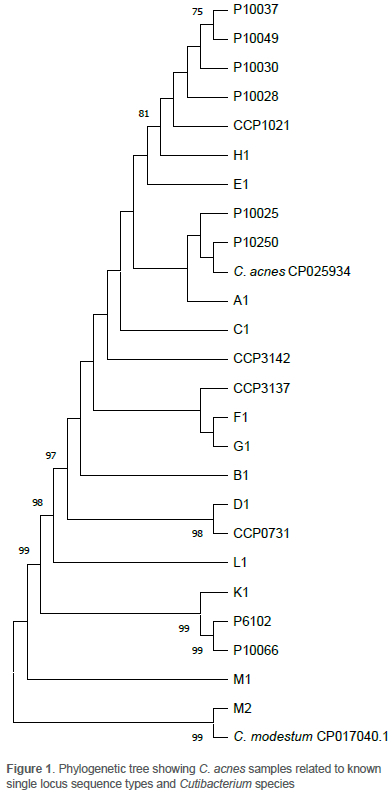
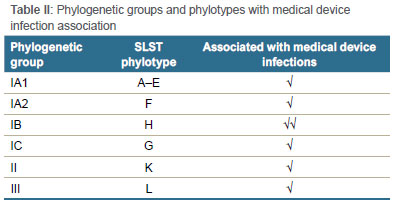
The phylogenetic tree shows that strains H1, E1, A1, C1, F1, G1, B1, D1, L1, K1, M1 and M2, obtained from the SLST database, are closely related, clustering together with minimal branch separation. Strains P10037, P10049, P10030, and P10028 form a separate cluster, clustering closest with strain H1. According to the SLST database, CCP3142 still has an unknown sequence type. The strains demonstrate a high degree of genetic similarity with only slight divergence (Figure I). All SLST phylotypes detected in the study have been associated with medical device infections described in the literature (Table II).
Discussion
The PRO-IMPLANT Foundation recommends treatment with intravenous penicillin G or ceftriaxone empirically for the first two weeks followed by oral amoxicillin or doxycycline with rifampicin.26C. acnes with clindamycin as an alternative.1Cutibacterium spp. are intrinsically resistant to metronidazole likely due to the absence of the PFOR system or an alternate pathway of pyruvate metabolism.16
Cutibacteria are usually highly susceptible to β-lactam antibiotics: penicillins, cephalosporins and carbapenems or glycopeptides, e.g. vancomycin, teicoplanin and other antibiotics administered intravenously such as daptomycin and linezolid.27
Parenteral antibiotics must be started postoperatively after prosthesis removal or exchange, ensuring high bone concentrations during the initial induction phase. The initial empiric intravenous antibiotic choice is guided by the patient's prior microbiological data, prior antibiotic exposure, local antimicrobial resistance profile, and host factors such as drug allergies and renal function. Afterwards, once the bacterial aetiology has been identified and antimicrobial susceptibility has been determined, the patient should transition to a suitable oral agent with high oral bioavailability, reach high bone concentrations, and to which the isolate is susceptible. The drug susceptibility results show 87% susceptibility to clindamycin.
Treatment guidelines for PJI caused by C. acnes are not standardised due to a lack of data. However, it is prudent to use agents that penetrate bone and joints well; initial intravenous penicillin or ceftriaxone followed by clindamycin would be a good oral option as it penetrates bone at approximately 40-70% of serum level.2829
Many clinicians support adding rifampicin to C. acnes PJI regimens for its biofilm activity, despite limited data. Kusejko et al. studied 187 patients and found a trend toward lower relapse, new infections, and overall treatment failure with rifampicin in the regimen, though the results were not statistically significant.30et al., found that rifampicin therapy did not improve outcomes.31C. acnes.
Although the OVIVA trial did not specifically include cutibacteria, switching from parenteral to oral antibiotics within seven days of surgery or antimicrobial initiation was as effective as prolonged parenteral therapy.29
The antibiotic treatment duration for a PJI following debridement and implant retention (DAIR), as well as a single stage revision, is typically 12 weeks long; hence, oral treatments are preferred.3032333
Routine resistance testing for daptomycin, rifampicin, ceftriaxone, fluoroquinolones, tetracyclines and linezolid was not performed, leaving no data on susceptibility, despite the potential role of moxifloxacin, tetracycline, rifampicin and linezolid as effective oral treatment options in osteoarticular infection. Note that no EUCAST and CLSI breakpoints exist for daptomycin, rifampicin and fluroquinolones other than moxifloxacin and tetracyclines. The increasing antibiotic resistance of C. acnes poses a strong argument for susceptibility testing before starting an antibiotic regimen to most effectively and efficiently treat these potentially serious infections.5
Infected prosthetic devices are treated with operative interventions such as prosthesis exchange or debridement with implant retention and intravenous and/or oral antibiotics.3430
To assess the genetic relationship of the strains causing bone and joint infections, phylogenetic testing was undertaken. The minor branch separations on the phylogenetic tree indicate high genetic similarity. For instance, strains such as H1 and E1 and A1 and C1 are closely grouped, reflecting their near-identical genetic makeup. Similarly, strains F1, G1, B1 and D1 show a strong relationship, suggesting they may belong to a similar subgroup or lineage within C. acnes. The differences in their positioning on the tree indicate some level of divergence. However, the proximity of these strains to each other within the tree suggests that they may represent variations of the same subspecies or different lineages with similar evolutionary origins.
The close phylogenetic relationship observed among strains isolated in this study is further supported by their antibiogram (Table I). Strains that cluster together on the phylogenetic tree, such as H1 and E1 or A1 and C1, exhibited comparable resistance profiles, indicating their genetic similarities reflected in their shared antimicrobial resistance patterns. This suggests these strains may have developed similar resistance mechanisms due to their genetic proximity. The close genetic relationship likely contributes to the uniformity in their resistance to specific antibiotics, providing valuable insights into how closely related strains may behave similarly regarding pathogenicity and treatment response.
The study is limited by the number of C. acnes isolated; however, PJI with a C. acnes is a relatively rare phenomenon.35
Conclusion
The findings have shown high susceptibility to penicillin, piperacillin-tazobactam and vancomycin. Vancomycin is often used as an empiric option with a Gram-negative agent. Clindamycin is a very good option when testing is unavailable; however, clinical diagnostic laboratories should ideally test for oral step-down options such as moxifloxacin, linezolid and clindamycin as breakpoints are available. All isolates showed a high degree of genetic similarity, and all phylotypes detected have been associated with bone and joint infections in the literature. Further research is required on the value of rifampicin in C. acnes treatment in bone and joint infection as well as the best antibiotic regimen and duration of treatment for C. acnes bone and joint infection.
Ethics statement
The authors declare that this submission is in accordance with the principles laid down by the Responsible Research Publication Position Statements as developed at the 2nd World Conference on Research Integrity in Singapore, 2010.
Prior to commencement of the study, ethical approval was obtained from the University of Cape Town Human Research Ethics Committee (HREC 937-2023). All procedures were in accordance with the ethical standards of the responsible committee on human experimentation (institutional and national) and with the Helsinki Declaration of 1975, as revised in 2008.
As this was a laboratory-based study, consent was not obtained. All samples were anonymised by using laboratory numbers only.
Declaration
The authors declare authorship of this article and that they have followed sound scientific research practice. This research is original and does not transgress plagiarism policies.
Author contributions
JW: study conceptualisation, data capture and analysis, preparation of first draft
ML: manuscript revisions
TH: manuscript revision
KR: manuscript revision
TP: data capture and analysis, design of testing set-up
ML: design of testing set-up, data analysis
MW: design of testing set-up, data analysis, manuscript revision
HvdP: manuscript revision
ORCIDWojno J https://orcid.org/0000-0003-3315-5298
Laubscher M https://orcid.org/0000-0002-5989-8383
Hilton T https://orcid.org/0000-0002-6178-5062
Rebe K https://orcid.org/0000-0001-5126-5357
Poole T https://orcid.org/0000-0009-0007-4532-7073
Laubscher M https://orcid.org/0000-0003-1657-428X
Wolfaardt M https://orcid.org/0000-0002-0700-2362
van der Plas H https://orcid.org/0000-0001-9492-2855
Acknowledgements
The authors would like to acknowledge the Lancet Century City Microbiology team for processing and storing the samples required for analysis.
References
- 1. Tande AJ, Patel R. Prosthetic joint infection. Clin Microbiol Rev. 2014;27(2):302-45.
-
2. Jan W, Fintan T, Toole O, et al. Personal view. The global burden of fracture-related infection: can we do better ? Lancet Infect Dis [Internet]. 2025;24(6):e386-93. http://dx.doi.org/10.1016/S1473-3099(23)00503-0
» http://dx.doi.org/10.1016/S1473-3099(23)00503-0 -
3. Atesok K, Macdonald P, Leiter J, et al. Postoperative deep shoulder infections following rotator cuff repair. World J Orthop. 2017 Aug 18;8(8):612-18. http://dx.doi.org/10.5312/wjo.v8.i8.612
» http://dx.doi.org/10.5312/wjo.v8.i8.612 - 4. Triffault-Fillit C, Ferry T, Laurent F, et al. Microbiologic epidemiology depending on time to occurrence of prosthetic joint infection: a prospective cohort study. Clin Microbiol Infect. 2019;25(3):353-58.
- 5. Nair R, Schweizer ML, Singh N. Septic arthritis and prosthetic joint infections in older adults. Infect Dis Clin North Am. 2017;31(4):715-29.
- 6. Meyssonnier V, Kerroumi Y, Heym B, et al. Cutibacterium acnes prosthetic joint infections : is rifampicin-combination therapy beneficial ? Antibiotics. 2022;11(1801).
-
7. Aubin GG, Portillo ME, Trampuz A, Corvec S. Propionibacterium acnes, an emerging pathogen : From acne to implant-infections, from phylotype to resistance. Med Mal Infect [Internet]. 2014;44(6):241-50. http://dx.doi.org/10.1016/j.medmal.2014.02.004
» http://dx.doi.org/10.1016/j.medmal.2014.02.004 -
8. Coenye T, Spittaels KJ, Achermann Y. The role of biofilm formation in the pathogenesis and antimicrobial susceptibility of Cutibacterium acnes. Biofilm [Internet]. 2022;4(September 2021):100063. https://doi.org/10.1016/j.bioflm.2021.100063
» https://doi.org/10.1016/j.bioflm.2021.100063 - 9. Ba MJE, Dupaix JP, Mbbs MIO, Atkinson RE. Cutibacterium acnes (formerly Proprionibacterium acnes) and shoulder surgery. 2019;78(11):7-9. Hawaii J Health Soc Welf. 2019 Nov;78(11 Suppl 2):3-5.
-
10. Boisrenoult P. Cutibacterium acnes prosthetic joint infection: Diagnosis and treatment. Orthop Traumatol Surg Res [Internet]. 2018;104(1):S19-24. http://dx.doi.org/10.1016/j.otsr.2017.05.030
» http://dx.doi.org/10.1016/j.otsr.2017.05.030 - 11. Osmon DR, Berbari EF, Berendt AR, et al. Diagnosis and management of prosthetic joint infection: Clinical practice guidelines by the infectious diseases Society of America. Clin Infect Dis. 2013;56(1):1-25.
- 12. Kim S, Cho YJ. Current guideline for diagnosis of periprosthetic joint infection: a review article. 2021;33(1):11-17.
-
13. European Committee on Antimicrobial Susceptibility Testing Breakpoint tables for interpretation of MICs and zone diameters European Committee on Antimicrobial Susceptibility Testing Breakpoint tables for interpretation of MICs and zone diameters [Internet]. Vol. 5. 2023. Available from: http://www.eucast.org/fileadmin/src/media/PDFs/EUCAST_files/Breakpoint_tables/v_5.0_Breakpoint_Table_01.pdf
» http://www.eucast.org/fileadmin/src/media/PDFs/EUCAST_files/Breakpoint_tables/v_5.0_Breakpoint_Table_01.pdf - 14. Lewis J, Weinstein M, Bobenchik A, et al. M100 Performance standards for antimicrobial susceptibility testing. Clinical and Laboratory Standards Institute. 2023;43.
- 15. Mclaughlin J, Watterson S, Layton AM, et al. Propionibacterium acnes and acne vulgaris : new insights from the integration of population genetic , multi-omic , biochemical and host-microbe studies. Microorganisms. 2019 May 13;7(5):128.
- 16. Reissier S, Penven M, Guérin F, Cattoir V. Recent trends in antimicrobial resistance among anaerobic clinical isolates. Microorganisms. 2023 Jun 1;11(6):1474.
- 17. Moon SH, Roh HS, Kim YH, et al. Antibiotic resistance of microbial strains isolated from Korean acne patients. J Dermatol. 2012;39(10):833-37.
- 18. Nakase K, Nakaminami H, Noguchi N, et al. First report of high levels of clindamycin resistant Propionibacterium acnes carrying erm(X) in Japanese patients with acne vulgaris. J Dermatol. 2012;39(9):794-96.
- 19. Crane JK, Hohman DW, Nodzo SR, Duquin TR. Antimicrobial susceptibility of Propionibacterium acnes isolates from shoulder surgery. Antimicrob Agents Chemother. 2013;57(7):3424-26.
- 20. El Sayed F, Roux A, Sapriel G, et al. Molecular typing of multiple isolates is essential to diagnose Cutibacterium acnes orthopedic device-related infection. Clin Infect Dis. 2019;68:1942-45.
- 21. Dagnelie MA, Khammari A, Dréno B, Corvec S. Cutibacterium acnes molecular typing: time to standardize the method. Clin Microbiol Infect. 2018;24(11):1149-55.
- 22. Salar-Vidal L, Achermann Y, Aguilera-Correa JJ, et al. Genomic analysis of Cutibacterium acnes strains isolated from prosthetic joint infections. Microorganisms. 2021;9(7):1-10.
- 23. Corvec S, Portillo ME, Pasticci BM, et al. Epidemiology and new developments in the diagnosis of prosthetic joint infection. Int J Artif Organs. 2012 Oct;35(10):923-34.
- 24. Kilian M, Scholz CFP, Jensen A, et al. A novel high-resolution single locus sequence typing scheme for mixed populations of Propionibacterium acnes in vivo. PLoS One .2014;9(8).
- 25. Tamura K, Stecher G, Kumar S. MEGA11: Molecular Evolutionary Genetics Analysis Version 11. Mol Biol Evol. 2021 Jun 25;38(7):3022-30.
- 26. Renz N, Trampuz A. Pro-Implant Foundation Pocket Guide to Diagnosis & Treatment of Periprosthetic Joint Infection (PJI). 2019.
- 27. Roberts SA, Shore KP, Paviour SD, et al. Antimicrobial susceptibility of anaerobic bacteria in New Zealand: 1999-2003. J Antimicrob Chemother. 2006;57(5):992-98.
- 28. Spellberg B, Lipsky BA. Systemic antibiotic therapy for chronic osteomyelitis in adults. Clin Infect Dis. 2012;54(3):393-407.
- 29. Lowman W. SASCM guideline for daptomycin use in South Africa - 2017 update. 2017;32(2):77-81.
- 30. Kusejko K, Auñón Á, Jost B, et al. The impact of surgical strategy and rifampin on treatment outcome in Cutibacterium periprosthetic joint infections. Clin Infect Dis. 2021;72(12):E1064-73.
- 31. Vilchez HH, Escudero-Sanchez R, Fernandez-Sampedro M, et al. Prosthetic shoulder joint infection by Cutibacterium acnes: does rifampin improve prognosis ? A retrospective, multicenter, observational study. Antibiotics (Basel). 2021 Apr 21;10(5):475.
- 32. Courduri A, Lotte R, Ruimy R, et al. Clindamycin efficacy for Cutibacterium acnes shoulder device-related infections. Antibiotics (Basel). 2022;1-10.
- 33. Benkabouche M, Racloz G, Lipsky BA, Gaspoz J. Four versus six weeks of antibiotic therapy for osteoarticular infections after implant removal: a randomized trial. J Antimicrob Chemother. 2019;(May):2394-99.
- 34. Tubb CC, Polkowksi GG, Krause B. Diagnosis and prevention of periprosthetic joint infections. J Am Acad Orthop Surg. 2020;28(8):E340-48.
- 35. Achermann Y, Goldstein EJC, Coenye T, Shirtliff ME. Propionibacterium acnes: from commensal to opportunistic biofilm-associated implant pathogen. 2014;27(3):419-40.
Accepted: August 2025
Published: May 2026
Editor: Prof. Theo le Roux, University of Pretoria, Pretoria, South Africa
Funding: No funding was received for this study. The typing of strains was funded by the authors.
Conflict of interest: The authors declare they have no conflicts of interest that are directly or indirectly related to the research.