The role of interventional angiography and embolisation in the management of high-energy pelvic ring injuries with uncontrolled haemorrhage
Abstract
BACKGROUND: The availability of and advances in interventional angiography and embolisation for the management of high-energy pelvic ring injuries with uncontrolled haemorrhage have expanded considerably during the last decade. Its routine use, however, still remains controversial. The delay in performing angiography is often cited as a major limitation for this intervention. PURPOSE OF THE STUDY: We aim to determine the mean time to interventional angiography and embolisation and report on the success rate thereof in patients with pelvic ring injuries and associated haemorrhage in a Level 1 Trauma Unit. METHODOLOGY: Between 1997 and 2012, we identified a total of seven patients who were managed with interventional angiography for the treatment of pelvic ring injuries associated with massive haemorrhage that did not respond to fluids and blood products resuscitation alone. Data was collected retrospectively, with respect to the injury pattern, resuscitative parameters, survival rates and efficacy of the angiography. RESULTS: All seven patients presented with high energy injuries and had rotationally as well as vertically unstable pelvic fractures. The average systolic blood pressure on admission was 80 mmHg (range 60-140). On average 8.75 (range 2-21) units of packed red blood cells were transfused per patient. Three patients required a laparotomy for associated intra-abdominal injuries. The time from admission to an emergency laparotomy was 4.5 h (range 2-12). The time from admission to angiography was 14 h (range 4-24). Three of the seven patients had a successful pelvic angio-embolisation. Six patients survived until discharge and one patient demised due to multi-organ failure on day 14 after embolisation. DISCUSSION: Only seven patients with pelvic ring injuries were managed with angiography and embolisation in a period of 15 years, suggesting that we seldom use this modality for haemorrhage control. The delay from admission to angiography was 14 hours (range 4-24). An arterial bleed was successfully identified and embolised in three patients (43%). CONCLUSION: While it is used with greater frequency in other centres, in our hospital setting angiography in the management of haemorrhage in pelvic ring injuries is rarely used. Our success rate with this intervention is fair.
pelvis fracture; unstable; resuscitation; angiography; embolisation
Introduction
Patients who are haemodynamically unstable as a result of the presence of a pelvis fracture have a mortality rate of 40-60%, with haemorrhage being the leading cause of death.12in extremis the mortality rate is even higher.3451et al. overcome this by performing angiography in the operating theatre with an anaesthetist present in case the patient deteriorates and requires a laparotomy.6 7
Extraperitoneal pelvic packing is more widely available and is technically easier, but it is associated with a higher risk of infection as well as associated access morbidity.7
With this study, we aim to report on our own experience with and to determine the mean time to interventional angiography and embolisation, and the success rate thereof in patients with pelvic ring injuries and associated haemorrhage in a Level 1 Trauma Unit.
Methods
We retrospectively reviewed our trauma unit database for clinical and radiological data of all patients who presented with a pelvis fracture between 1997 and 2012. Out of this group we identified seven patients who underwent angiography for a pelvis fracture-associated haemorrhage.
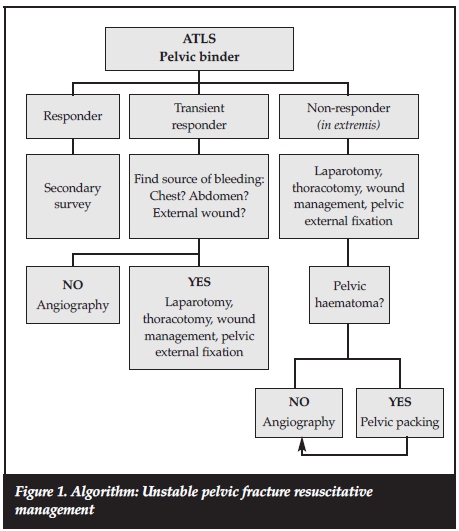
The indications for this procedure was extensive bleeding that could not be controlled after the pelvis was stabilised in a circumferential binder; extrapelvic haemorrhage was adequately managed; and the patients were receiving ongoing fluid resuscitation. All data was scrutinised for patient demographics, mechanism of injury, fracture pattern, various resuscitative parameters, survival rates, time to angio-embolisation, as well as efficacy of the embolisation procedure. Patients admitted to our facility were managed according to a standardised institutional algorithm (Figure 1).
Ethics clearance was obtained from our institution's ethics committee.
Results
During the study period seven patients with a mean age of 29 years (range 17-52) were identified as having undergone angiography after sustaining high-energy injuries with a consequent unstable pelvic injury. The average systolic blood pressure on admission was 80 mmHg (range 60-140). On average 8.75 (range 2-21) units of packed red cells were transfused per patient. Three of the patients required an explorative laparotomy for associated intra-abdominal injuries. The laparotomy was performed before angiography in all three cases. The median time from admission to emergency laparotomy was 4.5 hours (range 2-12). The median time from admission to angiography was 14 hours (range 4-24).
Angiography and embolisation were performed in a dedicated angiography suite by qualified interventional radiologists. Of the seven patients who underwent angiography, three had a successful embolisation of a bleeding pelvic arterial lesion. We defined embolisation success as the absence of contrast leak after coiling of the bleeding vessel. In the remaining patients, no active pelvic arterial bleeding was identified and embolisation was not performed. Of the seven patients who underwent angio-graphic embolisation, six survived until discharge and one demised on day 14 from multi-organ failure.
Discussion
Three pelvic causes of haemorrhage (arterial, venous and osseous) and three remote sources (abdomen, chest and long bone fractures) may contribute to haemorrhage in pelvic ring disruption.891
Various classification systems exist to describe pelvic fractures. In this study the AO/OTA and Young and Burgess classification system of pelvic fractures were both used, as they closely correlate with resuscitation needs, patterns of associated injuries and mortality.1011
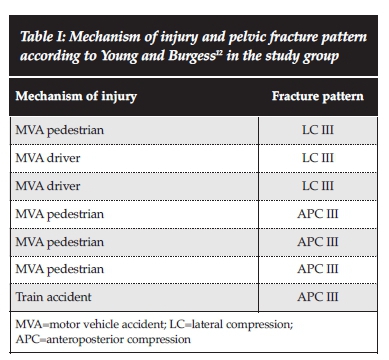
Lateral compression (LC) injury results from a lateral impact to the pelvis, rotating the affected hemipelvis away from the side of the impact towards the midline. The internal iliac vessels are shortened in Grade I and Grade II LC injuries but can be subjected to tensile forces in Grade III LC injuries when a 'windshield wiper mechanism' causes an opening of the iliosacral joint of the contralateral hemipelvis.121314et al. the overall mortality rate was 8 per cent.1215Table I).
Pelvic binders, external skeletal fixation, immediate open reduction and internal fixation and angiographic emboli-sation have all been used with variable success in controlling blood loss either alone or in combination.16 1 2
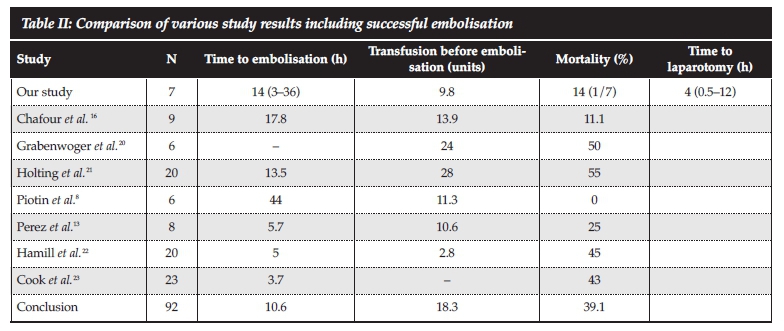
The question of whether angio-embolisation should be performed before or after a laparotomy is the subject of ongoing debate. According to Hak et al. angio-emboli-sation should only be considered in patients with continued blood loss despite pelvic fracture stabilisation and aggressive fluid management.2217,18,19 Successful embolisation rates for arterial injuries have been reported to be 85-100%.1Table II).
However, even with aggressive resuscitation, mechanical stabilisation and successful embolisation, mortality remains high and is reported to reach up to 55% (Table II).
This number varies markedly when comparing previous studies (between 0% and 55%) as it is greatly influenced by the selection criteria for angio-embolisation.19Figure 1), transient responders are selected for angio-embolisation once other sources of bleeding have been excluded. Furthermore, non-responders who presented in extremis are chosen to undergo angio-emboli-sation after the application of an external fixator and pelvic packing have been performed and ongoing bleeding from the pelvis is evident from the presence of a pelvis haematoma. With these indications for embolisation the mortality rate was 14% (one of seven patients).
Our algorithm differs to that of Metsemakers in that application of an external fixator does not form a primary part of our resuscitative intervention.4et al. identified 11 patients over a 5-year period who underwent angio-embolisation and their selection criteria are more liberal than ours.6
The retrospective nature of our series and the low patient numbers reflect limitations of our study.
Conclusion
In our hospital setting, angiography in the management of haemorrhage associated with pelvic ring injuries is seldom used as there is a prolonged time delay to the procedure being performed. The average time to angio-embolisation was 14 h and this delay discourages its use before laparotomy in patients who are in extremis. It does play a role in patients who have ongoing surgical bleeding despite skeletal stabilisation and adequate fluid resuscitation.
Conclusive recommendations are difficult to draw due to the paucity of high level evidence studies addressing these injuries. Each unit should have a treatment algorithm that takes into account available local resources.
Compliance with Ethics Guidelines
All authors confirm that no benefits of any form have been received from a commercial party related directly or indirectly to the subject of this article.
Ethics clearance was obtained from our institution's ethics committee.
References
- 1. Suzuki T, Smith WR, Moore EE. Pelvic packing or angiography: competitive or complementary? Injury. 2009 Apr 30;40(4):343-53.
- 2. Hak DJ, Smith WR, Suzuki T. Management of hemorrhage in life-threatening pelvic fracture. Journal of the American Academy of Orthopaedic Surgeons. 2009 Jul 1;17(7):447-57.
- 3. Osborn PM, Smith WR, Moore EE, Cothren CC, Morgan SJ, Williams AE, Stahel PF. Direct retroperitoneal pelvic packing versus pelvic angiography: a comparison of two management protocols for haemodynamically unstable pelvic fractures. Injury. 2009 Jan 31;40(1):54-60.
- 4. Metsemakers WJ, Vanderschot P, Jennes E, Nijs S, Heye S, Maleux G. Transcatheter embolotherapy after external surgical stabilization is a valuable treatment algorithm for patients with persistent haemorrhage from unstable pelvic fractures: outcomes of a single centre experience. Injury. 2013 Jul 31;44(7):964-68.
- 5. Huittinen VM, Slätis P. Postmortem angiography and dissection of the hypogastric artery in pelvic fractures. Surgery. 1973 Mar 1;73(3):454-62.
- 6. Anandakumar V, Hussein FK, Varuun B, Zhu R. Predictive parameters for angiography and embolization in the bleeding pelvic fracture. Journal of Clinical Orthopaedics and Trauma. 2013 Jun 30;4(2):70-74.
- 7. Papakostidis C, Kanakaris N, Dimitriou R, Giannoudis PV. The role of arterial embolization in controlling pelvic fracture haemorrhage: a systematic review of the literature. European Journal of Radiology. 2012 May 31;81(5):897-904.
- 8. Piotin M, Herbreteau D, Guichard JP, Houdart E, Reizine D, Aymard A, Payen D, Merland JJ. Percutaneous transcatheter embolization in multiply injured patients with pelvic ring disruption associated with severe haemorrhage and coagulopathy. Injury. 1995 Dec 31;26(10):677-80.
- 9. Dalal SA, Burgess AR, Siegel JH, Young JW, Brumback RJ, Poka A, Dunham CM, Gens D, Bathon H. Pelvic fracture in multiple trauma: classification by mechanism is key to pattern of organ injury, resuscitative requirements, and outcome. Journal of Trauma and Acute Care Surgery. 1989 Jul 1;29(7):981-1002.
- 10. Whitbeck Jr MG, H Jay Zwally II, Burgess AR. Innominosacral dissociation: mechanism of injury as a predictor of resuscitation requirements, morbidity, and mortality. Journal of Orthopaedic Trauma. 1997 Feb 1;11(2):82-88.
- 11. Pennal GF, Tile M, Waddell JP, Garside H. Pelvic disruption: assessment and classification. Clinical Orthopaedics and Related Research 1980 Sep 1;151:12-21.
- 12. Burgess AR, Eastridge BJ, Young JW, Ellison TS, Ellison Jr PS, Poka A, Bathon GH, Brumback RJ. Pelvic ring disruptions: effective classification system and treatment protocols. Journal of Trauma and Acute Care Surgery. 1990 Jul 1;30(7):848-56.
- 13. Perez JV, Hughes TM, Bowers K. Angiographic embolisation in pelvic fracture. Injury. 1998 Apr 30;29(3):187-91.
- 14. Agolini SF, Shah K, Jaffe J, Newcomb J, Rhodes M, Reed JF. Arterial embolization is a rapid and effective technique for controlling pelvic fracture hemorrhage. Journal of Trauma and Acute Care Surgery. 1997 Sep 1;43(3):395-99.
- 15. Balogh Z, Caldwell E, Heetveld M, D'Amours S, Schlaphoff G, Harris I, Sugrue M. Institutional practice guidelines on management of pelvic fracture-related hemodynamic instability: do they make a difference? Journal of Trauma and Acute Care Surgery. 2005 Apr 1;58(4):778-82.
- 16. Chaufour J, Melki JP, Riche MC, Fernand M, Cormier JM, Laurian C, Fichelle JM, Gigou F. [Hemorrhagic vascular complications of pelvic fractures. The role of embolization. 9 cases]. Presse medicale (Paris, France: 1983). 1986 Nov;15(42):2097-100.
- 17. Papakostidis C, Giannoudis PV. Pelvic ring injuries with haemodynamic instability: efficacy of pelvic packing, a systematic review. Injury. 2009 Nov 30;40:S53-61.
- 18. Anandakumar V, Hussein FK, Varuun B, Zhu R. Predictive parameters for angiography and embolization in the bleeding pelvic fracture. Journal of Clinical Orthopaedics and Trauma. 2013 Jun 30;4(2):70-74.
- 19. Travis T, Monsky WL, London J, Danielson M, Brock J, Wegelin J, Link DP. Evaluation of short-term and longterm complications after emergent internal iliac artery embolization in patients with pelvic trauma. Journal of Vascular and Interventional Radiology. 2008 Jun 30;19(6):840-47.
- 20. Grabenwoger F, Dock W, Ittner G. Percutaneous emobolization of retroperitoneal haemorrhages in pelvic fractures. Rofo 1989 Mar;150(3):335-38.
- 21. Hölting T, Buhr HJ, Richter GM, Roeren T, Friedl W, Herfarth C. Diagnosis and treatment of retroperitoneal hematoma in multiple trauma patients. Archives of Orthopaedic and Trauma Surgery 1992;111:323-26.
- 22. Hamill J, Holden A, Paice R, Civil I. Pelvic fracture pattern predicts pelvic arterial haemorrhage. Australian and New Zealand Journal of Surgery 2000 May;70(5):338-43.
- 23. Cook RE, Keating JF, Gillespie I. The role of angiography in the management of haemorrhage from major fractures of the pelvis. Journal of Bone and Joint Surgery (Br) 2002;84-B:178-82.
Dr Sithombo Maqungo
Department of Orthopaedic Surgery
H49 Old Main Building
Groote Schuur Hospital
Tel: +27832341723
Email: