Outcomes of single-stage surgical treatment of diaphyseal non-union of the humerus
Abstract
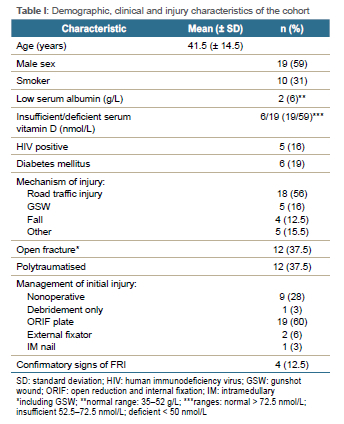
BACKGROUND: Non-union of diaphyseal humerus fractures occurs in up to 30% of non-surgically managed fractures and 10% of surgically treated fractures. Failed nonoperative treatment may present with muscle atrophy, pseudoarthrosis and shoulder and elbow stiffness; and surgically treated fractures may have compromised soft tissues, broken hardware and infection. There is no accepted gold standard of treatment for this complex problem. METHODS: A retrospective cross-sectional study was performed of data collected prospectively over an eight-year period, from February 2016 to January 2024. Our single-stage surgical technique is described. RESULTS: We included 32 single-stage non-union surgeries. The average age was 42 years, and 59% were male. Ten patients were smokers. Twelve were open fractures, including gunshot wounds. Seventy-two per cent of patients had already had some form of surgery to their arm, and four had confirmatory signs of infection prior to non-union surgery. Three patients required a debridement post non-union surgery due to new signs of infection. Two patients required late additional unplanned revision surgery due to ongoing non-union, but also ultimately united. CONCLUSION: Single-stage revision surgery may be an effective form of treatment of diaphyseal humerus fracture non-unions. In our series, this was successfully used in the setting of active infection. The authors suggest performing a biopsy in all cases of humerus non-unions. Level of evidence: 3
humerus; non-union; fracture-related infection; diaphyseal; plate osteosynthesis