Reducing the sodium content of high-salt foods: effect on cardiovascular disease in South Africa
BACKGROUND: Average salt intake in South African (SA) adults, 8.1 g/day, is higher than the 4 - 6 g/day recommended by the World Health Organization. Much salt consumption arises from non-discretionary intake (the highest proportion from bread, with contributions from margarine, soup mixes and gravies). This contributes to an increasing burden of hypertension and cardiovascular disease (CVD). OBJECTIVES: To provide SA-specific information on the number of fatal CVD events (stroke, ischaemic heart disease and hypertensive heart disease) and non-fatal strokes that would be prevented each year following a reduction in the sodium content of bread, soup mix, seasoning and margarine. METHODS: Based on the potential sodium reduction in selected products, we calculated the expected change in population-level systolic blood pressure (SBP) and mortality due to CVD and stroke. RESULTS: Proposed reductions would decrease the average salt intake by 0.85 g/person/day. This would result in 7 400 fewer CVD deaths and 4 300 less non-fatal strokes per year compared with 2008. Cost savings of up to R300 million would also occur. CONCLUSION: Population-wide strategies have great potential to achieve public health gains as they do not rely on individual behaviour or a well-functioning health system. This is the first study to show the potential effect of a salt reduction policy on health in SA.
Reducing the sodium content of high-salt foods: effect on cardiovascular disease in South Africa
Melanie Y BertramI; Krisela SteynIV; Edelweiss Wentze-ViljoenV; Stephen TollmanII, VI; Karen J HofmanIII
IBBioMedSci, Grad Cert Health Econ, PhD.Medical Research Council/Wits Rural Public Health and Health Transitions Research Unit (Agincourt), and Health and Population Division, School of Public Health, Faculty of Health Sciences, University of the Witwatersrand, Johannesburg
IIBSc, MMed, MA, MPH, PhD. Medical Research Council/Wits Rural Public Health and Health Transitions Research Unit (Agincourt), and Health and Population Division, School of Public Health, Faculty of Health Sciences, University of the Witwatersrand, Johannesburg
IIIMB BCh, FAAP. Medical Research Council/Wits Rural Public Health and Health Transitions Research Unit (Agincourt), and Health and Population Division, School of Public Health, Faculty of Health Sciences, University of the Witwatersrand, Johannesburg
IVMSc, MD, Chronic Disease Initiative in Africa, Department of Medicine, Faculty of Health Sciences, University of Cape Town
VPhD, RD (SA). Centre of Excellence for Nutrition, Faculty of Health Sciences, North-West University, Potchefstroom
VIBSc, MMed, MA, MPH, PhD. INDEPTH Network, Accra, Ghana, and Centre for Global Health Research, Umea University, Sweden
BACKGROUND: Average salt intake in South African (SA) adults, 8.1 g/day, is higher than the 4 - 6 g/day recommended by the World Health Organization. Much salt consumption arises from non-discretionary intake (the highest proportion from bread, with contributions from margarine, soup mixes and gravies). This contributes to an increasing burden of hypertension and cardiovascular disease (CVD).
OBJECTIVES: To provide SA-specific information on the number of fatal CVD events (stroke, ischaemic heart disease and hypertensive heart disease) and non-fatal strokes that would be prevented each year following a reduction in the sodium content of bread, soup mix, seasoning and margarine.
METHODS: Based on the potential sodium reduction in selected products, we calculated the expected change in population-level systolic blood pressure (SBP) and mortality due to CVD and stroke.
RESULTS: Proposed reductions would decrease the average salt intake by 0.85 g/person/day. This would result in 7 400 fewer CVD deaths and 4 300 less non-fatal strokes per year compared with 2008. Cost savings of up to R300 million would also occur.
CONCLUSION: Population-wide strategies have great potential to achieve public health gains as they do not rely on individual behaviour or a well-functioning health system. This is the first study to show the potential effect of a salt reduction policy on health in SA.
South Africa (SA) confronts a quadruple burden of disease, with the chronic non-communicable disease (NCD) burden increasing in the face of high levels of HIV, injuries and maternal and child health issues. Chronic diseases contributed nearly one-third of all disability-adjusted life years (DALYs) in SA in 2000.11
The SA Hypertension Guidelines recommend a maximum salt intake of 6 g/day;2344
The SA health system functions poorly; queues, lack of care continuity and drug stock-outs contribute to a lack of preventive healthcare.5
Salt is known to affect blood pressure (BP) via a linear association.6
Methods
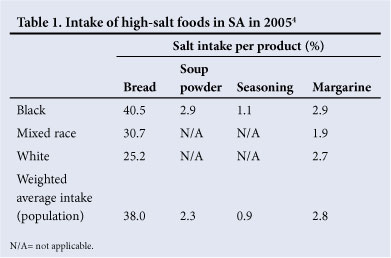
Average salt intake in SA was previously reported in 2005.47Table 1).
A study undertaken with Sasko Milling and Baking found that it was possible to produce bread with a sodium content of 342 mg/100 g, without affecting texture or taste.891010et al.11
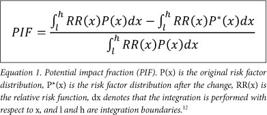
The potential impact fraction (PIF) (Equation 1), employed in the South African and WHO comparative risk assessments, estimates the reduction in morbidity and mortality anticipated if exposure to common risk factors were to be reduced.1111113
Results
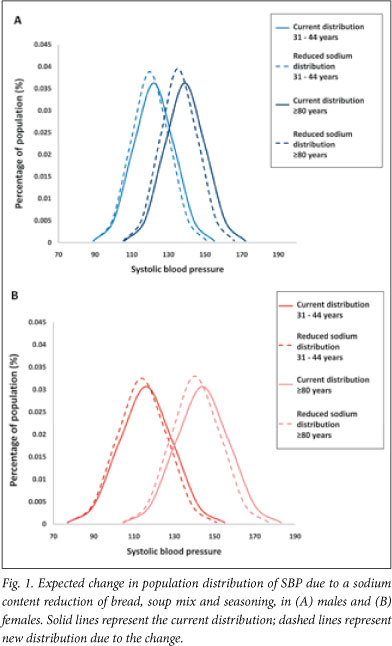
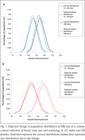
The average sodium intake from bread in SA is 1.6 g/person/day; a reduction of 0.73 g/person/day would result from a decrease in the sodium content of bread from 650 mg/100 g to 350 mg/100 g. This reduction would increase to 0.85 g/person/day if the sodium content of margarine, soup and seasoning was lowered as well. The effect of this sodium intake on population SBP varies by age and sex. Fig. 1 shows the projected shift in BP distribution for the youngest and oldest age groups.
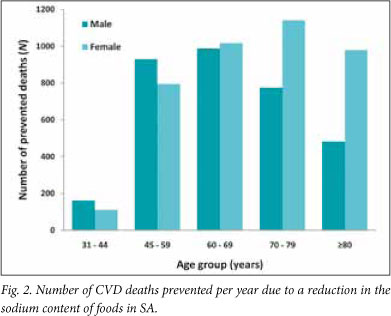
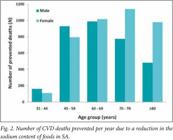
Applying the PIF values to the total number of fatal and non-fatal incident strokes estimated in 2008,13Fig. 2). This includes deaths related to stroke (2 900), ischaemic heart disease (2 500) and hypertensive heart disease (2 000). Furthermore, approximately 4 300 non-fatal strokes would be prevented. Overall, 8% of strokes, 6.5% of ischaemic heart disease and 11% of hypertensive heart disease could be prevented.
Discussion
Reducing the sodium content of food has the potential for large public health effects. As well as preventing 7 400 CVD deaths per year, the prevention of non-fatal strokes will relieve pressure on the overburdened health system. Data indicate that the direct costs of treating a stroke amount to R76 000 (excluding follow-up and rehabilitation costs;14
These values may underestimate the true effect of reduced sodium intake on stroke, as an independent effect not mediated via BP has been hypothesised;151617
The cost of baking a regular loaf of brown bread was 92.3 cents per loaf in 2005.99
We excluded from our analysis a controversial observational study1819
Evidence indicates that a reduced sodium diet has an effect on hypertension equivalent to first-line drug treatment with a diuretic or beta-blocker.202122
Voluntary measures to reduce the sodium content of packaged food have been introduced successfully in several countries.23232224
We applaud the efforts of the DoH to engage with the appropriate consumer and industry groups to begin the process of a voluntary reduction in food sodium levels. Engagement with companies producing cereals, gravies and soup mixes, consumed in high quantities in SA, is needed for a comprehensive salt reduction plan. Industry concerns regarding consumer acceptance of lower-sodium products are unwarranted. Evidence indicates that the palate adapts to lower-sodium foods, particularly if the salt content is reduced incrementally in small steps to a desired level,25
Acknowledgements. We acknowledge close relationships with policy makers developed through the Priority Cost Effective Lessons for Systems Strengthening (PRICELESS)-SA project and engagements with the DoH. Funding is acknowledged from the Bill & Melinda Gates Foundation through the Disease Control Priorities Network (DCPN) project grant to the Department of Global Health at the University of Washington, and the Fogarty International Centre and the United States National Institutes of Health. Funding sources had no role in study design, reporting and data collection, analysis and interpretation.
References
- 1. Norman R, Bradshaw D, Schneider M, Pieterse D, Groenewald P. Revised Burden of Disease Estimates for the Comparative Risk Factor Assessment, South Africa 2000. Cape Town: Medical Research Council, 2006.
- 2. Seedat YK, Croasdale MA, Milne FJ, et al. Joint National Hypertension Guideline Working Group 2006. South African Hypertension Guidelines. S Afr Med J 2006;96:337-362.
-
3. World Health Organization. Diet, Nutrition and the Prevention of Chronic Disease. Geneva: WHO, 2003. http://www.who.int/hpr/NPH/docs/who_fao_expert_report.pdf. 2003 (accessed 26 May 2011).
» http://www.who.int/hpr/NPH/docs/who_fao_expert_report.pdf -
4. Charlton KE, Steyn K, Levitt NS, et al. Diet and blood pressure in South Africa: intake of foods containing sodium, potassium, calcium and magnesium in three ethnic groups. Nutrition 2005;21:39-50. [http://dxdoi.org/10.1016/j.nut.2004.09.007]
» http://dxdoi.org/10.1016/j.nut.2004.09.007 -
5. Goudge J, Gilson L, Russell S, Gumede T, Mills A. Affordability, availability and acceptability barriers to health care for the chronically ill: Longitudinal case studies from South Africa. BMC Health Serv Res 2009;9(1):1-18. [http://dx.doi.org/10.1186/1472-6963-9-75]
» http://dx.doi.org/10.1186/1472-6963-9-75 - 6. He FJ, MacGregor GA. Effect of modest salt reduction on blood pressure: a meta-analysis of randomized trials. Implications for public health. J Human Hypert 2002;16:761-770.
-
7. Statistics South Africa. Mid-year population estimates. Pretoria: SSA, 2010. http://www.statssa.gov.za/keyindicators/keyindicators.asp (accessed 5 November 2010).
» http://www.statssa.gov.za/keyindicators/keyindicators.asp -
8. Charlton KE, MacGregor E, Vorster NH, Levitt NS, Steyn K. Partial replacement of NaCl can be achieved with potassium, magnesium and calcium salts in brown bread. Int J Food Sci Nutr 2007;58:508-521. [http://dx.doi.org/10.1080/09637480701331148]
» http://dx.doi.org/10.1080/09637480701331148 - 9. Charlton KE. The development of a dietary intervention to modify dietary cation content and the evaluation of its effects on blood pressure in hypertensive black South Africans. Cape Town: University of Cape Town, 2007.
- 10. Law MR, Frost CE, Wald NJ. By how much does dietary salt reduction lower blood pressure? 1-Analysis of observational data among populations. BMJ 1991;302:811-815.
- 11. Norman R, Gaziano T, Laubscher R, Steyn K, Bradshaw D. Estimating the burden of disease attributable to high blood pressure in South Africa in 2000. S Afr Med J 2007;97:692-698.
-
12. Barendregt JJ, Veerman J. Categorical versus continuous risk factors and the calculation of potential impact fractions. J Epidemiol Community Health 2010;64:209-212. [http://dx.doi.org/10.1136/jech.2009.090274]
» http://dx.doi.org/10.1136/jech.2009.090274 - 13. Bertram MY, Katzenellenbogen J, Bradshaw D, Vos T, Hofman K. The disability adjusted life years due to stroke in South Africa in 2008. Int J Stroke (in press).
-
14. Gaziano TA, Steyn K, Cohen DJ, Weinstein MC, Opie LH. Cost-effectiveness analysis of hypertension guidelines in South Africa: Absolute risk versus blood pressure level. Circulation 2006;112:3569-4576. [http://dx.doi.org/10.1161/CIRCULATIONAHA.105.535922]
» http://dx.doi.org/10.1161/CIRCULATIONAHA.105.535922 - 15. Perry IJ, Beevers DG. Salt intake and stroke: a possible direct effect. J Human Hypert 1992;6(1):23-25.
- 16. He FJ, Markandu ND, Sagnella GA, MacGregor GA. Importance of the renin system in determining blood pressure fall with salt restriction in black and white hypertensives. Hypertension 1998;32:820-824.
-
17. Bolhuis DP, Temme EHM, Koeman FT, Noort MWJ, Kremer S, Janssen AM. A Salt reduction of 50% in bread does not decrease bread consumption or increase sodium intake by the choice of sandwich fillings. J Nutr 2011;141(12):2249-2255. [http://dx.doi.org/10.3945/jn.111.141366]
» http://dx.doi.org/10.3945/jn.111.141366 -
18. Stolarz-Strzypek K, Kuznetsova T, Thujs L, et al. Fatal and nonfatal outcomes, incidence of hypertension, and blood pressure changes in relation to urinary sodium excretion. JAMA 2011;305:1777-1785. [http://dx.doi.org/10.1001/jama.2011.574]
» http://dx.doi.org/10.1001/jama.2011.574 -
19. The Editor. Salt and cardiovascular disease mortality. Lancet 2011;377:1626. [http://dx.doi.org/10.1016/S0140-6736(11)60657-0]
» http://dx.doi.org/10.1016/S0140-6736(11)60657-0 -
20. MacGregor GA, Markandu ND, Best FE et al. Double-blind randomised crossover trial of moderate sodium restriction in essential hypertension. Lancet 1982;319:351-355. [http://dx.doi.org/10.1016/S0140-6736(82)91389-7]
» http://dx.doi.org/10.1016/S0140-6736(82)91389-7 - 21. Hooper L, Bartlett C, Davey Smith G, Ebrahim S. Advice to reduce dietary salt for prevention of cardiovascular disease. Cochrane Database Syst Revs 2004;1.
-
22. Cobiac LJ, Vos T, Veerman JL. Cost-effectiveness of interventions to reduce dietary salt intake. Heart 2010. [http://dx.doi.org/10.1136/hrt.2010.199240]
» http://dx.doi.org/10.1136/hrt.2010.199240 -
23. He FJ, MacGregor GA. A comprehensive review on salt and health and current experience of worldwide salt reduction programmes. J Human Hypert 2009;23:363-384. [http://dx.doi.org/10.1038/jhh.2008.144]
» http://dx.doi.org/10.1038/jhh.2008.144 - 24. Smith-Spangler C, Juusola JL, Enns EA, Owens DK, Garber AM. Prevention strategies to decrease sodium intake and the burden of cardiovascular disease. A cost-effectiveness analysis. Ann Int Med 2010;152:481-487.
- 25. Blais CA, Borhani NO, Ferell MF, Prineas RJ, Laing B. Effect of dietary sodium restriction on taste responses to sodium choloride: a longitudinal study. Am J Clin Nutr 1986;44:232-243.