Assessment of people living with obesity
Introduction
Obesity is a chronic disease that requires a systematic and comprehensive diagnosis, assessment and treatment approach.[21] The objective assessment of PLWO is to gather information to confirm the diagnosis, determine related comorbidities due to excess body fat along with the severity of the disease, and identify causes of and contributors to weight gain (see the chapter 'The science of obesity'), and to guide appropriate management discussions in a non-biased and stigma-free clinical setting.[22] HCPs should initiate a discussion with PLWO about their values and goals for treatment, facilitate reflection, and encourage accountability and self-directed management to promote long-term improvements in health.[23]
This chapter provides an evidence-based approach to assessing PLWO in the primary care setting through a structured history, physical examination, and clinically appropriate laboratory testing. The authors also discuss clinical tools that allow for easy and efficient use in routine clinical practice.
-
Definition of obesity
Obesity is a complex chronic disease in which abnormal or excess body fat (adiposity) impairs health, increases the risk of long-term medical complications, and reduces lifespan.[23-25] It can no longer be regarded as a condition caused simply by an imbalance between energy in and energy out and, by implication, something that can be managed with mere willpower. Obesity has, in addition, traditionally been viewed as a risk factor for a wide range of other health issues. The Clinical Practice Guideline for the Management of Obesity in Adults in South Africa Committee, along with the Canadian Medical Association,[21,26] the Association for the Study of Obesity on the Island of Ireland,[27] Obesity Canada,[28] the American Medical Association,[29] the World Health Organization (WHO),[25] the World Obesity Federation (WOF) and others,[29-31] now acknowledge that obesity is a chronic disease in its own right, similar to type 2 diabetes (T2DM), hypertension and dyslipidaemia. A recent publication by the Lancet Diabetes and Endocrinology Commission[32] introduced new definitions of preclinical and clinical obesity, but does not cover the management of PLWO. The new definitions are also not formally included in any guideline and have not gained universal acceptance.
Initiating a discussion about obesity management
HCPs in primary care play an important role in the management of most chronic diseases. However, owing to the multitude of demands in primary care and lack of comfort and training, the assessment and management of PLWO are not easily undertaken. The initial approach, communication and attitude of the HCP during the assessment of PLWO is a significant determinant of their success.[33,34]
Many PLWO have experienced some form of weight bias in the primary care setting.[35,36] This is due in part to some HCPs' endorsement of negative attitudes and beliefs about PLWO, misinformation about causality, and perceptions that PLWO may be unmotivated and non-compliant. Many PLWO feel discriminated against and, as a result, will often avoid seeking treatment and delay preventive care.[37] This can affect their health status, their relationship with HCPs and their response to interventions,[38] which may lead to worsened outcomes including disordered eating, increased rates of depression, and lower rates of physical activity.[39,40]
We recommend that HCPs approach PLWO with empathy and sensitivity. In addition, it is important to acknowledge the complexity of the disease and the difficulty in sustaining behavioural change, as well as to avoid stereotypes and oversimplification of the disease.[41] A supportive environment with appropriate equipment (for example, appropriately sized blood pressure cuffs and gowns, armless chairs in waiting rooms, a private room for weigh-ins) and asking permission to weigh PLWO can help foster patient comfort and dignity. Stigmatisation of PLWO leads to worsened outcomes and promotes disordered eating, increased rates of depression and lower rates of physical activity. (See the chapter 'Reducing weight bias in obesity management, practice and policy'.)
The use of structured interview formats has been proposed to help facilitate discussions about obesity in primary care.[42,43] An adaptation of the '5As' template has been developed by Obesity Canada for use in clinical practice.[44] The main components of this framework include:
1. ASK for permission to discuss weight and explore readiness.
2. ASSESS obesity-related risks and root causes of and contributors to obesity.
3. ADVISE on health risks and treatment options.
4. AGREE on health outcomes and behavioural goals.
5. ASSIST in accessing appropriate resources and providers.[45,46]
Finally, when conducting an assessment of PLWO, and in order to achieve long-term success, it is important to assess the PLWO's readiness to change, intrinsic motivation, and values and goals when initiating a treatment plan. Personalising the approach, recognising PLWOs' strengths, and reframing misconceptions about obesity are important key processes that can have a positive impact on the PLWO's ability to make long-term changes.'15,251 (See the chapter 'Effective psychological and behavioural interventions in obesity management'.)
Screening for obesity
Before initiating screening or assessment of a PLWO, it is important to ask the PLWO's permission to discuss the topic and/or to conduct anthropometric measurements. Evaluation of anthropometric parameters is recommended as a practical screening tool to identify people with increased adiposity in whom more intensive assessments may be indicated. Moreover, performing regular anthropometric screening can identify people at risk of developing obesity, and the subsequent implementation of preventive measures can have a significant positive long-term effect on their health.[47,48] Many anthropometric parameters have been recommended in the screening and assessment of obesity; however, a calculated body mass index (BMI) and measured waist circumference (WC)[49] are the most widely used (Box 1), with some authors suggesting waist-to-height ratio (WtHR) as a useful measurement (Box 2).[50]

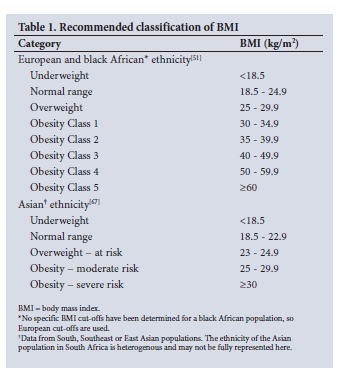
Traditionally, the BMI, calculated as weight in kilograms divided by height in metres squared (kg/m2[12,51-54] Widely accepted classifications of obesity based on specific BMI cut-offs are presented in Table 1. Although the BMI is a simple, objective and reproducible measure, it has certain limitations that need to be recognised by HCPs:[42,43]
• BMI is not a direct measure of body fat, cardiovascular risk or health.
• BMI does not indicate body fat distribution.
• BMI does not account for muscle mass (it overestimates body fat in muscular individuals).
• BMI can underestimate body fat in people who have lost muscle mass (sarcopenic obesity [SO]).
• BMI is less accurate in certain populations (e.g. the elderly, people with physical disability, people less than 18 years of age and people with severe obesity, and during pregnancy and in cases of ascites or severe oedema).
Height plays a role in the relationship between adiposity and metabolic risk. Taller individuals are at greater risk than those of shorter stature.[55]
•Importantly, BMI cutoffs can vary significantly between different ethnicities. Most Asian populations, which include China, Japan and Korea, have an increase in cardiovascular risk at a lower BMI compared with populations of European ancestry. Large epidemiological studies have shown that Asian populations may have increased adiposity and cardiometabolic risk at a lower BMI, and alternative cut-off points have been proposed for this patient population (Table 1).[56-61] In distinct populations such as the elderly, very muscular patients and those with extremely tall or short stature, the BMI can be misleading and needs to be interpreted with caution.[4]
Specific cut-offs for BMI in the black African population are still to be determined. A study in the South African (SA) black population reported an increase in cardiovascular risk in black African men at a BMI of 22 kg/m22[62] There is a considerable need for further research in this area. Until a consensus is reached, the WHO cut-offs are used in the black SA population.
A BMI >30 kg/m2[1,5] For most populations, the presence of overweight (BMI >25 kg/m2>23 kg/m2[5,63]
Given its simplicity, objectivity and reproducibility, the BMI continues to be an important measure in epidemiological and population-based surveillance studies. In a clinical setting, BMI at the recommended cut-offs should serve only as a simple screening measure.
The new proposed definitions of preclinical and clinical obesity continue to use BMI as an integral component of the diagnostic criteria, but the consensus is that another anthropometric measure such as WC or WtHR should be added in a clinical setting.[32]
Integration of both BMI and WC in clinical assessment may identify the higher-risk phenotype of PLWO better than either BMI or WC alone, particularly in individuals with a lower BMI.[64-66]
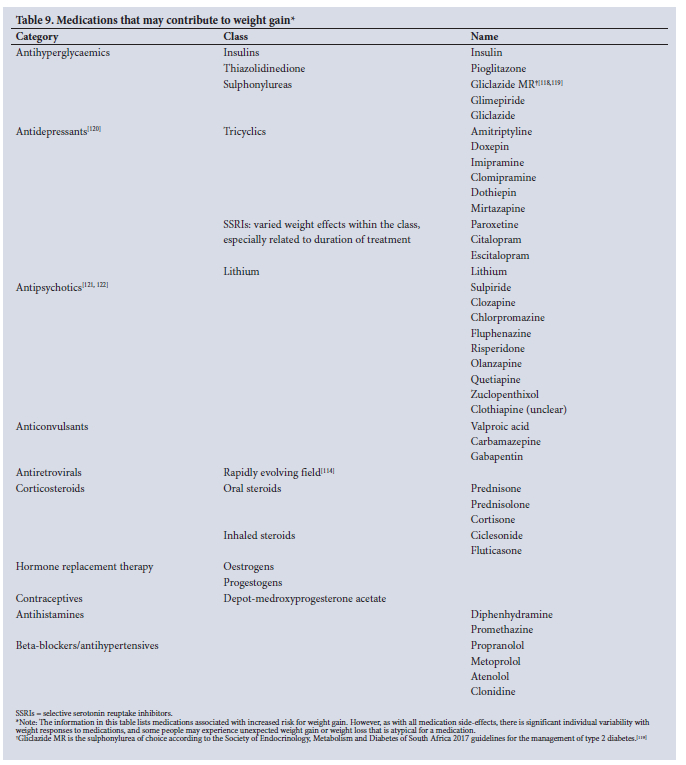
Regular assessment of BMI, WC and cardiometabolic risk factors can help identify people at increased risk of developing obesity. Regular assessment should also inform care and allow for increased vigilance in avoiding obesogenic medications (see Table 9) and for counselling on the avoidance of weight gain during high-risk periods such as pregnancy or forced sedentariness due to injury (see the chapter 'Prevention and harm reduction of obesity [clinical prevention]').
Waist circumference
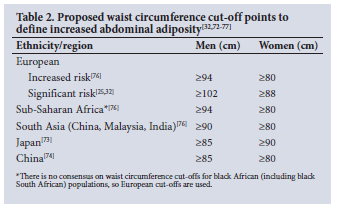
Identifying which cut-off level to use for abdominal obesity is difficult. The purpose of a WC threshold is to identify individuals with an increased risk of metabolic complications.[64,66,68] Evidence from both cross-sectional and longitudinal data highlights that the thresholds vary between sexes and ethnic groups.[69-71] The WHO recognises two abdominal obesity measurements in European populations:[25]
• A WC of >94 cm in men and >80 cm in women indicates increased abdominal adiposity and an increased risk of cardiovascular disease.
• A WC of >102 cm in men and >88 cm in women indicates significant abdominal adiposity and an even greater risk of cardiovascular disease.
The Lancet Commission on Clinical Obesity, in its 2025 report, emphasises the use of WC as a key measure alongside BMI to assess obesity.[32] For populations of European descent, they define a WC >88 cm in women and >102 cm in men as measurements of body size in the assessment of excess body fat. Although there is value in international consensus, national health systems should adopt WC cut-offs appropriate to their population. For adults with a predominant South Asian, Southeast Asian or East Asian ethnicity, lower WC cut-offs have been recommended, as shown in Table 2.[72-74]
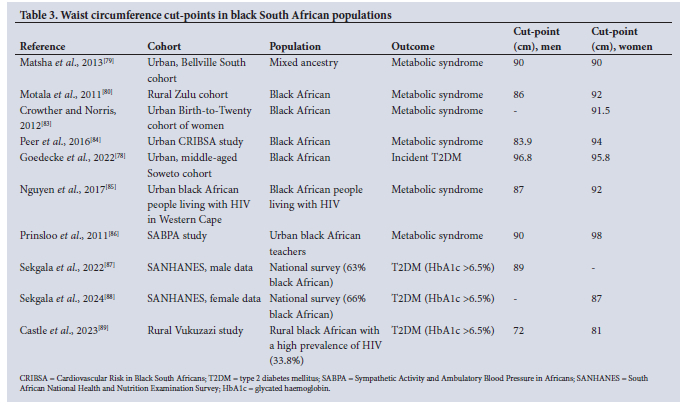
Owing to insufficient evidence, there are no specific WC cut-offs for black African populations. Accordingly, the International Diabetes Federation (IDF) Europid cut-points are recommended.[72] However, these may not be appropriate because for a given WC, black Africans have less visceral adipose tissue than their white European counterparts. Several SA studies have been undertaken to identify WC cut-points for risk (summarised in Table 3). Apart from one longitudinal study with incident T2DM as the outcome,[78] the remainder have been cross-sectional and relied on the metabolic syndrome (excluding WC) or glycated haemoglobin (HbA1c) as outcomes. Nonetheless, these studies have consistently shown that the European cut-points may not be appropriate for black South Africans, especially women. Compared with the IDF cut-points, the devised WC cut-points for SA women were higher (~90 cm), whereas those for men were lower (~90 cm). Based on these findings, there was a recommendation that the cut-points for men and women should be similar (~90 cm) for ease of implementation in resource-poor settings.[78-80] However, it is important to note that the cut-points may be dependent on the obesity prevalence of the region, with lower cut-points being observed in rural areas where the obesity prevalence is lower.[81,82]
The current recommended WC cut-offs for South Africans of Asian descent are those from South Asia, which are >90 cm for men and >80 cm for women. For the rest of the SA population, the WHO thresholds for Europeans (Table 2) can be used to screen for increased or significantly increased abdominal obesity and cardiovascular risk.
Despite its low-tech appeal and significant statistical association with cardiometabolic risk, there are important limitations to the routine use of WC measurement in the clinical setting:
• WC is not a direct measure of visceral fat.
• Considerable training and standardisation are required to ensure inter- and intra-reader reproducibility.
• WC is sensitive to abdominal distension due to food or fluid intake, bloating, ascites, pregnancy.
• Varying cut-offs are required for ethnic populations.
• WC is a less sensitive measure of visceral fat with increasing BMI.
• WC requires further body exposure and can be perceived as an intrusive measurement by some patients.
Waist-to-height ratio
The WtHR, calculated in centimetres, can be a valuable anthropometric indicator of central obesity and the accumulation of high-risk fat. By avoiding the ethnic, gender and age variations of WC measurements, it may be applied more generally.[50] A consensus statement from the European Association for the Study of Obesity (EASO) includes WtHR as a reliable marker of cardiometabolic risk at a cut-off of >0.5. A diagnosis of obesity is made if BMI is >30 kg/m22>25 kg/m2>0.5 in an individual with medical, mechanical or psychological complications.[90]
Integration of anthropometric measurements
BMI, WC and WtHR provide valuable and complementary information in the assessment of PLWO and the estimation of cardiometabolic risk. In PLWO with a BMI >40 kg/m2[32] In people with an increased BMI, an increase in WC or WtHR may imply intra-abdominal fat deposition and an increased risk of cardiometabolic disease.[90'91] These people may benefit from early intervention to treat and prevent obesity-related complications. In addition, measuring WC may not change management, but it can provide PLWO with valuable information regarding the efficacy of their treatment during their long-term follow-up. Some PLWO can see changes in adipose distribution before a significant change in body weight or BMI.
Assessing the impact of excess or abnormal adiposity on health
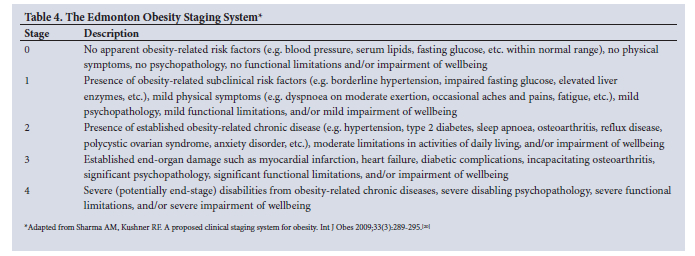
The association between a diagnosis of obesity and the development of related complications is strong but not always linear. Comparable levels of excess adiposity can result in varying degrees of health impact and impairment in quality of life among different individuals. While some patients with obesity may not initially present with elevated cardiometabolic risk markers, they may still face increased mortality risk,[92,93] and are more likely to experience other obesity-related conditions such as sleep apnoea, depression and musculoskeletal pain. A comprehensive obesity assessment, including use of the Edmonton Obesity Staging System (EOSS),[20,21] can provide a more accurate understanding of disease severity and help determine the appropriate intensity of treatment.
The Edmonton Obesity Staging System
Elements of the EOSS have been proposed to guide clinical decisions from the obesity assessment and at each BMI category.[20] Table 4 reviews the proposed clinical staging and its impact on management. The EOSS is a measure of the mental, metabolic and physical impact that obesity has had on people's health and uses these factors to determine their stage of obesity (from stage 0 to 4). In population studies, the EOSS has been shown to be a better predictor of all-cause mortality compared with BMI or WC measurements alone.[94]
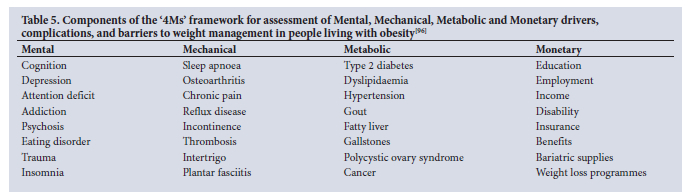
Once the diagnosis has been established, the primary goal for the clinical assessment of PLWO should be to identify the possible causes and contributors leading to weight gain, determine the extent to which weight has affected the patient's health, and systematically look for barriers in their management.[95] Given that obesity is a complex and heterogeneous disease, this is often a daunting task for the HCP. Using a clinical tool such as the '4Ms' framework (Mental health, Mechanical, Metabolic, Monetary health/Milieu) can provide a practical approach for HCPs to explore major drivers, barriers and complications of obesity (Table 5).[96] It can be used to provide a structure to perform an efficient and complete obesity assessment, including the history, physical examination and clinically indicated investigations.
Patient-reported outcome measures[40]
Patient-reported outcome measures (PROMS) are tools that capture PLWOs' perspective on the effectiveness of interventions, and can include symptoms, function, and physical, mental and social health.[97] Until recently, there has been a lack of standardisation in the use of the measures in obesity assessment and treatment, although the 'Standardizing Quality of life measures in Obesity Treatment (S.Q.O.T.)' initiative has now identified eight domains considered important to measure: self-esteem, physical health/functioning, mental/psychological health, social health, eating, stigma, body image, and excess skin. In addition, other helpful patient-centred tools suggested are the Impact of Weight on Quality of Life-Lite (IWOOL-Lite), the International Consortium for Health Outcome Measurement (ICHOM) Set of Patient-Centered Outcome Measures,[98] BODY-Q, the 36-item Short Form Health Survey (SF-36), the Obesity related Problems scale (OP), and the Quality of Life for Obesity Surgery (QOLOS).[99]
Components of an obesity-centred history
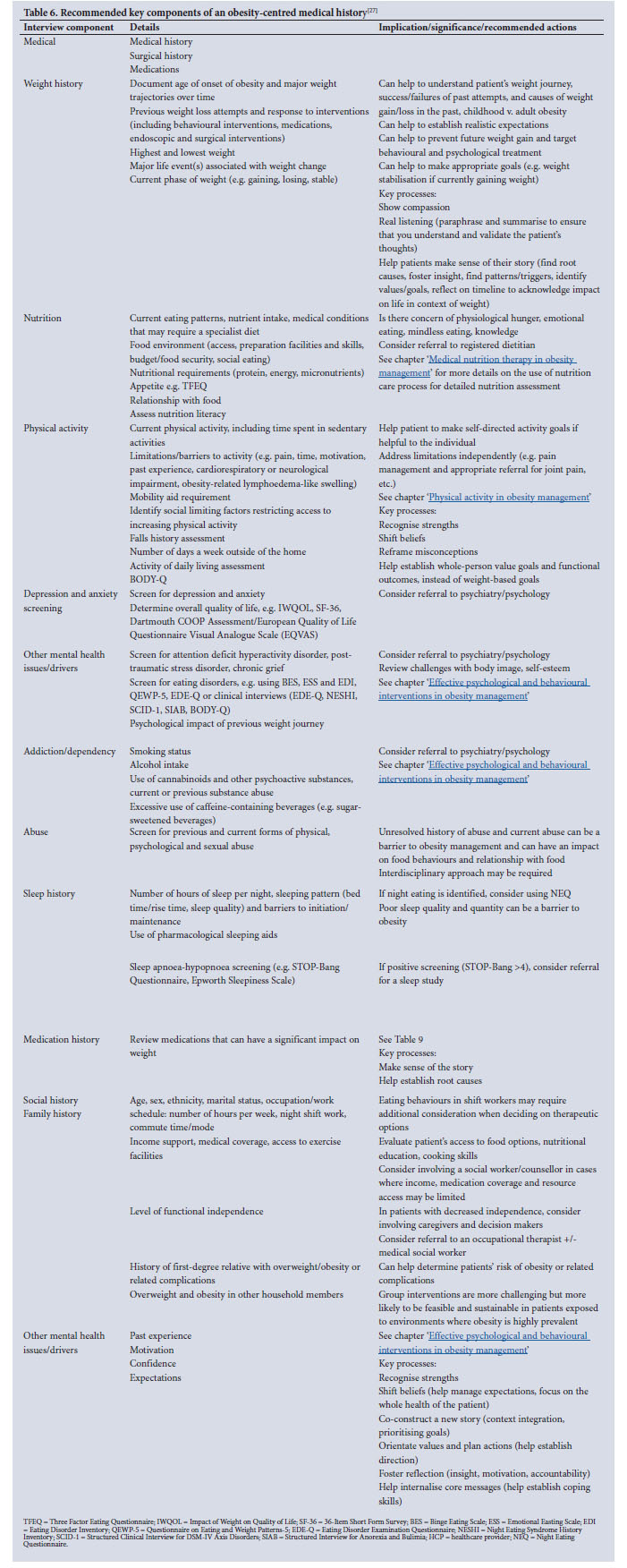
An obesity-centred history should include all parts of a routine clinical interview, such as past medical and surgical history, medications, allergies and social and family history. However, an emphasis should be placed on screening for underlying root causes of, contributors to and consequences of obesity (Table 6). Key elements of a history include screening for sleep disorders; physical, sexual and psychological abuse; description of eating patterns; physical activity and screen time; internalised weight bias; mood and anxiety disorders; and substance abuse and addiction.[14,16] A thorough history of medications should screen for weight-promoting medications. Consider alternative options where possible. The most common weight-promoting medications are outlined in Table 9. The HCP conducting the assessment should also identify and document the person's values and goals around treatment and foster insight to help with long-term coping and self-management skills.[15,25] Table 6 reviews some key components that are specific to an obesity-focused interview. The table highlights some key processes of a personalise obesity assessment in primary care; these have been shown to have a positive impact on the individual's ability to foster everyday change and facilitate improvements in their physical, mental and social health.[14,25]
Components of an obesity-centred physical examination
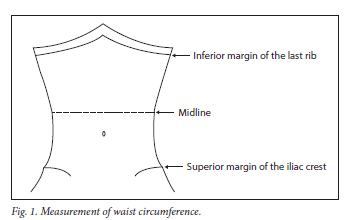
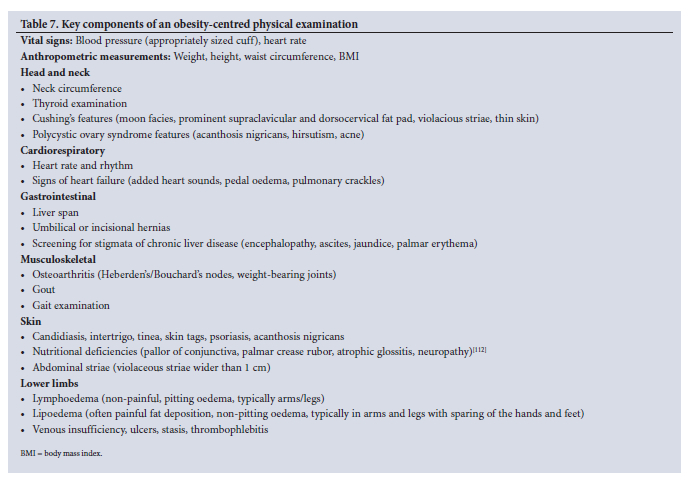
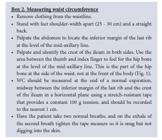
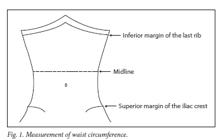
An obesity-centred physical examination should be focused on determining the obesity phenotype, causes of and contributors to weight gain, and treatment barriers for all patients. The key components of an obesity-centred physical exam are outlined in Table 7. Routine anthropometric measurements should include height, weight, BMI (Box 1) and WC (Box 2; Fig. 1). Blood pressure should be measured with an appropriately sized cuff according to the patient's arm circumference. If a large upper arm size is prohibitive, systolic blood pressure can be measured in the forearm, selecting the cuff size (small cuff [20.0 - 26.0 cm], standard cuff [25.4 - 40.6 cm and 25.0 - 34.0 cm] and large cuff [>32.0 cm]) according to the individual's forearm circumference. For cuff installation in the forearm, position the distal edge of the cuff about 6 cm proximal to the styloid process of the ulna.[100,101] Neck circumference and airway patency are also helpful to estimate the risk of sleep apnoea. In addition to a routine cardiorespiratory examination, a head, neck and gastrointestinal examination should be performed along with a general skin examination to rule out common skin findings (see Table 7). A joint and gait examination is also recommended to assess barriers in mobility. A cursory endocrine examination includes palpating for an enlarged thyroid gland and screening for signs of Cushing's syndrome and polycystic ovarian syndrome. If present, these signs should prompt further biochemical screening.
Investigations to assess obesity
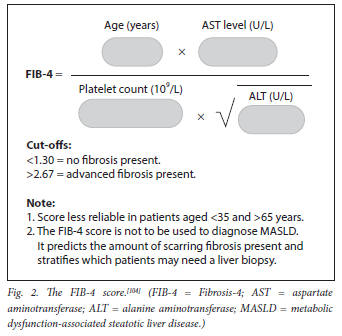
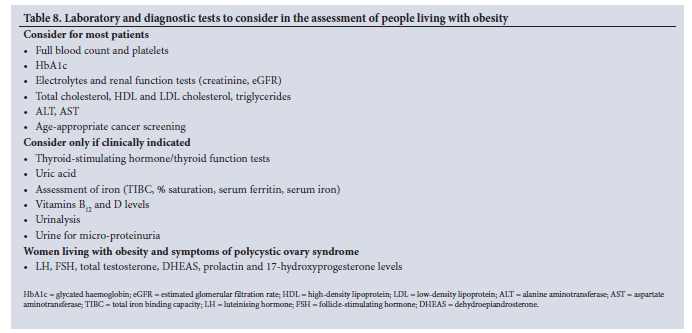
Diagnostic testing is commonly ordered during the initial assessment of PLWO to identify metabolic problems and to tailor therapy. There is no single blood test or diagnostic evaluation that is indicated for all PLWO. The specific evaluations performed should be based on the presenting symptoms, the person's risk factors and the index of suspicion. Table 8 lists some blood and diagnostic tests for HCPs to consider when assessing a PLWO. Screening for metabolic syndrome with HbA1c or fasting blood sugar, total cholesterol, serum triglycerides and high-density lipoprotein is recommended in most PLWO.[102] PLWO who are at high risk of metabolic dysfunction-associated steatotic liver disease (MASLD), including those living with T2DM or metabolic syndrome, should be screened with alanine aminotransferase and aspartate aminotransferase levels and an abdominal ultrasound scan. A referral to gastroenterology/ hepatology may be appropriate in PLWO with persistently elevated liver enzymes (greater than two times the upper limit of normal over 6 months) and/or high Fibrosis-4 (FIB-4) scores (Fig. 2). The gold standard to diagnose MASLD is a liver biopsy.[103]
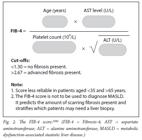
In patients aged over 65 years, a FIB-4 cut-off of >2.0 should be used. FIB-4 has low accuracy in those under age 35, so secondary assessment should be considered in individuals in this age group with increased metabolic risk.
Evaluation of coronary artery disease
Large prospective studies have documented obesity as being an independent predictor of coronary artery disease.[105] This relationship was stronger in younger individuals. Susceptibility to obesity-related cardiovascular complications is not only mediated by overall body fat mass, but is largely dependent upon individual differences in regional body fat distribution.[91,106] Large cohort studies using imaging techniques have identified excess abdominal visceral adipose tissue as a strong predictor in the development of cardiovascular disease over time, independently of total body fat mass.[1071 Numerous non-invasive tests can diagnose atherosclerosis or myocardial ischaemia, or both. The correct choice depends on local expertise, the relative strengths and weaknesses of each modality and individual patient characteristics, as well as the pretest likelihood of coronary artery disease.
Electrocardiogram
Obesity has the potential to affect the ECG in several ways, including displacement of the heart by elevating the diaphragm in the supine position, increasing the cardiac workload, and increasing the distance between the heart and the recording electrodes. Besides low QRS voltage and leftward trend in the axis, other alterations frequently seen are nonspecific flattening of the T waves in the inferolateral leads (attributed to the horizontal displacement of the heart) and voltage criteria for left atrial abnormality. An increased incidence of false-positive criteria for inferior myocardial infarction in PLWO due to the elevation of the diaphragm has been reported.[108] Left ventricular hypertrophy is probably underdiagnosed based on the usual ECG criteria in individuals with greater than Class 2 obesity. Since baseline ECG may be influenced by obesity (false positive for inferior myocardial infarction, microvoltage, nonspecific ST-T changes) and PLWO may have impaired maximal exercise testing capacity (dyspnoea, mechanical limitations, left ventricular diastolic dysfunction), other modalities may be of interest in the evaluation of coronary artery disease in this population. Indeed, owing to impaired exercise tolerance because of mechanical and physiological limitations related to stress testing in patients at very high BMIs, a perfusion scan may be used instead of exercise testing for evaluating the presence of ischaemic heart disease.[109-111]
Evaluation of other conditions associated with obesity
Women living with obesity and symptoms of polycystic ovary syndrome should be screened for luteinising hormone, follicle-stimulating hormone, total testosterone, dehydroepiandrosterone, prolactin, thyroid-stimulating hormone and 17-hydroxyprogesterone levels. Other endocrinopathies, including thyroid dysfunction, Cushing's syndrome or acromegaly, are not routinely recommended unless clinically warranted. We encourage age-appropriate cancer screening for PLWO, as they are at an increased risk and often have poor outcomes owing to lower rates of routine screening and delays in seeking treatment.
Screening for chronic kidney disease has always been controversial to some extent owing to inability to treat beyond controlling blood pressure as well as difficulty in proving cost-effectiveness. However, morbid obesity has recently been added as a condition where screening is advocated owing to the quicker decline in kidney function and risk of progression to end-stage kidney disease. Treating obesity has been shown to improve overall kidney function.[113]
The advancement and availability of antiretroviral treatment (ART) have improved the life expectancy of people living with HIV (PLWH) to near normal. However, PLWH are presenting with obesity after treatment initiation. This is especially the case in black African people, in women, and when treatment is started in the setting of advanced disease. The pathophysiological mechanisms are currently unclear, as are the long-term impact and cardiovascular consequences.[114] At present the priority would be studies to clarify the mechanisms of and approach to this significant problem. Focus should remain on: (i) identifying ART regimens that are less obesogenic - this is a rapidly evolving field; (ii) promoting an overall healthy lifestyle; and (iii) consideration of specific treatments for PLWO (medication and/or surgery). Guidelines for HIV treatment are updated by the Southern African HIV Clinicians Society.[115]
Can one have a high BMI and be healthy?
This remains controversial. Attempts have been made to define the concept of health in the setting of obesity.[32] In epidemiological studies, the relationship between body fat (or BMI as a surrogate) and health impacts follows a U-shaped curve with health risks progressively increasing at both the lower and higher ends of the BMI spectrum.[116] Cardiovascular disease risk increases with increasing BMI, even in the absence of metabolic abnormalities.[117] In addition to metabolic complications (often with variable and inconsistent definitions used), mechanical and mental health impact needs to be considered. Finally, it should be noted that 'health' is often an illusion of limited testing - not an actual absence of disease processes.
Sarcopenic obesity
SO is defined as the coexistence of obesity, characterised by high body fat percentage, and sarcopenia, defined as low skeletal muscle mass accompanied by diminished muscle function.[123] This unique clinical condition poses a higher risk for metabolic diseases and functional impairments than either condition alone, owing to the synergistic effects of fat accumulation and muscle loss.
In 2022, the EASO and the European Society for Clinical Nutrition and Metabolism released a joint consensus statement on the definition and diagnostic criteria for SO for use in clinical settings.[124] They recommend three steps:
• Screening. Based on the concomitant presence of an elevated BMI/WC (using WHO cut-points) and surrogate indicators of sarcopenia (e.g. clinical symptoms, risk factors 'including age >70 years, chronic/acute disease diagnosis and history of falls, fatigue or weakness1) and/or validated questionnaires (e.g. SARC-F 'strength, assistance with walking, rising from a chair, climbing stairs, and falls1 in older subjects).
• Diagnosis. Based on altered skeletal muscle function (using hand-grip strength or chair stand tests) and altered body composition of increased fat mass plus reduced muscle mass (assessed using appendicular lean mass adjusted to body weight by dual-energy X-ray absorption or skeletal muscle mass adjusted by weight by bioelectrical impedance analysis).
• Staging. To establish the severity of SO, consider the absence (Stage 1) or presence (Stage 2) of at least one complication attributable to altered body composition and skeletal muscle functional parameters (e.g. metabolic diseases, disability, cardiovascular and respiratory diseases).
Conclusion
Obesity is a complex chronic disease requiring a structured, compassionate and individualised approach to assessment. The Guideline Committee emphasises the use of validated frameworks -the 5As (Ask, Assess, Advise, Agree, Assist) to guide patient-centred discussions, and the 4Ms (Mental, Mechanical, Metabolic, Milieu/ Monetary) to evaluate the multifaceted impact of excess adiposity. Initial screening involves anthropometric measures: BMI, a widely used but imperfect indicator of body fat, and WC, a better predictor of visceral fat and cardiometabolic risk. Limitations of the BMI include its inability to distinguish between fat and muscle or to capture fat distribution. Combining BMI with WC or WtHR improves risk stratification. Ethnic-specific cut-offs are crucial, especially in black African and Asian populations. A comprehensive assessment should also include a physical and mental health history, lifestyle factors and laboratory tests. The EOSS provides clinical staging beyond BMI, predicting health risks more effectively. A non-judgemental, stigma-free environment is essential to foster trust and engagement. Ultimately, the goal is to identify drivers and complications of obesity, tailor interventions, and support long-term, patient-directed care.
Acknowledgement. Assessment of people living with obesity' is adapted from the Canadian Adult Obesity Clinical Practice Guideline (the 'Guideline'), which Obesity Canada owns and from whom we have a licence. SAMMSS adapted the Guideline having regard for relevant context affecting South Africa using the ADAPTE Tool.
SAMMSS acknowledges that Obesity Canada and the authors of the Guideline have not formally reviewed 'Assessment of people living with obesity' and bear no responsibility for changes made to such chapter, or how the adapted Guideline is presented or disseminated. Therefore, such parties, according to their policy, disclaim any association with such adapted materials. The original Guideline may be viewed in English at: www.obesitycanada.ca/guidelines
Author contributions. AM adapted the Canadian guideline and extensively updated the text and figures, as well as drafting new figures. All authors edited and approved the final version of the chapter.
References
-
1. Berrington de Gonzalez A, Hartge P, Cerhan JR, et al. Body-mass index and mortality among 1.46 million white adults. N Engl J Med 2010;363(23):2211-2219. https://doi.org/10.1056/NEJMoa1000367
» https://doi.org/10.1056/NEJMoa1000367 -
2. Cerhan JR, Moore SC, Jacobs EJ, et al. A pooled analysis of waist circumference and mortality in 650,000 adults. Mayo Clin Proc 2014;89(3):335-345. https://doi.org/10.1016/j.mayocp.2013.11.011
» https://doi.org/10.1016/j.mayocp.2013.11.011 -
3. Cornier M-A, Després J-P, Davis N, et al. Assessing adiposity: A scientific statement from the American Heart Association. Circulation 2011;124(18):1996-2019. https://doi.org/10.1161/CIR.0b013e318233bc6a
» https://doi.org/10.1161/CIR.0b013e318233bc6a -
4. Gavriilidou NN, Pihlsgard M, Elmstahl S. Anthropometric reference data for elderly Swedes and its disease-related pattern. Eur J Clin Nutr 2015;69(9):1066-1075. https://doi.org/10.1038/ejcn.2015.73
» https://doi.org/10.1038/ejcn.2015.73 -
5. Guh DP, Zhang W, Bansback N, Amarsi Z, Birmingham CL, Anis AH. The incidence of co-morbidities related to obesity and overweight: A systematic review and meta-analysis. BMC Public Health 2009;9:88. https://doi.org/10.1186/1471-2458-9-88
» https://doi.org/10.1186/1471-2458-9-88 -
6. Lassale C, Tzoulaki I, Moons KGM, et al. Separate and combined associations of obesity and metabolic health with coronary heart disease: A pan-European case-cohort analysis. Eur Heart J 2018;39(5):397-406. https://doi.org/10.1093/eurheartj/ehx448
» https://doi.org/10.1093/eurheartj/ehx448 -
7. Prospective Studies Collaboration; Whitlock G, Lewington S, Sherliker P, et al. Body-mass index and cause-specific mortality in 900 000 adults: Collaborative analyses of 57 prospective studies. Lancet 2009;373(9669):1083-1096. https://doi.org/10.1016/s0140-6736(09)60318-4
» https://doi.org/10.1016/s0140-6736(09)60318-4 -
8. WHO Expert Consultation. Appropriate body-mass index for Asian populations and its implications for policy and intervention strategies. Lancet 2004;363(9403):157-163. https://doi.org/10.1016/S0140-6736(03)15268-3
» https://doi.org/10.1016/S0140-6736(03)15268-3 -
9. Emerging Risk Factors Collaboration; Wormser D, Kaptoge S, di Angelantonio E, et al. Separate and combined associations of body-mass index and abdominal adiposity with cardiovascular disease: Collaborative analysis of 58 prospective studies. Lancet 2011;377(9771):1085-1095. https://doi.org/10.1016/s0140-6736(11)60105-0
» https://doi.org/10.1016/s0140-6736(11)60105-0 -
10. Balkau B, Deanfield JE, Despres JP, et al. International Day for the Evaluation of Abdominal Obesity (IDEA): A study of waist circumference, cardiovascular disease, and diabetes mellitus in 168,000 primary care patients in 63 countries. Circulation 2007;116(17):1942-1951. https://doi.org/10.1161/CIRCULATIONAHA.106.676379
» https://doi.org/10.1161/CIRCULATIONAHA.106.676379 -
11. De Koning L, Merchant AT, Pogue J, Anand SS. Waist circumference and waist-to-hip ratio as predictors of cardiovascular events: Meta-regression analysis of prospective studies. Eur Heart J 2007;28(7):850-856. https://doi.org/10.1093/eurheartj/ehm026
» https://doi.org/10.1093/eurheartj/ehm026 -
12. Vazquez G, Duval S, Jacobs DR Jr, Silventoinen K. Comparison of body mass index, waist circumference, and waist/hip ratio in predicting incident diabetes: A meta-analysis. Epidemiol Rev 2007;29:115-128. https://doi.org/10.1093/epirev/mxm008
» https://doi.org/10.1093/epirev/mxm008 -
13. Shah AG, Lydecker A, Murray K, et al. Comparison of noninvasive markers of fibrosis in patients with nonalcoholic fatty liver disease. Clin Gastroenterol Hepatol 2009;7(10):1104-1112. https://doi.org/10.1016/j.cgh.2009.05.033
» https://doi.org/10.1016/j.cgh.2009.05.033 -
14. Foster GD, Borradaile KE, Sanders MH, et al. A randomized study on the effect of weight loss on obstructive sleep apnea among obese patients with type 2 diabetes: The Sleep AHEAD study. Arch Intern Med 2009;169(17):1619-1626. https://doi.org/10.1001/archinternmed.2009.266
» https://doi.org/10.1001/archinternmed.2009.266 -
15. Luig T, Anderson R, Sharma AM, Campbell-Scherer DL. Personalizing obesity assessment and care planning in primary care: Patient experience and outcomes in everyday life and health. Clin Obes 2018;8(6):411-423. https://doi.org/10.1111/cob.12283
» https://doi.org/10.1111/cob.12283 -
16. Luppino FS, de Wit LM, Bouvy PF, et al. Overweight, obesity, and depression: A systematic review and meta-analysis of longitudinal studies. Arch Gen Psychiatry 2010;67(3):220-229. https://doi.org/10.1001/archgenpsychiatry.2010.2
» https://doi.org/10.1001/archgenpsychiatry.2010.2 -
17. Campbell-Scherer D, Rogers J, Manca D, et al. Guideline harmonisation and implementation plan for the BETTER triai Building on Existing Tools to Improve Chronic Disease Prevention and Screening in Family Practice. CMAJ Open 2014;2(1):E1-E10. https://doi.org/10.9778/cmajo.20130040
» https://doi.org/10.9778/cmajo.20130040 -
18. Wildman RP, Muntner P, Reynolds K, et al. The obese without cardiometabolic risk factor clustering and the normal weight with cardiometabolic risk factor clustering: Prevalence and correlates of 2 phenotypes among the US population (NHANES 1999-2004). Arch Intern Med 2008;168(15):1617-1624. https://doi.org/10.1001/archinte.168.15.1617
» https://doi.org/10.1001/archinte.168.15.1617 -
19. Grammatikopoulou MG, Chourdakis M, Gkiouras K, et al. Edmonton Obesity Staging System among pediatric patients: A validation and obesogenic risk factor analysis. J Endocrinol Invest 2018;41(8):947-957. https://link.springer.com/article/10.1007/s40618-017-0821-9
» https://link.springer.com/article/10.1007/s40618-017-0821-9 -
20. Sharma AM, Kushner RF. A proposed clinical staging system for obesity. Int J Obes (Lond) 2009;33(3):289-295. https://doi.org/10.1038/ijo.2009.2
» https://doi.org/10.1038/ijo.2009.2 -
21. Wisniewski AE. The weight of communication: The Canadian Medical Association Journal's discourse on obesity. Public Underst Sci 2013;22(3):351-364. https://doi.org/10.1177/0963662511412861
» https://doi.org/10.1177/0963662511412861 -
22. Phelan SM, Burgess DJ, Yeazel MW, Hellerstedt WL, Griffin JM, van Ryn M. Impact of weight bias and stigma on quality of care and outcomes for patients with obesity. Obes Rev 2015;16(4):319-326. https://doi.org/10.1111/obr.12266
» https://doi.org/10.1111/obr.12266 -
23. Mechanick JI, Hurley DL, Garvey WT. Adiposity-based chronic disease as a new diagnostic term: The American Association of Clinical Endocrinologists and American College of Endocrinology position statement. Endocr Pract 2017;23(3):372-378. https://doi.org/10.4158/ep161688.PS
» https://doi.org/10.4158/ep161688.PS -
24. Garvey WT, Mechanick JI. Proposal for a scientifically correct and medically actionable disease classification system (ICD) for obesity. Obesity (Silver Spring) 2020;28(3):484-492. https://doi.org/10.1002/oby.22727
» https://doi.org/10.1002/oby.22727 -
25. World Health Organization. Obesity: Preventing and managing the global epidemic. Report of a WHO consultation. World Health Organ Tech Rep Ser 2000;894:i-xii, 1-253. https://www.ncbi.nlm.nih.gov/pubmed/11234459 (accessed February 2025).
» https://www.ncbi.nlm.nih.gov/pubmed/11234459 -
26. Rich P. CMA recognises obesity as a disease. 2015. https://web.archive.org/web/20170421083232/https:/www.cma.ca/En/Pages/cma-recognises-obesity-as-a-disease.aspx (accessed 30 April 2025).
» https://web.archive.org/web/20170421083232/https:/www.cma.ca/En/Pages/cma-recognises-obesity-as-a-disease.aspx -
27. Breen C, O'Connell J, Geoghegan J, et al. Obesity in adults: A 2022 adapted clinical practice guideline for Ireland. Obes Facts 2022;15(6):736-752. https://doi.org/10.1159/000527131
» https://doi.org/10.1159/000527131 -
28. Obesity Canada. Obesity education, research, & advocacy. https://obesitycanada.ca/?s=education+research+and+advocacy (accessed February 2025).
» https://obesitycanada.ca/?s=education+research+and+advocacy -
29. Kyle TK, Dhurandhar EJ, Allison DB. Regarding obesity as a disease: Evolving policies and their implications. Endocrinol Metab Clin North Am 2016;45(3):511-520. https://doi.org/10.1016/j.ecl.2016.04.004
» https://doi.org/10.1016/j.ecl.2016.04.004 -
30. Ortiz SE, Kawachi I, Boyce AM. The medicalisation of obesity, bariatric surgery, and population health. Health (London) 2017;21(5):498-518. https://doi.org/10.1177/1363459316660858
» https://doi.org/10.1177/1363459316660858 -
31. Vallgårda S, Nielsen MEJ, Hansen AKK, et al. Should Europe follow the US and declare obesity a disease?: A discussion of the so-called utilitarian argument. Eur J Clin Nutr 2017;71(11):1263-1267. https://doi.org/10.1038/ejcn.2017.103
» https://doi.org/10.1038/ejcn.2017.103 -
32. Rubino F, Cummings DE, Eckel RH, et al. Definition and diagnostic criteria of clinical obesity. Lancet Diabetes Endocrinol 2025;13(3):221-262. https://doi.org/10.1016/S2213-8587(24)00316-4
» https://doi.org/10.1016/S2213-8587(24)00316-4 -
33. Retat L, Pimpin L, Webber L, et al. Screening and brief intervention for obesity in primary care: Cost-effectiveness analysis in the BWeL trial. Int J Obes (Lond) 2019;43(10):2066-2075. https://doi.org/10.1038/s41366-018-0295-7
» https://doi.org/10.1038/s41366-018-0295-7 -
34. Welzel FD, Stein J, Pabst A, et al. Five A's counseling in weight management of obese patients in primary care: A cluster-randomized controlled trial (INTERACT). BMC Fam Pract 2018;19(1):97. https://doi.org/10.1186/s12875-018-0785-7
» https://doi.org/10.1186/s12875-018-0785-7 -
35. Puhl RM, Luedicke J, Grilo CM. Obesity bias in training: Attitudes, beliefs, and observations among advanced trainees in professional health disciplines. Obesity (Silver Spring) 2014;22(4):1008-1015. https://doi.org/10.1002/oby.20637
» https://doi.org/10.1002/oby.20637 -
36. Smigelski-Theiss R, Gampong M, Kurasaki J. Weight bias and psychosocial implications for acute care of patients with obesity. AACN Adv Crit Care 2017;28(3):254-262. https://doi.org/10.4037/aacnacc2017446
» https://doi.org/10.4037/aacnacc2017446 -
37. Hunte HE, Williams DR. The association between perceived discrimination and obesity in a population-based multiracial and multiethnic adult sample. Am J Public Health 2009;99(7):1285-1292. https://doi.org/10.2105/AJPH.2007.128090
» https://doi.org/10.2105/AJPH.2007.128090 -
38. Pearl RL, Hopkins CH, Berkowitz RI, Wadden TA. Group cognitive-behavioral treatment for internalized weight stigma: A pilot study. Eat Weight Disord 2018;23(3):357-362. https://doi.org/10.1007/s40519-016-0336-y
» https://doi.org/10.1007/s40519-016-0336-y -
39. Puhl RM, Heuer CA. The stigma of obesity: A review and update. Obesity (Silver Spring) 2009;17(5):941-964. https://doi.org/10.1038/oby.2008.636
» https://doi.org/10.1038/oby.2008.636 -
40. ASOI Adult Obesity Clinical Practice Guideline (ASOI version 1, 2022) by: Duggan D, Kearney C, Hynes M, Manning S, O'Malley E. Chapter adapted from: Rueda-Clausen C, Poddar M, Lear S, Poirier P, Sharma A. https://asoi.info/guidelines/assessment/ (accessed May 2025).
» https://asoi.info/guidelines/assessment/ -
41. Fruh SM, Nadglowski J, Hall HR, Davis SL, Crook ED, Zlomke K. Obesity stigma and bias. J Nurse Pract 2016;12(7):425-432. https://doi.org/10.1016/j.nurpra.2016.05.013
» https://doi.org/10.1016/j.nurpra.2016.05.013 - 42. Akpinar E, Bashan I, Bozdemir N, Saatci E. Which is the best anthropometric technique to identify obesity: body mass index, waist circumference or waist-hip ratio? Coll Antropol 2007;31(2):387-393.
-
43. Feldstein CA, Akopian M, Olivieri AO, Kramer AP, Nasi M, Garrido D. A comparison of body mass index and waist-to-hip ratio as indicators of hypertension risk in an urban Argentine population: A hospital-based study. Nutr Metab Cardiovasc Dis 2005;15(4):310-315. https://doi.org/10.1016/j.numecd.2005.03.001
» https://doi.org/10.1016/j.numecd.2005.03.001 -
44. Obesity Canada. Canadian Adult Obesity Clinical Practice Guideline: Appendix 2: 5A's framework for obesity management. 2020. https://obesitycanada.ca/healthcare-professionals/adult-clinical-practice-guideline/ (accessed 25 May 2025).
» https://obesitycanada.ca/healthcare-professionals/adult-clinical-practice-guideline/ -
45. Jay M, Gillespie C, Schlair S, Sherman S, Kalet A. Physicians' use of the 5As in counseling obese patients: Is the quality of counseling associated with patients' motivation and intention to lose weight? BMC Health Serv Res 2010;10:159. https://doi.org/10.1186/1472-6963-10-159
» https://doi.org/10.1186/1472-6963-10-159 -
46. Rueda-Clausen CF, Benterud E, Bond T, Olzowska R, Vallis MT, Sharma AM. Effect of implementing the 5As of obesity management framework on provider-patient interactions in primary care. Clin Obes 2014;4(1):39-44. https://doi.org/10.1111/cob.12038
» https://doi.org/10.1111/cob.12038 -
47. Lau DC, Douketis JD, Morrison KM, Hramiak IM, Sharma AM, Ur E; for members of the Obesity Canada Clinical Practice Guidelines Expert Panel. 2006 Canadian clinical practice guidelines on the management and prevention of obesity in adults and children [summary]. CMAJ 2007;176(8):S1-S13. https://doi.org/10.1503/cmaj.061409
» https://doi.org/10.1503/cmaj.061409 -
48. Littman AJ, Damschroder LJ, Verchinina L, et al. National evaluation of obesity screening and treatment among veterans with and without mental health disorders. Gen Hosp Psychiatry 2015;37(1):7-13. https://doi.org/10.1016/j.genhosppsych.2014.11.005
» https://doi.org/10.1016/j.genhosppsych.2014.11.005 -
49. Ortega FB, Sui X, Lavie CJ, Blair SN. Body mass index, the most widely used but also widely criticised index: Would a criterion standard measure of total body fat be a better predictor of cardiovascular disease mortality? Mayo Clin Proc 2016;91(4):443-455. https://doi.org/10.1016/j.mayocp.2016.01.008
» https://doi.org/10.1016/j.mayocp.2016.01.008 -
50. Ashwell M, Hsieh SD. Six reasons why the waist-to-height ratio is a rapid and effective global indicator for health risks of obesity and how its use could simplify the international public health message on obesity. Int J Food Sci Nutr 2005;56(5):303-307. https://doi.org/10.1080/09637480500195066
» https://doi.org/10.1080/09637480500195066 -
51. World Health Organization. Physical status: The use and interpretation of anthropometry: Report of a WHO expert committee. Geneva: WHO, 1995. https://apps.who.int/iris/handle/10665/37003 (accessed May 2025).
» https://apps.who.int/iris/handle/10665/37003 -
52. Seidell JC, Kahn HS, Williamson DF, Lissner L, Valdez R. Report from a Centers for Disease Control and Prevention workshop on use of adult anthropometry for public health and primary health care. Am J Clin Nutr 2001;73(1):123-126. https://doi.org/10.1093/ajcn/73.1.123
» https://doi.org/10.1093/ajcn/73.1.123 -
53. Pi-Sunyer FX. Obesity: Criteria and classification. Proc Nutr Soc 2000;59(4):505-509. https://doi.org/10.1017/s0029665100000732
» https://doi.org/10.1017/s0029665100000732 -
54. Javed A, Jumean M, Murad MH, et al. Diagnostic performance of body mass index to identify obesity as defined by body adiposity in children and adolescents: A systematic review and meta-analysis. Pediatr Obes 2015;10(3):234-244. https://doi.org/10.1111/ijpo.242
» https://doi.org/10.1111/ijpo.242 -
55. Stefan N, Schiborn C, Machann J, Birkenfeld AL, Schulze MB. Impact of higher BMI on cardiometabolic risk: Does height matter? Lancet Diabetes Endocrinol 2024;12(8):514-515. https://doi.org/10.1016/s2213-8587(24)00164-5
» https://doi.org/10.1016/s2213-8587(24)00164-5 -
56. Altschuler EL. Prescient description of frontal lobe syndrome in an Edgar Allan Poe tale. Lancet 2004;363(9412):902. https://doi.org/10.1016/S0140-6736(04)15758-9
» https://doi.org/10.1016/S0140-6736(04)15758-9 -
57. Herath HMM, Weerasinghe NP, Weerarathna TP, et al. A comparison of the prevalence of the metabolic syndrome among Sri Lankan patients with type 2 diabetes mellitus using WHO, NCEP-ATP III, and IDF definitions. Int J Chronic Dis 2018;2018:7813537. https://doi.org/10.1155/2018/7813537
» https://doi.org/10.1155/2018/7813537 -
58. James WP, Chunming C, Inoue S. Appropriate Asian body mass indices? Obes Rev 2002;3(3):139. https://doi.org/10.1046/j.1467-789x.2002.00063.x
» https://doi.org/10.1046/j.1467-789x.2002.00063.x -
59. Misra A, Khurana L. The metabolic syndrome in South Asians: Epidemiology, determinants, and prevention. Metab Syndr Relat Disord 2009;7(6):497-514. https://doi.org/10.1089/met.2009.0024
» https://doi.org/10.1089/met.2009.0024 - 60. Pan WH, Yeh WT. How to define obesity evidence-based multiple action points for public awareness, screening, and treatment: An extension of Asian-Pacific recommendations. Asia Pac J Clin Nutr 2008;17(3):370-374.
- 61. Pan WH, Yeh WT, Weng LC. Epidemiology of metabolic syndrome in Asia. Asia Pac J Clin Nutr 2008;17(Suppl 1):37-42.
-
62. Kruger HS, Schutte AE, Walsh CM, Kruger A, Rennie KL. Body mass index cut-points to identify cardiometabolic risk in black South Africans. Eur J Nutr 2017;56(1):193-202. https://doi.org/10.1007/s00394-015-1069-9
» https://doi.org/10.1007/s00394-015-1069-9 -
63. Hartemink N, Boshuizen HC, Nagelkerke NJ, Jacobs MAM, van Houwelingen HC. Combining risk estimates from observational studies with different exposure cutpoints: A meta-analysis on body mass index and diabetes type 2. Am J Epidemiol 2006;163(11):1042-1052. https://doi.org/10.1093/aje/kwj141
» https://doi.org/10.1093/aje/kwj141 -
64. Du SM, Ma GS, Li YP, et al. Relationship of body mass index, waist circumference and cardiovascular risk factors in Chinese adult. Biomed Environ Sci 2010;23(2):92-101. https://doi.org/10.1016/S0895-3988(10)60037-2
» https://doi.org/10.1016/S0895-3988(10)60037-2 -
65. Janssen I, Heymsfield SB, Allison DB, Kotler DP, Ross R. Body mass index and waist circumference independently contribute to the prediction of nonabdominal, abdominal subcutaneous, and visceral fat. Am J Clin Nutr 2002;75(4):683-688. https://doi.org/10.1093/ajcn/75.4.683
» https://doi.org/10.1093/ajcn/75.4.683 -
66. Tran NT, Blizzard CL, Luong KN, et al The importance of waist circumference and body mass index in cross-sectional relationships with risk of cardiovascular disease in Vietnam. PLoS ONE 2018;13(5):e0198202. https://doi.org/10.1371/journal.pone.0198202
» https://doi.org/10.1371/journal.pone.0198202 -
67. World Health Organization, Regional Office for the Western Pacific. The Asia-Pacific perspective: Redefining obesity and its treatment. Geneva: WHO, 2000. https://iris.who.int/handle/10665/206936 (accessed May 2025).
» https://iris.who.int/handle/10665/206936 -
68. Yusuf S, Hawken S, Ôunpuu S, et al Obesity and the risk of myocardial infarction in 27 000 participants from 52 countries: A case-control study. Lancet 2005;366(9497):1640-1649. https://doi.org/10.1016/s0140-6736(05)67663-5
» https://doi.org/10.1016/s0140-6736(05)67663-5 -
69. Csongova M, Volkovova K, Gajdos M, et al Gender-associated differences in the prevalence of central obesity using waist circumference and waist-to-height ratio, and that of general obesity, in Slovak adults. Cent Eur J Public Health 2018;26(3):228-233. https://doi.org/10.21101/cejph.a4719
» https://doi.org/10.21101/cejph.a4719 -
70. Wang Z, Ma J, Si D. Optimal cut-off values and population means of waist circumference in different populations. Nutr Res Rev 2010;23(2):191-199. https://doi.org/10.1017/S0954422410000120
» https://doi.org/10.1017/S0954422410000120 -
71. Lear SA, James PT, Ko GT, Kumanyika S Appropriateness of waist circumference and waist-to-hip ratio cutoffs for different ethnic groups. Eur J Clin Nutr 2010;64(1):42-61. https://doi.org/10.1038/ejcn.2009.70
» https://doi.org/10.1038/ejcn.2009.70 -
72. Alberti KG, Eckel RH, Grundy SM, et al. Harmonizing the metabolic syndrome: A joint interim statement of the International Diabetes Federation Task Force on Epidemiology and Prevention; National Heart, Lung, and Blood Institute; American Heart Association; World Heart Federation; International Atherosclerosis Society; and International Association for the Study of Obesity. Circulation 2009;120(16):1640-1645. https://doi.org/10.1161/CIRCULATIONAHA.109.192644
» https://doi.org/10.1161/CIRCULATIONAHA.109.192644 -
73. Examination Committee of Criteria for 'Obesity Disease' in Japan; Japan Society for the Study of Obesity. New criteria for 'obesity disease' in Japan. Circ J 2002;66(11):987-992. https://doi.org/10.1253/circj.66.987
» https://doi.org/10.1253/circj.66.987 - 74. Zhou BF. Predictive values of body mass index and waist circumference for risk factors of certain related diseases in Chinese adults - study on optimal cut-off points of body mass index and waist circumference in Chinese adults. Biomed Environ Sci 2002;15(1):83-96.
-
75. Haam JH, Kim BT, Kim EM, et al. Diagnosis of obesity: 2022 update of clinical practice guidelines for obesity by the Korean Society for the Study of Obesity. J Obes Metab Syndr 2023;32(2):121-129. https://doi.org/10.7570/jomes23031
» https://doi.org/10.7570/jomes23031 -
76. Alberti KG, Zimmet P, Shaw J. Metabolic syndrome - a new world-wide definition. A consensus statement from the International Diabetes Federation. Diabet Med 2006;23(5):469-480. https://doi.org/10.1111/j.1464-5491.2006.01858.x
» https://doi.org/10.1111/j.1464-5491.2006.01858.x -
77. World Health Organization. Regional Office for the Western Pacific. The Asia-Pacific perspective: Redefining obesity and its treatment. Sydney: Health Communications Australia, 2000. https://iris.who.int/handle/10665/206936 (accessed May 2025).
» https://iris.who.int/handle/10665/206936 -
78. Goedecke JH, Nguyen KA, Kufe C, et al. Waist circumference thresholds predicting incident dysglycaemia and type 2 diabetes in black African men and women. Diabetes Obes Metab 2022;24(5):918-927. https://doi.org/10.1111/dom.14655
» https://doi.org/10.1111/dom.14655 -
79. Matsha TE, Hassan MS, Hon GM, Soita DJ, Kegne AP, Erasmus RT. Derivation and validation of a waist circumference optimal cutoff for diagnosing metabolic syndrome in a South African mixed ancestry population. Int J Cardiol 2013;168(3):2954-2955. https://doi.org/10.1016/j.ijcard.2013.03.150
» https://doi.org/10.1016/j.ijcard.2013.03.150 -
80. Motala AA, Esterhuizen T, Pirie FJ, Omar MAK. The prevalence of metabolic syndrome and determination of the optimal waist circumference cutoff points in a rural South African community Diabetes Care 2011;34(4):1032-1037. https://doi.org/10.2337/dc10-1921
» https://doi.org/10.2337/dc10-1921 -
81. Gradidge PJ, Norris SA, Crowther NJ. The effect of obesity on the waist circumference cut-point used for the diagnosis of the metabolic syndrome in African women: Results from the SWEET study. Int J Environ Res Public Health 2022;19(16):10250. https://doi.org/10.3390/ijerph191610250
» https://doi.org/10.3390/ijerph191610250 -
82. Ekoru K, Murphy GAV, Young EH, et al. Deriving an optimal threshold of waist circumference for detecting cardiometabolic risk in sub-Saharan Africa. Int J Obes (Lond) 2017;42(3):487-494. https://doi.org/10.1038/ijo.2017.240
» https://doi.org/10.1038/ijo.2017.240 -
83. Crowther NJ, Norris SA. The current waist circumference cut point used for the diagnosis of metabolic syndrome in sub-Saharan African women is not appropriate. PLoS ONE 2012;7(11):e48883. https://doi.org/10.1371/journal.pone.0048883
» https://doi.org/10.1371/journal.pone.0048883 -
84. Peer N, Steyn K, Levitt N. Differential obesity indices identify the metabolic syndrome in black men and women in Cape Town: The CRIBSA study. J Public Health (Oxf) 2016;38(1):175-182. https://doi.org/10.1093/pubmed/fdu115
» https://doi.org/10.1093/pubmed/fdu115 -
85. Nguyen KA, Peer N, de Villiers A, et al. Optimal waist circumference threshold for diagnosing metabolic syndrome in African people living with HIV infection. PLoS ONE 2017;12(9):e0183029. https://doi.org/10.1371/journal.pone.0183029
» https://doi.org/10.1371/journal.pone.0183029 -
86. Prinsloo J, Malan L, de Ridder JH, Potgieter JC, Steyn HS. Determining the waist circumference cut off which best predicts the metabolic syndrome components in urban Africans: The SABPA study. Exp Clin Endocrinol Diabetes 2011;119(10):599-603. https://doi.org/10.1055/s-0031-1280801
» https://doi.org/10.1055/s-0031-1280801 -
87. Sekgala MD, Sewpaul R, Opperman M, Mchiza ZJ. Comparison of the ability of anthropometric indices to predict the risk of diabetes mellitus in South African males: SANHANES-1. Int J Environ Res Public Health 2022;19(6):3224. https://doi.org/10.3390/ijerph19063224
» https://doi.org/10.3390/ijerph19063224 -
88. Sekgala MD, Sewpaul R, Kengne AP, Mchiza Z, Peer N. Clinical utility of novel anthropometric indices in identifying type 2 diabetes mellitus among South African adult females. BMC Public Health 2024;24(1):2676. https://doi.org/10.1186/s12889-024-20168-7
» https://doi.org/10.1186/s12889-024-20168-7 -
89. Casttle AC, Hoeppner SS, Manne-Goehler JM, et al Identifying sex-specific anthropometric measures and thresholds for dysglycemia screening in an HIV-endemic rural South African population. PLOS Glob Public Health 2023;3(10):e0001698. https://doi.org/10.1371/journal.pgph.0001698
» https://doi.org/10.1371/journal.pgph.0001698 -
90. Busetto L, Dicker D, Frühbeck G, et al. A new framework for the diagnosis, staging and management of obesity in adults. Nat Med 2024;30(9):2395-2399. https://doi.org/10.1038/s41591-024-03095-3
» https://doi.org/10.1038/s41591-024-03095-3 -
91. Yusuf S, Hawken S, Ounpuu S, et al Effect of potentially modifiable risk factors associated with myocardial infarction in 52 countries (the INTERHEART study): Case-control study. Lancet 2004;364(9438):937-952. https://doi.org/10.1016/s0140-6736(04)17018-9
» https://doi.org/10.1016/s0140-6736(04)17018-9 -
92. Li H, He D, Zheng D, et al Metabolically healthy obese phenottype and risk of cardiovascular disease: Results from the China Health and Retirement Longitudinal Study. Arch Gerontol Geriatr 2019;82:1-7. https://doi.org/10.1016/j.archger.2019.01.004
» https://doi.org/10.1016/j.archger.2019.01.004 -
93. Neeland IJ, Poirier P, Despres JP. Cardiovascular and metabolic heterogeneity of obesity: Clinical challenges and implications for management. Circulation 2018;137(13):1391-1406. https://doi.org/10.1161/CIRCULATIONAHA.117.029617
» https://doi.org/10.1161/CIRCULATIONAHA.117.029617 -
94. Sharma AM, Campbell-Scherer DL. Redefining obesity: Beyond the numbers. Obesity (Silver Spring) 2017;25(4):660-661. https://doi.org/10.1002/oby.21801
» https://doi.org/10.1002/oby.21801 -
95. Aronne LJ. Classification of obesity and assessment of obesity-related health risks. Obes Res 2002;10(Suppl 2):105S-115S. https://doi.org/10.1038/oby.2002.203
» https://doi.org/10.1038/oby.2002.203 -
96. Sharma AM. M, M, M & M: A mnemonic for assessing obesity. Obes Rev 2010;11(11):808-809. https://doi.org/10.1111/j.1467-789X.2010.00766.x
» https://doi.org/10.1111/j.1467-789X.2010.00766.x -
97. Canadian Institute for Health Information. Patient-reported outcome measures (PROMS). 2022. https://www.cihi.ca/en/about-cihi/contact-us (accessed January 2025).
» https://www.cihi.ca/en/about-cihi/contact-us -
98. Mekonnen T, Stanford L, Connell S, et al. Development of a core patient-centred outcome set for adults living with obesity: a modified delphi-based international consensus. eClinicalMedicine 2025;87:103422. https://doi.org/10.1016/j.eclinm.2025.103422
» https://doi.org/10.1016/j.eclinm.2025.103422 -
99. De Vries CE, Terwee CB, Al Nawas M, et al Outcomes of the first global multidisciplinary consensus meeting including persons living with obesity to standardise pattientHreported outcome measurement in obesity treatment research. Obes Rev 2022;23(8):e13452. https://doi.org/10.1111/obr.13452
» https://doi.org/10.1111/obr.13452 -
100. Leblanc M-È, Auclair A, Leclerc J, et al. Blood pressure measurement in severely obese patients: Validation of the forearm approach in different arm positions. Am J Hypertens 2019;32(2):175-185. https://doi.org/10.1093/ajh/hpy152
» https://doi.org/10.1093/ajh/hpy152 -
101. Leblanc M-È, Croteau S, Ferland A, et al. Blood pressure assessment in severe obesity: Validation of a forearm approach. Obesity (Silver Spring) 2013;21(12):E533-541. https://doi.org/10.1002/oby.20458
» https://doi.org/10.1002/oby.20458 -
102. Canadian Cardiovascular Society. CCS dyslipidemia guideline and resources. 2016. https://ccs.ca/guideline/2021-lipids/ (accessed February 2025).
» https://ccs.ca/guideline/2021-lipids/ -
103. Chalasani N, Younossi Z, Lavine JE, et al. The diagnosis and management of nonalcoholic fatty liver disease: Practice guidance from the American Association for the Study of Liver Diseases. Hepatology 2018;67(1):328-357. https://doi.org/10.1002/hep.29367
» https://doi.org/10.1002/hep.29367 -
104. Sterling RK, Lissen E, Clumeck N, et al. Development of a simple noninvasive index to predict significant fibrosis in patients with HIV/HCV confection. Hepatology 2006;43(6):1317-1325. https://doi.org/10.1002/hep.21178
» https://doi.org/10.1002/hep.21178 -
105. Poirier P, Giles TD, Bray GA, et al. Obesity and cardiovascular disease: Pathophysiology, evaluation, and effect of weight loss: An update of the 1997 American Heart Association scientific statement on obesity and heart disease from the Obesity Committee of the Council on Nutrition, Physical Activity, and Metabolism. Circulation 2006;113(6):898-918. https://doi.org/10.1161/CIRCULATIONAHA.106.171016
» https://doi.org/10.1161/CIRCULATIONAHA.106.171016 -
106. Kragelund C, Hassager C, Hildebrandt P, Torp-Pedersen C, Kober L; TRACE study group. Impact of obesity on long-term prognosis following acute myocardial infarction. Int J Cardiol 2005;98(1):123-131. https://doi.org/10.1016/j.ijcard.2004.03.042
» https://doi.org/10.1016/j.ijcard.2004.03.042 -
107. Abraham TM, Pedley A, Massaro JM, Hoffmann U, Fox CS. Association between visceral and subcutaneous adipose depots and incident cardiovascular disease risk factors. Circulation 2015;132(17):1639-1647. https://doi.org/10.1161/CIRCULATIONAHA.114.015000
» https://doi.org/10.1161/CIRCULATIONAHA.114.015000 - 108. Fuster V, Alexander R, O'Rourke R. Hurst's The Heart. 10th ed. New York: McGraw-Hill Professional Publishing, 2000.
-
109. Korbee RS, Boiten HJ, Ottenhof M, Valkema R, van Domburg RT, Schinkel AFL. What is the value of stress (99m)Tc-tetrofosmin myocardial perfusion imaging for the assessment of very long-term outcome in obese patients? J Nucl Cardiol 2013;20(2):227-233. https://doi.org/10.1007/s12350-012-9657-z
» https://doi.org/10.1007/s12350-012-9657-z -
110. Freedman N, Schechter D, Klein M, Marciano R, Rozenman Y, Chisin R. SPECT attenuation artifacts in normal and overweight persons: Insights from a retrospective comparison of Rb-82 positron emission tomography and TI-201 SPECT myocardial perfusion imaging. Clin Nucl Med 2000;25(12):1019-1023. https://doi.org/10.1097/00003072-200012000-00014
» https://doi.org/10.1097/00003072-200012000-00014 -
111. Yoshinaga K, Chow BJ, Williams K, et al. What is the prognostic value of myocardial perfusion imaging using rubidium-82 positron emission tomography? J Am Coll Cardiol 2006;48(5):1029-1039. https://doi.org/10.1016/j.jacc.2006.06.025
» https://doi.org/10.1016/j.jacc.2006.06.025 -
112. Aasheim ET, Aylwin SJ, Radhakrishnan ST, et al. Assessment of obesity beyond body mass index to determine benefit of treatment. Clin Obes 2011;1(2-3):77-84. https://doi.org/10.1111/j.1758-8111.2011.00017.x
» https://doi.org/10.1111/j.1758-8111.2011.00017.x -
113. Ferro CJ, Wanner C, Luyckx V, et al. ABCDE to identify and prevent chronic kidney disease: A call to action. Nephrol Dial Transplant 2025;gfaf057. https://doi.org/10.1093/ndt/gfaf057
» https://doi.org/10.1093/ndt/gfaf057 -
114. Chandiwana NC, Siedner MJ, Marconi VC, et al. Weight gain after HIV therapy initiation: Pathophysiology and implications. J Clin Endocrinol Metab 2024;109(2):e478-e487. https://doi.org/10.1210/clinem/dgad411
» https://doi.org/10.1210/clinem/dgad411 -
115. Dawood H, Richards L, Lutchminarain K, et al. Southern African HIV Clinicians Society guideline on the management of non-tuberculous mycobacteria in people with HIV. South Afr J HIV Med 2024;25(1):1657. https://doi.org/10.4102/sajhivmed.v25i1.1657
» https://doi.org/10.4102/sajhivmed.v25i1.1657 -
116. Bhaskaran K, dos-Santos-Silva I, Leon DA, Douglas IJ, Smeeth L. Association of BMI with overall and cause-specific mortality: A population-based cohort study of 3·6 million adults in the UK. Lancet Diabetes Endocrinol 2018;6(12):944-953. https://doi.org/10.1016/s2213-8587(18)30288-2
» https://doi.org/10.1016/s2213-8587(18)30288-2 -
117. Schulze MB, Stefan N. Metabolically healthy obesity: From epidemiology and mechanisms to clinical implications. Nat Rev Endocrinol 2024;20(11):633-646. https://doi.org/10.1038/s41574-024-01008-5
» https://doi.org/10.1038/s41574-024-01008-5 -
118. Leiter LA, Shestakova MV, Sattman I. Effectiveness of gliclazide MR 60 mg in the management of type 2 diabetes: Analyses from the EASYDia trial. Diabetol Metab Syndr 2018;10:30. https://doi.org/10.1186/s13098-018-0331-8
» https://doi.org/10.1186/s13098-018-0331-8 - 119. Webb D. 2017 SEMDSA diabetes management guidelines. S Afr J Diab Vasc Dis Res 2018;15(1):37-40.
-
120. Moss L, Laudenslager M, Steffen KJ, Sockalingam S, Coughlin JW. Antidepressants and weight gain: An update on the evidence and clinical implications. Curr Obes Rep 2025;14(1):2. https://doi.org/10.1007/s13679-024-00598-5
» https://doi.org/10.1007/s13679-024-00598-5 -
121. Pillinger T, McCutcheon RA, Vano L, et al. Comparative effects of 18 antipsychotics on metabolic function in patients with schizophrenia, predictors of metabolic dysregulation, and association with psychopathology: A systematic review and network meta-analysis. Lancet Psychiatry 2020;7(1):64-77. https://doi.org/10.1016/S2215-0366(19)30416-X
» https://doi.org/10.1016/S2215-0366(19)30416-X - 122. Taylor DM, Barnes TR, Young AH. The Maudsley Prescribing Guidelines in Psychiatry. John Wiley & Sons, 2021.
-
123. Barazzoni R, Bischoff S, Boirie Y, et al. Sarcopenic obesity: Time to meet the challenge. Obes Facts 2018;11(4):294-305. https://doi.org/10.1159/000490361
» https://doi.org/10.1159/000490361 -
124. Donini LM, Busetto L, Bischoff SC, et al. Definition and diagnostic criteria for sarcopenic obesity: ESPEN and EASO consensus statement. Obes Facts 2022;15(3):321-335. https://doi.org/10.1159/000521241
» https://doi.org/10.1159/000521241