Accounting for the full benefits of childhood vaccination in South Africa
SAMJ FORUM
MEDICINE AND ECONOMICS
Accounting for the full benefits of childhood vaccination in South Africa
Till BärnighausenI; David E BloomII; David CanningIII; Jennifer O'BrienIV
ITill Barnighausen is a family physician and Associate Professor of Health and Population Studies at the Africa Centre for Health and Population Studies, University of KwaZulu-Natal. His research is in HIV epidemiology, health systems and population health
IIDavid E Bloom is Clarence James Gamble Professor of Economics and Demography and Chair of the Department of Global Health and Population at the Harvard School of Public Health (HSPH). His research focuses on the interplay between demography, population health, and economic well-being
IIIDavid Canning is Professor of Economics and International Health in the Department of Global Health and Population at HSPH. His research focuses on the effect of demographic change and population health on economic growth
IVJennifer O'Brien is a researcher in the Department of Global Health and Population at HSPH. Her research focuses on vaccination campaigns, the biology of ageing, and urban health
While remarkable gains in health have been achieved since the mid-20th century, they have been unequally distributed, and mortality and morbidity burdens in some regions remain enormous. Of the almost 10 million children under 5 years of age who died in 2006, only 100 000 died in industrialised countries, while 4.8 million died in sub-Saharan Africa.123
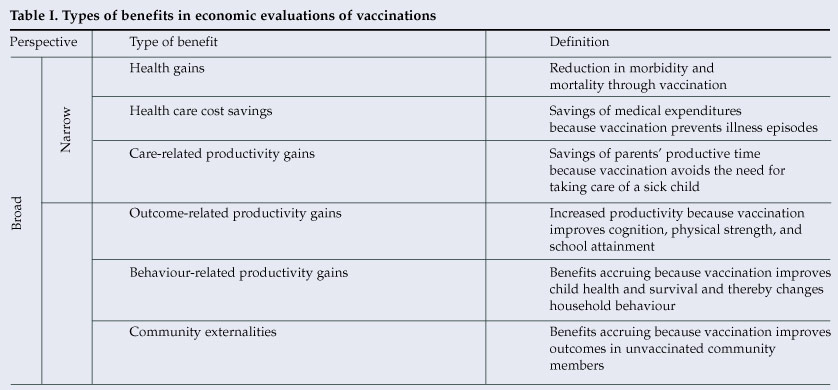
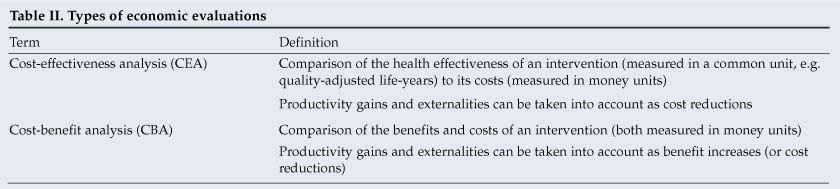
Most economic evaluations of vaccinations focus heavily on the benefits of avoided health care costs (Table I). While it is theoretically possible to take productivity gains into account in economic evaluation (Table II), traditionally, evaluations of vaccinations have either not considered such gains or have only included one particular type of gain: the value of the time that parents would have spent caring for a sick child had a disease episode not been averted by vaccination (care-related productivity gains, Table I).4Table I). Cost-benefit analyses (CBAs) in developing countries find return on investment in vaccinations (due to improved cognitive development and worker productivity)56
A narrow focus on care-related productivity gains further excludes increases in productivity due to changes in behaviour in response to vaccination effects (behaviour-related productivity gains, Table I). Many vaccinations significantly reduce child mortality from infectious diseases. As child mortality declines, parents realise that they can give birth to fewer children to attain their desired minimum number of offspring.7
Most economic evaluations of vaccinations also do not consider the value of externalities in the wider community, i.e. the effect of a child's vaccination on non-vaccinated community members. Such community externalities (Table I) include reductions in infection rates in unvaccinated people because vaccinations reduce the probability that a healthy individual will encounter an infectious person (up to the point of herd immunity, where sufficient numbers of people are vaccinated such that infection of one individual will not result in an epidemic). They also include decreased rates of antibiotic resistance because less antibiotics are used when more children are protected by vaccination against bacterial infections.
Applying the broad perspective to value of vaccination in South Africa
Taking a broad perspective may be especially important in evaluating vaccinations in South Africa (Table I). From 1976 to 2006, the proportion of the South African population younger than 15 years of age fell from 42% to 32%891087
Health is an important form of human capital, including health attained through vaccinations. South Africa has made great strides in increasing coverage of basic childhood immunisation. The South African Demographic and Health Survey reported coverage with routine vaccines in children 12 - 23 months of age ranging from 62% for measles vaccination to 81% for bacille Calmette-Guérin (BCG) vaccination in 2003.11
Vaccinations have contributed significantly to South Africa's decline in child mortality. From 1975 to 1990, under-5 mortality declined by almost half, from 110 to 60 deaths per 1 000 live births.91211
Many interventions that could reduce child mortality in South Africa - such as improved access to safe water and sanitation, improved childhood nutrition, or poverty reduction - require large infrastructure investment or sustained changes in social policy. In this situation, the recent decision by the South African Department of Health to add PCV and rotavirus vaccinations to the national immunisation schedule, despite their comparatively high prices,13
Pneumococcal diseases are a major cause of childhood mortality and morbidity in South Africa.141514
PCV is further likely to lead to considerable outcome-related productivity gains. First, episodes of pneumococcal pneumonia will keep children, especially those who are HIV-infected, out of school for substantial periods of time, preventing cognitive development and learning.1617181920
Moreover, PCV coverage is likely to benefit unvaccinated community members. It decreases the rate of occurrence of antibiotic-resistant pneumococcal infections,212223
Conclusions
South Africa has proven its commitment to ensuring that children receive effective vaccines, attaining high national vaccination coverage levels. In 2006 the country pledged $20 million to the International Finance Facility for Immunization (IFFIm), the major source of finance for the GAVI Alliance's effort to extend coverage with new and under-used vaccines to low-income countries.2425
The authors acknowledge financial support from The Pneumococcal Vaccines Accelerated Development and Introduction Plan (PneumoADIP) at the Johns Hopkins Bloomberg School of Public Health in connection with a multi-country research project on the value of vaccination.
References
- 1. UNICEF. The State of the World's Children 2008. New York: UNICEF, 2007.
-
2. World Health Organization. Vaccine-preventable disease. 2008. http://www.who.int/immunization_monitoring/diseases/en/ (accessed 4 September 2008).
» http://www.who.int/immunization_monitoring/diseases/en/ -
3. Schultz TP. Evidence of returns to schooling in Africa from household surveys: monitoring and restructuring the market for education. 2003. http://www.econ.yale.edu/growth_pdf/cdp875.pdf (accessed 28 September 2008).
» http://www.econ.yale.edu/growth_pdf/cdp875.pdf - 4. Ehreth J. The global value of vaccination. Vaccine 2003; 21: 596-600.
- 5. Bloom D, Canning D, Weston M. The value of vaccination. World Economics 2005; 6: 15-39.
- 6. Psacharopoulos G, Patrinos H. Returns on investment in education: a further update. Education Economics 2004; 12: 111-134.
- 7. Bloom D, Canning D, Sevilla J. The Demographic Dividend. Santa Monica, USA: RAND, 2003.
- 8. World Bank. World Development Indicators. Washington, DC: World Bank, 2008.
- 9. Moultrie TA, Timaeus IM. Trends in South African Fertility between 1970 and 1998. Cape Town: South African Medical Research Council, 2002.
- 10. Zaba B, Gregson S. Measuring the impact of HIV on fertility in Africa. AIDS 1998; 12: Suppl 1, S41-50.
- 11. Department of Health, Medical Research Council. South Africa Demographic and Health Survey 2003. Pretoria: Department of Health, 2007.
-
12. Nannan N, Bradshaw D, Timaeus IM, Dorrington R. The impact of HIV/AIDS on infant and child mortality in South Africa. In: 16th International Conference on AIDS, 2000, Durban, South Africa. http://gateway.nlm.nih.gov/MeetingAbstracts/ma?f=102238260.html (accessed 7 October 2008).
» http://gateway.nlm.nih.gov/MeetingAbstracts/ma?f=102238260.html -
13. Ngcobo M. Improved pneumonia vaccine, but not for poor. 2007. http://www.health-e.org.za/news/article.php?uid=20031704 (accessed 8 September 2008).
» http://www.health-e.org.za/news/article.php?uid=20031704 - 14. Madhi SA, Kuwanda L, Cutland C, Klugman KP. The impact of a 9-valent pneumococcal conjugate vaccine on the public health burden of pneumonia in HIV-infected and -uninfected children. Clin Infect Dis 2005; 40: 1511-1518.
- 15. Zar HJ, Madhi SA. Pneumococcal conjugate vaccine - a health priority. S Afr Med J 2008; 98: 463-467.
- 16. Heiskanen-Kosma T, Korppi M, Leinonen, M. Serologically indicated pneumococcal pneumonia in children: a population-based study in primary care settings. Apmis 2003; 111: 945-950.
- 17. Goetghebuer T, West TE, Wermenbol V, et al. Outcome of meningitis caused by Streptococcus pneumoniae and Haemophilus influenzae type b in children in The Gambia. Trop Med Int Health 2000; 5: 207-213.
- 18. Teele DW, Klein JO, Chase C, Menyuk P, Rosner BA. Otitis media in infancy and intellectual ability, school achievement, speech, and language at age 7 years. Greater Boston Otitis Media Study Group. J Infect Dis 1990; 162: 685-694.
- 19. Tuomanen EI. Pathogenesis of pneumococcal inflammation: otitis media. Vaccine 2000; 19: Suppl 1, S38-40.
-
20. Berke J. Ways to help deaf people in developing countries. 2007. http://deafness.about.com/od/deafcommunity/a/waystohelp.htm (accessed 1 September 2008).
» http://deafness.about.com/od/deafcommunity/a/waystohelp.htm - 21. Kyaw MH, Lynfield R, Schaffner W, et al. Effect of introduction of the pneumococcal conjugate vaccine on drug-resistant Streptococcus pneumoniae. N Engl J Med 2006; 354: 1455-1463.
- 22. Ray GT, Whitney CG, Fireman BH, Ciuryla V, Black SB. Cost-effectiveness of pneumococcal conjugate vaccine: evidence from the first 5 years of use in the United States incorporating herd effects. Pediatr Infect Dis J 2006; 25: 494-501.
- 23. Beutels P, Thiry N, Van Damme P. Convincing or confusing? Economic evaluations of childhood pneumococcal conjugate vaccination - a review (2002 - 2006). Vaccine 2007; 25: 1355-1367.
- 24. GAVI Alliance. GAVI Alliance Progress Report 2007. Geneva: GAVI Alliance, 2007.
- 25. Govender S. South Africa: milestone vaccine rollout to fight infant mortality. 2008. http://allafrica.com/stories/200809120703.html (accessed 18 September 2008).