Pregnancy and H1N1 influenza: lessons to learn
Pregnancy, with or without additional complications, constitutes a high-risk condition for complications of influenza infection and warrants early intervention with neuraminidase inhibitors such as oseltamivir, if influenza is suspected. Treatment should not be delayed for laboratory confirmation. In South Africa, the high burden of HIV infection is a further complication.
Pregnancy and H1N1 influenza : lessons to learn
J MoodleyI; L BlumbergII; B D SchoubIII
IMB ChB, FCOG (SA), FRCOG (UK), MD. Department of Obstetrics and Gynaecology, and Women's Health and HIV Research Unit, Nelson R Mandela School of Medicine, University of KwaZulu-Natal, Durban
IIMB BCh, MMed, DTM&H, DCH, DOH. National Institute for Communicable Diseases, National Health Laboratory Service, Johannesburg
IIIMB BCh, MMed, MD, DSc, FRCPath, FCPath (SA), FRSSAf, MASSAf. National Institute for Communicable Diseases, National Health Laboratory Service, Johannesburg
Pregnancy, with or without additional complications, constitutes a high-risk condition for complications of influenza infection and warrants early intervention with neuraminidase inhibitors such as oseltamivir, if influenza is suspected. Treatment should not be delayed for laboratory confirmation. In South Africa, the high burden of HIV infection is a further complication.
To the Editor: Pregnancy has long been recognised as a risk factor for both pandemic and seasonal influenza. Changes in the immune, cardiac and respiratory systems increase the risk of complications, as evidenced by higher hospitalisation and mortality rates in pregnant women during influenza outbreaks. The 2009 H1N1 pandemic was no exception.1 2
Further information on pH1N1 in pregnancy in South Africa was provided from an analysis of 11 deaths reported to the National Committee on Confidential Enquiries into Maternal Deaths in South Africa between July and September 2009.3<200 cells/µl. None of the HIV-infected women was on antiretroviral therapy. Seven cases required ventilation. Most cases presented with cough, fever, diarrhoea, muscle aches and breathlessness, and had symptoms for 3 - 4 days before seeking medical attention. In some, severe illness (pneumonia and respiratory distress syndrome) developed very rapidly. Laboratory tests for H1N1 were not performed on admission to hospitals because H1N1 was not initially considered.
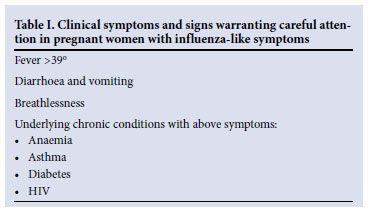
It is now universally accepted that pregnancy, with or without additional complications, constitutes a high-risk condition for complications of influenza infection and warrants early intervention with neuraminidase inhibitors such as oseltamivir, if influenza is suspected (Table I). Treatment should not be delayed for laboratory confirmation. Although not ideal, delayed administration (over 48 hours) could still reduce maternal morbidity and mortality. The regular dose of oseltamivir is 75 mg bd for 5 days; however, if circumstances warrant it, a higher dose of 150 mg bd for a longer period may be necessary. Laboratory confirmation is by PCR; presently available point-of-care tests such as antigen detection are inadequately sensitive and should not be relied on to confirm diagnosis. Caesarean section does not appear to improve maternal outcome4
In very ill patients, respiratory ventilation may be required. In our case series, 3 of the 11 patients required assisted respiration in an ICU. Patients with severe symptoms should have oxygen saturation monitoring and arterial blood gases performed. Antipyretics such as paracetamol are recommended to reduce fever in the first trimester as hyperpyrexia in early pregnancy has been associated with congenital abnormalities such as neural tube defects, cleft palate and congenital heart defects.4
References
- 1. Jamieson DJ, Honein MA, Rasmussen SA, et al. Novel Influenza A (H1N1) Pregnancy Working Group. H1N1 2009 influenza virus infection during pregnancy in the USA. Lancet 2009;374(9688):451-458.
- 2. Archer B, Cohen C, Naidoo D, et al. Interim report on pandemic H1N1 influenza virus infections in South Africa, April to October 2009: epidemiology and factors associated with fatal cases. Euro Surveill 2009;14 (42):pii 19369.
- 3. Saving Mothers Report of the National Committee on Confidential Enquiries into Maternal Deaths 2005-2007. Pretoria: National Department of Health, 2009.
- 4. Saleeby E, Chapmen J, Morse J, Byrant A. H1N1 influenza in pregnancy. Obstet Gynecol 2009;114(4):885-891.