High prevalence of hookah smoking among secondary school students in a disadvantaged community in Johannesburg
A CombrinkI; N IrwinI; G LaudinI; K NaidooI; S PlagersonII; A MatheeIII
IMB ChB. Faculty of Health Sciences, University of the Witwatersrand, Johannesburg
IIPhD. Environment and Health Research Unit, South African Medical Research Council, Johannesburg
IIIPhD. Environment and Health Research Unit, South African Medical Research Council, Johannesburg, and Faculty of Health Sciences, University of Johannesburg
To the Editor: Smoking of hookahs (also known as water-pipes) represents an emerging trend in tobacco use.1 2
Methods
The Health, Environment and Development study,3 N=202) in the four classes were from 14 - 20 years (mean 16.3 years). Three students elected not to participate.
Results
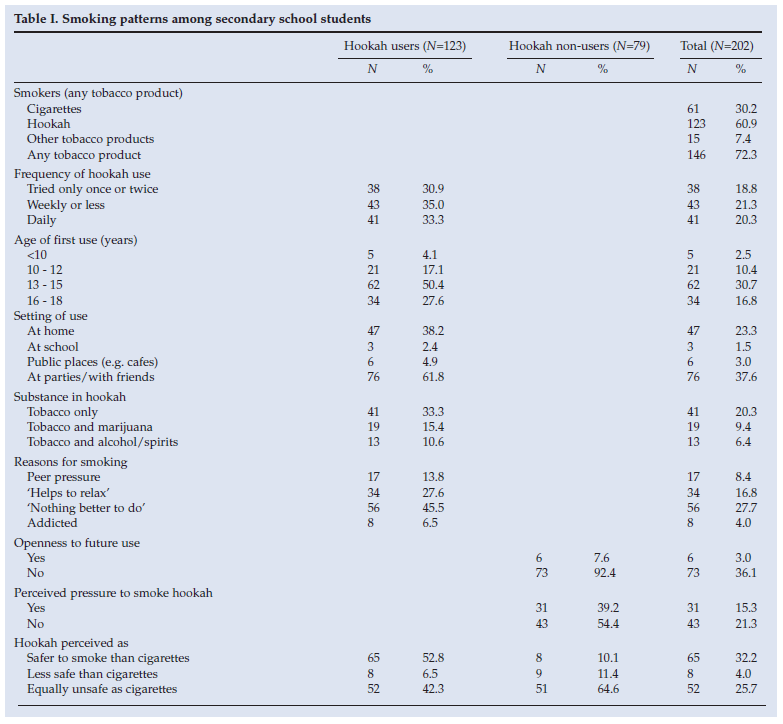
The survey findings are summarised in Table I; 72% of respondents reported having used a tobacco product, including over 60% who said they had used or were using hookahs at the time of the study. A third of hookah users and a fifth of the entire sample reported daily use. Most respondents started smoking hookahs between the ages of 13 and 15, while 21% had started when <12 years old. The most common setting for smoking was social occasions (such as parties), with many also reporting home use. While the norm was to use tobacco in the hookah, significant numbers also reported using marijuana and/or alcohol-based products in combination with tobacco. Almost 10% of the total sample reported using marijuana in hookahs. The most common reason for smoking a hookah was the absence of alternative recreation ('nothing better to do'); other reasons were peer pressure, relaxation and addiction.
Among non-users, the vast majority said they would not consider smoking a hookah in the future; however, 39% had been subjected to pressure from peers to do so. Hookahs were perceived to be safer than cigarettes by most users, but as equally unsafe by the majority of non-users.
Discussion
The survey highlighted an alarmingly high rate of hookah use among the schoolchildren surveyed. Sixty per cent of study participants reported use of a hookah, including 20% who reported daily use, which is comparable with the rates observed among youths in settings where the use of hookahs is traditional.4 5
Though conducted on a small scale, our study plays an important role in bringing to light the disturbingly high prevalence of hookah smoking in one community, and points to an urgent need to conduct research on a nation-wide basis to determine the extent of hookah smoking in South Africa and the factors associated with its use. The reasons given by participants for commencing hookah smoking (e.g. boredom and a lack of recreational opportunities) imply a probable need for social and public health interventions that provide safer recreational alternatives to urban youth in Johannesburg and very likely elsewhere in South Africa.
References
- 1. Maziak W, Ward D, Afifi S, Soweid R, Eissenberg T. Tobacco smoking using a waterpipe: a re-emerging strain in a global epidemic. Tobacco Control 2004; 13(4): 327-333.
- 2. WHO. Waterpipe Tobacco Smoking: Health EffectsResearch Needs and Recommended Actions by Regulators. Geneva: World Health Organization, 2005.
- 3. Mathee A. Indicators of Health, Environment and Development: A Longitudinal Study in Johannesburg 2006-2008. Johannesburg: World Health Organization Collaborating Centre for Urban Health, 2009.
- 4. Afifi R, Yeretzian J, Rouhana A, Nehlawi M, Mack A. Neighbourhood influences on narghile smoking among youth in Beirut. Eur J Publ Health 2009; 2 Nov [epub ahead of print]
- 5. Roskin J, Aveyard P. Canadian and English students' beliefs about waterpipe smoking: a qualitative study. BMC Publ Health 2009; 10(9): 10.