Hereditary C1 esterase deficiency in a Zulu kindred
E MoranI; G S IsaacsII; B NaidooII; D J PudifinIII
IMB BCh, PhD, MRCP. John Radcliffe Hospital, Oxford, UK; and formerly of Hlabisa Hospital, Hlabisa, KwaZulu-Natal
IIMB ChB. Department of Medicine, King Edward VIII Hospital, Durban
IIIMB ChB, FCP (SA), FRCP. Nelson Mandela School of Medicine, University of KwaZulu-Natal, Durban
To the Editor: Hereditary angio-oedema is a rare genetic disorder characterised by recurrent episodes of potentially life-threatening angio-oedema. Despite the apparent absence of variation in incidence among ethnic groups, this is the first reported series in a sub-Saharan African family, and it is likely that the disease remains largely undiagnosed in southern Africa. Although cost and availability limit the use of certain treatments which are available in resource-rich health systems, early diagnosis allows patient education and the initiation of less costly, more widely available prophylactic medications that are life-saving in individuals at risk of severe attacks. The diagnosis should be considered in the differential diagnosis of those presenting with apparent allergies and drug reactions.
Case description and diagnosis
Several family members who had all experienced repeated episodes of angio-oedema were seen at Hlabisa District Hospital and King Edward VIII Hospital. The first (NM1), a 16-year-old girl, presented twice to Hlabisa with acute onset facial swelling and respiratory difficulty. The swelling of her face and tongue was unresponsive to intramuscular adrenaline and intravenous steroids. On both occasions, she developed stridor and required endotracheal intubations when severe laryngeal oedema was noted. The oedema settled spontaneously over 2 -3 days. She had had similar, milder episodes about twice a year over the previous 10 years, and other family members had similar episodes.
The second patient (NM2), a 14-year-old cousin of NM1, was well at the time of assessment. She gave a history of attacks of swelling of the lips, face and neck which had started at a young age and resolved spontaneously. She said her brother experienced similar attacks and that her father had died as a result of a severe episode.
NM3, the 12-year-old brother of NM1, presented to Hlabisa with spontaneous facial swelling which subsided after the administration of freeze-dried plasma. Similar episodes had occurred about twice a year over the previous 5 years.
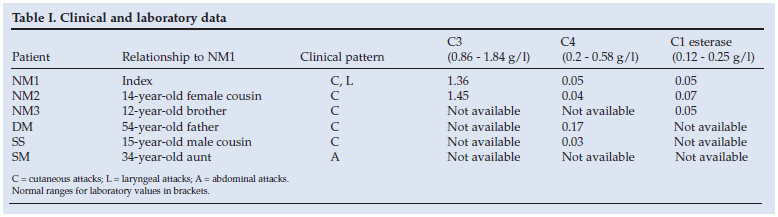
There were no identifiable precipitating factors for the angio-oedema in the 3 patients, and they were otherwise well and physically normal. Since circumstances strongly suggested the diagnosis of familial angio-oedema, complement function was investigated, which confirmed a low C4 level and deficiency of C1 esterase in all 3.
Three other family members (SS, DM and SM) were seen only once as outpatients, and limited data are available (Table I). SS and DM had experienced mild cutaneous episodes. SM, the 34-year-old aunt of NM1, had experienced recurrent episodes of abdominal pain, sometimes associated with facial swelling. A laparotomy and cholecystectomy had been performed following ultrasound demonstration of a single gallstone, but episodes of pain persisted. There were no abnormal signs apart from mild generalised abdominal tenderness during the attacks, which always settled spontaneously over a few days. Full blood count, serum urea, electrolytes and liver function were normal when the patient was seen.
These findings indicate that this kindred of African/Zulu descent harbours one of the mutations giving rise to deficiency of C1 esterase, and this is believed to be the first report of this abnormality in this ethnic group. (The literature search was performed using Pubmed, and the terms Africa and African and Zulu in combination with each of C1 esterase inhibitor, hereditary angio-oedema and hereditary angioedema. Although cases have been identified in North Africa and North America among individuals described as 'African-American', there were no cases reported among those of confirmed sole sub-Saharan African descent.)
Pathogenesis and clinical features of hereditary angio-oedema
Hereditary angio-oedema (HA) is a rare autosomal dominant disorder characterised by recurrent episodes of angio-oedema without urticaria or pruritus. Incidence is estimated at around 1/50 000, with no described variation between ethnic groups. Most commonly affecting the skin and tissues of the upper airways, attacks are self-limited but laryngeal involvement can lead to airway obstruction and death. It is a consequence of either a deficiency (type 1 - 85% of affected families) or a dysfunction (type 2) of C1 inhibitor (C1-INH) - a protein that prevents complement activation by both the classic route and the mannan-binding pathway.1 1
Although attacks of angio-oedema may occur spontaneously with no obvious precipitant, some patients may be able to identify specific triggers such as dental work, mild trauma, stress, excitement, certain foods, oestrogen, menstruation, and angiotensin-converting enzyme (ACE) inhibitors. A prodrome of mood or skin changes may precede an episode. Attacks may be cutaneous, abdominal or laryngeal1
Cutaneous attacks tend to affect the hands, feet, face and genitals, with swelling lasting 2 -4 days. Abdominal attacks cause pain, nausea, vomiting and diarrhoea (because of bowel wall oedema). Most patients experience an abdominal attack at some point in their lives that lasts around 4 days, with symptoms peaking on day 2. Resemblance to the acute surgical abdomen leads to unnecessary surgery in around a third of patients with undiagnosed HA (as in SM). Laryngeal attacks occur in half of all patients at some point in their lives, and are less common after the age of 45 years. They can occur in the absence of swelling of the upper airway and lips. It usually takes a few hours to progress from first symptom to potential airway obstruction, but obstruction can occur within half an hour of first symptom.
Diagnosis and treatment
Initial screening is by measuring C4 and C1 inhibitor levels in a patient with a suggestive personal or family history (e.g. repeated episodes of facial swelling or abdominal pain or an affected relative). Both levels are likely to be reduced in an affected individual; 90% of HA patients have low C4 levels even when asymptomatic, and most have low C4 levels during attacks. A normal C4 in an asymptomatic patient does not exclude HA.2
If a patient with possible HA has no family history or is older than 40 years at first presentation, a rare form of acquired C1-INH deficiency is possible. The diagnosis is suggested by low C1q and C4 levels. Such patients should be screened for malignancy, as 85% are found to have lymphoproliferative disorders. Genetic studies may be required. In addition to acquired C1-INH deficiency, the differential diagnosis for HA includes autoimmune disease (e.g. systemic lupus erythematosus, which may cause an isolated low C4), allergy, anaphylaxis, idiopathic or drug-induced angio-oedema, and parasitic infection.
Treatment of acute attacks
Swift emergency management of laryngeal attacks can be life saving; airway management is paramount, and severely affected individuals may require urgent intubation or cricothyroidotomy. Antihistamines, steroids and adrenaline are not effective but are often given, particularly if the diagnosis is in doubt or not confirmed. The most effective medical treatment for acute episodes of HA is intravenous C1 esterase inhibitor protein,3 4 5 1,6 It is most effective if given early in the course of symptoms; its mechanism of action is unclear. Symptomatic therapy for pain, vomiting and abdominal cramps should also be given.
Prophylaxis of attacks
Synthetic androgens such as danazol are effective in short- and long-term prophylaxis by increasing hepatic production of C1-INH, but have significant side-effects.7 3
Non-medical measures important in the long-term management of HA include education and avoidance of any identified trigger. Patients should be counselled to seek early hospital care, particularly if they have a record of laryngeal attacks, and be provided with an emergency treatment plan to show to hospital emergency departments to facilitate prompt effective therapy.
References
- 1. Gompels MM, Lock RJ, Abinun M, et al. C1 inhibitor deficiency: consensus document. Clin Exp Immunol 2005; 139(3): 379-394.
- 2. Karim Y, Griffiths H, Deacock S. Normal complement C4 values do not exclude hereditary angioedema. J Clin Pathol 2004; 57(2): 213-214.
- 3. Cicardi M, Zingale LC, Zanichelli A, Deliliers DL, Caccia S. The use of plasma-derived C1 inhibitor in the treatment of hereditary angioedema. Expert Opin Pharmacother 2007; 8(18): 3173-3181.
- 4. Prematta M, Gibbs JG, Pratt EL, Stoughton TR, Craig TJ. Fresh frozen plasma for the treatment of hereditary angioedema. Ann Allergy Asthma Immunol 2007; 98(4): 383-388.
- 5. Davis AE 3rd. New treatments addressing the pathophysiology of hereditary angioedema. Clin Mol Allergy 2008; 6: 2.
- 6. Sheffer AL, Austen KF, Rosen FS. Tranexamic acid therapy in hereditary angioneurotic edema. N Engl J Med 1972; 287(9): 452-454.
- 7. Bork K, Bygum A, Hardt J. Benefits and risks of danazol in hereditary angioedema: a long-term survey of 118 patients. Ann Allergy Asthma Immunol 2008; 100(2): 153-161.