Namaqua dwarf adder (Bitis schneideri) envenomation
Bryan Maritz
BSc (Hons), MSc. School of Animal, Plant and Environmental Sciences, University of the Witwatersrand, Johannesburg
Correspondence
To the Editor: Both snake envenomation and its treatment are poorly understood. Given the potential for variation in snakebite severity and symptoms,1(Bitis schneideri) is limited to a single case report from southern Namibia.2B. schneideri from 2 localities on the Namaqualand coast in Northern Cape Province.
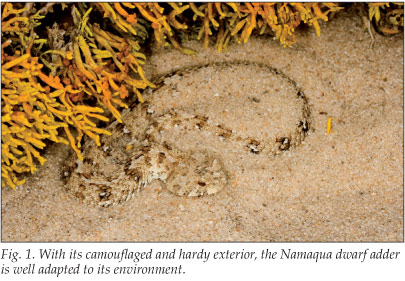
The Namaqua dwarf adder is a small (mean adult total length 214 mm; mean adult mass 14 g) viperid snake that occurs along the west coast of southern Africa (Fig.1).3B. schneideri and the low human population density throughout most of its range results in few humans being bitten by this species. However, envenomations do occur in urbanised areas within the distribution. B. schneideri is also dealt with in the pet trade,4
Case 1
A 23-year-old man was bitten on the proximal interphalangeal joint of the middle finger of his right hand while attempting to place the snake in a bag. The snake was a small juvenile female (total length 129 mm; mass 3.4 g). The patient described immediate pain 'similar to a bee sting'. The site of the bite remained sensitive and slightly discoloured for approximately 18 hours. All symptoms had passed within 24 hours. The patient received no treatment.
Case 2
A 25-year-old man was bitten behind the wrist by an adult male snake (total length 244 mm; mass 17.7 g). He did not experience immediate pain; within 15 minutes there were signs of localised swelling, and he described numbness at the site of the bite, but remained pain-free. Within 30 minutes, the swelling and redness had spread up the arm, a distance of about 150 mm. All symptoms disappeared within 30 hours of the bite. At no stage did the victim complain of pain.
Case 3
A man in his mid-thirties was bitten on the hand when he picked up a specimen of the snake. After about 4 hours, his arm swelled to above the elbow. He was taken to hospital, given an antihistamine and painkiller, and kept overnight for observation. The swelling subsided overnight and he was released the next day. Though details of this bite are limited, the known treatment indicates that the patient experienced both pain and swelling, but no further symptoms.
Case 4
A boy of about 10 years of age was bitten on the foot while running on a beach. He was immediately taken to hospital, given an antihistamine and painkiller, kept overnight for observation and released the following day. He experienced pain but limited swelling and no other major symptoms.
Conclusion
The venom of B. schneideri is generally not dangerous and very unlikely to result in fatalities in human victims. It is not used in the production of polyvalent anti-venom.5
I thank Andre van Wyk for sharing the details of cases 3 and 4, and Alain Hocepied, Gavin Masterson, Bruce Wessels and Rose Sephton-Poultney for their contributions.
References
- 1. Fry BG, Winkel KD, Wickramaratna JC, Hodgson WC, Wuster W. Effectiveness of snake antivenom: species and regional venom variation and its clinical impact. J Toxicol 2003; 22(1): 23-34.
- 2. Hurrell DP. Namaqua dwarf adder bite. S Afr Med J 1981; 59: 491-492.
- 3. Branch WR. Field Guide to the Snakes and Other Reptiles of Southern Africa. 3rd ed. Cape Town: Struik Publishers, 1998: 399.
- 4. Auliya M. Hot Trade in Cool Creatures: A Review of the Live Reptile Trade in the European Union in the 1990s with a focus on Germany. Brussels, Belgium: TRAFFIC Europe, 2003: 105.
-
5. South African Vaccine Producers. SAVP products: equine antivenoms. www.savp.co.za/Products. htm (accessed 18 May 2008).
» www.savp.co.za/Products. htm
 Correspondence:
B Maritz
(