Medical management of 'failing' Kasai portoenterostomy
The only effective treatment for 'failing' Kasai portoenterostomy is liver transplantation (LT). However, to maximise a patient's chances to achieve the proclaimed >95% survival with sequential surgical management, medical follow-up and treatment must be planned carefully. This includes routine fat-soluble vitamin supplementation with choleretics, aggressive nutritional support, regular ultrasonography, optimal general paediatric care, and psychological support for the family once complications arise. Careful timing of LT is of critical importance, although recent trends include earlier consideration of LT in children with biliary atresia. This management can only be offered through centralised, specialised national services. Due to its ramifications in paediatric surgery, dietetics, metabolic, social, adolescent and transplantation medicine, paediatric hepatology is a fine example of patient care that is genuinely multidisciplinary.
FORUM
REVIEW
Medical management of 'failing' Kasai portoenterostomy
N Hadzic
Professor Nedim Hadzic has been a leading paediatric hepatologist in arguably the world's busiest Paediatric Liver Unit, at King's College, London, UK, since 1994. He trained at the University Children's Hospital in Sarajevo, Bosnia-Herzegovina, and the Institute of Child Health/Great Ormond Street Hospital, London. His research interests include biliary atresia, alpha-1-antitrypsin deficiency, liver involvement in primary immunodeficiencies and haematopoietic stem cell transplantation, autoimmune liver disease and liver transplantation. His publication record includes more than 130 articles in international journals and 12 book chapters. He is frequently invited to lecture nationally and internationally. In 2012 he was awarded a personal Chair in Paediatric Hepatology at King's College Medical School, University of London
Corresponding author
ABSTRACTThe only effective treatment for 'failing' Kasai portoenterostomy is liver transplantation (LT). However, to maximise a patient's chances to achieve the proclaimed >95% survival with sequential surgical management, medical follow-up and treatment must be planned carefully. This includes routine fat-soluble vitamin supplementation with choleretics, aggressive nutritional support, regular ultrasonography, optimal general paediatric care, and psychological support for the family once complications arise. Careful timing of LT is of critical importance, although recent trends include earlier consideration of LT in children with biliary atresia. This management can only be offered through centralised, specialised national services. Due to its ramifications in paediatric surgery, dietetics, metabolic, social, adolescent and transplantation medicine, paediatric hepatology is a fine example of patient care that is genuinely multidisciplinary.
Biliary atresia (BA), a progressive chronic cholangiopathy affecting 1/8 000 - 1/17 000 live births, is the most common cause of chronic liver disease (CLD) in children and a considerable burden for public health resources.11,2 BA is by far the most common indication for liver transplantation (LT) in children, with reported 1- and 5-year patient survival rates of between 85% and 95% in the majority of experienced centres.2,3
The primary LT approach for infants who present timely with BA has been discouraged.34
What is failed Kasai portoenterostomy?
Kasai portoenterostomy (KPE) procedure aims to restore bile flow, which is the main prerequisite for the loss of clinical jaundice. The surgical success of KPE is conventionally defined as complete normalisation of serum bilirubin at either 6 or 12 months of age.1
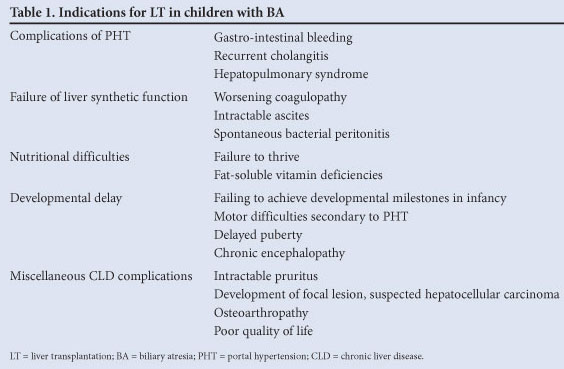
However, the clearance of jaundice does not necessarily equate with the absence of CLD complications (for categorisation see Table 1), although many complications overlap in clinical practice. The most common indications for considering LT in children with BA are abdominal distension secondary to synthetic function failure (ascites) and recurrent gastro-intestinal bleeding.
Non-surgical management after KPE
Children with partially successful KPE must be monitored 3-monthly with abdominal ultrasound to assess: (i) arterial flow (hepatic artery resistance index); (ii) the progression of splenomegaly; and (iii) the development of focal lesions. Most focal lesions are non-vascularised regenerative nodules (nodular regenerative hyperplasia) within cirrhotic livers, but about 1 - 2% of BA children develop hepatocellular carcinoma (HCC), which could also be an incidental finding at the time of LT.55
There is little scientific evidence for the long-term benefits of pharmacological treatment in BA. The use of steroids in the immediate post-operative period is discussed elsewhere. Choleretic medications, such as ursodeoxycholic acid (UDCA), phenobarbitone or low-dose rifampicin, are often used. Cholestyramine can be helpful for clearing jaundice in the early post-operative stages, but its interference with the gastro-intestinal absorption of other nutrients outweighs its medium-to long-term benefits.
Nutritional care after KPE
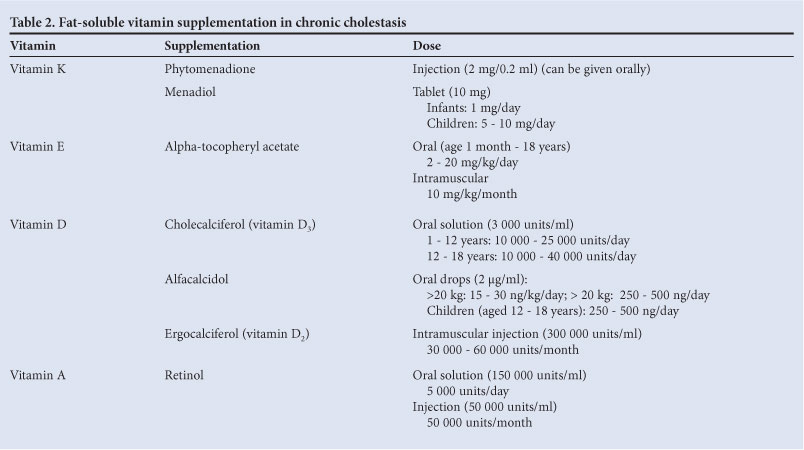
The supportive role of adequate nutrition after corrective surgery for BA cannot be overemphasised.67Table 2.
Nutritional interventions include special medium-chain triglyceride-based milk formulas, which do not require bile salts for effective intestinal absorption. These formulas are often constituted in more concentrated, smaller volumes to counteract the mechanical effects of PHT in these children. The next step in nutritional management is naso-gastric feeding (either partial at the end of each feed or continuous overnight). The effects are often dramatic on nutritional condition, neurological development and the number of infections, and occasionally on symptoms such as jaundice and itching.8,9 The patients' families usually have no difficulty managing infusion pumps and specialised formulas at home.
Percutaneous endoscopic gastrostomy (PEG) feeding, which has a clear role in managing other forms of nutritional difficulties in childhood, is best avoided in children with CLD. Most of these children have PHT, which often becomes more significant with PEG insertion, leading to worsening of the existing PHT and often to peristomal varices and associated complications. In all forms of nutritional support, it is important to maintain a regular oral intake (no matter how small) during infancy. Failure to do so could lead to ongoing behavioural feeding difficulties, which are very resistant to management, even after successful LT.
Total parenteral nutrition (TPN) is rarely required in children with end-stage CLD secondary to BA. Presently, such patients should be listed for LT before becoming severely malnourished. TPN also aggravates jaundice and possibly increases the risk of vascular access-related infectious complications and septicaemias, which could be life-threatening in end-stage CLD. Optimising nutritional status prior to LT appears to have a beneficial effect on outcome.49
Symptomatic management
The most challenging cases for medical management post-KPE include children who have not completely cleared their jaundice, but do not yet qualify for LT. Common problems include nose bleeding, easy bruising, itching, tiredness and lack of concentration, with suboptimal academic achievements. Fat-soluble vitamin supplementation, including vitamin K, is all that can be arranged for the coagulopathy, with occasional additional parenteral vitamin K (10 mg) during intercurrent infections, if required. With significant splenomegaly, there is anecdotal experience of a potential risk for rupture following direct abdominal trauma, but the real risks are difficult to quantify. We typically recommend that children with splenomegaly and platelet counts <100x109
Chronic pruritus, secondary to abnormal bile flow and retention of pruritogenic chemicals, including bile acids, usually heralds decompensation of the liver disease. This symptom is usually not as severe as in other conditions such as progressive familial intrahepatic cholestasis or Alagille syndrome. To alleviate the itching, we recommend UDCA (20 mg/kg/day) and rifampicin (up to 10 mg/kg/day), before attempting antihistamines such as alimemazine, opiate- (naltrexone) or serotonin-antagonists (ondansetron).10
Re-emergence of jaundice after KPE
After KPE, the remodelled biliary substitute has very little or no peristalsis, which is a physiological deterrent for microbial invasion of the biliary system. The bile is sterile under normal circumstances. The most common infectious complication in children with BA is ascending cholangitis (AC), which is often caused by intestinal micro-organisms.11
AC typically occurs in children who have practically cleared jaundice; those with poor bile flow usually develop different, more dramatic CLD complications. The additional inflammation of the biliary system could worsen chronic post-KPE histological changes in the liver.11bona fide indication for LT.
Occasionally, children with BA develop sudden jaundice with no systemic symptoms. In such children, ultrasonography plays a limited role and hepatobiliary scintigraphy is indicated to assess biliary excretion and possible mechanical problems with bile flow. These children could benefit exceptionally from surgical exploration and refashioning of the Roux-en-Y loop,12
Management of PHT
Children with BA almost inevitably develop chronic biliary disease, which often leads to PHT and associated complications.1313141415
Standard measures to control PHT in children with all forms of CLD, including BA, include upper and lower gastro-intestinal endoscopy with variceal banding or sclerotherapy, when indicated. The stools of children with BA are often positive for occult blood, particularly in the first several months after initial surgery. However, any sudden drop in haemoglobin or haematocrit is an indication for endoscopy, irrespective of whether it has been associated with haematemesis, haematochezia or melaena. Some children with PHT develop anorectal varices which also occasionally require sclerotherapy. Exceptionally, additional tests such as barium contrast studies, Meckel's scintigraphy or haemolytic screening are required. Our centre does not perform elective surveillance endoscopies in children with BA due to reliable clinical follow-up based on non-invasive markers (platelet count, portal vein and hepatic artery flows, and hepatic artery resistance on Doppler ultrasound). Furthermore, there are logistical difficulties in scoping all children with BA and anecdotal evidence of triggering gastro-intestinal bleeding following endoscopic intervention. The role of propranolol in primary prevention and post-bleeding management of oesophageal varices in childhood remains controversial.1617
The development of abdominal distension and ascites is a harbinger of terminal hepatic decompensation. Combinations of spironolactone (up to 8 mg/kg/day), albumin infusions and sodium restriction could induce short-term recompensation, but the next step should be consideration for LT. It is important to rule out spontaneous bacterial peritonitis by diagnostic paracentesis and to consider antibiotic prophylaxis (ciprofloxacin or norfloxacin) until LT, if cytology suggests >300 cells/ml of aspirate. Tolvaptan, a selective vasopressin V2-receptor antagonist, is the novel oral medication which is increasingly used in hypervolaemic and euvolaemic hyponatraemia.18
Hepatopulmonary syndrome
Hepatopulmonary syndrome (HPS) is a rare complication of intrahepatic PHT which leads to chronic intrapulmonary vasodilatation and abnormal alveolar-arterial oxygenation.151914
HPS diagnosis is made by a combination of clinical features, such as peripheral and lip cyanosis, chronic fatigue, exertional dyspnoea and clubbing, associated with arterial hypoxaemia and increased intrapulmonary shunting (usually above 6-8% threshold) on tehnetium-labelled macro-aggregated scintigraphy. Echocardiography should always be performed to exclude cardiac pathology and the development of primary pulmonary hypertension; bubble contrast echocardiography in adults is more valuable than in children to discriminate intracardiac shunting. Orthodeoxia, a drop in oxygen saturation associated with vertical posture, is characteristically present in HPS, but not in porto-pulmonary hypertension, which is much more serious, but thankfully a much less common complication of PHT in childhood.15
Children with BA must be monitored for the development of HPS as it represents a prompt indication for LT; delaying LT could considerably reduce their chances for a successful post-operative outcome. Such patients soon become oxygen-dependent and often remain so for several weeks or even months after LT. In the early transplant era, this complication was a contra-indication for surgery, but increased awareness and meticulous peri-operative and postoperative care have contributed to these children having similar risks and outcomes compared with their peers transplanted for other elective indications.
Social issues
Any chronic illness represents a dramatic burden on family life. Numerous studies suggest that disrupted family dynamics result in a significantly higher prevalence of marital problems, divorces and alcoholism.2021,22 most of which peak during adolescence. Furthermore, siblings often feel neglected due to the ongoing attention directed to the child with BA. Consideration for living-related LT can often help address some of these conflicts, but its long-term consequences remain unknown.
Preparation for liver transplantation
All children should be managed in anticipation of future LT following KPE, although it may never be required.13
In our experience, there are broadly two peak periods for consideration of LT in BA in childhood. The first is in infancy, where LT is a life-saving procedure and the living-related option with use of the left lobe segmental graft from a parent is relatively straightforward. The bonus of this early operation is the lack of active memory of the illness and the surgery for the patient. This, however, may eventually result in increased management adherence problems during adolescence. The second is the peri-pubertal period, when suboptimal liver function could lead to stunted growth, delayed puberty, and eventual full-blown decompensation of CLD. The living-related option then becomes more challenging, as these children would probably need a larger right lobe graft. However, this is usually outweighed by the advantages of deferring LT.
References
- 1. Hadzic N. Biliary atresia. In: Jara P, ed. Liver diseases in children. International Hepatology Updates. Barcelona: Permanyer Publications, 2009.
-
2. Shneider BL, Mazariegos GV. Biliary atresia: a transplant perspective. Liver Transplant 2007;13:1482-1495. [http://dx.doi.org/10.1002/lt.21303]
» http://dx.doi.org/10.1002/lt.21303 -
3. Shneider BL, Brown MB, Haber B, et al. Biliary Atresia Research Consortium. A multicenter study of the outcome of biliary atresia in the United States, 1997 to 2000. J Pediatr 2006;148:467-474. [http://dx.doi.org/10.1016/j.jpeds.2005.12.054]
» http://dx.doi.org/10.1016/j.jpeds.2005.12.054 -
4. Utterson EC, Shepherd RW, Sokol RJ, et al. Split Research Group. Biliary atresia: Clinical profiles, risk factors, and outcomes of 755 patients listed for liver transplantation. J Pediatr 2005;147:180-185. [http://dxdoi.org/10.1016/j.jpeds.2005.04.073]
» http://dxdoi.org/10.1016/j.jpeds.2005.04.073 -
5. Hadzic N, Quaglia A, Portmann B, et al. Hepatocellular carcinoma in biliary atresia: King's College Hospital experience. J Pediatr 2011;159:617-622. [http://dx.doi.org/10.1016/j.jpeds.2011.03.004]
» http://dx.doi.org/10.1016/j.jpeds.2011.03.004 - 6. Pierro A, Koletzko B, Carnielli V, et al. Resting energy expenditure is increased in infants and children with extrahepatic biliary atresia. J Pediatr Surg 1989;24:534-538.
- 7. Holt RI, Miell JP, Jones JS, Mieli-Vergani G, Baker AJ. Nasogastric feeding enhances nutritional status in paediatric liver disease but does not alter circulating levels of IGF-I and IGF binding proteins. Clin Endocrinol (Oxf) 2000;52:217-224.
-
8. DeRusso PA, Ye W, Shepherd R, et al. Biliary Atresia Research Consortium. Growth failure and outcomes in infants with biliary atresia: A report from the Biliary Atresia Research Consortium. Hepatology 2007;46:1632-1638. [http://dx.doi.org/10.1002/hep.21923;
» http://dx.doi.org/10.1002/hep.21923; - 9. Holt RI, Broide E, Buchanan CR, et al. Orthotopic liver transplantation reverses the adverse nutritional changes of end-stage liver disease in children. Am J Clin Nutr 1997;65:534-542.
- 10. Cynamon HA, Andres JM, Iafrate RP. Rifampin relieves pruritus in children with cholestatic liver disease. Gastroenterol 1990;98:1013-1016.
-
11. Ernest van Heurn LW, Saing H, Tam PK. Cholangitis after hepatic portoenterostomy for biliary atresia: A multivariate analysis of risk factors. J Pediatr 2003;142:566-571. [http://dx.doi.org/10.1067/mpd.2003.195]
» http://dx.doi.org/10.1067/mpd.2003.195 -
12. Houben C, Phelan S, Davenport M. Late-presenting cholangitis and Roux loop obstruction after Kasai portoenterostomy for biliary atresia. J Pediatr Surg 2006;41:1159-1164. [http://dxdoi.org/10.1016/j. jpedsurg.2006.01.066]
» http://dxdoi.org/10.1016/j - 13. Hadzic N, Tizzard S, Davenport M, Singer J, Howard ER, Mieli-Vergani G. Long term outcome of biliary atresia; is chronic liver disease inevitable? J Pediatr Gastroenterol Nutr 2003;37:430-433.
-
14. Davenport M, Tizzard SA, Mieli-Vergani G, Hadzic N. Biliary atresia splenic malformation syndrome: a 28 year single center experience. J Pediatr 2006;149:393-400. [http://dx.doi.org/10.1016/j.jpeds.2006.05.030]
» http://dx.doi.org/10.1016/j.jpeds.2006.05.030 - 15. Barbé T, Losay J, Grimon G, et al. Pulmonary arteriovenous shunting in children with liver disease. J Pediatr 1995;126:571-579.
-
16. Ling SC, Walters T, McKiernan PJ, Schwarz KB, Garcia-Tsao G, Shneider BL. Primary prophylaxis of variceal hemorrhage in children with portal hypertension: A framework for future research. J Pediatr Gastroenterol Nutr 2011;52:254-261. [http://dx.doi.org/10.1097/MPG.0b013e318205993a]
» http://dx.doi.org/10.1097/MPG.0b013e318205993a - 17. O'Meara M, Cicalese MP, Hadzic N, Mieli-Vergani G. Successful use of long-acting octreotide for intractable chronic gastrointestinal bleeding in children (submitted for publication).
-
18. Zhang J, Fallon MB. Hepatopulmonary syndrome: update on pathogenesis and clinical features. Nat Rev Gastroenterol Hepatol 2012 (in press). [http://dx.doi.org/10.1038/nrgastro.2012.123]
» http://dx.doi.org/10.1038/nrgastro.2012.123 -
19. Schrier RW, Gross P, Gheorghiade M, et al. SALT Investigators. Tolvaptan, a selective oral vasopressin V2-receptor antagonist, for hyponatremia. N Engl J Med 2006;355:2099-2112. [http://dx.doi.org/10.1056/NEJMoa065181
» http://dx.doi.org/10.1056/NEJMoa065181 - Arial, Helvetica, sans-serif" size="2">]
- 20. Alonso EM, Neighbors K, Mattson C, et al. Functional outcomes of pediatric liver transplantation. J Pediatr Gastroenterol Nutr 2003;37:155-160.
-
21. Caudle SE, Katzenstein JM, Karpen SJ, McLin VA. Language and motor skills are impaired in infants with biliary atresia before transplantation. J Pediatr 2010;156:936-940. [http://dx.doi.org/10.1016/j.jpeds.2009.12.014]
» http://dx.doi.org/10.1016/j.jpeds.2009.12.014 -
22. Alonso EM, Neighbors K, Barton FB, et al. Studies of Pediatric Liver Transplant Research Group. Health-related quality of life and family function following pediatric liver transplantation. Liver Transpl 2008;14:460-468. [http://dx.doi.org/10.1002/lt.21352]
» http://dx.doi.org/10.1002/lt.21352
 Corresponding author:
N Hadzic
(