Lightning medicine in South Africa
Abstract
South Africa has a rich history of lightning research; however, research on the clinical and pathological effects and features of lightning-related injury (keraunomedicine or lightning medicine) remains neglected locally. By providing an overview of keraunomedicine and focussing on South African perspectives, we hope to raise awareness and propose that a concerted and co-ordinated attempt be made to report and collate data regarding lightning strike victims in South Africa.
Lightning medicine in South Africa
Ryan BlumenthalI; Estelle TrengroveII; Ian R JandrellIII; Gert SaaymanIV
IMB ChB, MMed (Med Forens), Dip For Med (SA), FC For Path (SA). Department of Forensic Medicine, University of Pretoria
IIMB ChB, MMed (Med Forens), FC For Path (SA). Department of Forensic Medicine, University of Pretoria
IIIPrEng, BA, BSc (Eng), MSc, FSAIEE, MIEEE. School of Electrical and Information Engineering, University of the Witwatersrand, Johannesburg
IVPrEng, BSc (Eng), PhD, FSAIEE, MIEEE. School of Electrical and Information Engineering, University of the Witwatersrand, Johannesburg
South Africa has a rich history of lightning research; however, research on the clinical and pathological effects and features of lightning-related injury (keraunomedicine or lightning medicine) remains neglected locally. By providing an overview of keraunomedicine and focussing on South African perspectives, we hope to raise awareness and propose that a concerted and co-ordinated attempt be made to report and collate data regarding lightning strike victims in South Africa.
At any moment, about 2 000 thunderstorms occur worldwide, producing about 100 lightning strikes each second or 8 million strikes each day. Excluding incidental catastrophes and disasters, lightning causes more deaths than any other natural event or phenomenon,1 2
Lightning poses a risk to people, animals, plants and industrial systems. Its damaging characteristics are primarily due to the immense electrical potential differences and currents that are generated.3
Lightning is a complex phenomenon; understanding its effects on humans, animals and plants, and on the built environment, requires knowledge and expertise involving several disciplines, including climatology, engineering and medicine. To make substantial progress in our understanding of the effects of lightning, a more integrated and multidisciplinary research approach is essential.
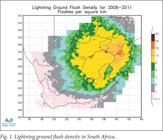
Certain areas of Southern Africa have a particularly high incidence of lightning and thunderstorm activity. Early maps of lightning ground flash density (Ng) in South Africa were based on data obtained for the period 1975 - 1986. Owing to the nature of the measurement systems, it was not possible to determine the number of strokes per flash.
More recently, the South African Weather Service installed a 20-station Southern African Lightning Detection Network (SALDN) comprising 19 strategically located sensors in South Africa and 1 in Swaziland. The SALDN was commissioned during 2005, and data have been collected since January 2006.4,5 Although representing a limited period, SALDN data analysis suggests that the ground flash density values for areas with Ng >8 may have been previously significantly underestimated. The SALDN identifies a number of areas with Ng values higher than the maximum value of 14 flashes/ km22
The higher Ng values in South Africa happen to coincide with the distribution of its population, with more ground flashes taking place on the Highveld and Escarpment, where there is a higher population density (Fig. 1).
South Africa has had a rich tradition of lightning-related research, with Schonland, Malan, Anderson, Eriksson, Proctor and Geldenhuys having been internationally acknowledged in this field. While early work can be traced back to the 1920s, when the first electric field measurements were made, the work of Schonland and Malan (also considered to be the founding members of the CSIR) perhaps was of most value in the early years. The CSIR has maintained its lightning research activities, and from the 1960s has actively participated in the development and testing of lightning detection equipment through the National Electrical Engineering Research Institute (NEERI) in Pretoria, and in collaboration with Cigré (International Council on Large Electric Systems).
Lightning medicine and related research in South Africa
Before 1998, almost all reported lightning morbidity and mortality cases emanated from the lay press. In 1998, the National Injury Mortality Surveillance System (NIMSS) was launched in South Africa. Its annual report is intended to capture data from medico-legal mortuaries, and is based on non-natural deaths. This system has provided more reliable data regarding lightning deaths from some centres in South Africa.
Eminent South African electrical engineers, including R B Anderson, A E Carte, A J Eriksson, I R Jandrell and I S McKechnie, have made significant research contributions to lightning medicine, which in turn has led to greater understanding of the mechanisms of lightning injury in the human body and has played a role in developing lightning safety guidelines and standards for South Africa.
The study of lightning and its effects on humans and animals (keraunomedicine) is rapidly developing, with substantial representation at international conferences on lightning research, trauma and forensic medicine.6
The clinical management of a lightning strike survivor may require a multidisciplinary approach because of its many resulting effects and potential long-term sequelae. Paramedics, emergency medicine physicians, intensive care specialists, neurologists, ENT specialists, speech-and-hearing therapists, occupational therapists, physiotherapists and general practitioners may all be involved, and would require a thorough knowledge of the effects of lightning to effectively contribute to patient management. No standard assessment guidelines and/or management protocols have been published locally, with most patients being managed on an ad hoc basis.
Recent research into lightning mortality data has been undertaken in Gauteng, Transkei and Swaziland,7-9 the first retrospective keraunopathology studies for southern Africa. Studies from Gauteng highlight the high number of lightning fatality cases for the region compared with the rest of the world.10
According to published data, the death rate due to lightning strike in South Africa varies from 1.5 to 8.8 per million inhabitants per year. In the USA, the reported rate is 0.42 deaths per million people per year (data from 1959 to 1994), ranging from 0.3 to 2.0 per million people.10
In 2006, published guidelines proposed a more systematic and detailed approach to the medico-legal investigation of deaths apparently related to lightning, including that the scene of death should be visited by pathologists and/or other experts, that injuries be photographed at autopsy, and that tissues, including skin wounds etc., be histologically examined.11,12 A more standardised and structured approach would make better data available for future research, including such interesting pathological findings as Lichtenberg figures, 'tip-toe' signs and barotrauma-related phenomena, and more reliable lightning mortality data would become available.
There are virtually no published data on lightning morbidity in South Africa (how many lightning strike survivors, the nature of their symptoms and injuries, etc.). Casualty and emergency medicine units should provide case reports and retrospective reviews of lightning strike survivors. Diverse and interesting clinical effects have been reported in the international literature, which would require further research and evaluation by clinicians and researchers working together to validate or refute largely anecdotal reported findings and long-term complications. Many complications have been attributed to lightning strike, some of which are mythical; individuals and groups have entrenched beliefs that lightning may be directed to strike someone, that significant personality changes ensue after lightning strike, etc. A research project has recently been initiated to understand cultural and traditional South African beliefs regarding lightning.
In a society with rapid urban and rural electrification, forensic pathologists are seeing an increase in fatalities owing to electricity exposure and its association with illegal activities such as cable theft and illicit household electrical connections.12
Conclusions
We propose that consideration be given to establishing a multidisciplinary lightning/electricity interest group involving relevant scientific disciplines (including clinicians) and which may co-ordinate and facilitate research and funding in this field. This group could develop standard assessment guidelines and/or medical management protocols. Recently, such a multidisciplinary interest group was established at the University of the Witwatersrand (Lightning Interest Group for Health, Technology and Science (LIGHTS)). Its intentions are to provide a platform for lightning researchers to share their findings within Africa, to share knowledge on lightning physics and related sciences and foster inter-institution partnerships and collaborations to generate new knowledge, research and treatment opportunities. Interested parties may contact the corresponding author.
References
- 1. Newcott WR. Lightning. National Geographic 1993;184(1).
- 2. Auerbach PS. Wilderness Medicine. 6th ed. Amsterdam: Elsevier Saunders, 2012 (in press).
- 3. Uman MA. Understanding Lightning. Carnegie, Penn.: Bek Technical Publications, 1971.
- 4. Evert R. Adapting electric power utility insulation coordination procedures to incorporate accurate lightning data. Proceedings of the Cigré Regional Conference, Cape Town, August 2009.
- 5. Evert R, Schulze G. Impact of a new lightning detection and location system in South Africa. Proceedings of the Inaugural IEEE Power Engineering Society Conference and Exposition in Africa, Durban, July 2005.
-
6. Cooper MA. A fifth mechanism of lightning injury. Acad Emerg Med 2002;9(2):172-174. [http:// dx.doi.org/10.1197/aemj.9.2.1721]
» http:// dx.doi.org/10.1197/aemj.9.2.1721 -
7. Blumenthal R. Lightning fatalities on the South African Highveld - a retrospective descriptive study for the period 1997 - 2000. Am J Forensic Med Pathol 2005;26(1):66-69.[http://dx.doi.org/10.1097%2F01.paf.0000154115.12168.46]
» http://dx.doi.org/10.1097%2F01.paf.0000154115.12168.46 -
8. Dlamini WM. Lightning fatalities in Swaziland: 2000 - 2007. Natural Hazards 2009;50(1):171-191. [http://dx.doi.org/10.2007/s11069-008-9331-6]
» http://dx.doi.org/10.2007/s11069-008-9331-6 -
9. Meel BL. Lightning fatalities in the Transkei sub-region of South Africa. Medicine, Science and the Law 2007;47(2):161-164. [http://dx.doi.org/10.1258/rsmmsl.47.2.161]
» http://dx.doi.org/10.1258/rsmmsl.47.2.161 - 10. Holle RL. NOAA Technical Memorandum NWS sr-193, Section 4.
- 11. Blumenthal R. When thunder roars - go indoors! Lightning autopsy guidelines. S Afr Med J 2006;96(1):38-39.
-
12. Blumenthal R. A retrospective descriptive study of electrocution deaths in Gauteng, South Africa: 2001-2004. Burns 2009;35(6):888-894. [http://dx.doi.org/10.1016/j.burns.2009.01.009]
» http://dx.doi.org/10.1016/j.burns.2009.01.009