The World Health Organization's mechanisms for increasing the health sector budget: The South African context
South Africa (SA) has limited scope for raising income taxes, and the proposed National Health Insurance (NHI) scheme will necessitate growth in the health sector budget. The NHI White Paper suggests five funding scenarios to meet the expected shortfall. These scenarios are a mixture of a surcharge on taxable income, an increase in value-added tax and a payroll tax. Five alternative options, suggested by the World Health Organization, are interrogated as ways to decrease the general taxation proposed in the White Paper. The five mechanisms (corporate tax, financial transaction levy, and taxes on tobacco, alcohol and unhealthy foods) were chosen based on their fund-raising potential and their mandatory element. A literature review provides the information for a discussion of the potential costs of each mechanism. Within specific assumptions, potential budgetary contribution is compared with the requirement. First, raising corporate tax rates could raise enough funds, but the losses due to capital flight might be too much for the local economy to bear. Second, a levy on currency transactions is unlikely to raise the required resources, even without a probable decrease in the number of transactions. Third, the increase in the tax on tobacco and alcohol would need to be very large, even assuming that consumption patterns would remain unchanged. Lastly, a tax on unhealthy food products is a new idea and could be explored as an option - especially as the SA Treasury has announced its future implementation. Implementing only one of the mechanisms is unlikely to increase available funding sufficiently, but if they are implemented together the welfare-maximising tax rate for each mechanism may be high enough to fulfil the NHI scheme's budgetary requirement, moderating the increases in the tax burden of the SA population.
STATEMENT
The World Health Organization's mechanisms for increasing the health sector budget: The South African context
F H J VenterI; J E WolvaardtII
IMCom (Economics), DPH; School of Health Systems and Public Health, Faculty of Health Sciences, University of Pretoria, South Africa
IIBCur, MPH, PGCHE, PhD School of Health Systems and Public Health, Faculty of Health Sciences, University of Pretoria, South Africa
South Africa (SA) has limited scope for raising income taxes, and the proposed National Health Insurance (NHI) scheme will necessitate growth in the health sector budget. The NHI White Paper suggests five funding scenarios to meet the expected shortfall. These scenarios are a mixture of a surcharge on taxable income, an increase in value-added tax and a payroll tax. Five alternative options, suggested by the World Health Organization, are interrogated as ways to decrease the general taxation proposed in the White Paper. The five mechanisms (corporate tax, financial transaction levy, and taxes on tobacco, alcohol and unhealthy foods) were chosen based on their fund-raising potential and their mandatory element. A literature review provides the information for a discussion of the potential costs of each mechanism. Within specific assumptions, potential budgetary contribution is compared with the requirement. First, raising corporate tax rates could raise enough funds, but the losses due to capital flight might be too much for the local economy to bear. Second, a levy on currency transactions is unlikely to raise the required resources, even without a probable decrease in the number of transactions. Third, the increase in the tax on tobacco and alcohol would need to be very large, even assuming that consumption patterns would remain unchanged. Lastly, a tax on unhealthy food products is a new idea and could be explored as an option - especially as the SA Treasury has announced its future implementation. Implementing only one of the mechanisms is unlikely to increase available funding sufficiently, but if they are implemented together the welfare-maximising tax rate for each mechanism may be high enough to fulfil the NHI scheme's budgetary requirement, moderating the increases in the tax burden of the SA population.
The World Health Organization (WHO)'s 2010 report on health systems financing for universal health coverage1et al.2
South Africa (SA) is currently in the process of implementing a National Health Insurance (NHI) scheme. The resource requirement for implementation of this scheme is substantial, and the NHI White Paper (hereinafter referred to as 'the White Paper') outlines five scenarios to meet the middle-ground projected shortfall of ZAR71.9 billion (2010 prices) by 2025/26.3
Scenario A includes the introduction of a payroll tax, a surcharge on taxable income and increases in the rate of value-added tax (VAT). Scenario B utilises a combination of the surcharge with a payroll tax, while scenario C is a combination of a surcharge on taxable income with an increase in VAT. Scenario D is a payroll tax with a surcharge on taxable income, while scenario E is a surcharge on taxable income only. Four of the five scenarios include a surcharge on taxable income, and all five scenarios include percentage increases spread over the time period.3
This article considers excise duties on alcohol and tobacco products along with the various other low-medium, medium, mediumhigh and high potential fund-raising options, without a voluntary element, as defined and proposed by the WHO, and reviews each in the SA context. Stenberg et al.2
The result of the calculations is compared with the average yearly increase required by the NHI. The comparison is based on the assumption that the mechanism was implemented in 2010 and that the proceeds from the mechanism are earmarked for the health sector. Possible costs or negative effects of the mechanism's implementation in SA are extrapolated from the literature.
Health sector funding requirement
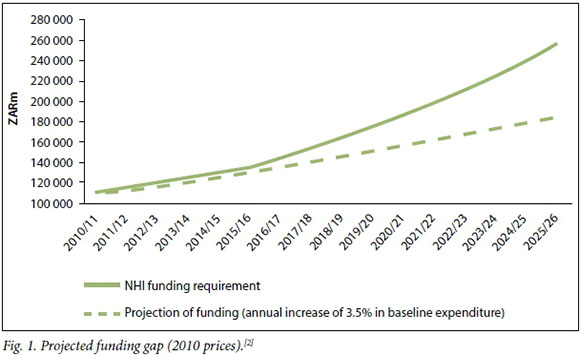
The White Paper states that the requirements for health (in real 2010 financial terms) will increase from ZAR109.8 billion in 2010 to ZAR255.8 billion in 2025/26, the proposed roll-out period of the scheme.344
Fig. 1 illustrates the gap between the funding requirement necessitated by NHI implementation (solid line) and the projected funding (dashed line). The projected funding assumes that the budget allocated to the health sector increases at the White Paper's middle-ground funding scenario rate of 3.5% between 2010 and 2025. Even though the White Paper assumes that this is its most likely scenario, a GDP growth rate of 3.5% seems optimistic. In the recently published statement by the South African Reserve Bank's Monetary Policy Committee, it is stated that GDP growth in 2015 was a mere 1.3% and that growth of only 0.8%, 1.4% and 1.8% is expected for 2016, 2017 and 2018, respectively.5
For the funding requirement, the prediction provided by the White Paper is used. This is a conservative estimate when compared with that of Mclntyre,43
The White Paper predicts various shortfalls in 2025/26 based on various specific health funding growth over the period -ZAR71.9 billion if the baseline resources increase by 3.5% per year (Fig. 1), ZAR27.6 billion if baseline resources increase by 5.0% per year, and finally ZAR108 billion if baseline resources grow by 2.0% per year. Rather than looking at the shortfall in 2025/26, this article calculates the cumulative shortfall under the 3.5% growth scenario over the 15-year period between 2010/11 and 2025/26, the NHI implementation period. This allowed us to calculate an average percentage shortfall for each year within the period and compare this value with the potential funding contribution for each of the instruments under review.
The shortfall, represented by the space between the solid and dashed lines in Fig. 1, aggregates to ZAR378.5 billion over the 15 years. This cumulative shortfall represents 16.4% of the cumulative funding projection over the same period, implying that if the funding, as projected by the 3.5% growth scenario, was and is increased by a further16.4% each year between 2010 and 2025,
the cumulative funding would equal the required cumulative expenditure over the implementation period. The five tax scenarios outlined by the White Paper are an attempt to address the shortfall, and this article explores the feasibility of using innovative finance mechanisms to moderate the size of the probable surcharge on taxable income - an inclusion in four of the five tax scenarios.
The options
Recognising the additional resources required for universal healthcare, the WHO proposed 13 options for increasing funding for health. For this article, the options categorised as having a low fundraising potential as well as those with a voluntary or charity element have been disregarded.2
Corporate tax
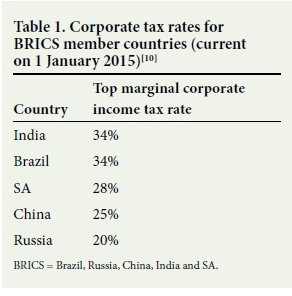
Corporate tax differentials, or a country's corporate tax rate relative to countries with which it competes for investment, are more important than the absolute level.6,7 SA's top marginal corporate income tax rate is currently 28%, with lower rates applying to smaller businesses.8Table 1).
Compared with the other BRICS (Brazil, Russia, China, India and SA) countries, SA may have some space for an increase in corporate taxation. However, following the abolishment of the Secondary Tax on Companies on 1 April 2012,101112
The WHO report does not suggest an increase in the taxation rate for all companies, but rather for the most profitable. If the shortfall is to be financed by an increase in the corporate tax rate of specific industries instead of all industries, the magnitude of the increase per company would have to be greater. The economic effects resulting from higher relative corporate tax rates that Diamond et al.7
Levies on financial transactions/instruments
Currency transactions are any transactions in which the buying and/or selling of foreign currency for domestic currency are involved. Stenberg et al.213142151616
The methodology applied to India described by Stenberg et al.217181920
Excise taxes on products harmful to health
The harmful side-effects of tobacco consumption (e.g. neoplastic, vascular and respiratory diseases,212223,24) are well documented. In fact, research has shown that tobacco and alcohol are the second and third largest contributors, respectively, to the global disease burden and together cause nearly 12% of the world's disability-adjusted life-years. There is therefore a rational reason for the widespread advocacy for the imposition of excise duties on alcohol and tobacco products, as it has been shown that these duties can decrease consumption and subsequently decrease the disease burden.25,26
In SA, specific excise duties on alcohol and tobacco contributed 3.2% to total tax revenue in 2013/14, or approximately ZAR24.7 billion (constant 2010 prices).126
The rationale for excise duties on unhealthy products is therefore similar for all products. The price elasticity of demand for alcohol29-31and tobacco29,31 is traditionally relatively low,31,32 meaning that the imposition of a tax can contribute substantially to the total revenue pool.231312
The imposition of specific excise taxes on harmful products has two major counter-arguments. The first of these relates to their potential to increase smuggling and the size of the illicit market.33,34This argument is specifically related to tobacco, although research shows that the size of this market and the effects of the tax are often overstated by the tobacco industry.33,35,36 Nevertheless, commenting on the illicit cigarette market in SA, Van Walbeek37333338,39
Even though taxes on unhealthy foods will not lead to an increase in illicit trade, the regressivity of excise taxes on these foods along with alcohol and tobacco40-44 is worth debate. With an ever-increasing Gini coefficient (0.66 in 1993 and 0.7 in 2008), SA is one of the most economically unequal societies in the world.45
In terms of the tax on unhealthy food, there are ways of circumventing the regressive effects of the tax by subsidising healthier options.41
Discussion
The White Paper has a specific focus on payroll taxes, surcharges on taxable income and increases in VAT as fiscal instruments that could cover the funding shortfall caused by the implementation of NHI. It also provides some discussion on current employer contributions to medical schemes being reallocated to the NHI fund, the current tax credit for medical scheme membership being scaled down, and the potential utilisation of the carbon tax in the health sector. No specific estimation of the size of the effect that these actions might have on the shortfall is provided, and further research into this area is strongly recommended.
This article reviewed various funding options, other than those already under consideration, that are available to the SA government to raise additional resources for its health sector.
Raising corporate taxation could raise enough funds, but the losses due to capital flight might be too much for the SA economy to bear. The increase would therefore have to be moderate, and it is unlikely that a welfare-maximising corporate tax rate could raise sufficient government income, especially if only specific companies or industries are targeted. A financial transaction tax, specifically a levy on currency transactions, is also unlikely to raise the required resources on its own, even without a likely decrease in the number of transactions. Finally, the required increase in the tax on tobacco and alcohol would have to be very large, even when assuming that consumption patterns would remain unchanged. The imposition of a tax on unhealthy food products is a very new idea and something that could be explored further as an option for SA. Nevertheless, the problem with excise duties is their regressivity which is a specific problem for a country as economically unequal as SA.
The White Paper clearly outlines five scenarios for revenue generation, all of which are combinations of more than a single source. If more mechanisms are used, less tax will have to be collected from each one, increasing the possibility that SA will be able to collect more tax revenue for the health sector without compromising the rest of the economy. All tax mechanisms have associated administrative costs,48,49 which also have to be taken into account when deciding on how many mechanisms should be implemented.
Conclusion
The calculations in this article make very strong assumptions and should by no means be confused with modelling. They are merely utilised as devices to illustrate to the reader the massive task that is set before the SA National Treasury to finance the implementation of the NHI scheme. The current scenario that makes use of the most sources of income (surcharge on taxable income, VAT increase and a payroll tax) has implications for the working population, the poor and employers. This article has outlined additional mechanisms to modify the burden on the average South African.
References
- 1. World Health Organization. Health Systems Financing: The Path to Universal Coverage. Geneva: World Health Organization, 2010.
-
2. Stenberg K, Elovainio R, Chisholm D, et al. Responding to the Challenge of Resource Mobilization - Mechanisms for Raising Additional Domestic Resources for Health. Geneva: World Health Organization, 2010. http://www.who.int/healthsystems/topics/nnancing/healthreport/13Innovativedomfinancing.pdf (accessed 4 February 2016).
» http://www.who.int/healthsystems/topics/nnancing/healthreport/13Innovativedomfinancing.pdf - 3. National Department of Health, South Africa. National Health Insurance for South Africa: Towards Universal Health Coverage. Version 40. Pretoria: NDoH, 2015.
- 4. McIntyre D. Health Service Financing for Universal Coverage in East and Southern Africa. EQUINET Discussion Paper 95. Cape Town: Health Economics Unit, University of Cape Town, 2012.
-
5. South African Reserve Bank: Monetary Policy Committee. Press Statement Embargo Delivery. Statement of the Monetary Policy Committee. 2016. https://www.resbank.co.za/Lists/News%20and%20Publications/Attachments/7223/MPC% 20Statement%2017%20March%202016%20.pdf (accessed 5 June 2016).
» https://www.resbank.co.za/Lists/News%20and%20Publications/Attachments/7223/MPC% 20Statement%2017%20March%202016%20.pdf -
6. Bénassy-Quéré A, Fontagné L, Lahrèche-Révil A. How does FDI react to corporate taxation? Int Tax Public Finance 2005;12(5):583-603. DOI:10.1007/s10797-005-2652-4
» https://doi.org/10.1007/s10797-005-2652-4 -
7. Diamond J, Zodrow G, Carroll R Macroeconomic Effects of Lower Corporate Income Tax Rates Recently Enacted Abroad: Report Prepared for the Reforming America's Taxes Equitably (RATE) Coalition. Washington, DC: Ernst & Young, 2013. http://ratecoalition.com/wp-content/uploads/2013/04/EY_TPA_RATE_Coalition_Macroanalysis_2013_03_04_FINAL.pdf (accessed 2 September 2015).
» http://ratecoalition.com/wp-content/uploads/2013/04/EY_TPA_RATE_Coalition_Macroanalysis_2013_03_04_FINAL.pdf -
8. South African Revenue Services. Tax Pocket Guide. Pretoria: National Treasury, 2015. http://www.treasury.gov.za/documents/national%20budget/2015/default.aspx (accessed 15 July 2015).
» http://www.treasury.gov.za/documents/national%20budget/2015/default.aspx - 9. Johansson A, Heady C, Arnold J, et al. Taxation and Economic Growth. OECD Economics Department Working Papers, No. 620. Paris: OECD Publishing, 2008. DOI:10.3386/w5826
-
10. Ernst and Young. Worldwide Corporate Tax Guide. London: Ernst & Young, 2015:175, 256, 586, 1184, 1284. http://www.ey.com/Publication/vwLUAssets/Worldwide_corporate_tax_guide_2015/SFILE/ Worldwide%20Corporate%20Tax%20Guide%202015.pdf (accessed 20 July 2015).
» http://www.ey.com/Publication/vwLUAssets/Worldwide_corporate_tax_guide_2015/SFILE/ Worldwide%20Corporate%20Tax%20Guide%202015.pdf -
11. National Treasury. Budget Review. Pretoria: National Treasury, 2015. http://www.treasury.gov.za/documents/national%20budget/2015/review/default.aspx (accessed 10 June 2015).
» http://www.treasury.gov.za/documents/national%20budget/2015/review/default.aspx -
12. Statistics South Africa. P0141 - Consumer Price Index (CPI). Pretoria: SSA, 2015:4. http://www.statssa.gov.za/?page_id=1854&PPN=P0141&SCH=6037 (accessed 1 August 2015).
» http://www.statssa.gov.za/?page_id=1854&PPN=P0141&SCH=6037 -
13. McCulloch N, Pacillo G. The Tobin tax: A review of the evidence. IDS Research Reports 2011;2011(68):1-77. DOI:10.1111/j.2040-0217.2011.00068_2.x
» https://doi.org/10.1111/j.2040-0217.2011.00068_2.x -
14. Wang GHK, Yau J. Would a Financial Transaction Tax Affect Financial Market Activity? Insights from Future Markets (July 9, 2012). Washington, DC: Cato Institute Policy Analysis, 2012. http://ssrn.com/abstract=2226961 (accessed 3 February 2016).
» http://ssrn.com/abstract=2226961 -
15. Nissanke M. Revenue potential of the currency transaction tax for development finance: A critical appraisal. WIDER Discussion Papers/World Institute for Development Economics (UNU-WIDER), No. 2003/81, 2003. http://hdl.handle.net/10419/53109 (accessed 3 February 2016).
» http://hdl.handle.net/10419/53109 - 16. Schmidt R The Currency Transaction Tax: Rate and Revenue Estimates. Ottawa: North-South Institute, 2007.
-
17. Bank for International Settlements: Monetary and Economic Department. Triennial Central Bank Survey. Basle: Bank for International Settlements, 2013:14. http://www.bis.org/publ/rpix13ixi.pdf (accessed 15 July 2015).
» http://www.bis.org/publ/rpix13ixi.pdf - 18. World Health Organization. Constraints to Scaling up the Health Millennium Development Goals: Costing and Financial Gap Analysis. Background Document for the Taskforce on Innovative International Financing for Health Systems. Geneva: WHO, 2010.
-
19. Nedbank Group. Exchange rates - annual averages from 1995. Nedbank Group, 2015. http://www.nedbankgroup.co.za/pdfs/economic/exchangeRates/Annual_Average_for_Knet_2015.pdf (accessed 27 August 2015).
» http://www.nedbankgroup.co.za/pdfs/economic/exchangeRates/Annual_Average_for_Knet_2015.pdf -
20. National Treasury. National Budget Review. Pretoria: National Treasury, 2014. http://www.treasurygov.za/documents/national%20budget/2014/default.aspx (accessed 10 June 2015).
» http://www.treasurygov.za/documents/national%20budget/2014/default.aspx -
21. Jha P, Ramasundarahettige C, Landsman V, et al. 21st-century hazards of smoking and benefits of cessation in the United States. N Engl J Med 2013;368(4):341-350. DOI:10.3410/f.717973072.793473561
» https://doi.org/10.3410/f.717973072.793473561 - 22. US Department of Health and Human Services. The Health Consequences of Smoking: A Report of the Surgeon General. Atlanta, Ga: US Department of Health and Human Services, Centers for Disease Control and Prevention, National Center for Chronic Disease Prevention and Health Promotion, Office on Smoking and Health, 2004.
- 23. Rehm J. The risks associated with alcohol use and alcoholism. Alcohol Res Health 2011;34(2):135-143.
- 24. World Health Organization. Global Status Report on Alcohol and Health. Geneva: WHO, 2014.
-
25. Salti N, Chaaban J, Nakkash R, Alaouie H. The effect of taxation on tobacco consumption and public revenues in Lebanon. Tob Control 2015;24(1):77-81. DOI:10.1136/tobaccocontrol-2012-050703
» https://doi.org/10.1136/tobaccocontrol-2012-050703 - 26. Xu X, Chaloupka FJ. The effects of prices on alcohol use and its consequences. Alcohol Res Health 2011;34(2):236.
-
27. Wang YC, Coxson P, Shen YM, Goldman L, Bibbins-Domingo K. A penny-per-ounce tax on sugar-sweetened beverages would cut health and cost burdens of diabetes. Health Aff 2012;31(1):199-207. DOI:10.1377/hlthaff.2011.0410
» https://doi.org/10.1377/hlthaff.2011.0410 -
28. Blecher E. Taxes on tobacco, alcohol and sugar sweetened beverages: Linkages and lessons learned. Soc Sci Med 2015;136:175-179. DOI:10.1016/j.socscimed.2015.05.022
» https://doi.org/10.1016/j.socscimed.2015.05.022 -
29. Diaz MC, Chaloupka FJ, Jernigan DH. The Effects of Alcohol Excise Tax Increases on Public Health and Safety in Texas. Texans Standing Tall, 2 March 2015. http://texansstandingtall.org/pdfs/15_Alcohol_ExciseReport.pdf (accessed 4 July 2016).
» http://texansstandingtall.org/pdfs/15_Alcohol_ExciseReport.pdf -
30. Daley JI, Stahre MA, Chaloupka FJ, Naimi TS. The impact of a 25-cent-per-drink alcohol tax increase. Am J Prev Med 2012;42(4):382-389. DOI:10.1016/j.amepre.2011.12.008
» https://doi.org/10.1016/j.amepre.2011.12.008 -
31. Sassi F, Belloni A, Capobianco C, Alemanno A. Taxation and Economic Incentives on Health-Related Commodities: Alcohol, Tobacco and Food. HEC Paris Research Paper No. LAW-2014-1038. Cambridge: Cambridge University Press, 2014. http://ssrn.com/abstract=2400930 (accessed 4 February 2016).
» http://ssrn.com/abstract=2400930 -
32. Chaloupka FJ, Yurekli A, Fong GT. Tobacco taxes as a tobacco control strategy. Tob Control 2012;21(2):172-180. DOI:10.1136/tobaccocontrol-2011-050417
» https://doi.org/10.1136/tobaccocontrol-2011-050417 -
33. Van Walbeek C, Shai L. Are the tobacco industry's claims about the size of the illicit cigarette market credible? The case of South Africa. Tob Control 2015;24(e2):e142-e146. DOI:10.1136/tobaccocontrol-2013-051441
» https://doi.org/10.1136/tobaccocontrol-2013-051441 - 34. Cooper A, Witt D. The linkage between tax burden and illicit trade of excisable products: The example of tobacco. World Customs J 2012;6(2):41-58.
-
35. Chen J, McGhee SM, Townsend J, Lam TH, Hedley AJ. Did the tobacco industry inflate estimates of illicit cigarette consumption in Asia? An empirical analysis. Tob Control 2015;24(e2):e161-e167. DOI:10.1136/tobaccocontrol-2014-051937
» https://doi.org/10.1136/tobaccocontrol-2014-051937 -
36. Stoklosa M, Ross H. Contrasting academic and tobacco industry estimates ofillicit cigarette trade: Evidence from Warsaw, Poland. Tob Control 2014;23(e1):e30-e34. DOI:10.1136/tobaccocontrol-2013-051099
» https://doi.org/10.1136/tobaccocontrol-2013-051099 -
37. Van Walbeek C. Measuring changes in the illicit cigarette market using government revenue data: The example of South Africa. Tob Control 2014;23(e1):e69-e74. DOI:10.1136/tobaccocontrol-2013-051178
» https://doi.org/10.1136/tobaccocontrol-2013-051178 -
38. Babor TF, Robaina K, Jernigan D. The influence of industry actions on the availability of alcoholic beverages in the African Region. Addiction 2015;110(4):561-571. DOI:10.1111/add.12832
» https://doi.org/10.1111/add.12832 -
39. Parry C, London L, Myers B. Delays in South Africa's plans to ban alcohol advertising. Lancet 2014;383(9933):1972. DOI:10.1016/s0140-6736(14)60954-5
» https://doi.org/10.1016/s0140-6736(14)60954-5 -
40. Monkan N, Woolard I, Ajam T. The tax system and inclusive growth in South Africa: Towards an analytical framework for the Davis Tax Committee. Pretoria: Davis Tax Committee, 2015. http://www.taxcom.org.za/docs/20150605%20DTC%20Macro%20Analysis%20Framework%20First %20Interim%20Report%20(Full)%20%20for%20public%20comment.pdf (accessed 1 August 2015).
» http://www.taxcom.org.za/docs/20150605%20DTC%20Macro%20Analysis%20Framework%20First %20Interim%20Report%20(Full)%20%20for%20public%20comment.pdf -
41. López-Casasnovas G, Gil J, Mora T. Taxation of unhealthy consumption of food and drinks: An updated literature review. Hacienda Pública Española/Review of Public Economics 2013;207(4/2013):119-140. DOI:10.7866/hpe-rpe.13.4.5
» https://doi.org/10.7866/hpe-rpe.13.4.5 - 42. Hoffer A, Gvillo R, Shughart II WF, Thomas MD. Regressive Effects: Causes and Consequences of Selective Consumption Taxation. Arlington, Va: Mercatus Center at George Mason University, 2015.
-
43. Ataguba JE. Alcohol policy and taxation in South Africa. Applied Health Econ Health Policy 2012;10(1):65-76. DOI:10.2165/11594860-000000000-00000
» https://doi.org/10.2165/11594860-000000000-00000 -
44. Mytton OT, Clarke D, Rayner M. Taxing unhealthy food and drinks to improve health. BMJ 2012;344:e2931. DOI:10.1136/bmj.e2931
» https://doi.org/10.1136/bmj.e2931 -
45. Hvistendahl M. While emerging economies boom, equality goes bust. Science 2014;344(6186):832- 835. DOI:10.1126/science.344.6186.832
» https://doi.org/10.1126/science.344.6186.832 -
46. Yates R. Universal health coverage: Progressive taxes are key. Lancet 2015;386(9990):227-229. DOI:10.1016/s0140-6736(15)60868-6
» https://doi.org/10.1016/s0140-6736(15)60868-6 -
47. Scháfer D, Schulmeister S, Vella J, Masciandaro D, Passarelli F, Buckley RP. The financial transaction tax - boon or bane? Intereconomics 2012;47(2):76-103. DOI:10.1007/s10272-012-0409-8
» https://doi.org/10.1007/s10272-012-0409-8 -
48. Auriol E, Warlters M. The marginal cost of public funds and tax reform in Africa. J Dev Econ 2012;97(1):58-72. DOI:10.1016/j.jdeveco.2011.01.003
» https://doi.org/10.1016/j.jdeveco.2011.01.003 -
49. Dharmapala D, Slemrod J, Wilson JD. Tax policy and the missing middle: Optimal tax remittance with firm-level administrative costs. J Public Econ 2011;95(9):1036-1047. DOI:10.2139/ssrn.1138015
» https://doi.org/10.2139/ssrn.1138015