The diagnosis of asthma in children: An evidence-based approach to a common clinical dilemma
BACKGROUND. Asthma is a heterogeneous condition characterised by chronic inflammation and variable expiratory airflow limitation, as well as airway reversibility. The diagnosis of asthma in young children is limited by the inability to perform objective lung function testing in this group of patients and the wide variety of conditions that can phenotypically present with asthma-like symptoms. OBJECTIVES. To provide an evidence-based approach for clinicians to accurately diagnose asthma in young children and to assess the level of control to guide therapeutic decisions. METHODS. The South African Childhood Asthma Working Group (SACAWG) convened in January 2017 with task groups, each headed by a section leader, constituting the editorial committee on assessment of asthma epidemiology, diagnosis, control, treatments, novel treatments and self-management plans. The asthma diagnosis and control task groups reviewed the available scientific literature and assigned evidence according to the Grades of Recommendation Assessment, Development and Evaluation (GRADE) system, providing recommendations based on current evidence. CONCLUSIONS. Asthma in young children should only be diagnosed if all other causes of wheezing have been considered and excluded, and if there is a response to a therapeutic trial and worsening with withdrawal of asthma medication. Asthma control should be assessed at each visit to guide therapeutic decisions.
The diagnosis of asthma in children: An evidence-based approach to a common clinical dilemma
R MasekelaI; S M RisengaII; O P KitchinIII; D A WhiteIV; G DavisV; P GoussardVI; A I ManjraVII; F E KritzingerVIII, IX; M LevinX; H ZarX; R J GreenXI
IPhD; Inkosi Albert Luthuli Central Hospital and Department of Paediatrics and Child Health, School of Clinical Medicine, College of Health Sciences, University of KwaZulu-Natal, Durban, South Africa
IICert Pulmonology (SA) Paed; Department of Pulmonology and Allergy, Faculty of Health Sciences, Polokwane/Mankweng Campus, University of Limpopo, Polokwane, South Africa
IIICert Pulmonology (SA) Paed; Private Practice, Netcare Waterfall City Hospital, Johannesburg, South Africa
IVCert Pulmonology (SA) Paed; Charlotte Maxeke Academic Hospital and Department of Paediatrics and Child Health, Faculty of Health Sciences, University of the Witwatersrand, Johannesburg, South Africa
VMB ChB; Private Practice, Greenside, Johannesburg, South Africa
VIPhD; Department of Paediatrics and Child Health, Faculty of Medicine and Health Sciences, Stellenbosch University, Cape Town, South Africa
VIIFCPaed (SA), M Clin Pharm; Private Practice, Life Westville Hospital, Durban, South Africa
VIII Cert Pulmonology (SA) Paed; Department of Paediatrics and Child Health, Faculty of Medicine and Health Sciences, Stellenbosch University, Cape Town, South Africa
IXCert Pulmonology (SA) Paed; Netcare Christiaan Barnard Memorial Hospital, Cape Town, South Africa
XPhD; Department of Paediatrics and Adolescent Health, Red Cross War Memorial Children's Hospital and Faculty of Health Sciences, University of Cape Town, South Africa
XIPhD, DSc; Steve Biko Academic Hospital and Department of Paediatrics and Child Health, School of Medicine, Faculty of Health Sciences, University of Pretoria, South Africa
BACKGROUND. Asthma is a heterogeneous condition characterised by chronic inflammation and variable expiratory airflow limitation, as well as airway reversibility. The diagnosis of asthma in young children is limited by the inability to perform objective lung function testing in this group of patients and the wide variety of conditions that can phenotypically present with asthma-like symptoms.
OBJECTIVES. To provide an evidence-based approach for clinicians to accurately diagnose asthma in young children and to assess the level of control to guide therapeutic decisions.
METHODS. The South African Childhood Asthma Working Group (SACAWG) convened in January 2017 with task groups, each headed by a section leader, constituting the editorial committee on assessment of asthma epidemiology, diagnosis, control, treatments, novel treatments and self-management plans. The asthma diagnosis and control task groups reviewed the available scientific literature and assigned evidence according to the Grades of Recommendation Assessment, Development and Evaluation (GRADE) system, providing recommendations based on current evidence.
CONCLUSIONS. Asthma in young children should only be diagnosed if all other causes of wheezing have been considered and excluded, and if there is a response to a therapeutic trial and worsening with withdrawal of asthma medication. Asthma control should be assessed at each visit to guide therapeutic decisions.
On a global scale, asthma is the most common chronic non-communicable disease in children. It is a heterogeneous condition characterised by chronic inflammation and variable expiratory airflow limitation,123
Objectives
We reviewed the current literature on the diagnosis of asthma in children, with particular emphasis on young children and the available evidence. We also examined the assessment of asthma control in children and the current evidence basis for the importance of these assessments.
Methods
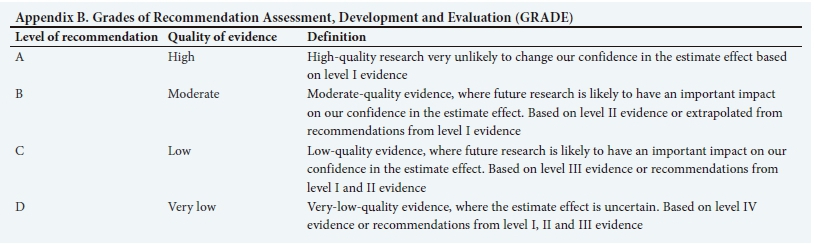
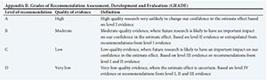
The South African Childhood Asthma Working Group (SACAWG) convened in January 2017 with six task groups, each assigned to a section leader (Appendix A), who constituted the editorial committee on assessment of asthma epidemiology, diagnosis, control, treatments, novel treatments and self-management plans. The task groups reviewed the available scientific literature on the diagnosis of asthma and assessment of asthma control in young children according to high-quality evidence, graded the level of evidence, and made recommendations based on the literature (Appendix B).
Asthma in children
The presentation and differential diagnosis of asthma differ significantly as the child matures. For the purpose of this review and in line with the current literature, children are categorised as preschoolers (<5 years of age) and older children.
Children <5 years of age
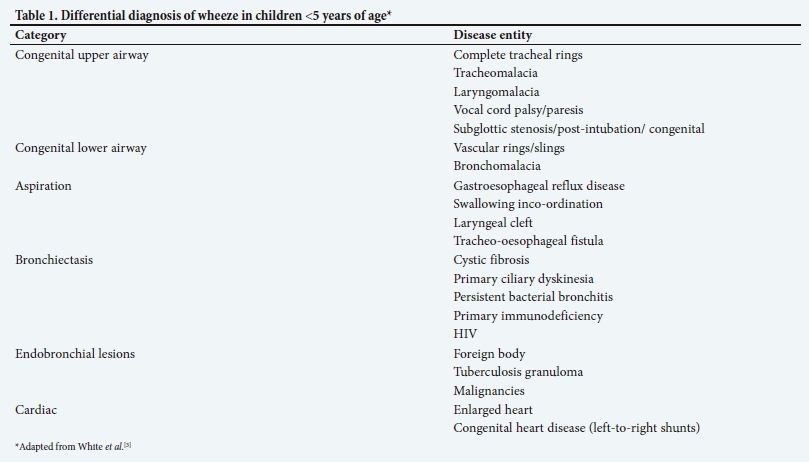
One-third of all children wheeze at least once before their third birthday. Children <5 years old are prone to frequently recurring viral upper-respiratory tract infections, which may be associated with wheeze. Although wheeze commonly occurs, most children are asymptomatic by school-going age, with only one-quarter having persistent symptoms and later developing asthma2Table 1).
Predictive indices for asthma
As asthma in infancy and preschoolers has nonspecific symptoms, making it difficult to determine who has or will have asthma, predictive models have been developed.455,6 Use of these scores has not been validated in the African setting, where the atopy levels are lower (evidence level C), and should therefore not be used in the SA context.
History
History-taking alone is often all that is needed to diagnose a preschool wheezing disorder. Rather than categorising the wheezy 'phenotype' of the child, the decision to initiate an asthma therapeutic trial should primarily be determined by the following:
Severity of wheezy episodes (presence of dyspnoea, increased respiratory rate and need for oxygen therapy during the episode).
Frequency of wheezy episodes (the child is symptomatic for >10 days during upper-respiratory tract infections or has >3 wheezy episodes per year).
Temporal pattern of symptoms (presence of wheezing not only with viral colds (infections), but triggered by allergens, irritants (pollution), exercise and sudden emotional changes (crying or laughing) between episodes (evidence level C) or worsening of symptoms on most days and nights).
Reversibility of wheezy episodes (bronchodilator response test (evidence level D)).
A positive family history of eczema (allergic dermatitis), allergic rhinitis, allergic conjunctivitis and/or food allergy (evidence level B).
History of an individual child's allergic problems, as mentioned above.
Clinical examination
This may be unhelpful in the young child, especially where there are no other atopic manifestations, but it must be remembered that 'not all that wheezes is asthma'.
Therapeutic trial
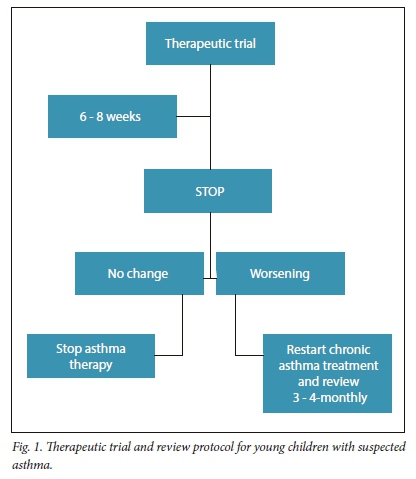
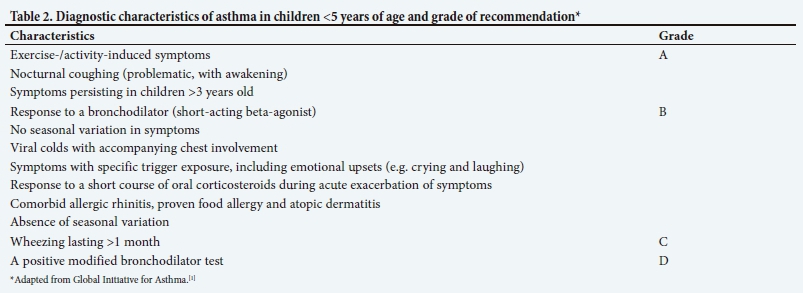
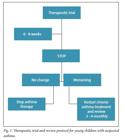
The current evidence based on symptoms and their relationship to asthma diagnosis in under-5 children are set out in Table 2. The principle when starting treatment for a child with a wheezing disorder is that treatment should be viewed as a therapeutic trial, i.e. therapy should be initiated and the child followed up after 6 - 8 weeks (Fig. 1).1,7,8 If there is no clinical response to therapy, it should be discontinued and a differential diagnosis considered as the cause of wheezing (Table 1). Should the child respond to therapy after the trial, medication should be discontinued. The reasons for a therapeutic response may be owing to the child being asthmatic or the natural history of improvement in the case of viral infections. Should symptoms recur after withdrawal of therapy, the child can be placed on maintenance therapy.7,8
Early use of inhaled corticosteroids (ICSs) in preschool children with wheeze, reduces symptoms and prevents or delays the onset of asthma in children (evidence level A).9-11 Therefore, early institution of therapy will not improve lung function of those who do not have asthma.
Children 6 - 11 years of age
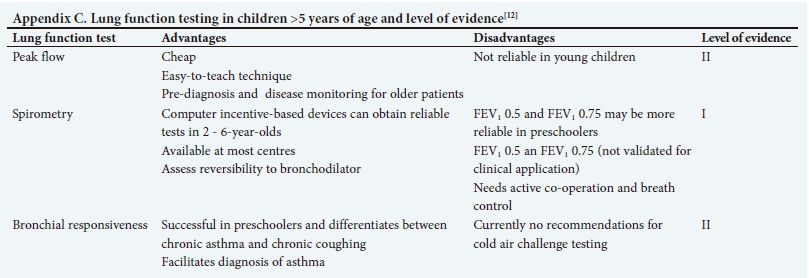
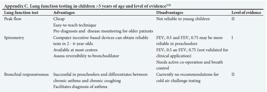
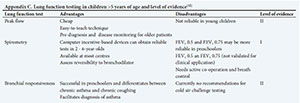
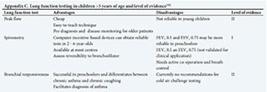
For children >6 years of age, besides the presenting symptoms, variable airflow limitation can be demonstrated by objective testing on peak flow measurements or by spirometry (Box 2) - ideally before commencement of controller medication. Normal lung function tests do not exclude the diagnosis of asthma (evidence level B).12Appendix C).
Appendix


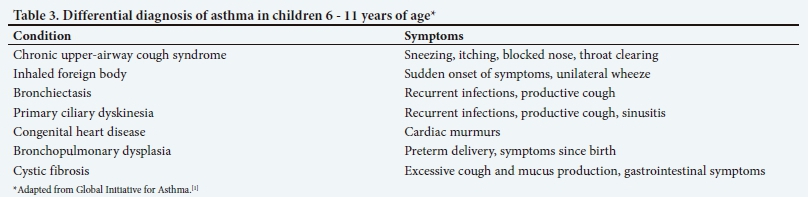
If the respiratory symptoms are suggestive of asthma, but not confirmed by variable airflow limitation or resolution with commencement of therapy, an alternative diagnosis is usually sought and may include those listed in Table 3. Some of these conditions may coexist with asthma. Investigations that are not helpful in diagnosing asthma include chest radiography, which may be normal or show evidence of air trapping with hyperinflation.
There are specific clinical pointers, which should guide the healthcare practitioner to seek another diagnosis in children with persistent wheezing (Box 1).
Predictors of asthma in childhood
Factors that independently predict asthma in late childhood are male sex, post-term delivery, medium or low parental education, family history of asthma and/or other atopic diseases, frequency of wheeze and wheezing dyspnoea (not associated with a cold).5
Asthma control
Asthma control is the extent to which asthma symptoms can be observed in a patient or have been reduced or eliminated by treatment.111314
Asthma control is significantly more likely in patients or parents/ caregivers who are educated (know their disease), are regularly taught to use the inhaler device, have a written action plan and educational material (www.asthmasa.co.za) and are encouraged to use controller medication regularly (level I evidence). If control is suboptimal, determine the reasons and educate the patient. A small number of patients need adjustment of their treatment (Box 3).
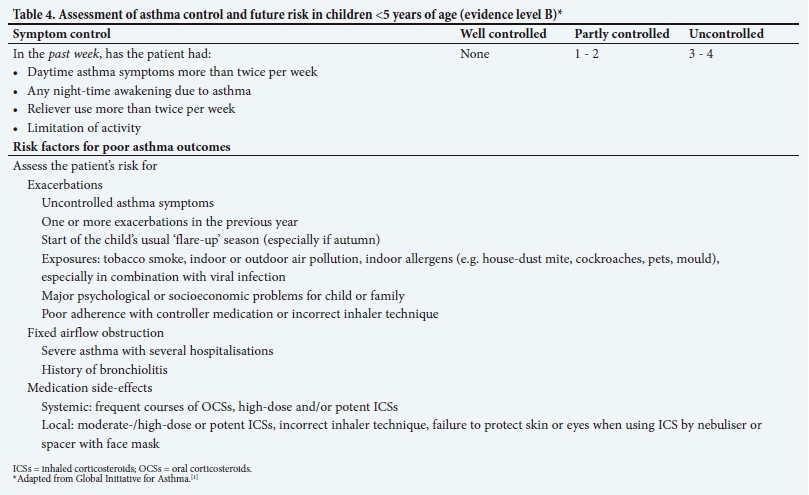
The child should demonstrate clinical improvement during the 2 -3 months of controller treatment, with worsening of symptoms after treatment cessation (Fig. 1). Thereafter, assessment of asthma control and future risk can be determined at each visit (Table 4).
Conclusion
Asthma in young children should only be diagnosed when all other causes of wheezing have been considered and excluded, more so in younger children. A therapeutic trial should be performed in uncertain cases, with follow-up and withdrawal of therapy to confirm or exclude the diagnosis of asthma. Asthma control should be assessed at each visit to guide therapeutic decisions.
Acknowledgements. We acknowledge the hard work and contribution of the South African Childhood Asthma Working Group (SACAWG) members. We also acknowledge the huge contribution of the late Prof. Cas Motala, who was convener of the past three SACAWG guidelines.
Author contributions. RM: methodology, review, write-up and manuscript editing; SMR: conceptualisation, write-up and manuscript editing; OPK, DA, HZ, GD: conceptualisation, methodology, write-up and manuscript editing; ML, RJG, AIM, FEK: write-up and manuscript editing; and PG: conceptualisation, methodology, write-up.
Funding. SACAWG conducted a workshop that received an unconditional educational grant from the Allergy Society of South Africa - funded by Novartis.
Conflicts of interest. None.
References
-
1. Global Initiative for Asthma. 2017. www.ginasthma.org (accessed 22 January 2017).
» www.ginasthma.org -
2. Brand PLP, Baraldi E, Bisgaard H, et al. Definition, assessment and treatment of wheezing disorders in preschool children: An evidence-based approach. Eur Respir J 2008;32:1096-1110. https://doi.org/10.1183/09031936.00002108
» https://doi.org/10.1183/09031936.00002108 - 3. White D, Masekela R. Recurrent wheeze in a child under five year of age. In: Manjra A, Levin M, Gray C, eds. ALLSA Handbook of Practical Allergy. 4th ed. Cape Town: ALLSA, 2018.
-
4. Martinez FD, Wright AL, Taussig LM, Holberg CJ, Halonen M, Morgan WJ. Asthma and wheezing in the first six years oflife. N Engl J Med 1995;332(3):133-138. https://doi.org/10.1056/NEJM199501193320301
» https://doi.org/10.1056/NEJM199501193320301 -
5. Castro-Rodriguez JA. The asthma predictive index: A very useful tool for predicting asthma in young children. J Allergy Clin Immunol 2010;126(2):212-216. https://doi.org/10.1016/j.jaci.2010.06.032
» https://doi.org/10.1016/j.jaci.2010.06.032 -
6. Hafkamp-de Groen E, Lingsma HF, Caudri D, et al. Predicting asthma in preschool children with asthma-like symptoms: Validating and updating the PIAMA risk score. J Allergy Clin Immunol 2013;132:1303-1310. https://doi.org/10.1016/j.jaci.2013.07.007
» https://doi.org/10.1016/j.jaci.2013.07.007 -
7. Brand PLP, Caudri D, Eber E, et al. Classification and pharmacological treatment ofpreschool wheezing Changes since 2008. Eur Respir J 2014;43(4):1172-1177. https://doi.org/10.1183/09031936.00199913
» https://doi.org/10.1183/09031936.00199913 - 8. Bush A, Ngakumar P. Preschool wheezing phenotypes. Eur Med J 2016;1(1):93-101.
-
9. Bisgaard H, Hermansen MN, Loland L, Halkjaer LB, Buchvald F. Intermittent inhaled corticosteroids in infants with episodic wheezing. N Engl J Med 2006;354(19):1998-2005. https://doi.org/10.1056/NEJMoa054692
» https://doi.org/10.1056/NEJMoa054692 -
10. Guilbert T, Morgan WJ, Zeiger RS, et al. Long-term inhaled corticosteroids in preschool children at high risk for asthma. N Engl J Med 2006;354(19):1985-1997. https://doi.org/10.1056/NEJMoa051378
» https://doi.org/10.1056/NEJMoa051378 -
11. The Childhood Asthma Management Program Research Group. Long-term effects of budesonide or nedocromil in children with asthma. N Engl J Med 2000;343(15):1054-1063. https://doi.org/10.1056/NEJM200010123431501
» https://doi.org/10.1056/NEJM200010123431501 -
12. Galant SP, Morphew T, Newcomb RL, Hioe K, Guijon O, Liao O. The relationship of the bronchodilator response to poor asthma control in children with normal spirometry. J Pediatr 2011;158(6):953-958. https://doi.org/10.1016/j.jpeds.2010.11.029
» https://doi.org/10.1016/j.jpeds.2010.11.029 -
13. Deschildre A, Pin I, El Abd K, et al. Asthma control assessment in a pediatric population: Comparison between GINA/NAEPP guidelines, childhood asthma control test (C-ACT), and physician's rating. Allergy 2014;69(6):784-790. https://doi.org/10.1111/all12402
» https://doi.org/10.1111/all12402 -
14. Green RJ, Klein M, Becker P, et al. Disagreement between common measures of asthma control. CHEST 2013;143:117-122. https://doi.org/10.1378/chest.12-1070
» https://doi.org/10.1378/chest.12-1070