Outcomes of emergency resuscitative thoracotomies in a trauma unit in Johannesburg, South Africa
BACKGROUND. Emergency resuscitative thoracotomies (ERTs) are life-saving procedures for traumatic cardiac arrest or severe haemorrhage, but their outcomes remain variable and are influenced by several factors, including timing, mechanism of injury and the presence of initial signs of life. Studies on ERT outcomes predominantly originate from well-resourced settings, leaving a gap in understanding their effectiveness in resource-constrained environments. OBJECTIVE. To conduct a prospective audit of ERTs performed at a level 1 trauma unit over a 1-year period (1 April 2023 - 31 March 2024), assessing initial presentation characteristics, indications for ERT and subsequent outcomes in terms of survival and complications. METHODS. A prospective analysis of 19 consecutive patients who underwent ERT was performed. Data included demographics, mechanism of injury, initial physiological parameters, ERT indications, resuscitation times, blood product transfusions, complications and survival to discharge. RESULTS. The study comprised predominantly male patients (94.74%) with a wide age range (19 - 68 years). Penetrating trauma was the most common mechanism of injury (94.44%). An association was observed between shorter interval between fluid resuscitation time and commencement of ERT time and survival. Elevated lactate levels and acidosis were more frequent in non-survivors. A high mortality rate was noted (only one patient survived). CONCLUSION. This study did not find statistically significant results, but recognising the importance of prompt and ongoing resuscitation in improving survival after ERT is consistent with existing literature. However, the small sample size significantly limits the ability to apply these findings to other cases. Larger studies are necessary to definitively establish the impact of factors such as resource limitations on ERT outcomes in under-resourced settings. The high mortality rate highlights the need for focused research into improving patient selection criteria, optimising ERT techniques and addressing resource constraints in developing countries.
trauma; thoracotomy; surgery; violence; injury
Outcomes of emergency resuscitative thoracotomies in a trauma unit in Johannesburg, South Africa
R PswarayiI; C BurnsII; D WinebergI
IFCS (SA), Cert Trauma Surgery (SA); Department of Surgery, Faculty of Health Sciences, University of the Witwatersrand, Johannesburg, South Africa
IIMB ChB; Department of Surgery, Faculty of Health Sciences, University of the Witwatersrand, Johannesburg, South Africa
BACKGROUND. Emergency resuscitative thoracotomies (ERTs) are life-saving procedures for traumatic cardiac arrest or severe haemorrhage, but their outcomes remain variable and are influenced by several factors, including timing, mechanism of injury and the presence of initial signs of life. Studies on ERT outcomes predominantly originate from well-resourced settings, leaving a gap in understanding their effectiveness in resource-constrained environments.
OBJECTIVE. To conduct a prospective audit of ERTs performed at a level 1 trauma unit over a 1-year period (1 April 2023 - 31 March 2024), assessing initial presentation characteristics, indications for ERT and subsequent outcomes in terms of survival and complications.
METHODS. A prospective analysis of 19 consecutive patients who underwent ERT was performed. Data included demographics, mechanism of injury, initial physiological parameters, ERT indications, resuscitation times, blood product transfusions, complications and survival to discharge.
RESULTS. The study comprised predominantly male patients (94.74%) with a wide age range (19 - 68 years). Penetrating trauma was the most common mechanism of injury (94.44%). An association was observed between shorter interval between fluid resuscitation time and commencement of ERT time and survival. Elevated lactate levels and acidosis were more frequent in non-survivors. A high mortality rate was noted (only one patient survived).
CONCLUSION. This study did not find statistically significant results, but recognising the importance of prompt and ongoing resuscitation in improving survival after ERT is consistent with existing literature. However, the small sample size significantly limits the ability to apply these findings to other cases. Larger studies are necessary to definitively establish the impact of factors such as resource limitations on ERT outcomes in under-resourced settings. The high mortality rate highlights the need for focused research into improving patient selection criteria, optimising ERT techniques and addressing resource constraints in developing countries.
Keywords: trauma, thoracotomy, surgery, violence, injury
Emergency resuscitative thoracotomies (ERTs) are life-saving interventions for traumatic cardiac arrest or uncontrolled haemorrhage. However, high mortality rates persist, particularly in resource-constrained settings. This study addresses a significant gap in the literature by examining the effectiveness of ERTs within a level 1 trauma unit in a developing country. The primary objective was to evaluate patient characteristics, ERT indications and survival outcomes.
ERTs, also known as emergency department thoracotomies (EDTs) or front-room thoracotomies, have been performed since the late 19th century, with formal descriptions emerging >60 years ago.[1] ERT outcomes are highly variable and depend on several factors. These include the mechanism of injury (blunt v. penetrating), the location of the injury (neck, thorax, abdomen, extremities) and the patient's initial physiological state, including blood gas parameters (pH, lactate, base excess, bicarbonate, haemoglobin) and the presence of any recordable vital signs.[2] Predicting ERT success or failure remains challenging because patients rarely fit neatly into established categories.[3]
Established indications for ERT typically include witnessed cardiac arrest following penetrating trauma (within 15 minutes of pre-hospital cardiopulmonary resuscitation (CPR)), witnessed cardiac arrest following blunt trauma (within 5 minutes of pre-hospital CPR) and persistent severe hypotension (<60 mmHg systolic blood pressure) due to suspected cardiac tamponade or exsanguinating haemorrhage from the neck, thorax, abdomen, or extremities.[4] The presence of signs of life (pupillary response, spontaneous ventilation, palpable pulse, measurable blood pressure and cardiac electrical activity) at the time of ERT significantly impacts prognosis.[4] Studies have shown considerably higher survival rates (~21%) for patients with penetrating intrathoracic injuries and signs of life compared with those with blunt intrathoracic injuries (~4.6%).[5] Survival rates decrease further in patients without signs of life, especially with blunt injuries (0.7%).[6] Extrathoracic penetrating injuries also show a significant survival difference between those with (15.6%) and without (2.9%) signs of life at presentation.[7] This highlights the critical need for careful patient selection.[8] The EAST guidelines offer valuable evidence-based recommendations for these decisions.[8,9] While ERT is a life-saving temporising procedure to stabilise critical patients before definitive surgical repair, the inherent complexity and patients' extremely compromised state contribute to the observed poor outcomes.[10]
The ERT procedure itself involves accessing the left anterior-lateral chest to address immediate life threats. This may include decompressing cardiac tamponade, controlling haemorrhage by aortic cross-clamping, facilitating direct control of intrathoracic bleeding, or performing internal cardiac massage.[11] Retrospectively analysing outcome data has revealed survival rates as low as 0.6% for blunt injuries, but as high as 8.3% for stab wounds and 4.4% for gunshot wounds.[12] The influence of injury mechanism, injury location and the presence of signs of life on survival have also been studied retrospectively, showing that optimal outcomes (up to 27.5% survival) are associated with penetrating intrathoracic injuries in patients with signs of life at presentation[8,13]
The majority of ERT outcome data originate from well-resourced settings in developed countries. This raises concerns about generalisability to under-resourced facilities in developing countries, particularly regarding access to resources and rapid response times. The present study aims to investigate these differences.
Methods
This prospective cohort study enrolled 19 consecutive adult patients (>18 years old) who underwent ERT at the 16-bed resuscitation bay of the trauma emergency unit (TEU) of Chris Hani Baragwanath Academic Hospital (CHBAH) between 1 April 1 2023 and 31 March 2024. CHBAH TEU is a high-volume level 1 trauma centre serving a population of ~2.5 million in Soweto and surrounding areas (Johannesburg, South Africa), with 24-hour on-call trauma surgeons onsite. The annual patient volume of the TEU is ~1 600 priority 1 patients. ERTs are performed by trauma surgery consultants together with trainee registrars and medical officers. A standardised protocol for ERT is a patient in extremis who is haemodynamically unstable, typically with penetrating injury with the potential of survival, according to the decision of the on-call consultant. Post-ERT resuscitation is managed by a multidisciplinary team, including critical care, trauma surgery and anaesthesia. Data were collected from patient records, surgical notes and postmortem reports. Data included demographics, mechanism of injury (penetrating v. blunt, location), pre-hospital CPR duration (if any), initial physiological parameters (heart rate, blood pressure, SpO2, respiratory rate, Glasgow Coma Scale (when available), lactate, pH, base excess, haemoglobin, bicarbonate), indications for ERT, time to resuscitation, blood product transfusions, operative findings, postoperative complications and survival status.
Ethical approval
Ethical approval was obtained from the Human Research Ethics Committee Medical of the University of the Witwatersrand (ref. no. M221007). Anonymity was maintained by using de-identified data.
Results
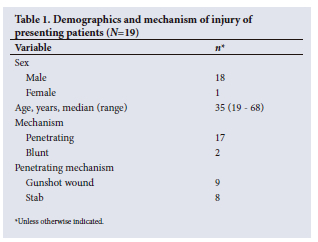
A sample of 19 patients underwent an ERT (Table 1). The majority of patients were male (94.74%). The age range (19 - 68 years old) was considerable. Penetrating trauma was the overwhelming cause of injury (94.44%), with a roughly equal number of gunshot (GSW) and stab wounds.
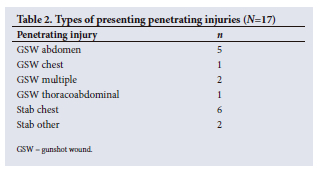
Injuries affected various locations, including the abdomen, chest, thoracic and other areas, such as the neck and gluteal region (Table 2). The detailed breakdown reveals the diversity and severity of injuries. Injury severity ranged widely, from affecting specific vessels (e.g. subclavian vein, superior gluteal artery) to multiple organ damage (e.g. liver, bowel, lung). Several cases involved significant vascular injuries (e.g. superior mesenteric vein, inferior mesenteric vein, inferior mesenteric artery, portal vein, inferior vena cava).
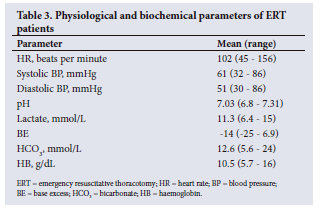
The data reveal a range of initial physiological parameters (heart rate, blood pressure, lactate, pH, etc.), reflecting the variability in patient condition upon arrival (Table 3). There is evidence of a difference in lactate levels between the single survivor and 18 non-survivors, although the difference is less pronounced than that in resuscitation time. The non-survivors tended to have higher lactate levels, indicating greater metabolic derangement. Similar to lactate, base excess showed a trend toward more significant acidosis (lower base excess) in non-survivors, reflecting a more severe physiological derangement.
A substantial proportion (68.42%) of patients required CPR, highlighting the severity of their condition. None of the 19 patients had cardiac arrest pre-arrival or on arrival, but rather later on. Blood products were administered in a significant number of cases. The analysis shows a statistically significant difference in the time to ERT between the survivor and non-survivors. The survivor had a significantly shorter time to resuscitation (15 minutes) than non-survivors (median 45.5 minutes). This is a crucial finding, suggesting a strong association between prompt resuscitation and survival.
Key findings
The overwhelming majority of patients (18/19, 94.7%) died. This highlights the critical nature of ERT cases and the challenges in achieving favourable outcomes, especially in a resource-constrained setting. The sample consisted primarily of males (18/19, 94.7%), and this could reflect existing patterns in trauma presentation.
Penetrating trauma was the most frequent mechanism of injury (17/19, 89.5%), which suggests a correlation between penetrating trauma and the need for ERT, aligning with established knowledge. Within penetrating injuries, GSWs were more prevalent than stab wounds. GSWs most frequently affected the abdomen. The wide range of initial physiological parameters indicate the severity and variability of patient presentations. Non-survivors showed higher lactate levels and more significant acidosis (lower base excess), suggesting more severe metabolic derangement upon arrival. While the sample size limits strong conclusions, the data indicate an association between shorter ERT initiation times and increased survival chances. A significant proportion of patients (68.4%) required CPR after arrival. A significant proportion (84.2%) of patients also received blood product transfusions, further demonstrating the severity of injuries and the need for aggressive resuscitation. Even the sole survivor experienced significant postoperative morbidities. The causes of death were multifactorial (coagulopathy and multiorgan failure being the main reasons) and related to the severity of injuries, but systemic inflammatory response syndrome was mentioned as a contributing factor in one case.
Discussion
The study confirms findings from previous research: a short interval between the arrival of patients in extremis and the performance of an ERT is key to the survival of the patient.[5-7] The statistically significant shorter median time to ERT in the survivor compared with non-survivors underscores this critical point. This aligns with the established understanding that early intervention is crucial for improving outcomes in these high-risk patients.[8,10] Elevated lactate levels and acidosis (indicated by base excess) were observed in non-survivors, consistent with findings in similar studies that demonstrate the correlation between metabolic derangement and poor prognosis.[11-13] The high proportion of patients requiring CPR soon after arrival demonstrates the injury severity of patients undergoing ERT in this setting. The study also points to the significant variability in initial physiological parameters, reflecting the heterogeneity of patients presenting for ERT. While the study acknowledges that this initial assessment does not allow for a definitive prediction of ERT success, it emphasises the importance of carefully selecting patients for ERT based on the presence of signs of life and the mechanism of injury, to optimise the chances of a successful outcome.[3,4]
The timing of ERT may play a role, with some literature suggesting that the likelihood of success decreases significantly with a longer interval time between arrival and ERT performance.[3-5] Determining the appropriate indications for ERT remains challenging due to the often chaotic and rapidly evolving circumstances in the emergency department, especially given the frequently unstable physiological state of patients. There is ongoing debate on the exact criteria for performing ERT, with conflicting evidence regarding its benefit in the absence of signs of life. [6,7] Performing ERT requires rapid access to the thoracic cavity, often under suboptimal conditions. The procedure needs skilled surgical expertise, with adequate equipment, and readily available theatre resources and support staff. [8] The presence of significant bleeding and organ damage necessitates precise and rapid control of haemorrhage along with blood transfusion products from the blood bank, supported with emergency stores of shelf products such as fibrin degradation products or emergency O-negative blood products in the resuscitation area.[10]
As described, patients undergoing ERT exhibit substantial variability in their physiological state, anatomical injuries and overall clinical picture. This heterogeneity makes it difficult to establish standardised protocols and predict outcomes with certainty.[11,12] Injuries may range from simple cardiac tamponade to massive vascular trauma, necessitating individualised treatment plans. Resource limitations in under-resourced settings can impede the successful performance of ERT and negatively affect outcomes.[13]
The decision to perform ERT involves significant ethical considerations, particularly given the high mortality rate associated with the procedure. These decisions often need to be made rapidly and under pressure, leading to potentially difficult ethical dilemmas when considering resource limitations such as intensive care unit bed availability and the possibility of hypoxic brain injury with prolonged rehabilitation times. The use of objective criteria, informed consent, when possible, and transparent communication between the surgical team and the family are essential.[14] While the majority of our patients presented with penetrating trauma, a smaller number had blunt injuries, reinforcing the established understanding that blunt trauma often has poor outcomes in ERT situations.
The recent advances in resuscitative endovascular balloon of the aorta (REBOA) offer a potentially impactful alternative or adjunct to ERT in select cases. Its ability to stabilise haemodynamics and improve perfusion may lessen the urgency or even eliminate the need for ERT in some scenarios.[15]
The success rate of ERT remains modest, with significant variability reported across different studies. Survival rates are influenced by several factors, including the mechanism of injury, presence or absence of signs of life before the procedure, time to intervention and the location of the injury. Patients with penetrating injuries, particularly those with signs of life before ERT, tend to have better outcomes than those with blunt trauma.[16,17] The presence of signs of life (e.g. palpable pulse, spontaneous respiration, pupillary response) before the procedure has been consistently identified as a key predictor of survival.[16,17] The faster initiation of ERT following cardiac arrest is associated with improved survival chances.[17] Access to adequate resources (skilled personnel, blood products, equipment) significantly improves the chances of a favourable outcome.[18] The poor survival rate in our subgroup may be reflective of the time delay to hospital and the lack of immediately available blood products; however, further research is required to confirm this.
Study limitations
The limitations of this study, including the small sample size, limit the generalisability of the findings. The small sample size also limited the statistical power, potentially masking significant relationships. The lack of standardised protocols for ERT within the institution may have introduced variability. Additional limitations include the potential for selection bias and missing data (e.g. blood pressure in certain patients). Future studies should incorporate a larger sample size, use more robust statistical analysis methods (e.g. multivariate analysis and survival analysis techniques such as Cox regression to adjust for confounders such as injury severity) and include variables such as injury severity scores to better account for the heterogeneity of injuries. The high incidence of tuberculosis in the study population and the mode of transport may also have affected the outcomes; however, these variables were not tracked in this study.
Recommendations
The key recommendations are to conduct the study with a much larger sample size over an extended study period, employ more sophisticated survival analysis techniques (e.g. Cox proportional hazard models) to more accurately model the time-to-event data (time to death) and identify factors influencing survival probability. A multivariate analysis to determine the most significant predictors of mortality and morbidity after ERT could incorporate variables such as injury severity scores, physiological measures and treatment interventions. The implementation of appropriate methods to handle missing data, such as multiple imputation, may be useful.
Conclusion
This prospective cohort study of ERTs within a busy level 1 trauma unit in a developing country highlights the critical importance of prompt resuscitation in improving survival rates. The high mortality rate and the small sample size underscore the need for further large-scale studies incorporating a broader range of potential confounders. The use of REBOA and the refinement of ERT selection criteria warrant further investigation to optimise outcomes in resource-constrained settings.
Data availability. The data used for this study are available from the authors on request.
Declaration. None.
Acknowledgements. The Trauma Unit team of Chris Hani Baragwanath Academic Hospital.
Author contributions. All authors contributed equally to the research and writing of this manuscript. No forms of artificial intelligence assists were used in this research.
Funding. None.
Conflicts of interest. None.
References
-
1. Beall AC Jr, Diethrich EB, Cooley DA, DeBakey ME. Surgical management of penetrating cardiovascular trauma. South Med J 1967;60(7):698-704. https://doi.org/10.1097/00007611-196707000-00005
» https://doi.org/10.1097/00007611-196707000-00005 - 2. Mattox KL, Espada R, Beall AC Jr, Jordan GL Jr. Performing thoracotomy in the emergency center. JACEP 1974;3(1):13-17.
- 3. Baker CC, Caronna JJ, Trunkey DD. Neurologic outcome after emergency room thoracotomy for trauma. Am J Surg 1980;139(5):677-681.
-
4. Cothren CC, Moore EE. Emergency department thoracotomy for the critically injured patient: Objectives, indications, and outcomes. World J Emerg Surg 2006;1:4. https://doi.org/10.1186/1749-7922-1-4
» https://doi.org/10.1186/1749-7922-1-4 -
5. Flynn TC, Ward RE, Miller PW. Emergency department thoracotomy. Ann Emerg Med 1982;11(8):413-416. https://doi.org/10.1016/S0196-0644(82)80037-1
» https://doi.org/10.1016/S0196-0644(82)80037-1 -
6. Bodai BI, Smith JP, Ward RE, O'Neill MB, Auborg R. Emergency thoracotomy in the management of trauma: A review. JAMA 1983;249(14):1891-1896. https://doi.org/10.1001/jama.1983.03330380079034
» https://doi.org/10.1001/jama.1983.03330380079034 - 7. Ivatury RR, Shah PM, Ito K, Ramirez-Schon G, Suarez F, Rohman M. Emergency room thoracotomy for the resuscitation of patients with 'fatal' penetrating injuries of the heart. Ann Thorac Surg 1981;32(4):377-385.
-
8. Weare S, Gnugnoli DM. Emergency room thoracotomy. Treasure Island (FL): StatPearls Publishing, 2023. https://www.ncbi.nlm.nih.gov/books/NBK560863/ (accessed 20 November 2025).
» https://www.ncbi.nlm.nih.gov/books/NBK560863/ -
9. Chang B, Tucker WD, Burns B. Thoracotomy. Treasure Island (FL): StatPearls Publishing, 2023. https://www.ncbi.nlm.nih.gov/books/NBK557600/ (accessed 20 November 2025).
» https://www.ncbi.nlm.nih.gov/books/NBK557600/ -
10. Sherman MM, Saini VK, Yarnoz MD, Ramp J, Williams LF, Berger RL. Management of penetrating heart wounds. Am J Surg 1978;135(4):553-558. https://doi.org/10.1016/0002-9610(78)90036-3
» https://doi.org/10.1016/0002-9610(78)90036-3 -
11. Kirkpatrick AW, Ball CG, D'Amours SK, Zygun D. Acute resuscitation of the unstable adult trauma patient: Bedside diagnosis and therapy. Can J Surg 2008;51(1):57-69. https://pubmed.ncbi.nlm.nih.gov/18248707/ (accessed 24 November 2025).
» https://pubmed.ncbi.nlm.nih.gov/18248707/ -
12. Velmahos GC, Degiannis E, Souter I, Allwood AC, Saadia R. Outcome of a strict policy on emergency department thoracotomies. Arch Surg 1995;130(7):774-777. https://doi.org/10.1001/archsurg.1995.01430070096019
» https://doi.org/10.1001/archsurg.1995.01430070096019 -
13. Leidel BA, Kanz KG, Kirchhoff C, Bürklein D, Wismüller A, Mutschler W Cardiac arrest following blunt chest injury: Emergency thoracotomy without ifs or buts? Unfallchirurg 2007;110(10):884-890. https://doi.org/10.1007/s00113-007-1349-4
» https://doi.org/10.1007/s00113-007-1349-4 -
14. Boczar ME, Howard MA, Rivers EP, et al. A technique revisited: Hemodynamic comparison of closed- and open-chest cardiac massage during human cardiopulmonary resuscitation. Crit Care Med 1995;23(3):498-503. https://doi.org/10.1097/00003246-199503000-00005
» https://doi.org/10.1097/00003246-199503000-00005 -
15. Mazzoli CA, Chiarini V, Coniglio C, et al. Resuscitative endovascular balloon occlusion of the aorta (REBOA) in non-traumatic cardiac arrest: A narrative review of known and potential physiological effects. J Clin Med 2022;11(3):742. https://doi.org/10.3390/jcm11030742
» https://doi.org/10.3390/jcm11030742 -
16. Tavares S, Hankins JR, Moulton AL, et al. Management of penetrating cardiac injuries: The role of emergency room thoracotomy. Ann Thorac Surg 1984;38(3):183-187. https://doi.org/10.1016/s0003-4975(10)62233-3
» https://doi.org/10.1016/s0003-4975(10)62233-3 -
17. Degiannis E, Degiannis K, Doll D. Technique of cross-clamping of descending thoracic aorta during emergency department thoracotomy. Am Surg 2023;89(11):4929. https://doi.org/10.1177/00031348211023441
» https://doi.org/10.1177/00031348211023441 -
18. Kish G, Kozloff L, Joseph WL, Adkins PC. Indications for early thoracotomy in the management of chest trauma. Ann Thorac Surg 1976;22(1):23-28. https://doi.org/10.1016/s0003-4975(10)63946-x
» https://doi.org/10.1016/s0003-4975(10)63946-x

Accepted 17 March 2025