Relationships of heredity and dry eye with pterygia in black African patients
Peter AnguriaI; Sam NtuliIII; Trevor CarmichaelII
IMB ChB, MMed Ophth Division of Ophthalmology, Department of Neurosciences, University of the Witwatersrand, Johannesburg
IIMB BCh, FCS (SA), PhD (Med), MSc (Med) Division of Ophthalmology, Department of Neurosciences, University of the Witwatersrand, Johannesburg
IIIBSc Stat, BSc (Hon) Stat, MSc Biostat University of Limpopo, Polokwane campus
To the Editor: Pterygium is a wing-shaped fibrovascular growth of the conjunctiva across the limbus onto the cornea.1 1 2
Pterygia are widely believed to be due to excessive exposure to sunlight,3,4 and a long duration of ultraviolet radiation has been reported to be responsible for its development.5 6 7 6 8 8 4 8
Ethical clearance was obtained from the institutional research ethics committees. We prospectively interviewed 71 patients and 71 age- and sex-matched controls in the Mankweng Eye Unit in Polokwane. Patients with ocular surface malignancy and pseudo-pterygium were excluded.
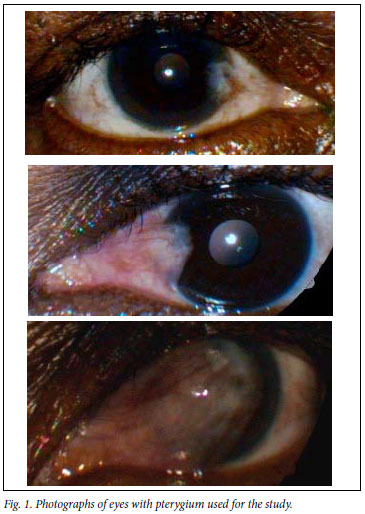
Consent was obtained and participants were shown three photographs of eyes with pterygia (Fig. 1) and asked questions similar to those used in a previous study.2 7
The mean age of the participants was 45 years (standard deviation 10.65), with a range of 22 - 65 years. There were nearly three times as many females as males in the series.
There was a positive family history of pterygium in 36% of cases and 10% of controls. A positive history was almost 5 times as common in cases as in controls. This was statistically significant (p<0.05, chi-square test).
The tear film was unstable in 7% of cases and 17% of controls. An unstable tear-film was 4 times more common in controls than in cases, and this was significant (p<0.05, chi-square test).
A positive family history implies hereditary predisposition.2 9 2
An unstable tear film (dry eye) was not associated with pterygium in this study, and this lack of association has previously been reported in Bantu patients.10 11 7 12
The inherited predisposition that appears to underlie the formation of pterygium in black African patients requires further study.
References
- 1. Duke-Elder S. System of Ophthalmology. Vol 8, part 1. London: Kimpton, 1965: 573-582.
- 2. Carmichael TR. Genetic factors in pterygium in South Africans. S Afr Med J 2001;91:322.
- 3. Cameron ME. Pterygium throughout the world. Springfield: Thomas, 1965.
- 4. Moran DJ, Hollows FC. Pterygium and ultraviolet radiation: a positive correlation. Br J Ophthalmol 1984;68:343-346.
- 5. Mackenzie FD, Hirst LW, Battistutta D, Green A: Risk analysis in the development of pterygia. Ophthalmology 1992;99:1056-1061.
- 6. Wong TY, Foster PJ, Johnson GJ, Seah SKL, Tan DTH. The prevalence and risk factors for pterygium in an adult Chinese population in Singapore: the Tanjong Pagar survey. Am J Ophthalmol 2001; 31:176-183.
- 7. Kadayifcilar SC, Orhan M, Irkec M. Tear functions in patients with pterygium. Acta Ophthalmol. Scand 1998;76:176-179.
- 8. Hill JC, Maske R. Pathogenesis of pterygium. Eye 1989;3:218-226.
- 9. Booth F. Heredity in one hundred patients admitted for excision of pterygia. Aust NZ J Ophthalmol 1985;13:59-61.
- 10. Goldberg L, David R. Pterygium and its relationship to the dry eye in the Bantu. Br J Ophthalmol 1976;60:720-721.
- 11. Wilson G, Horner D, Begley C, Page J. Ocular discomfort from pterygium in men and women. Eye Contact Lens 2008;34:201-206.
- 12. Balogun MM, Ashaye AO, Ajayi BGK, Osuntokun OO. Tear break-up time in eyes with pterygia and pingueculae in Ibadan. W Afr J med 2005; 24: 162-166. [Pubmed]