Part II. Health and economic context
health indicators; demographic indicators; economic indicators; health sector organisation; health services
health indicators; demographic indicators; economic indicators; health sector organisation; health services
Part II. Health and economic context
N Schellack; J C Meyer; A G S Gous; C Winters
Keywords: health indicators; demographic indicators; economic indicators; health sector organisation; health services
This overview of South Africa's demographic profile, economic development and health system provides the context in which to view the situation of antibiotic access and resistance. It presents information on national health policy and governance, infrastructure and human resources. The presence and utilisation of these features within the health system are discussed in relation to access to essential medicines, with a particular focus on antibiotics.
Demographics and economy
Demographic and social context
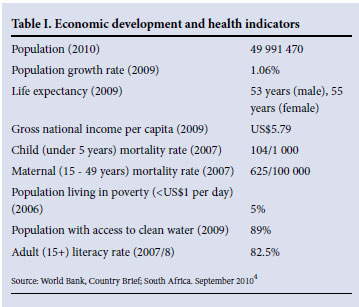
With an estimated population of 49.9 million, South Africa is a nation of diverse cultures, languages and religious beliefs.1
Decreasing fertility levels are also mirrored in the age profile of the population. Unlike most countries in the region, South Africa faces a high ageing index, defined as the number of people aged 65 and over per 100 youths under the age of 15. The index varies considerably, however, when disaggregated by population group: it is highest among whites, moderate among Indians and lowest among the black population.
South Africa instituted a 'no-fee' school system in the last decade. As a result, the percentage of adults without any schooling has dramatically fallen from 18% in 2001 to 7% in 2010. There remains, however, a high degree of inequality in access to education by region and racial group. Housing conditions vary as well. Although 83% of households are connected to electricity nationally, households relying on wood or paraffin remain high in Limpopo (54%) and the Eastern Cape (41%). Most households have access to piped water, with the national average at 89% in 2009. The Eastern Cape, however, lags with only 75% access.
Economic context
South Africa has achieved a high level of economic stability since the transition to a constitutional democracy in 1994. It has the largest economy in Africa, contributing 40% of the continent's gross domestic product (GDP) and exerting significant influence on trade and investment on the continent.23
As in other African countries, however, poverty remains a major challenge. Income is very skewed, and nearly half the population lives in developing-country conditions, despite average GDP placing South Africa among the middle-income countries.245
With the launch of the Accelerated and Shared Growth Initiative for South Africa (ASGISA) in 2006, the government adopted a comprehensive approach to meet economic challenges through a number of programmes that emphasise employment, land reform and agriculture revival.67
Of these approaches, social grants have had the most impact on both health outcomes and poverty indicators. Old-age pensions (the older persons' grant) were shown to dramatically improve household food security, and child support grants resulted in better nutritional status of children than those in households not receiving the grants. Conversely, the grant system has also led to negative unintended consequences. Reports of patients with tuberculosis (TB) opting to remain infectious and sell their sputum to TB-negative individuals seeking disability grants are common. As a result, not only is the system abused, but sick people also go untreated and can spread the disease to others. Finally, given the ability of illness to absorb the value of social grants, other strategies to complement this approach have been proposed.
Absolute poverty
Economic growth in the post-apartheid period and investments in human development have enabled a measurable decline in income poverty.47
Uncertainty about the progress on poverty reduction goals exists when the definition of poverty is expanded beyond income, as found in the 2009 United Nations 'Rethinking Poverty' report.1
Income inequality
Despite the impressive economic performance, inequality has increased as measured by the 'Gini coefficient' (a value of 0 expressing total equality and a value of 1 maximal inequality).45
Of the black population, 93%, and only 3% of the white population, earned income in the lowest decile. In the top income decile, 73% of income goes to the white population and 17% to blacks.
Health system
Health indicators
South Africa is a paradox of high health expenditure and supportive policies coupled with persistently poor health outcomes. The country has four concurrent epidemics, a health profile found only in the Southern African Development Community region.811,9 By most estimates, South Africa's per capita health burden is the highest of any middle-income country in the world, the brunt of which is carried by the poorest families.1,8
Malnutrition, another important health indicator, has increased since 1994. According to the 2010 South African MDG report, 10% of children under the age of 5 years were underweight in 2005, compared with 9% in 1994.1
The political and social history of South Africa has profoundly affected the country's health outcomes and current health policies.8Table I summarises the country indicators.
Current health policies
According to the South African Health Review, the current health leadership in the country is committed to a substantial overhaul of the public health sector to address the complex burden of disease, improve health outcomes and increase access to services.10
Several initiatives exist with potential to improve antibiotic management, from prescribing and access to surveillance for bacterial disease and resistance. These include the Health Sector Road-map, integrated support teams, and the establishment of a ministerial task team on national health insurance.
Health sector road-map
In 2008, the Health and Education Committee of the National Executive Council of the African National Congress (ANC) commissioned a 'Health Road-map'. This was in response to national concerns that South Africa, unlike most emerging economies, had witnessed profound health deterioration since the late 1990s. Several meetings of working groups were convened between August and September 2008, with teams producing background documents on the health status of the population and a final report with a '10-point plan'. The road-map was intended to guide government health policy and identify opportunities to improve access to quality health care.
A review of government strategic plans for 2009 - 2013 suggests that a number of the Road-map's recommendations have been adopted. It is unclear, however, what remains to be addressed or how these recommendations have improved access to medicines and services in practice.
Integrated support teams
The Ministry of Health established integrated support teams (ISTs) in 2009. They were intended to quantify the waste and overspending in provincial health departments that had allegedly contributed to a halt in antiretroviral treatment in the Free State. The ISTs made a number of recommendations on finance, service delivery, human resources, information management, medical supplies and technology, which were given to the Minister of Health and the National Health Council.
Progress on the recommendations is slow. While some reports indicate that a number of provinces have incorporated the recommendations into their annual performance plans, others express concerns that, without improving management systems, initiatives will not lead to expected results.
Advisory Committee on National Health Insurance (NHI)
In 2007, the ANC resolved to 'reaffirm the implementation of national health insurance'. By 2009, a broad outline of the NHI was available for debate and discussion, and an Advisory Committee on NHI was established to support the Minister in developing policy and legislation for the implementation of NHI.
Unfortunately, there has been little transparency in the functioning or outputs of the advisory team. Currently, South Africa is still without a detailed plan for NHI.
Organisation and distribution of services
At the end of the apartheid era, South Africa was not structured to serve the health needs of the entire population adequately. The health system inherited by the newly elected government was well resourced compared with other middle-income countries, with total health care expenditure at 8.5% of GDP.8
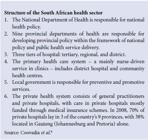
Today, the health care system still comprises both public and private sectors, with a shift in emphasis to primary health care. Public sector health services are organised according to a hierarchy of clinics and hospitals with care provided through a referral system.11
Higher earners and foreigners working in the country access health services through the private sector, funded largely through medical insurance. The number of private hospitals has grown in the past years, topping 200 in 2005. For medical conditions not requiring hospitalisation, patients can visit the practices of family physicians (general practitioners).
Financing
In the past two decades, the government transformed a disparate homeland system into an integrated, comprehensive national system, driven by the need to redress inequities and provide critical services to disadvantaged areas.8121112
The market for private health insurance (also referred to as medical schemes) has slowly grown and covers the majority of spending in the private sector.11
Human resource challenges
Insufficient human resources are the major challenge facing the South African health system. A 2008 report by the South African Department of Labour concluded that 'it is clear that there is a shortage of doctors in South Africa in both absolute and relative terms', and recommended 'urgent measures to recruit doctors and other health professionals back to South Africa'.138118
Regarding antibiotic management, the human resource situation is dire. In 2007, there were insufficient personnel to render adequate pharmaceutical services in South Africa, with 25.5 pharmacists per 100 000 inhabitants. This equates to about 10 000 pharmacists in the entire country, with only 11% employed by the public sector nationwide and 40% of all pharmacists concentrated in Gauteng's private sector. Although registered pharmacists had increased to 12 813 in 2010, this was barely enough to maintain the same pharmacist/population ratio as in 2007, when accounting for population growth. The shortage of qualified pharmaceutical personnel is worsened by a yearly loss of 30% of pharmacy graduates to other countries, undermining the delivery of pharmaceutical care and the monitoring of rational drug use.14
Access to essential medicines and health care services
Coverage of health services in South Africa could be described as relatively good, as the majority of health care funding occurs through prepayment mechanisms.15
Despite these figures, there is room for improvement. While there is an extensive breadth of coverage 'on paper', many South Africans in reality cannot access health services when needed. While primary health care services are free of charge at point of service, distances to facilities and inability to cover transport costs to reach facilities that are not within a reasonable walking distance are particular problems. Other access constraints include limited facility working hours, insufficient staff, lost income as a result of taking time off work to wait for long periods at clinics, lack of availability of medicines, and poor service quality.
Overall, most children in all provinces are dependent on the public sector, where 7 - 8% live more than 30 minutes' travel distance from a primary health care clinic.16
Although most children visit their local primary health care clinic at least 3 times a year, this is below the target number of 5 well-child visits per annum during the first 5 years of life. The health promotion value of these visits is also questionable, as immunisation coverage hovers around 80% (except in Western Cape) and the measles drop-out rate is close to 20%.
For women, the coverage gap in maternal health services is low by developing-country standards, with only 8% of women not attending antenatal care and 9% not delivering with a skilled birth attendant.17
There is a significant quality gap in the provision of critical services. To address the issue of sub-standard care, the Department of Health developed a quality of care policy.1819
Demand side-issues are another component of evaluating access to health care. Currently, there is limited information on community-level dynamics influencing utilisation of health care services.15,17 In the report of the National Committee on Confidential Enquiries into Maternal Deaths, patient-related demand was identified in 46% of maternal deaths reported in 2005 - 2007. A separate study assessing utilisation of maternal health services in Western Cape, Eastern Cape and KwaZulu-Natal found that distances to facilities and lack of transport were the biggest problems, but lack of quality care and poor provider communication with patients were also factors of low utilisation.
References
- 1. Day C, Gray A. Health and related indicators. In: Fonn S, Padarath A, eds. South African Health Review. Durban: Health Systems Trust, 2010.
-
2. Saleson M. Africa now - building a better future in Africa's middle income countries. 13 October 2007. http://go.worldbank.org/I353NN7TY0 (accessed 30 June 2011).
» http://go.worldbank.org/I353NN7TY0 -
3. World Bank. Country Page - South Africa. 2011. http://go.worldbank.org/0V0IPMVXT0 (accessed 30 June 2011).
» http://go.worldbank.org/0V0IPMVXT0 -
4. World Bank. South Africa: Country Brief. September 2010. http://go.worldbank.org/GSBYF92330 (accessed 30 June 2011).
» http://go.worldbank.org/GSBYF92330 - 5. Lutge E, Friedman I. The cycle of poverty, hunger and ill-health. In: Fonn S, Padarath A, eds. South African Health Review. Durban: Health Systems Trust, 2010.
-
6. Government of South Africa. Key issues - accelerated and shared growth initiative for South Africa (AsgiSA). 18 February 2011. http://www.info.gov.za/asgisa (accessed 30 June 2011).
» http://www.info.gov.za/asgisa - 7. Statistics South Africa. Millennium Development Goals Country Report. Pretoria: Statistics South Africa, 2010.
- 8. Coovadia H, Jewkes R, Barron P, Sanders D, McIntyre D. The health and health system of South Africa: historical roots of current public health challenges. Lancet 2009;374:817-834.
- 9. Nicol E, Bradshaw D. Maternal, newborn and child survival: data challenges. In: Fonn S, Padarath A, eds. South African Health Review. Durban: Health Systems Trust, 2010.
- 10. Rispel L, Moorman J. Health legislation and policy: context, progress and progress. In: Fonn S, Padarath A, eds. South African Health Review. Durban: Health Systems Trust, 2010.
- 11. Business Monitor International. South Africa Pharmaceuticals & Healthcare Report. London: Business Monitor International Ltd, 2010.
- 12. Chopra M, Lawn J, Sanders D, et al. Achieving the health Millennium Development Goals for South Africa: challenges and priorities. Lancet 2009;374:1023-1031.
-
13. Miller T. South Africa's health system and challenges. PBS NewsHour. 24 March 2009. http://www.pbs.org/newshour/globalhealth/jan-june09/sahealth_03-24.html (accessed 30 June 2011).
» http://www.pbs.org/newshour/globalhealth/jan-june09/sahealth_03-24.html - 14. Fomundam H. The Challenges of Pharmaceutical Care in Africa - The Case of South Africa - HIV and AIDS (Presentation). Pretoria: Medunsa Pharmacovigilance Centre, 2007.
- 15. McIntyre D. National Health Insurance: Providing a Vocabulary for Public Engagement. In: Fonn S, Padarath A, eds. South African Health Review. Durban: Health Systems Trust, 2010.
- 16. McKerrow N, Mulaudzi M. Child Mortality in South Africa: Using Existing Data. In: Fonn S, Padarath A, eds. South African Health Review. Durban: Health Systems Trust, 2010.
- 17. Blaauw D, Penn-Kekana L. Maternal Health. In: Fonn S, Padarath A, eds. South Africa Health Review. Durban: Health Systems Trust, 2010.
- 18. Department of Health. Improving Quality of Care. Pretoria: Government Printer, 2001.
- 19. Department of Health. Revised Draft of Health Charter. Pretoria: Government Printer, 2005.