Shedding the load of hypertension: The proteolytic processing of angiotensin-converting enzyme
A number of membrane proteins are enzymatically cleaved or ‘shed’ from the cell surface, resulting in the modulation of biological events and opening novel pharmaceutical approaches to diverse diseases by targeting shedding. Our focus has been on understanding the shedding of angiotensin-converting enzyme (ACE), an enzyme that plays a pivotal role in blood pressure regulation. The identification of novel hereditary ACE mutations that result in increased ACE shedding has advanced our understanding of the role of ACE shedding in health and disease. Extensive biochemical and molecular analysis has helped to elucidate the mechanism of ACE shedding. These findings point to the potential therapeutic role of targeting shedding in regulating tissue ACE levels in cardiovascular disease.
FORUM
REVIEW
Shedding the load of hypertension: The proteolytic processing of angiotensin-converting enzyme
Mario R W EhlersI; Kerry GordonIV; Sylva L U SchwagerIII; Edward D SturrockII
IDeputy Director of the Clinical Trials Group at the Immune Tolerance Network, USA. He was formerly Professor and Head of the Department of Medical Biochemistry at the University of Cape Town (UCT). His principal therapeutic areas of interest include diabetes, cardiovascular disease, and auto-immunity
IIProfessor of Medical Biochemistry at UCT and an author of more than 75 peer-reviewed scientific papers. His research interests include structure-function studies of metalloproteases and the development of next-generation ACE inhibitors for treating hypertension and fibrosis
IIIProtein biochemist and co-author of more than 30 scientific papers. She obtained her undergraduate and postgraduate degrees from UCT. Her research interests include the ectodomain shedding of membrane proteins, the structure and function of metalloproteases and drug discovery and development
IVPostdoctoral fellow in the Department of Molecular and Cell Biology at UCT. Her research interests include the role of envelope glycosylation in HIV and protein-protein interactions and ectodomain shedding of ACE
A number of membrane proteins are enzymatically cleaved or ‘shed’ from the cell surface, resulting in the modulation of biological events and opening novel pharmaceutical approaches to diverse diseases by targeting shedding. Our focus has been on understanding the shedding of angiotensin-converting enzyme (ACE), an enzyme that plays a pivotal role in blood pressure regulation. The identification of novel hereditary ACE mutations that result in increased ACE shedding has advanced our understanding of the role of ACE shedding in health and disease. Extensive biochemical and molecular analysis has helped to elucidate the mechanism of ACE shedding. These findings point to the potential therapeutic role of targeting shedding in regulating tissue ACE levels in cardiovascular disease.
Shedding of membrane proteins
Barely 20 years have elapsed since our first description of membrane protein shedding as a general phenomenon in biology.12
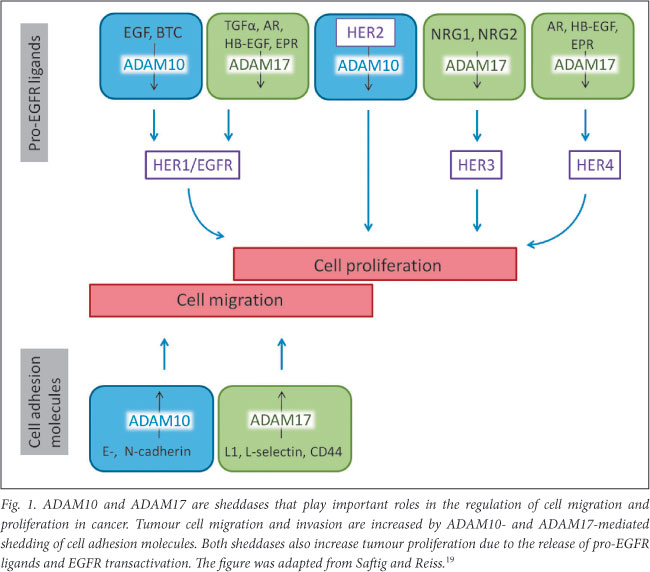
Why is ectodomain shedding so widespread? Diverse types of membrane proteins are involved, most commonly adhesion proteins, various kinds of receptors, and cytokines and enzymes tethered to the cell surface. Ectodomain shedding allows for the rapid modulation of biological events on cell surfaces, especially cell-cell communication. In many cases, cell activation in response to endocrine or immune signals requires changes in cell-surface expression of receptors, adhesion molecules or cytokines, or the production of soluble forms of these proteins, and this is rapidly achieved by shedding.1
Given this ubiquity, it is not surprising that genetic disruption of one of the principal sheddases, ADAM17, is lethal during embryogenesis.2Fig. 1). There is significant interest in finding specific sheddase inhibitors, because of enormous pharmaceutical potential in diverse diseases, including auto-immunity, cancer and Alzheimer's disease.
The discovery of ACE shedding
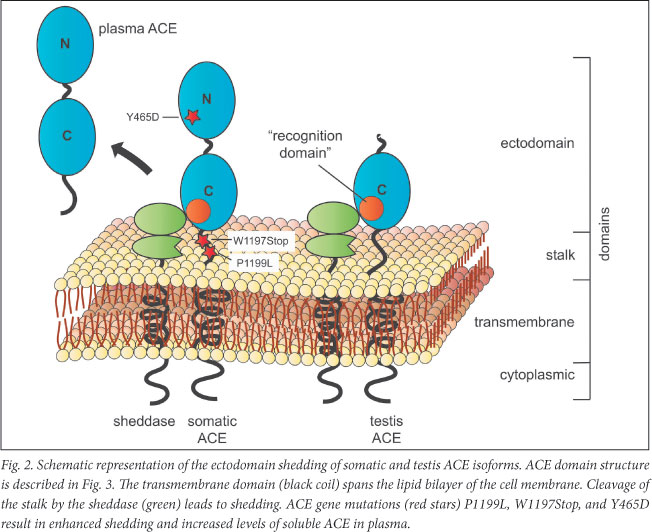
Among membrane proteins that are shed, a significant proportion are cell surface enzymes, often called ecto-enzymes, including angiotensin-converting enzyme (ACE), which we were the first to show was spontaneously shed in a mammalian cell line.34Fig. 2). It is widely believed that it is the membrane-bound ('tissue') ACE that is principally responsible for its role within the RAS, although ACE was originally discovered as a soluble protein in plasma.
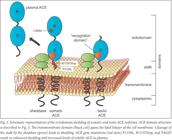
Soluble ACE is found in plasma, seminal fluid, cerebrospinal fluid and urine. Plasma ACE levels increase in certain inflammatory conditions, notably sarcoidosis, and it is believed the source is activated monocytes and macrophages.56
Despite the absence of definitive data, it is probable that soluble ACE has subtle biological functions in its own right. For example, soluble ACE in plasma offers a means for delivery of the enzyme to tissues that do not express their own ACE, thereby enabling local angiotensin II production with regional effects on vascular and the receptors for TNFa and IL-6.26
The mechanism of ACE shedding
In our laboratory we have focused on the mechanism of ACE shedding: how does the sheddase recognise its target; where in the target protein does the cleavage occur; how is the process regulated; and what are the identities of the sheddases? As shown in Fig. 2, we now know that membrane proteins that are the targets of sheddases generally have a stalk that connects the ectodomain to the membrane anchor. This stalk is open and accessible and contains the cleavage site. This has led to the notion that sheddases function like lawnmowers that move over the surface of the cell and cut any protein stalks in their path. Although this is true in broad outline, our research indicates that sheddases follow certain rules: the sheddase not only looks for an open stalk but positions itself relative to the ectodomain and requires a minimum distance from the membrane.7
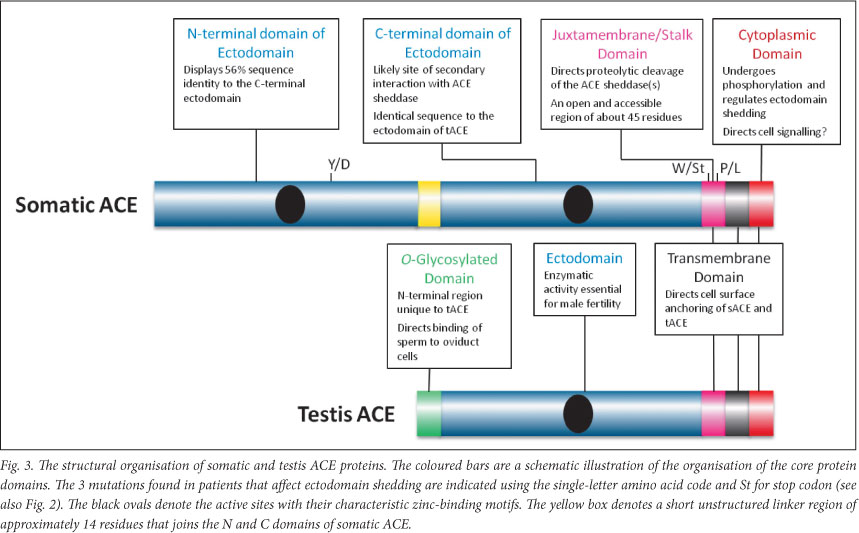
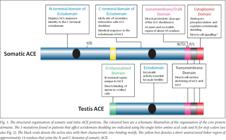
Many of these concepts emerged from our work on ACE, in which we have the advantage of a natural experiment. As shown in Fig. 3, there are in fact 2 kinds of ACE: the common form of the enzyme that is tone and fluid and electrolyte homeostasis. Similarly, monocytes widely distributed ('somatic ACE') and an ACE variant, first cloned and macrophages expressing ACE may require both membrane- in our laboratory, which is only expressed in spermatozoa ('testis bound and soluble forms for immune activation and regulation, as ACE'). Somatic ACE contains 2 similar but distinct domains arranged has been shown for other immune system proteins, such as TNFa in tandem: the second of the 2 domains (the C domain) is identical to the bulk of the testis enzyme and both proteins share identical stalk, membrane, and cytoplasmic domains (Fig. 3). Despite this, shedding of testis ACE is much more efficient than shedding of somatic ACE. Why? Work from our and other laboratories has indicated that this is most likely because there is a sheddase recognition domain in the C domain of ACE, which in somatic ACE is partly occluded by the presence of the second domain (N domain).8,9 Indeed, when a mutant ACE was constructed in which the N domain of somatic ACE was fused directly to the stalk, this mutant was not shed, suggesting that it lacked a critical recognition element for the sheddase.9
Candidate ACE sheddases
The search for the ACE sheddase is ongoing. The 2 sheddases that are most widely implicated in shedding diverse membrane proteins - ADAM17 and ADAM10 - are not involved in ACE shedding.10
ACE mutations that affect ectodomain shedding and their implications
Recently, 3 novel ACE gene polymorphisms have been described that are associated with increased plasma ACE levels (see Figs 2 and 3).
First, a mutation was identified in subjects from studies of unrelated individuals in Europe.1111
A second mutation in a family of African-Americans (W1197Stop)12
Collaboration of our group with the University of Chicago has revealed a third ACE mutation present in a family of individuals where the affected members suffer from intermittent nausea, vomiting, fatigue and depression.1313
The Y465D mutation is the first ACE polymorphism described that is associated with clinical pathology. Dysregulation of ACE expression and processing may produce the pathology by altering plasma levels of vaso- and neuropeptides degraded by ACE. A likely candidate is substance P, a peptide involved in pain and chronic inflammation, elevated plasma levels of which are associated with nausea, vomiting, depression and fatigue.141513
ACE sheddases as therapeutic targets
The dynamics between the membrane-bound and soluble forms of ACE in the local and systemic renin-angiotensin systems are complex and a better understanding of the role played by the ACE sheddase(s) is still required. Moreover, unlike the systemic RAS, where renin secretion by the kidney plays an important regulatory role in the processing of angiotensinogen, it is not clear how the production of angiotensin II by the tissue RAS is controlled. In terms of therapeutic interventions, an important question is whether limiting the production of angiotensin II is best achieved by blocking the activity of ACE or by inhibiting its release from the cell membrane. While circulating ACE levels might have some clinical implications in certain diseases such as metabolic syndrome,161718
Conclusions
Shedding of membrane-bound ACE occurs in all mammalian species in which this has been studied and likely plays a critical role in regulating this enzyme at the cell and tissue levels. A more detailed picture of the process of ACE ectodomain shedding will not only further our understanding of the biology of ACE but also holds promise for novel therapeutic interventions. Beyond the shedding of ACE, sheddases affect a wide and emerging range of pathologies and thus are attractive targets for future therapeutic approaches. However, the number of target proteins and tissue distribution for each sheddase varies considerably, requiring care in selectively inhibiting a sheddase in an organ associated with a specific disease without affecting the function of the protease in other tissues. Despite this, there is optimism that sheddase inhibitors may be useful in autoimmune diseases, malignancies, and neurodegenerative conditions.
References
- 1. Ehlers MR, Riordan JF. Membrane proteins with soluble counterparts: role of proteolysis in the release of transmembrane proteins. Biochemistry 1991;30(42):10065-10074.
- 2. Scheller J, Chalaris A, Garbers C, Rose-John S. ADAM17: a molecular switch to control inflammation and tissue regeneration. Trends Immunol 2011;32(8):380-387.
- 3. Ehlers MR, Chen YN, Riordan JF. Spontaneous solubilization of membrane-bound human testis angiotensin-converting enzyme expressed in Chinese hamster ovary cells. Proc Natl Acad Sci USA 1991;88(3):1009-1013.
- 4. Acharya KR, Sturrock ED, Riordan JF, Ehlers MR. ACE revisited: a new target for structure-based drug design. Nat Rev Drug Discov 2003;2(11):891-902.
- 5. Ehlers MR, Riordan JF. Angiotensin-converting enzyme: new concepts concerning its biological role. Biochemistry 1989;28(13):5311-5318.
- 6. Shen XZ, Xiao HD, Li P, et al. New insights into the role of angiotensin-converting enzyme obtained from the analysis of genetically modified mice. J Mol Med (Berl) 2008;86(6):679-684.
- 7. Ehlers MR, Schwager SL, Scholle RR, Manji GA, Brandt WF, Riordan JF. Proteolytic release of membrane-bound angiotensin-converting enzyme: role of the juxtamembrane stalk sequence. Biochemistry 1996;35(29):9549-9559.
- 8. Beldent V, Michaud A, Bonnefoy C, Chauvet MT, Corvol P. Cell surface localization of proteolysis of human endothelial angiotensin I-converting enzyme. Effect of the amino-terminal domain in the solubilization process. J Biol Chem 1995;270(48):28962-28969.
- 9. Woodman ZL, Schwager SL, Redelinghuys P, Carmona AK, Ehlers MR, Sturrock ED. The N domain of somatic angiotensin-converting enzyme negatively regulates ectodomain shedding and catalytic activity. Biochem J 2005;389(Pt 3):739-744.
- 10. Allinson TM, Parkin ET, Condon TP, et al. The role of ADAM10 and ADAM17 in the ectodomain shedding of angiotensin converting enzyme and the amyloid precursor protein. Eur J Biochem 2004;271(12):2539-2547.
- 11. Eyries M, Michaud A, Deinum J, et al. Increased shedding of angiotensin-converting enzyme by a mutation identified in the stalk region. J Biol Chem 2001;276(8):5525-5532.
- 12. Nesterovitch AB, Hogarth KD, Adarichev VA, et al. Angiotensin I-converting enzyme mutation (Trp1197Stop) causes a dramatic increase in blood ACE. PLoS One 2009;4(12):e8282.
- 13. Danilov SM, Gordon K, Nesterovitch AB, et al. An angiotensin I-converting enzyme mutation (Y465D) causes a dramatic increase in blood ACE via accelerated ACE shedding. PLoS One 2011;6(10):e25952.
- 14. Harrison S, Geppetti P. Substance p. Int J Biochem Cell Biol 2001;33(6):555-576.
- 15. Ehlers MRW, Riordan JF. Angiotensin-converting enzyme: zinc and inhibitor-binding stoichiometries of the somatic and testis isozymes. Biochemistry 1991;30:7118-7126.
- 16. Nagi DK, Foy CA, Mohamed-Ali V, Yudkin JS, Grant PJ, Knowler WC. Angiotensin-1-converting enzyme (ACE) gene polymorphism, plasma ACE levels, and their association with the metabolic syndrome and electrocardiographic coronary artery disease in Pima Indians. Metabolism 1998;47(5):622-626.
- 17. Dzau VJ, Bernstein K, Celermajer D, et al. Pathophysiologic and therapeutic importance of tissue ACE: a consensus report. Cardiovasc Drugs Ther 2002;16(2):149-160.
- 18. Douglas RG, Ehlers MRW, Sturrock ED. Vasopeptidase inhibition - solving the cardiovascular puzzle? Drugs of the Future 2011;36(1):33-43.
- 19. Saftig P, Reiss K. The A disintegrin and metalloproteases' ADAM10 and ADAM17: novel drug targets with therapeutic potential? Eur J Cell Biol 2011;90(6-7):527-535.