Beware of 'normal' creatine kinase levels in HIV-associated polymyositis
C KenyonI; K PillayII; J M HeckmannIII
IMB ChB, MPH. Division of Infectious Disease and HIV Medicine, Department of Medicine, University of Cape Town
IIMB ChB, MMed (Anat Path). Division of Anatomical Pathology, National Health Laboratory Services, Red Cross War Memorial Children's Hospital and University of Cape Town
IIIMB BCh, PhD. Division of Neurology, Department of Medicine, Groote Schuur Hospital and University of Cape Town
To the Editor: Generalised weakness may be a common complaint of persons infected with HIV, but the development of significant proximal weakness requires specific attention. Polymyositis may occur in HIV infection and is readily treatable with prednisone. Elevated creatine kinase (CK) levels have been regarded as an important criterion for diagnosing polymyositis. A study of HIV-associated polymyositis reported similarly elevated CK levels to those observed in non-HIV settings.1
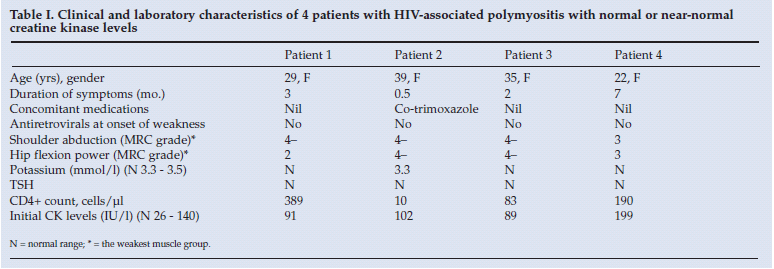
Patient 1 presented with a subacute history of painful proximal muscle weakness and arthralgia (Table I). The CK level was normal, but electromyography (EMG) showed an active myopathic process and a muscle biopsy revealed features of polymyositis. She responded to prednisone but relapsed clinically within 3.5 months of weaning from the steroids. Re-introduction of prednisone 30 mg daily, with subsequent weaning, led to a durable clinical response. Patient 2 presented with a diarrhoeal illness and 2 weeks of proximal muscle weakness. Stool microscopy revealed Cryptosporidium cysts. She was rehydrated and antiretroviral therapy was commenced with resolution of the diarrhoea. Despite adequate rehydration and normal electrolyte levels she remained too weak to walk without assistance. Examination confirmed a proximal myopathy with normal reflexes and normal findings on sensory examination, and EMG and muscle biopsy showed features of polymyositis. Her power improved substantially on prednisone therapy. Patients 3 and 4 both presented with a subacute history of proximal weakness. EMG revealed an active myopathic process in both as well as polymyositis on both muscle biopsies. Patient 3's weakness resolved completely within 2 months on prednisone 60 mg. The clinician attending patient 4 assessed the low CK level as suggestive of 'burnt out' myositis and decided against steroid therapy. The patient was commenced on antiretrovirals and within 3 months her power had almost completely normalised.
Discussion
HIV-associated polymyositis has the same clinical, electromyographic and histological features as polymyositis in HIV-negative subjects.2
CK levels relate to the amount of enzyme released by the muscle cells, and their measurement is the most frequently used laboratory test screening for inflammatory myositis. CK levels are usually raised at least 3- to 4-fold in polymyositis.3 4 3 5 6 7 8 8in vitro.8 9
Polymyositis is the most common HIV-associated muscle disease, although in rare cases uncomplicated myalgias, asymptomatic elevation of CK and rhabdomyolysis may also be encountered.2 1
We highlight the fact that a patient with HIV-associated polymyositis may have normal serum CK levels, and in this setting one should perform an EMG and/or a muscle biopsy or at least assess other muscle enzyme levels such as serum aldolase and myoglobin.6
References
- 1. Johnson RW, Williams FM, Kazi S, Dimachkie MM, Reveille JD. Human immunodeficiency virus-associated polymyositis: a longitudinal study of outcome. Arthritis Rheum 2003; 49(2): 172-178.
- 2. Robinson-Papp J, Simpson DM. Neuromuscular diseases associated with HIV-1 infection. Muscle Nerve 2009; 40: 1043-1053.
- 3. Chahin N, Engel AG. Correlation of muscle biopsy, clinical course, and outcome in PM and sporadic IBM. Neurology 2008; 70(6): 418-424.
- 4. Peloro TM, Miller OF 3rd, Hahn TF, Newman ED. Juvenile dermatomyositis: a retrospective review of a 30-year experience. J Am Acad Dermatol 2001; 45(1): 28-34.
- 5. Sanmarti R, Collado A, Gratacos J, et al. Reduced activity of serum creatine kinase in rheumatoid arthritis: a phenomenon linked to the inflammatory response. Br J Rheumatol 1994; 33(3): 231-234.
- 6. Rosalki SB. Low serum creatine kinase activity. Clin Chem 1998; 44(5): 905.
- 7. Koffman BM, Dalakas MC. Effect of high-dose intravenous immunoglobulin on serum chemistry, hematology, and lymphocyte subpopulations: assessments based on controlled treatment trials in patients with neurological diseases. Muscle Nerve 1997; 20(9): 1102-1107.
- 8. Delanghe JR, De Buyzere ML. Low creatine kinase activity in rheumatoid arthritis. J Rheumatol 1997; 24: 231-232.
- 9. Russo S, Lopalco L. Is autoimmunity a component of natural immunity to HIV? Curr HIV Res 2006; 4(2): 177-190.