Variations in blood transfusion practices among South African haematology providers: A survey of haemato-oncology and haematopoietic stem cell transplant prescribers
BACKGROUND. Patients with haematological malignancies and haematopoietic stem cell transplant recipients are major consumers of blood products. In South Africa (SA), both medical oncologists and clinical haematologists (haematology providers) manage these patients. We hypothesised that there may be varied blood transfusion practices between these two specialty groups. OBJECTIVES. To compare red blood cell (RBC) and platelet transfusion practices among haematology providers in SA, focusing on transfusion thresholds, blood product modifications and differences between clinical haematologists and medical oncologists. METHODS. We conducted an online REDCap survey among SA haematology providers, including clinical haematologists (and trainees), medical oncologists (and trainees), paediatric oncologists/haematologists (and trainees) and medical officers managing haemato-oncology patients. RESULTS. The survey response rate was 51% (79/155), of which 58 (73%) responses were complete and eligible for analysis. RBC and prophylactic platelet transfusion thresholds were generally similar across haematology providers. However, significant variation was observed in platelet thresholds for central venous catheter insertion, lumbar puncture and major surgery. Marked inconsistency was also noted in clinicians' understanding of when blood product irradiation is indicated. CONCLUSION. This study confirms a variation in blood transfusion practices and blood product modification requests between haematology providers. This emphasises the need for targeted education and national standardisation efforts to optimise transfusion practice and ensure patient safety.
transfusion; haemato-oncology; stem cell transplant
Variations in blood transfusion practices among South African haematology providers: A survey of haemato-oncology and haematopoietic stem cell transplant prescribers
J R du ToitI, *; A SetzerII, *; M D SettelIII, IV; M GoeijenbierV, VI; E VerburghVII; V J LouwVII, VIII
IFCP (SA), Cert Clin Haem Phys (SA); Cellular and Immunotherapy Centre, Wits Donald Gordon Medical Centre, School of Clinical Medicine, Faculty of Health Sciences, University of the Witwatersrand, Johannesburg, South Africa
IIMB ChB; Cellular and Immunotherapy Centre, Wits Donald Gordon Medical Centre, School of Clinical Medicine, Faculty of Health Sciences, University of the Witwatersrand, Johannesburg, South Africa
IIIMD, FRCPC; Division of Clinical Haematology, Department of Medicine, Groote Schuur Hospital, University of Cape Town, South Africa
IVMD, FRCPC; Canadian Blood Services and Department of Medicine, University of British Columbia, Vancouver, Canada
VMD, PhD; Department of Intensive Care, Spaarne Gasthuis, Haarlem, the Netherlands
VIMD, PhD; Department of Intensive Care, Erasmus MC, Rotterdam, the Netherlands
VIIMD, PhD; Division of Clinical Haematology, Department of Medicine, Groote Schuur Hospital, University of Cape Town, South Africa
VIIIMD, PhD; Division of Clinical Haematology, Department of Medicine, Stellenbosch University and Tygerberg Hospital, Cape Town, South Africa
BACKGROUND. Patients with haematological malignancies and haematopoietic stem cell transplant recipients are major consumers of blood products. In South Africa (SA), both medical oncologists and clinical haematologists (haematology providers) manage these patients. We hypothesised that there may be varied blood transfusion practices between these two specialty groups.
OBJECTIVES. To compare red blood cell (RBC) and platelet transfusion practices among haematology providers in SA, focusing on transfusion thresholds, blood product modifications and differences between clinical haematologists and medical oncologists.
METHODS. We conducted an online REDCap survey among SA haematology providers, including clinical haematologists (and trainees), medical oncologists (and trainees), paediatric oncologists/haematologists (and trainees) and medical officers managing haemato-oncology patients.
RESULTS. The survey response rate was 51% (79/155), of which 58 (73%) responses were complete and eligible for analysis. RBC and prophylactic platelet transfusion thresholds were generally similar across haematology providers. However, significant variation was observed in platelet thresholds for central venous catheter insertion, lumbar puncture and major surgery. Marked inconsistency was also noted in clinicians' understanding of when blood product irradiation is indicated.
CONCLUSION. This study confirms a variation in blood transfusion practices and blood product modification requests between haematology providers. This emphasises the need for targeted education and national standardisation efforts to optimise transfusion practice and ensure patient safety.
Keywords: transfusion, haemato-oncology, stem cell transplant
Patients with aggressive haematological malignancies receive intensive chemotherapy, often followed by either autologous or allogeneic haematopoietic stem cell transplantation (HSCT). During these treatment modalities there is substantial bone marrow suppression, during which red blood cell (RBC) and platelet transfusions are required to prevent symptomatic anaemia and thrombocytopenia-related bleeding. However, transfusion support is costly, and may adversely affect patients through risks such as blood-borne infection transmission, acute and delayed transfusion reactions, alloimmunisation, immune modulation, transfusion-associated graft-v.-host disease (TA-GVHD), iron overload and potentially fatal transfusion errors.[1,2]
Globally there has been a paradigm shift towards restrictive transfusion practices, supported by evidence that restrictive RBC transfusion strategies are safe (and sometimes superior), especially in surgical and critical care settings.[3-5] Patient blood management (PBM) is globally defined as a patient-centred, systematic, evidence-based approach to improve patient outcomes by managing and preserving a patient's own blood, while promoting patient safety and empowerment[6,7] and the use of restrictive strategies.
Despite the heavy transfusion requirements in the haematology-oncology/HSCT setting, very few trials have investigated restrictive v. liberal RBC transfusion thresholds in patients undergoing intensive chemotherapy, as highlighted by a recent Cochrane review.[8] A systematic review and meta-analysis in 2017[9] that included 15 trials (2 636 patients) showed no negative impact on clinical outcomes for a restrictive approach in haemato-oncology patients. These findings were supported by the TRIST trial,[10] the largest randomised controlled trial to date to evaluate restrictive v. liberal transfusion thresholds in patients undergoing HSCT. The outcome of this trial favoured a restrictive strategy, as no significant differences were found in clinical outcomes or patient-reported quality of life.
RBC and platelet modifications are mostly requested in haemato-oncology patients, which includes leuco-reduction and/ or irradiation - the leuco-depletion decreases the risk of human leucocyte antigen alloimmunisation and platelet refractoriness, febrile non-haemolytic transfusion reactions, bacterial infections and reperfusion injury in cardiac patients.[11-15] The irradiation mainly prevents TA-GVHD,[16] which, although rare, is invariably fatal. Both modifications can be specifically requested from the Blood Bank, but these modifications add complexity and cost, and therefore should be used for the correct indications.
There are currently limited published data on transfusion practice and modification requests specific to haemato-oncology/HSCT patients in South Africa (SA). In SA, patients with haematological malignancies are typically treated either by medical oncologists or clinical haematologists. Compared with medical oncologists, clinical haematologists receive training in transfusion medicine as part of their standard curriculum. Based on this difference in training, we hypothesised that there would be variations in blood transfusion practices and blood product modification requests between these two subspecialties and their respective trainees. This information will help us to harmonise transfusion and modification practices to establish best care recommendations specifically for our haemato-oncology patients.
To address this question, we performed an online survey of haematology providers (clinical haematologists, medical oncologists, paediatric oncologists and haematologists and their respective trainees) in SA.
Methods
Study setting and participants
A cross-sectional study was conducted using a questionnaire distributed between July 2022 and June 2023 via an online REDCap survey (23 questions related to blood transfusion practices). The survey link was circulated through WhatsApp and email to haematology providers who care for patients with haematological malignancies, recipients of HSCT and patients with chronic anaemias, such as myelodysplastic syndrome, haemoglobinopathies including thalassaemia major and sickle cell disease, and severe aplastic anaemia. Eligible participants included registered clinical haematologists, medical oncologists, paediatric oncologists/haematologists and their trainees, as well as medical officers and haematopathology registrars working within haematology departments who prescribe RBCs and platelets. Clinical haematologists in training are required to complete a minimum of 3 months in a blood transfusion unit as part of their specialisation, whereas oncology trainees do not undergo this training. Participants were unable to proceed with the survey if they did not regularly prescribe these products within the haemato-oncology setting.
Statistical analysis
Data were captured using REDCap - a secure electronic data capture tool.[17] A descriptive analysis of the survey responses and a comparison of the survey responses between the different clinician groups were performed. We divided the clinician groups into three categories: clinical haematologists; medical oncologists; and 'other', which comprised medical officers (qualified medical doctors not in training) and general medicine registrars (medical doctors part of internal medicine training programme in SA) rotating in oncology and haematology, and haemato-pathologists.
Chi-square or Fisher's exact (n<5) tests were used to assess relationships between survey questions and clinician groups. Data analysis was carried out using SAS version 9.4 for Windows (SAS Institute Inc., SA). A significance level of p<0.05 was applied.
Ethical considerations
Research ethics approval was obtained through the University of Cape Town Human Research Ethics Committee (ref. no. 340/2022). Participation was voluntary. Participants were not asked to provide their names or any other personal identifying information. The participant was only allowed to access the survey questions once consent was obtained.
Results
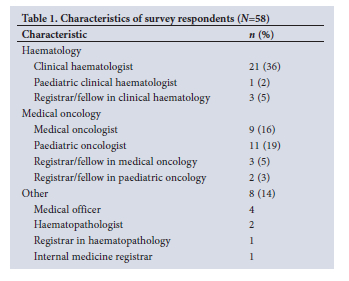
Of 155 requests, 79 survey responses were received, corresponding to an overall response rate of 51%. Of these, 19 responses were non-qualifiers, and two further responses were incomplete and were omitted. Thus 58 responses remained for further analysis. The characteristics of survey respondents are shown in Table 1.
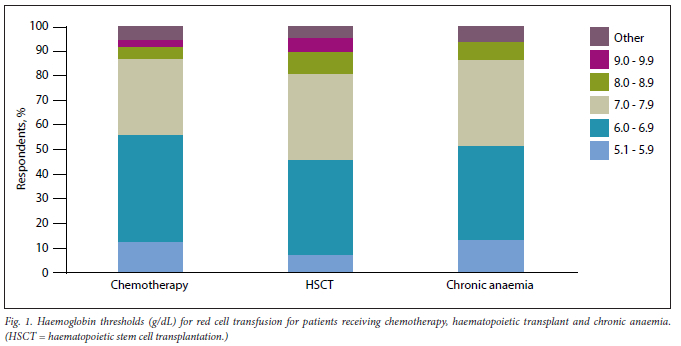
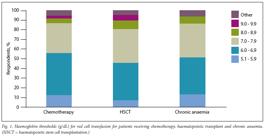
Distribution of haemoglobin thresholds (g/dL) were used to guide RBC transfusion in patients receiving chemotherapy or HSCT, and those with chronic anaemia.
Across all clinical scenarios (chemotherapy, HSCT and chronic anaemia), participants predominantly adopted a restrictive RBC transfusion strategy, with most selecting haemoglobin thresholds between 6.0 and 6.9 g/dL (Fig. 1).[8] Only a small minority reported using thresholds <6 g/dL or >8 g/dL.
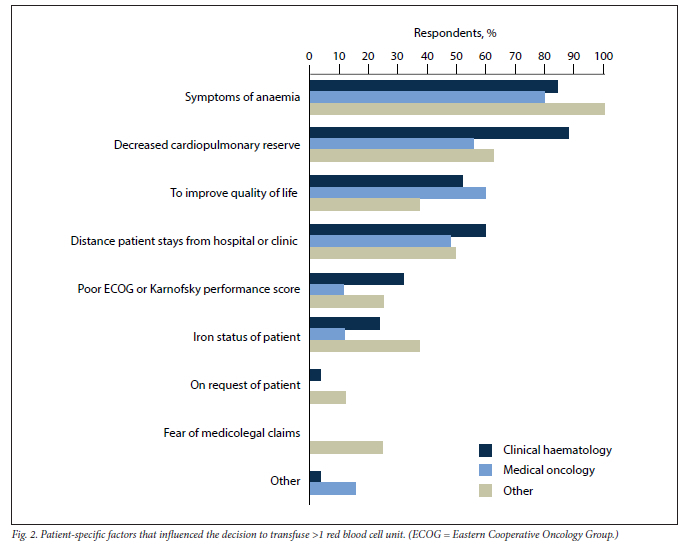
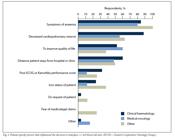
Clinical haematologists were more likely to choose decreased cardiopulmonary reserve as a reason to transfuse >1 unit of RBCs compared with medical oncologists and the 'other' group (p=0.036) (Fig. 2). Medicolegal concerns were reported mainly by the 'other' group (p=0.017), although these were ranked lower than other clinical factors influencing transfusion decisions.
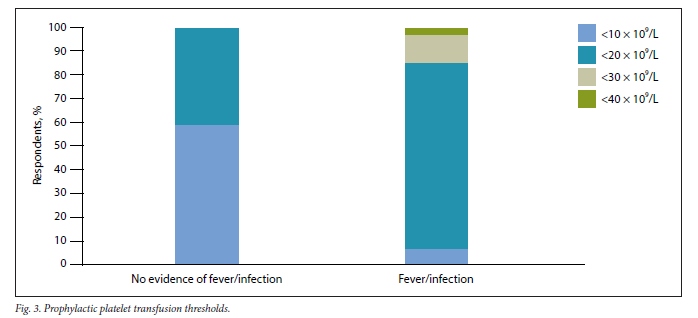
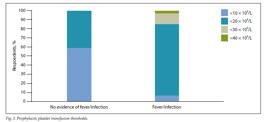
In patients without fever or infection, most clinical haematologists (68%) and medical oncologists (56%) selected a transfusion threshold of <10 × 109p=0.450; Fig. 3). In the context of fever or infection, clinical haematologists (92%) and medical oncologists (72%) predominantly used a threshold of <20 × 109p=0.180). These findings indicate overall adherence to standard prophylactic platelet thresholds, with modest inter-group variation.
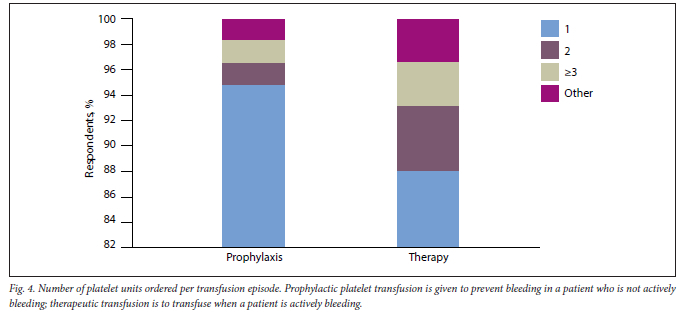
In Fig. 4, the number of platelet units ordered per transfusion episode (prophylaxis v. therapy) is shown. Most respondents across all provider groups selected one platelet unit for both prophylactic and therapeutic transfusions.
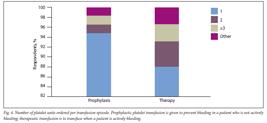
In the prophylaxis group, 92% of clinical haematologists, 100% of medical oncologists and 88% of the 'other' group reported transfusing a single platelet unit (p=0.200).
For therapeutic platelet transfusions, 92% of clinical haematologists and 96% of medical oncologists, but only 50% of the 'other' group reported transfusing one unit (p=0.001). Three respondents in the 'other' group reported transfusing >2, and one reported using >3 units per episode.
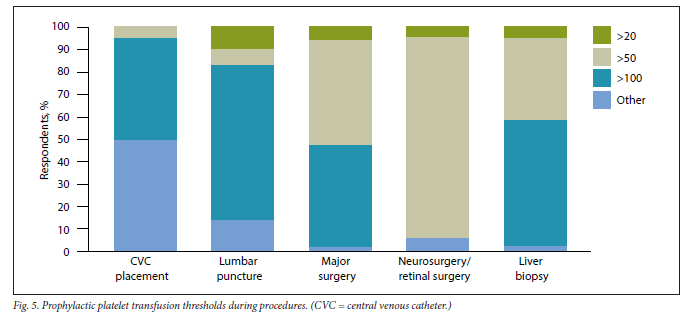
Preferred prophylactic platelet transfusion thresholds prior to various invasive procedures are shown in Fig. 5.
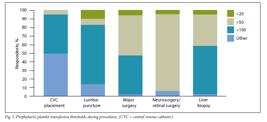
For central venous catheter (CVC) placement, most clinical haematologists and the 'other' group (74% and 100%, respectively) selected a platelet threshold of >20 × 1099p=0.003). Notably, international guidelines[19] recommend a platelet threshold of 10 × 109
For lumbar puncture, most clinical haematologists and medical oncologists (71% and 75%, respectively) selected a platelet threshold of >50 × 109/L. The most recent guidelines suggest transfusing platelets at a threshold of <20 × 109[19]
For major surgery, clinical haematologists mostly (61%) selected >50 × 1099(p=0.006). The vast majority in all groups correctly selected >100 × 109999
There were no significant differences in platelet transfusion modification requests across provider groups, and overall practice aligned well with current guideline recommendations[16] (appendix Fig. S1). In this analysis, the haematological conditions refer specifically to patients with haematological malignancies receiving chemotherapy.
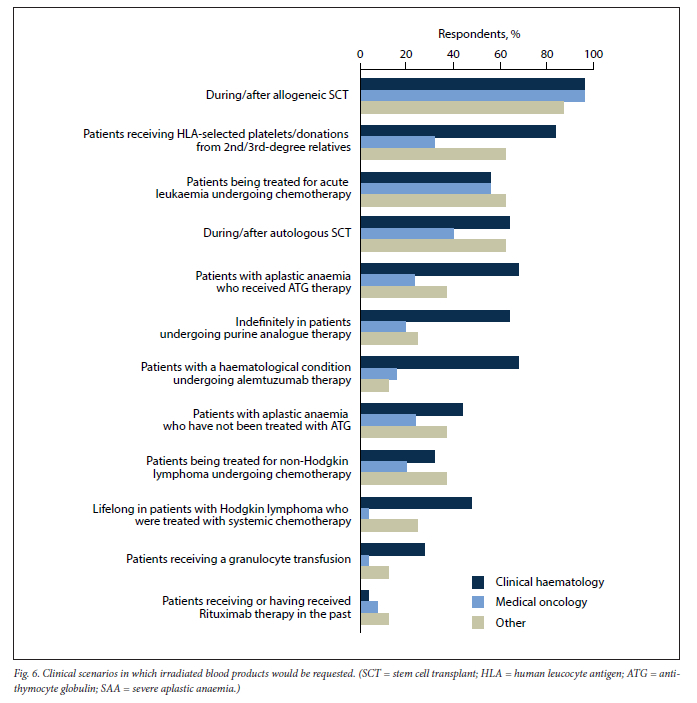
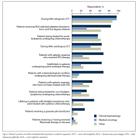
Significant differences were noted regarding indications for irradiation of blood products between the three groups of haematology providers (Fig. 6). Most clinical haematologists would request irradiate blood products for the correct indications according to international guidelines, in comparison with medical oncologists and 'other' group, except for patients receiving chemotherapy for Hodgkin lymphoma, where all three groups would, in contrast to the recent guidelines, not request irradiated blood products.[16]
Discussion
This national survey of haematology providers in SA highlights notable variations in transfusion practices, particularly in two domains: platelet transfusion thresholds before procedures, and requests for blood product modifications, such as irradiation.
RBC transfusion thresholds provide insight into clinicians' overarching transfusion philosophies, i.e. whether they favour liberal or restrictive approaches. Most SA haematology providers in this study selected a restrictive haemoglobin trigger of 6.0 - 6.9 g/dL, with no significant differences between provider groups. Although our survey did not formally assess knowledge of PBM, this uniformity may suggest baseline awareness of PBM principles among specialists and trainees. This pattern aligns with international trends, where studies from Europe and North America demonstrate increasing adoption of restrictive transfusion strategies, consistent with evolving PBM guidelines recommending haemoglobin thresholds <7 g/dL for clinically stable patients.[3,8]
Several patient-specific factors influenced RBC transfusion decision-making. Clinical haematologists more often prioritised cardiopulmonary reserve, while the 'other' group, which included haematopathologists, internal medicine registrars and trainees, expressed greater concern about medicolegal implications. These differences likely reflect variation in clinical exposure to transfusion scenarios, and differing levels of experience with complex decision-making.
Haematology providers are recognised globally as among the highest users of platelet transfusions. [20] Our findings reveal significant variation in platelet transfusion behaviours across provider groups. Although prophylactic platelet transfusion thresholds were broadly similar, even in the presence of fever or infection, the 'other' group was significantly more likely to transfuse >1 platelet unit per episode. This practice diverges from both local and international recommendations, which typically advise transfusing a single apheresis unit in most clinical scenarios.[8,18] In SA, such variation carries economic consequences, with a single apheresis unit from the SA National Blood Service costing ~ZAR15 311.91 in 2025.[21] Importantly, transfusing two units does not proportionally increase clinical benefit, underscoring the need for improved adherence to cost-effective, evidence-based protocols.
We also observed wide variation in platelet transfusion thresholds prior to invasive procedures. Clinical haematologists were more likely to align with guideline-recommended thresholds, possibly reflecting greater formal training in transfusion medicine and practical experience. Similar international patterns have been documented; for example, a large UK audit demonstrated significantly lower compliance with guideline-recommended platelet thresholds among non-haematology specialties compared with haematology teams.[22]
Regarding blood product modifications, especially irradiation, we identified significant differences between provider groups. Although leucodepletion requests did not differ, clinical haematologists were substantially more likely to request irradiation for appropriate indications, consistent with current guidelines. Since irradiation remains a key measure in preventing TA-GVHD, deviations from recommended practice are clinically relevant. Internationally, comparable knowledge gaps have been reported, with studies from the UK and the Netherlands describing underutilisation or inappropriate use of irradiation among non-haematology services.[23,24] These findings highlight the need for targeted education on transfusion safety principles.
Study strengths and limitations
As with most survey-based research, our 51% response rate introduces the possibility of response bias. Nevertheless, representation across public and private sectors, multiple specialties and varying levels of training enhances generalisability within the SA haematology context. Study limitations include selection bias inherent to convenience sampling, potential recall bias due to self-reporting, and reduced statistical power in subgroup analyses. Additionally, institutional-level variations could not be fully accounted for. Finally, because this was an observational survey, we were not able to link reported practices to patient outcomes. Evaluating clinical outcomes in relation to transfusion decisions will be the focus of a future study to provide a more robust evidence base for local practice.
Despite these limitations, our findings reveal important knowledge and practice gaps. Variation in platelet transfusion thresholds and inconsistencies in blood product modification requests point to opportunities for improving standardisation. Regular continuing professional development activities on transfusion medicine and PBM, combined with audit-and-feedback strategies, could help to harmonise practice across provider groups. Integrating decision-support tools into electronic ordering systems may further improve guideline adherence. Strengthening collaboration among haematologists and oncologists through national forums and research initiatives could also support shared learning and consensus-building, and ultimately contribute to more consistent practice and improved patient outcomes.
Conclusion
This national survey demonstrates considerable variation in transfusion practices among SA haematology providers, particularly in platelet transfusion thresholds and indications for blood product modifications. These findings highlight the need for greater standardisation and targeted education efforts to optimise transfusion practice, save costs and ensure patient safety.
Data availability. The data used for this study are available from the first author upon request.
Declaration. None.
Acknowledgements. The authors thank all the SA haematology providers who participated in the survey and generously contributed their time and professional insights. The authors also acknowledge the colleagues who assisted with circulating the survey to eligible participants. The authors would also like to thank Dr Petra Gaylard, consulting statistician at Wits Donald Gordon Medical Centre, for her statistical advice and support with the data analysis.
Author contributions. JRdT conceptualised the study and obtained ethics approval. AS contributed to drafting and writing the manuscript under supervision of JRdT. MDS and EV critically reviewed and revised the manuscript. VJL contributed to the interpretation of the data, development of the discussion and critical review of the manuscript. All authors reviewed and approved the final version of the manuscript and accept responsibility for its content.
Funding. None.
Conflicts of interest. None.
AI contribution. During the preparation of this work, the authors used ChatGPT to improve readability and language. After using this tool/ service, the authors reviewed and edited the content as needed, and take full responsibility for the content of the publication.
References
-
1. Toner RW, Pizzi LT, Leas B, Ballas SK, Quigley A, Goldfarb NI. Costs to hospitals of acquiring and processing blood in the US: A survey of hospital-based blood banks and transfusion services. Appl Health Econ Health Policy 2011;9(1):29-37. https://doi.org/10.2165/11530740-000000000-00000
» https://doi.org/10.2165/11530740-000000000-00000 -
2. Busch MP, Bloch EM, Kleinman SH. Prevention of transfusion-transmitted infections. Blood 2019;133(17):1854-1864. https://doi.org/10.1182/blood-2018-11-833996
» https://doi.org/10.1182/blood-2018-11-833996 -
3. Carson JL, Stanworth SJ, Guyatt G, et al. Red blood cell transfusion: 2023 AABB international guidelines. JAMA 2023;330(19):1892-1902. https://doi.org/10.1001/jama.2023.12914
» https://doi.org/10.1001/jama.2023.12914 -
4. Mueller MM, Van Remoortel H, Meybohm P, et al. Patient blood management: Recommendations from the 2018 Frankfurt Consensus Conference. JAMA 2019;321(10):983-997. https://doi.org/10.1001/jama.2019.0554
» https://doi.org/10.1001/jama.2019.0554 -
5. Gammon RR, Dubey R, Gupta GK, et al. Patient blood management and its role in supporting blood supply: A review. J Blood Med 2023;14:595-611. https://doi.org/10.2147/JBM.S387322
» https://doi.org/10.2147/JBM.S387322 -
6. World Health Organization. The urgent need to implement patient blood management: Policy brief. Geneva: WHO, 2021. https://www.who.int/publicattions/i/item/9789240035744 (accessed 15 November 2025).
» https://www.who.int/publicattions/i/item/9789240035744 -
7. South African National Blood Service, Western Cape Blood Service. Clinical guidelines for the use of blood and blood products in South Africa. 6th ed. Cape Town/Johannesburg: SANBS, WCBS, 2023. https://www.sanbs.org.za/uploads/media/medical/training_and_advisory/SANBS_Clinical_Guidelines_Booklet_6th_Edittion_FINAL.pdf (accessed 15 November 2025).
» https://www.sanbs.org.za/uploads/media/medical/training_and_advisory/SANBS_Clinical_Guidelines_Booklet_6th_Edittion_FINAL.pdf -
8. Radford M, Estcourt LJ, Sirotich E, et al. Restrictive versus liberal red blood cell transfusion strategies. Cochrane Database Syst Rev 2024;5(5):CD011305. https://doi.org/10.1002/14651858.CD011305.pub3
» https://doi.org/10.1002/14651858.CD011305.pub3 -
9. Hoeks MPA, Middelburg RA, Romeijn B, et al. Red blood cell transfusion support and management of secondary iron overload. Vox Sang 2018;113(2):152-159. https://doi.org/10.1111/vox.12617
» https://doi.org/10.1111/vox.12617 -
10. Tay J, Allan DS, Chatelain E, et al. Liberal versus restrictive red blood cell transfusion thresholds. J Clin Oncol 2020;38(13):1463-1473. https://doi.org/10.1200/JCO.19.01836
» https://doi.org/10.1200/JCO.19.01836 -
11. Yazer MH, Podlosky L, Clarke G, Nahirniak SM. Effect of prestorage white blood cell reduction on transfusion reactions. Transfusion 2004;44(1):10-15. https://doi.org/10.1046/j.0041-1132.2003.00518.x
» https://doi.org/10.1046/j.0041-1132.2003.00518.x -
12. Paglino JC, Pomper GJ, Fisch GS, et al. Reduction of febrile but not allergic transfusion reactions. Transfusion 2004;44(1):16-24. https://doi.org/10.1046/j.0041-1132.2004.00608.x
» https://doi.org/10.1046/j.0041-1132.2004.00608.x -
13. King KE, Shirey RS, Thoman SK, et al. Universal leukoreducttion decreases transfusion reactions. Transfusion 2004;44(1):25-29. https://doi.org/10.1046/j.0041-1132.2004.00609.x
» https://doi.org/10.1046/j.0041-1132.2004.00609.x -
14. Heddle NM, Klama L, Meyer R, et al. Randomised controlled trial comparing plasma removal with white blood cell reduction. Transfusion 1999;39(3):231-238. https://doi.org/10.1046/j.1537-2995.1999.39399219278.x
» https://doi.org/10.1046/j.1537-2995.1999.39399219278.x -
15. Azuma H, Hirayama J, Akino M, et al. Reduction in adverse reactions to platelet transfusions using leukoreduction. Transfusion 2009;49(2):214-218. https://doi.org/10.1111/j.1537-2995.2008.01918.x
» https://doi.org/10.1111/j.1537-2995.2008.01918.x -
16. Foukaneli T, Kerr P, Bolton-Maggs PHB, et al. Guidelines on the use of irradiated blood components. Br J Haematol 2020;191(5):704-724. https://doi.org/10.1111/bjh.17015
» https://doi.org/10.1111/bjh.17015 -
17. Harris PA, Taylor R, Thielke R, et al. REDCap: A metadata-driven methodology and workflow process for providing translational research informatics support. J Biomed Inform 2009;42(2):377-381. https://doi.org/10.1016/j.jbi.2008.08.010
» https://doi.org/10.1016/j.jbi.2008.08.010 -
18. Estcourt LJ, Birchall J, Allard S, et al. Guidelines for the use of platelet transfusions. Br J Haematol 2017;176(3):365-394. https://doi.org/10.1111/bjh.14423
» https://doi.org/10.1111/bjh.14423 -
19. Metcalf RA, Nahirniak S, Guyatt G, et al. Platelet transfusion: 2025 AABB and ICTMG international clinical practice guidelines. JAMA 2025;334(7):606-617. https://doi.org/10.1001/jama.2025.7529
» https://doi.org/10.1001/jama.2025.7529 -
20. Jug R, La Rocca U, Al-Riyami AZ, et al. The clinical use of platelet transfusions. Transfusion 2025;65(6):1155-1169. https://doi.org/10.1111/trf.18277
» https://doi.org/10.1111/trf.18277 -
21. South African National Blood Service. State patient pricelist 2025. Johannesburg: SANBS, 2025. https://www.sanbs.org.za/uploads/media/procurement%20and%20finance/SANBS--State-Patients-Pricelist-2025.pdf (accessed 15 November 2025).
» https://www.sanbs.org.za/uploads/media/procurement%20and%20finance/SANBS--State-Patients-Pricelist-2025.pdf -
22. Etchells M, Spradbrow J, Cohen R, et al. Audit of the appropriate use of platelet transfusions in the United Kingdom. Vox Sang 2018;113(1):40-50. https://doi.org/10.1111/vox.12621
» https://doi.org/10.1111/vox.12621 -
23. Treleaven J, Gennery A, Marsh J, et al. Guideline development for prevention of transfusion-associated graft-versus-host disease. Br J Haematol 2021;194(4):704-718. https://doi.org/10.1111/bjh.17822
» https://doi.org/10.1111/bjh.17822 -
24. Elliott J, Narayan S, Poles D, Tuckley V, Bolton-Maggs PHB. Missed irradiation of cellular blood components for vulnerable patients: Insights from 10 years of SHOT data. Transfusion 2021;61(2):385-392. https://doi.org/10.1111/trf.16189
» https://doi.org/10.1111/trf.16189

Accepted 23 January 2026