HIV index testing implementation at public health clinics in South Africa
BACKGROUND. Most ongoing HIV infection is caused by individuals with undiagnosed or untreated HIV. HIV index testing services (ITS), also known as risk network recruitment, have been recommended by international and national programmes to increase diagnosis of untreated people living with HIV (PLHIV) to link them to HIV treatment services. The scale of routine implementation of ITS is unclear. OBJECTIVES. To describe clinic-level adoption and implementation of ITS in South Africa (SA). METHODS. We used random sampling to select participating healthcare facilities from all nine SA provinces. A survey link was sent to a facility manager via email or WhatsApp. Summary statistics were used to describe the findings. RESULTS. From August 2022 to March 2024, we sent a survey link to 350 systematically sampled clinics; 305 (87.1%) completed the survey. Of those clinics, 260 (85.2%) reported some form of ITS implementation. More than half (n=166, 63.8%) reported using client (passive) referral. Available intimate partner violence (IPV) mitigation services provided counselling by lay HIV testing counsellors for most (n=215, 82.7%) facilities; 120 (46.1%) also had an on-site social worker to assist with IPV mitigation, and 12 (4.1%) had no IPV service available. Approximately half of the clinics offering ITS depended on a supporting non-governmental organisation to provide this service. CONCLUSION. ITS was reported to be provided by most public clinics in SA. However, the majority provided passive ITS, depending on the index client to refer their contacts to a local clinic for HIV testing. This approach had little evidence of effectiveness.
HIV testing; index testing services; index testing implementation
HIV index testing implementation at public health clinics in South Africa
N Mshweshwe-PakelaI; T MabutoII; R LebyaneIII; M HamisiIV; S GininzaV; V ChihotaVI, II, VII; C J HoffmannVIII, IX, X
IMPH; Implementation Research Division, The Aurum Institute, Johannesburg, South Africa
IIPhD; Implementation Research Division, The Aurum Institute, Johannesburg, South Africa
IIISAW; Implementation Research Division, The Aurum Institute, Johannesburg, South Africa
IVBSc, BCM; Implementation Research Division, The Aurum Institute, Johannesburg, South Africa
VMSc; Implementation Research Division, The Aurum Institute, Johannesburg, South Africa
VIPhD; Implementation Research Division, The Aurum Institute, Johannesburg, South Africa
VIIPhD; Department of Medicine, Vanderbilt University School of Medicine, Nashville, Tenn, USA
VIIIMD, MPH; Implementation Research Division, The Aurum Institute, Johannesburg, South Africa
IXMD, MPH; Department of Medicine, Johns Hopkins University School of Medicine, Baltimore, Md, USA
XMD, MPH; Department of Health, Behaviour, and Society, Johns Hopkins Bloomberg School of Public Health, Baltimore, Md, USA
BACKGROUND. Most ongoing HIV infection is caused by individuals with undiagnosed or untreated HIV. HIV index testing services (ITS), also known as risk network recruitment, have been recommended by international and national programmes to increase diagnosis of untreated people living with HIV (PLHIV) to link them to HIV treatment services. The scale of routine implementation of ITS is unclear.
OBJECTIVES. To describe clinic-level adoption and implementation of ITS in South Africa (SA).
METHODS. We used random sampling to select participating healthcare facilities from all nine SA provinces. A survey link was sent to a facility manager via email or WhatsApp. Summary statistics were used to describe the findings.
RESULTS. From August 2022 to March 2024, we sent a survey link to 350 systematically sampled clinics; 305 (87.1%) completed the survey. Of those clinics, 260 (85.2%) reported some form of ITS implementation. More than half (n=166, 63.8%) reported using client (passive) referral. Available intimate partner violence (IPV) mitigation services provided counselling by lay HIV testing counsellors for most (n=215, 82.7%) facilities; 120 (46.1%) also had an on-site social worker to assist with IPV mitigation, and 12 (4.1%) had no IPV service available. Approximately half of the clinics offering ITS depended on a supporting non-governmental organisation to provide this service.
CONCLUSION. ITS was reported to be provided by most public clinics in SA. However, the majority provided passive ITS, depending on the index client to refer their contacts to a local clinic for HIV testing. This approach had little evidence of effectiveness.
Keywords: HIV testing, index testing services, index testing implementation
Substantial progress has been made to control the HIV epidemic through HIV diagnosis and treatment. However, new HIV infections continue to hinder the target of ending HIV/AIDS by 2030.[1] Most ongoing infections are caused by individuals with undiagnosed or untreated HIV.[2,3] Identifying people with untreated HIV, especially those with recent HIV infection, and initiating them on antiretroviral treatment (ART), is a cornerstone of global HIV prevention efforts.
To support global treatment goals, the World Health Organization (WHO), in 2016, recommended an expanded suite of HIV testing approaches to reach more people living with HIV (PLHIV) who are not yet seeking care.[4,5] One approach with a potential high yield of identifying undiagnosed or untreated HIV is (partner) index testing services (ITS). ITS refers to HIV testing of sexual and injection drug use partners (and their children) of PLHIV. ITS is delivered either through passive referral, where the person is responsible for discussing HIV with their contacts and encouraging them to seek HIV testing, or active referral, where a healthcare worker is involved in informing contacts (listed by the index client) about possible HIV exposure and encouraging them to get tested.[6] Active referral can be further grouped into three strategies: (i) provider referral - a healthcare worker contacts a client's contact(s) and informs them of possible exposure to HIV and requests them to visit a health facility; (ii) contractual referral - an index client is given a time frame to inform and refer their contact(s), and in that time frame the healthcare worker contacts the contacts; and (iii) dual referral - a healthcare worker sits with the index client and their contact(s) to support them while the client discloses their HIV status, or the healthcare worker tests both and provides couple counselling.[4,7,8]
South Africa (SA) added ITS to its national HIV testing guidelines in 2016. According to the guidelines, ITS should be provided to all PLHIV, with more emphasis on those newly diagnosed and those who are on treatment but are virally unsuppressed.[7,9] These guidelines and updated standard operating procedures suggest prioritising ITS. However, passive referral is often the default option.[4,8,10] Although national guidelines have been in place for several years, the proportion of clinics providing ITS and the specific nature of these services - whether active or passive - have not been systematically documented. This lack of detailed, up-to-date information hinders the ability to assess the effectiveness of the guidelines and identify areas for improvement. To address this critical gap, we sought to describe ITS implementation in the public sector across SA by conducting a survey of ITS practices in a representative sample of clinics in all nine provinces of SA.
Methods
Study design and setting
A cross-sectional survey was conducted in 30 health districts located in the nine provinces of SA between August 2022 and March 2024.
SA has a total of 3 863 public clinics and 407 public hospitals, all of which offer HIV testing services free of charge. Many of these facilities are supported by non-governmental organisations (NGOs) to provide specific services such as ITS.
Sample
We conducted two-stage simple random sampling using Epitools software (2018) (Epitools, Australia). The first stage involved selecting a random sample of 30 health districts from 52 such districts in SA. This approach aimed to ensure that the sample represented the country's diverse clinics, while maintaining the practicality of collecting data within budgetary constraints. The 30 districts had a total of 2 667 public health clinics, which served as the sampling unit. In the second stage, we applied random sampling to select 350 clinics for participation.[11]
Data collection
Based on our reading of the ITS guidelines, standard operating procedures and implementation tools, we developed a structured data collection tool for completion by clinic staff. The data collection tool also included a comments section for open-ended responses entered as free text by the participating key informant to describe ITS challenges. We contacted the facilities included in our randomisation scheme and informed the facility manager about the study. If they agreed to participate, we sent them the link via email or WhatsApp. Data were collected electronically and managed using REDCap (Research Electronic Data Capture).[12]
Data analysis
We sought to describe the proportion of facilities reporting implementation of any ITS strategy, the key implementers, implementation strategies and intimate partner violence (IPV) mitigation strategies. Data were analysed using Stata version16 (Stata Corp., USA). We grouped frequently occurring statement contact to describe the open-ended comments regarding ITS challenges.
Ethical considerations
Regulatory approvals were obtained from the University of the Witwatersrand (ref. no. M220110) and University of the Free State (ref. no. UFS-HSD2023/0129/2006) ethics committees, provincial health research committees and district health management. Study information and participants' rights appeared on the first page of the survey link. Participants agreed to participate if they proceeded beyond the consent form page to completing and submitting the survey.
Results
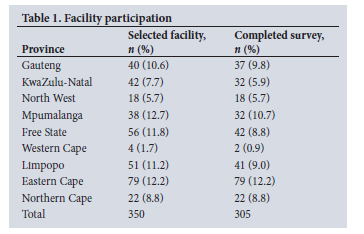
From August 2022 to March 2024, we sent a survey link to the 350 systematically selected clinics. Of those, 305 (87.1%) completed the survey; we did not replace clinics that did not respond with other clinics. As a result of our health district randomisation, Eastern Cape Province had most (n=79, 26.7%) sampled and 79 (100%) completed the survey, while Western Cape Province had the least (n=4, 1.1%) sampled and 2 (50%) completed the survey (Table 1).
Implementation strategies
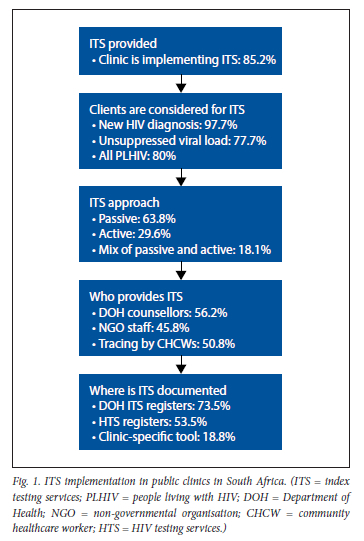
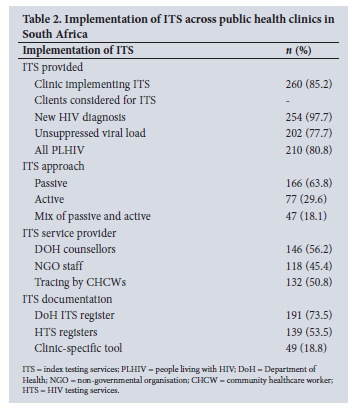
Of 305 facilities providing data, 260 (85.2%) reported some form of ITS implementation. Clients targeted for ITS varied: 254 (97.7%) clinics reported including clients newly diagnosed with HIV, and 210 (80.8%) reported including clients with known HIV who were not virologically suppressed. None of the facilities reported providing ITS for clients of sex workers or for individuals sharing injection drug paraphernalia. Of facilities offering ITS, 166 (63.8%) only provided passive ITS, 77 (29.6%) reported providing active ITS, and 47 (18.1%) reported a mix of passive and active referral (Fig. 1). One hundred and eighteen (43.5%) of the clinics had NGO support for HIV testing services. Of the clinics with active ITS, 62 (52.5%) were supported by an NGO.
ITS implementation was mainly provided and co-ordinated by lay HIV testing counsellors. Half of the facilities (n=132, 50.8%) reported also involving community health workers in aspects of active ITS. A total of 118 facilities (43.5%) reported support by an NGO partner to implement all or parts of ITS.
Most facilities reported having an approach to mitigate IPV associated with ITS. The most common approach was counselling by a lay HIV testing services (HTS) counsellor, reported by 215 (82.7%) facilities. One hundred and twenty (46.1%) of the facilities reported having an on-site social worker to whom clients who reported experiencing IPV could be referred. Twelve (4.6%) of the facilities that provided ITS did not have any IPV mitigation service available (Table 2).
The majority of the clinics (n=191, 73.5%), reported using part or all of the National Department of Health (NDoH) ITS register. The other clinics reported including ITS documentation in standard HIV testing registers, using clinic-specific documentation, or not documenting at all. In addition, documentation was generally limited to counselling or names of contacts (sometimes with contact information). None of the clinics reported whether listed contacts received testing.
Challenges faced in ITS implementation
Challenges with ITS implementation were noted in the following categories: (i) index clients were not willing to disclose contact names or self-disclose their HIV status to contacts due to fear of stigma and IPV; (ii) when contacts were listed, tracing them was often a challenge owing to incorrect contact information; (iii) a lack of resources for implementation of ITS was frequently listed as a barrier, including limited access to telephones, transport and private rooms to provide ITS-related services; and (iv) lack of a systematic approach to documenting ITS offers and HTS of contacts.
Discussion
We conducted a national survey of 305 clinics across SA to characterise ITS implementation. We found that 85.2% of clinics reported implementing some form of ITS; however, passive ITS was most commonly used. Most clinics reported some services for IPV, but none reported a system for monitoring IPV or other potential harms of ITS such as relationship dissolution or loss of financial support. Facilities mainly targeted clients newly diagnosed with HIV; some also offered ITS to people with established diagnoses and unsuppressed viral loads.
Our study findings demonstrate that clinics are aware of ITS and that most clinics have made efforts to provide ITS. However, ITS was largely passive and provided during post-test counselling. Overall, the onus was on index clients to discuss HIV testing with their partners and refer them for testing. This passive approach depends on clients internalising the recommendations, being empowered to discuss HIV with their partners, and then to recommend testing to their partners. Robust randomised controlled trials (RCTs) have demonstrated the limited success of this approach.[13,14] A cluster-randomised trial in Kenya compared active with passive ITS and reported that 67% of partners were tested with active ITS compared with 13% with passive ITS.[15] Several other studies have also reported substantially lower testing reach with passive referral when compared with active referral.[13,16-19] A programme assessment study from SA of community-based HIV testing and active HTS reported a low number of diagnoses and testing through ITS (3% of total adults tested).[20] Despite their lower efficacy, passive methods are preferred by some clients and healthcare workers.[21] Importantly, even active ITS may have limited reach if index clients are reluctant to disclose their partners' names and accurate contact information. In clinical trials of active ITS, only 60 - 80% of potentially eligible individuals are willing to disclose partner identities.[22-24] A substantial amount of work has gone into improving counselling for passive ITS.[25,26]
An added barrier with implementing and improving ITS quality, especially passive ITS, is that there is no mechanism for documenting and monitoring the proportion of contacts who do come for testing. A further barrier is that lay counsellors in SA generally have limited training and oversight and may have limited ability to provide counselling needed to motivate index clients to reach out to sexual (or injection drug use) contacts.[27]
In other sub-Saharan countries, active ITS has been successfully implemented and has achieved a substantial extent of testing. This has been reported from settings supported by community efforts and expert client involvement.[19,28-30] The research literature suggests that with sufficient added resources, active ITS with a high yield of HIV testing is feasible. For example, in Lesotho, an NGO provided active ITS with home HIV testing. Non-priority clinics not supported by an NGO did not provide ITS.[24] Similarly, a study of NGO-provided ITS in Zambia reported a high yield of HIV testing and diagnoses.[24,29] NGO partner support assists this process by bringing additional funding from donors, resources and support to facilitate scale-up of interventions and policy translation and implementation. Compared with the approaches in these studies, public clinics in SA have multiple competing priorities in terms of service delivery and HIV testing and often have limited space, capacity, transportation resources and telephone infrastructure to conduct in-person counselling, telephonic follow-up or home visits. Additional barriers to effective ITS implementation possibly include not having the resources to train and retain appropriately skilled counsellors and ITS tracers, appropriate registers and other documentation for monitoring and quality improvement, and administrative oversight. An additional gap may be the availability of evidence-based approaches to guide counselling to interest the largest proportion of index clients in participating in ITS. Without additional dedicated resources and a focus on ITS, our findings suggest that the reach of ITS will remain limited. Failure to effectively implement ITS may hinder closing the remaining testing and treatment gap for ART in SA.
Assessing and mitigating IPV risk is noted as a critical component of ITS in national and international guidelines. We found that most, but not all, clinics reported some ability to address IPV through on-site counselling, social work or referrals. This is consistent with the results of a prior study, which noted that most facilities offered counselling or had an IPV mitigation service available.[31] However, we found that the majority of IPV mitigation services were provided by lay HIV testing counsellors, who often have very limited training to address this issue. Importantly, because of the passive nature of most of the IPV services, it is possible that index clients at greatest risk of disclosure-related IPV simply did not disclose or discuss HIV testing with contacts.
Strengths of this study are that we conducted a national survey using a randomly selected sample, with a high response rate. Findings can be generalisable to ITS delivery in SA at the time of the study. Moreover, the survey was self-administered by healthcare workers involved in implementing HTS in each facility. This gave those completing the survey freedom to express themselves without social desirability bias. A limitation of this study is the under-representation of the Western Cape, which occurred as a result of random sampling with stratifying by province. Our findings may therefore not be generalisable to this province. Another limitation of our survey approach is that it did not allow us to measure actual ITS implementation or the reach of ITS offered. Other studies are needed to characterise the extent to which ITS is implemented and the proportion of contacts of index clients reached.
Conclusion
We found that ITS was provided in most public clinics in SA, mostly with a passive approach. Given the literature that suggests that passive ITS only reaches a small fraction of potential contacts (<5%), it is unclear, from this study, whether ITS efforts are meaningfully contributing to HIV testing and diagnosis in SA. Further research is needed to characterise the current impact of ITS and the extent of resources needed to achieve meaningful gains to guide future implementation strategies and policy decisions.
Data availability. De-identified data will be made available upon reasonable request from the principal investigator.
Declaration. The research for this study was done in partial fulfilment of the requirements for NM-P's PhD degree at the University of the Witwatersrand, Johannesburg, South Africa.
Acknowledgements. We thank all the provincial managers, facility managers and staff members who completed the survey.
Author contributions. NM-P designed the study, managed data collection, cleaned and contributed to data analysis and wrote the first draft of the manuscript. TM advised data collection processes and reviewed the drafts of the manuscript. SG contributed to data analysis and reviewed the manuscript. RL and MH contributed to data collection and reviewed the final draft of the manuscript. VC guided the study design, data collection and reviewed all drafts of the manuscript. CH guided the study design, data collection, data analysis and reviewed all drafts of the manuscript.
Funding. Fogarty International Center of the National Institutes of Health (NIH) under Award Number D43TW009774. Wits-UNC partnership -Expanding Capacity in HIV implementation Science in South Africa.
Conflicts of interest. None.
References
-
1. Joint United Nations Programme on HIV/ AIDS. In Danger: UNAIDS Global AIDS Update 2022. Geneva: UNAIDS, 2022. https://doi.org/10.18356/9789210019798 (accessed 8 August 2025).
» https://doi.org/10.18356/9789210019798 -
2. Burns DN, DeGruttola V, Pilcher CD, et al. Toward an endgame: Finding and engaging people unaware of their HIV-1 infection in treatment and prevention. AIDS Res Hum Retroviruses 2014;30(3):217-224. https://doi.org/10.1089/aid.2013.0274
» https://doi.org/10.1089/aid.2013.0274 -
3. Wong CS, Wei L, Kim Yeon-Sook. HIV late presenters in Asia: Management and public health challenges. AIDS Res Treat 2023;9488051. https://doi.org/10.1155/2023/9488051
» https://doi.org/10.1155/2023/9488051 -
4. Kahabuka C, Plotkin M, Christensen A, et al. Addressing the first 90: A highly effective partner notification approach reaches previously undiagnosed sexual partners in Tanzania. AIDS Behav 2017;21(8):2551-2560. https://doi.org/10.1007/s10461-017-1750-5
» https://doi.org/10.1007/s10461-017-1750-5 -
5. Sharma M, Naughton B, Lagat H, et al. Real-world impact of integrating HIV assisted partner services into 31 facilities in Kenya: A single-arm, hybrid type 2 implementation-effectiveness study. Lancet Glob Health 2023;11(5):e749-e758. http://doi.org/10.1016/S2214-109X(23)00153-5
» http://doi.org/10.1016/S2214-109X(23)00153-5 - 6. World Health Organization. Guidelines on HIV Self-testing and Partner Notification. Supplement to Consolidated Guidelines on HIV Testing Services. Geneva: WHO, 2016.
- 7. National Department of Health. Standard Operating Procedures for HIV Index Testing Services 2021. Pretoria: NDoH, 2021.
-
8. Plotkin M, Kahabuka C, Christensen A, et al. Outcomes and experiences of men and women with partner notification for HIV testing in Tanzania: Results from a mixed method study. AIDS Behav 2018;22(1):102-116. https://doi.org/10.1007/s10461-017-1936-x
» https://doi.org/10.1007/s10461-017-1936-x -
9. US President's Emergency Plan for AIDS Relief. PEPFAR 2021 Country and Regional Operational Plan (COP/ROP) Guidance for all PEPFAR Countries, 2021:1-487. https://www.state.gov/wp-content/uploads/2020/12/PEPFAR-COP21-Guidance-Finalpdf (accessed 16 March 2023).
» https://www.state.gov/wp-content/uploads/2020/12/PEPFAR-COP21-Guidance-Finalpdf -
10. Odoyo JB, Morton JF, Ngure K, et al. Integrating PrEP into HIV care clinics could improve partner testing services and reinforce mutual support among couples: Provider views from a PrEP implementation project in Kenya. J Int AIDS Soc 2019;22(S3):65-71. https://doi.org/10.1002/jia2.25303
» https://doi.org/10.1002/jia2.25303 -
11. Chauvet G. Inference for two-stage sampling designs. J R Stat Soc 2020;82(3):797-815. https://doi.org/10.1111/rssb.12368
» https://doi.org/10.1111/rssb.12368 -
12. Harris PA, Taylor R, Minor BL, et al. The REDCap consortium: Building an international community of software platform partners. J Biomed Inform 2019;95:103208. https://doi.org/10.1016/j.jbi.2019.103208
» https://doi.org/10.1016/j.jbi.2019.103208 -
13. Masyuko SJ, Cherutich PK, Contesse MG, et al. Index participant characteristics and HIV assisted partner services efficacy in Kenya: Results of a cluster randomised trial. J Int AIDS Soc 2019;22(S3):49-56. https://doi.org/10.1002/jia2.25305
» https://doi.org/10.1002/jia2.25305 -
14. Qing-Hai H, Han-Zhu Q, Jia-Ming L, et al. Assisted partner notification and uptake of HIV testing among men who have sex with men: A randomised controlled trial in China. Lancet Regional Health Western Pacific 2021;12:100171. https://doi.org/10.1016/j.lanwpc.2021.100171
» https://doi.org/10.1016/j.lanwpc.2021.100171 -
15. Cherutich P, Golden MR, Wamuti B, et al. Assisted partner services for HIV in Kenya: A cluster randomised controlled trial. Lancet HIV 2017;4(2):e74-e82. https://doi.org/10.1016/S2352-3018(16)30214-4
» https://doi.org/10.1016/S2352-3018(16)30214-4 -
16. Maierhofer CN, Powers KA, Matoga MM, et al. Characterizing network-based HIV testing interventions to guide HIV testing and contact tracing at STI clinics in Lilongwe, Malawi. J Acquir Immune Defic Syndr 2023;94(2):151-159. https://doi.org/10.1097/QAI.0000000000003240
» https://doi.org/10.1097/QAI.0000000000003240 -
17. Brown LB, Miller WC, Kamanga G, et al. HIV partner notification is effective and feasible in sub-Saharan Africa: Opportunities for HIV treatment and prevention. J Acquir Immune Defic Syndr 2011;56(5):437-442. https://doi.org/10.1097/qai.0b013e318202bf7d
» https://doi.org/10.1097/qai.0b013e318202bf7d -
18. Dalal S, Johnson C, Fonner V, et al. Improving HIV test uptake and case finding with assisted partner notification services. AIDS 2017;31(13):1867-1876. https://doi.org/10.1097/QAD.0000000000001555
» https://doi.org/10.1097/QAD.0000000000001555 -
19. Grande M, Mawandia S, Bakae O, et al. Intensified assisted partner notification implementation in Botswana increased partner identification but not HIV case-finding: Findings highlight the need for improved data monitoring. J Acquir Immune Defic Syndr 2021;87(3):951-958. https://doi.org/10.1097/QAI.0000000000002673
» https://doi.org/10.1097/QAI.0000000000002673 -
20. Shamu S, Farirai T, Kuwanda L, et al. Comparison of community-based HIV counselling and testing (CBCT) through index client tracing and other modalities: Outcomes in 13 South African high HIV prevalence districts by gender and age. PLoS ONE 2019;14(9):1-14. https://doi.org/10.1371/journal.pone.0221215
» https://doi.org/10.1371/journal.pone.0221215 - 21. Kamanga G, Brown L, Jawati P, Chiwanda D, Nyirenda N. Maximizing HIV partner notification opportunities for index patients and their sexual partners in Malawi. Malawi Med J 2015;27(4):140-144.
-
22. Katbi M, Adegboye A, Adedoyin A, et al. Effect of clients strategic index case testing on community-based detection of HIV infections (STRICT study). Int J Infect Dis 2018;74:54-60. https://doi.org/10.1016/j.ijid.2018.06.018
» https://doi.org/10.1016/j.ijid.2018.06.018 -
23. Little KM, Kan M, Samoylova O, et al. Implementation experiences and insights from the scale-up of an HIV assisted partner notification intervention in Central Asia. J Int AIDS Soc 2019;22(S3). https://doi.org/10.1002/jia2.25313
» https://doi.org/10.1002/jia2.25313 -
24. Jubilee M, Park FJ, Chipango K, Pule K, Machinda A, Taruberekera N. HIV index testing to improve HIV positivity rate and linkage to care and treatment of sexual partners, adolescents and children of PLHIV in Lesotho. PLoS ONE 2019;14(3):1-12. https://doi.org/10.1371/journalpone.0212762
» https://doi.org/10.1371/journalpone.0212762 -
25. Tembo TA, Kim MH, Simon KR, et al. Enhancing an HIV index case testing passive referral model through a behavioural skills-building training for healthcare providers: A pre-/post-assessment in Mangochi District, Malawi. J Int AIDS Soc 2019;22(S3):90-97. https://doi.org/10.1002/jia2.25292
» https://doi.org/10.1002/jia2.25292 -
26. Mutale W, Freeborn K, Graybill LA, et al. Addition of HIV self-test kits to partner notification services to increase HIV testing of male partners of pregnant women in Zambia: Two parallel randomised trials. Lancet Glob Health 2021;9(12):e1719-e1729. https://doi.org/10.1016/S2214-109X(21)00393-4
» https://doi.org/10.1016/S2214-109X(21)00393-4 -
27. Mabuto T, Mshweshwe-Pakela N, Ntombela N, et al. Is HIV post-test counselling aligned with universal test and treat goals? A qualitative analysis of counselling session content and delivery in South Africa. AIDS Behav 202135(5):1583-1596. https://doi.org/10.1007/s10461-020-03075-x
» https://doi.org/10.1007/s10461-020-03075-x -
28. Mahachi N, Muchedzi A, Tafuma TA, et al. Sustained high HIV case-finding through index testing and partner notification services: Experiences from three provinces in Zimbabwe. J Int AIDS Soc 2019;22(S3):23-30. https://doi.org/10.1002/jia2.2532
» https://doi.org/10.1002/jia2.2532 -
29. Mwango LK, Stafford KA, Blanco NC, et al. Index and targeted community-based testing to optimise HIV case finding and ART linkage among men in Zambia. J Int AIDS Soc 2020;23(S2):51-61. https://doi.org/10.1002/jia2.25520
» https://doi.org/10.1002/jia2.25520 -
30. Greensides D, Bishop K, Manfredini L, Wong V. Do no harm: A review of social harms associated with HIV partner notification. Glob Health Sci Pract 2023;11(6):e2300189. https://doi.org/10.9745/ghsp-d-23-00189
» https://doi.org/10.9745/ghsp-d-23-00189 -
31. Young CR, Arnos DM, Matthews LT. A scoping review of interventions to address intimate partner violence in sub-Saharan African healthcare. Glob Public Health 2019;14(9):1335-1346. https://doi.org/10.1080/17441692.2019.1567802
» https://doi.org/10.1080/17441692.2019.1567802

Accepted 10 March 2025