Mite and cockroach sensitisation in patients with allergic rhinitis in the Free State
BACKGROUND: Studies in patients with allergic rhinitis living in the Free State have shown grass pollens to be the predominant allergens, with house-dust mite sensitisation being less prevalent than in the coastal areas and a low rate of sensitisation to the storage mite Lepidoglyphus destructor. No studies have been conducted on sensitisation to the other storage mites, spider mites or cockroaches. We aimed to determine the prevalence of sensitisation to various housedust mites, storage mites, spider mites and cockroaches in patients with allergic rhinitis living in the Free State. METHODS: Fifty consecutive patients with allergic rhinitis attending the ear, nose and throat clinic at Universitas Hospital underwent skin-prick testing and/or ImmunoCAP RAST testing for common aero-allergens, house-dust mites, storage mites, spider mites and cockroaches. RESULTS: Forty-six per cent of patients were sensitised to one of the house-dust mites, with house mite sensitisation being significantly more common in patients who had previously lived at the coast. Storage mites were not common aeroallergens, while 46% of patients were sensitised to the spider mite Tetranychus urticae. Blatella germanica was the cockroach species to which patients were most commonly found to be sensitised on ImmunoCAP RAST testing, with 38% of patients being sensitised to this aero-allergen. CONCLUSIONS: House-dust mites, T. urticae and the cockroach B. germanica appear to be important aero-allergens in the Free State. Storage mite sensitisation is not common.
Mite and cockroach sensitisation in patients with allergic rhinitis in the Free State
R Y SeedatI; J ClaassenII; A J ClaassenIII; G JoubertIV
IMB ChB, MMed (Orl), FCOrl (SA). Department of Otorhinolaryngology, Universitas Hospital and University of the Free State, Bloemfontein
IIMB ChB, MMed (Orl). Department of Otorhinolaryngology, Universitas Hospital and University of the Free State, Bloemfontein
IIIMB ChB, MMed (Orl), FCOrl (SA). Department of Otorhinolaryngology, Universitas Hospital and University of the Free State, Bloemfontein
IVBA, MSc . Department of Biostatistics, University of the Free State
BACKGROUND: Studies in patients with allergic rhinitis living in the Free State have shown grass pollens to be the predominant allergens, with house-dust mite sensitisation being less prevalent than in the coastal areas and a low rate of sensitisation to the storage mite Lepidoglyphus destructor. No studies have been conducted on sensitisation to the other storage mites, spider mites or cockroaches. We aimed to determine the prevalence of sensitisation to various housedust mites, storage mites, spider mites and cockroaches in patients with allergic rhinitis living in the Free State.
METHODS: Fifty consecutive patients with allergic rhinitis attending the ear, nose and throat clinic at Universitas Hospital underwent skin-prick testing and/or ImmunoCAP RAST testing for common aero-allergens, house-dust mites, storage mites, spider mites and cockroaches.
RESULTS: Forty-six per cent of patients were sensitised to one of the house-dust mites, with house mite sensitisation being significantly more common in patients who had previously lived at the coast. Storage mites were not common aeroallergens, while 46% of patients were sensitised to the spider mite Tetranychus urticae. Blatella germanica was the cockroach species to which patients were most commonly found to be sensitised on ImmunoCAP RAST testing, with 38% of patients being sensitised to this aero-allergen.
CONCLUSIONS: House-dust mites, T. urticae and the cockroach B. germanica appear to be important aero-allergens in the Free State. Storage mite sensitisation is not common.
Allergen sensitivities of patients with allergic rhinitis in the Free State have been described,1,2 with sensitisation patterns being similar in asthmatic patients.3 4-7 Despite there being a large farming population, there was a low prevalence of sensitisation to the storage mite Lepidoglypghus destructor.1
The prevalence of cockroach sensitisation in atopic patients in various parts of southern Africa is similar to that in Europe, the USA and Asia.7-9 Although sensitisation to Blatella germanica has been found in patients from coastal and inland areas of southern Africa,8,9 Periplanata americana and Blatta orientalis elicit the strongest IgE responses in Cape Town and Durban, while B. germanica sensitisation predominates in Pretoria and Harare.8
Aim
We aimed to determine the prevalence of sensitisation to house-dust mites, storage mites, spider mites and cockroaches in patients with allergic rhinitis treated at the ear, nose and throat (ENT) clinic at Universitas Hospital, the tertiary referral hospital for the Free State.
Methods
Fifty consecutive patients with allergic rhinitis attending the ENT clinic at Universitas Hospital for routine follow-up visits underwent skin-prick tests (Alk-Abello; Hørsholm, Denmark) for common aero-allergens (Bermuda grass, rye grass, maize pollen, London plane tree, Alternaria alternata, Aspergillus fumigatus, cat epithelia, dog epithelia and feathers), house-dust mites (Dermatophygoides pteronyssinus and D. farinae), storage mites (Glycophagus domesticus, L. destructor, Blomia tropicalis, Acarus siro and Tyrophagus putrescentiae) and B. germanica, as well as ImmunoCAP RAST tests (Phadia; Uppsala, Sweden) for house-dust mites (D. pteronyssinus and D. farinae), storage mites (G. domesticus, L. destructor, B. tropicalis, A. siro and T. putrescentiae), the two-spotted spider mite Tetranychus urticae and cockroaches (P. americana, B. orientalis and B. germanica).
Skin-prick testing was performed as recommended by the Allergy Society of South Africa.10
The study was approved by the Ethics Committee of the Faculty of Health Sciences of the University of the Free State and the chief executive officer of Universitas Hospital. Written informed consent was obtained from all patients.
Results were summarised by frequencies and percentages. Agreement as an indication of clustering or similarity was measured using the simple kappa statistic. For this analysis, RAST values were grouped as less than 0.35 versus 0.35 and larger. Kappa values below 0.4 indicate poor agreement, values between 0.4 and 0.75 fair to good agreement, and values greater than 0.75 excellent agreement.11
Associations between risk factors and sensitisation were investigated using chi-square tests. In cases of small cell sizes, Fisher's exact test was used.
Results
There were 25 males and 25 females. The age of the patients ranged between 5.6 and 57.2 years (median 30.9 years). Most patients (82%) lived in an urban environment, while 9 (18%) lived in a rural environment, of whom 3 lived on a farm. All patients had moderate to severe persistent allergic rhinitis according to the Allergic Rhinitis and its Impact on Asthma (ARIA) classification.12
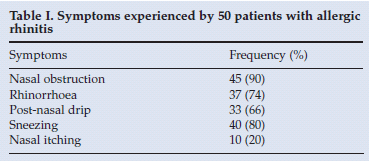
Nasal obstruction was the most common symptom experienced by the patients (Table I). Twelve patients (24%) were asthmatic and 7 (14%) had eczema, while 38 (76%) had allergic conjunctivitis. Most patients felt that their symptoms were worse in spring (N=25, 50%) and summer (N=16, 32%) while 19 (38%) felt that their symptoms were better in winter.
Total IgE levels ranged between 3.10 kU/l and 1 443 kU/l (median 202.5 kU/l). In 4 patients the total IgE level was within normal limits.
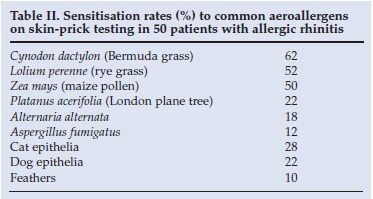
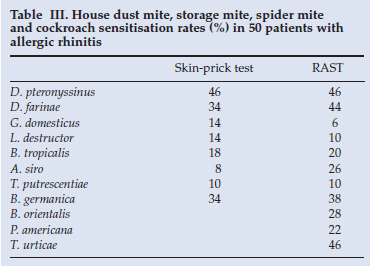
The sensitisation rates for the common aero-allergens again confirmed that grass pollens were the predominant allergens in these patients (Table II). Forty-six per cent of patients were sensitised to at least one of the house-dust mites on skin-prick testing and ImmunoCAP RAST testing (Table III). All patients sensitised to D. farinae were also sensitised to D. pteronyssinus. There was good agreement between sensitisation to D. pteronyssinus and D. farinae on both skin-prick testing (kappa = 0.75) and ImmunoCAP RAST testing (kappa = 0.72). House-dust mite sensitisation on skin-prick testing was significantly more prevalent in patients who had previously lived at the coast (N=16) than in those who had not (N=34) (D. pteronyssinus 75.0% v. 32.3%, p=0.0048; D. farinae 68.8% v. 17.7%, p=0.0004), but there was no significant difference between those with carpets in the home (N=38) and those without (N=12) (50% v. 33%, p=0.3126).
Storage mites were not common allergens (Table III), while 46% of patients were sensitised to the spider mite T. urticae. When sensitisation to storage mites was present, this was in the lower ranges (<17.5 kU/l). There was no significant difference in the prevalence of sensitisation to any of the storage mites on skin-prick testing between patients who had previously lived at the coast and those who had not (p>0.05).
There was fair agreement between B. tropicalis sensitisation and sensitisation to both D. pteronyssinus (kappa = 0.41) and D. farinae (kappa = 0.50) on skin-prick testing and between sensitisation to D. farinae and G. domesticus sensitisation (kappa = 0.48) on skin-prick testing, but no agreement between sensitisation to the house-dust mites and sensitisation to any of the other storage mites (kappa <0.4). ImmunoCAP RAST testing showed a fair agreement between sensitisation to both of the house-dust mites and A. siro sensitisation (D. pteronyssinus kappa = 0.42) (D. farinae kappa = 0.53) and between sensitisation to D. farinae and B. tropicalis sensitisation (kappa = 0.48), but no agreement between house-dust mite sensitisation and sensitisation to any of the other storage mites (kappa <0.4).
There was no significant difference in sensitisation to T. urticae between patients from urban and rural areas (46% v. 44%, p=1.000) or between patients who had previously lived at the coast and other patients (50% v. 44%, p=0.6971). There was a fair to good agreement between spider mite sensitisation and sensitisation to house-dust mites, cockroaches and the storage mite A. siro (kappa >0.4), but poor agreement with sensitisation to the other storage mites (kappa <0.4).
B. germanica was the cockroach species to which most patients were sensitised (Table III) and was also the cockroach species with the highest concentration of specific IgE on the ImmunoCAP RAST tests.
There was good agreement between sensitisation to any one of the cockroach species and sensitisation to the other cockroach species (B. germanica and B. orientalis, kappa = 0.69; B. germanica and P. americana, kappa = 0.63; B. orientalis and P. americana, kappa = 0.84). There was no significant difference between patients who had previously lived at the coast and other patients with regard to sensitisation to any of the cockroaches on ImmunoCAP RAST testing (B. germanica 38% v. 38%, p=1.000; B. orientalis 38% v. 24%, p=0.3304; P. americana 25% v. 21%, p=0.7278).
Discussion
Most patients had an elevated total IgE level, but in 4 cases (8%) this was within normal limits in spite of the patients having moderate to severe persistent allergic rhinitis with sensitisation to one or more aero-allergens, confirming that total IgE is a poor screening test for the diagnosis of atopy.
The rate of sensitisation to pollens (Table II) was similar to that previously reported from our clinic,1 D. pteronyssinus was higher than previously reported by us (24%),1 D. pteronyssinus in these patients was 32%, compared with 46% in this study. The prevalence of house-dust mite sensitisation in this study is still lower than the prevalence of house-dust mite sensitisation in atopic patients in the coastal areas.4-7
House-dust mite levels have been studied in various towns and cities in South Africa and have been found to be higher along the humid coastal regions and usually lower in the inland areas of high altitude where the climate is characterised by wide 24-hour temperature fluctuations and lower relative humidity. These levels are reflected in the rate of house-dust mite allergy in South Africa, which ranges between 65.5% and 95% in atopic patients in the humid coastal areas of South Africa and between 25% and 45% in the dry inland regions.4
House-dust mites require a relative humidity of between 55% and 73% in the temperature range of 15ºC to 35ºC and die from dehydration if the relative humidity is below 51%.13 D. pteronyssinus has slightly higher relative humidity requirements than D. farinae, with D. farinae better surviving long periods of low relative humidity.14 15 16 15
We found an association between house-dust mite sensitisation and having previously lived at the coast, suggesting that sensitisation had occurred when the patients had been living at the coast. This is also supported by the fact that D. pteronyssinus sensitisation was more common than D. farinae. With the lower humidity requirements of D. farinae,14
Storage mites mainly comprise members of the Acaridae and Glycyphagidae families.17 17 17-20 this was not the case in our patients. This may also be due to the low humidity. The optimal living conditions for storage mites are temperatures of 25 -30ºC and 80% relative humidity.18
B. tropicalis was the storage mite with the highest rate of sensitisation on skin-prick testing, while A. siro had the highest sensitisation rate on ImmunoCAP RAST testing. It is possible that sensitisation to B. tropicalis also occurred while patients were at the coast, as B. tropicalis is a common mite in homes in tropical and subtropical areas of the world,17 B. tropicalis between patients who had previously lived at the coast and those who had not. Studies on the mite flora present in homes in the Free State would show whether exposure to this mite occurs in patients' homes. A. siro has a considerably greater tolerance to temperatures as low as 5ºC and humidity of 67.5%,18
We found only a fair agreement between house-dust mite sensitisation and sensitisation to some of the storage mites, which may be a result of co-sensitisation or immunological cross-reactivity. Most investigations have found a positive association between storage mites and house-dust mite sensitisation, while other studies have found no association.1,17,19-21 The rate of sensitisation to storage mites in house-dust mite-allergic patients has been reported to be 60 - 90%,19-22 but it is uncertain whether this is a result of cosensitisation or of cross-reacting antibodies.18
Spider mites are outdoor phytophagous mites, with the spider mite T. urticae being the most important pest species in the family Tetranychidae.23,24 They have emerged as an important allergen in agricultural workers dealing with fruit trees or working in greenhouses as well as in the surrounding populations, the main symptoms associated with sensitisation and exposure to Tetranychidae mites being rhinoconjunctivitis and asthma.17,23,25 Jeebhay et al. found that T. urticae could be responsible for work-related asthma symptoms in their study of table grape farm workers in the Western Cape and that skin reactivity to T. urticae was more common than to housedust mite.25 26
T. urticae has a worldwide distribution and is a pest on deciduous trees, fruit trees, ornamental trees, fields, strawberries, gooseberries and most vegetables.24 24 T. urticae in our patients, suggesting that this mite is a previously unrecognised allergen in patients in the Free State, but further studies are required to determine the clinical significance of this sensitisation. It was not possible to determine whether any patients were monosensitised to T. urticae as all patients included in the study were known to be sensitised to one or more common aero-allergens.
Among table grape farm workers a strong correlation was found between house-dust mite sensitisation and storage mite sensitisation, but there was only a modest correlation between spider mite sensitisation and sensitisation to either house-dust mites or storage mites.25 T. urticae and sensitisation to the house-dust mites and A. siro, and a fair agreement between sensitisation to any of the house-dust mites and sensitisation to the storage mites B. tropicalis and A. siro but not the other storage mites. Although spider mite-derived extracts contain allergens that are shared in common with domestic mites, major allergens derived from spider mites are unique in terms of cross-reactivity with domestic mites.23
The prevalence of cockroach sensitisation is between 30% and 70% worldwide and between 12% and 40% in South Africa.8 27
The strongest IgE response among patients in Durban was to P. americana, and in patients in Pretoria and Harare to B. germanica, while in Cape Town the level of specific IgE responses to the three cockroach species (P. americana, B. germanica and B. orientalis) were similar.8 P. americana favours coastal areas as it requires a high temperature and humidity for optimal population growth, while B. germanica is found throughout the country, but is the main inland domestic cockroach.27,28 It is therefore not surprising that B. germanica was the most common sensitising cockroach in our study, as in the inland cities of Pretoria and Harare.8
Conclusions
We showed a high rate of sensitisation to house-dust mites in patients with moderate to severe persistent allergic rhinitis living in the Free State. There was an association between house-dust mite sensitisation and having previously lived at the coast, suggesting that sensitisation to this aero-allergen may have occurred while the patients were at the coast and did not occur in the Free State. Studies on the dust mite flora in the homes of patients would shed more light on the role of house-dust mites in causing sensitisation and symptoms in atopic patients living in the Free State. There was a low rate of sensitisation to storage mites but a high rate of sensitisation to the spider mite T. urticae, suggesting that spider mites may be a previously unrecognised allergen in the Free State. Further work is required to determine the clinical relevance of T. urticae sensitisation. Cockroaches appear to be important allergens in the Free State, with B. germanica appearing to be the most important of the cockroach species in the Free State, as in other inland areas in South Africa.
References
- 1. Seedat RY, Rautenbach J, Steenkamp G, Venter J, Joubert G. Allergen sensitivities of patients with allergic rhinitis presenting to the ENT clinic at Universitas Academic Hospital. Current Allergy & Clinical Immunology 2006; 19: 130-132.
- 2. Mercer MJ, van der Linde GP, Joubert G. Rhinitis (allergic and nonallergic) in an atopic pediatric referral population in the grasslands of inland South Africa. Ann Allergy Asthm a Immunol 2002; 89: 503-512.
- 3. Mercer MJ, van Niekerk CH. Clinical characteristics of childhood asthma. S Afr Med J 1991; 79: 77-79.
- 4. Potter PC, Davis G, Manjra A, Luyt D. House dust mite allergy in Southern Africa - historical perspective and current status. Clin Exp Allergy 1996; 26: 132-137.
- 5. Joubert JR, Brink S, Hentzen GM. Allergic asthma in different population groups in the western Cape. Causative and complicating factors. S Afr Med J 1988; 73: 150-154.
- 6. Potter PC, Berman D, Toerien A, Malherbe D, Weinberg EG. Clinical significance of aeroallergen identification in the western Cape. S Afr Med J 1991; 79: 80-84.
- 7. Manjra A, Prescott R, Potter PC. Cockroach allergy in Durban. Current Allergy & Clinical Immunology 1995; 8: 3-7.
- 8. Lopata AL, Jeebhay MF, Groenewald M, et al. Sensitisation to three cockroach species in southern Africa. Current Allergy & Clinical Immunology 2005; 18: 62-66.
- 9. Fraser BN. Cockroaches in relation to bronchial asthma in the Durban area. S Afr Med J 1979; 55: 637-638.
- 10. Morris A. Allsa position statement: allergen skin-prick testing. Current Allergy & Clinical Immunology 2006; 19: 22-25.
- 11. Fleiss J, Levin B, Paik M. Statistical Methods for Rates and Proportions. 3rd ed. Hoboken, NJ: John Wiley & Sons, 2003.
- 12. Bousquet J, Khaltaev N, Cruz AA, et al. Allergic Rhinitis and its Impact on Asthma (ARIA) 2008 update (in collaboration with the World Health Organization, GA(2)LEN and AllerGen). Allergy 2008; 63 S86: 8-160.
- 13. Arlian LG, Morgan MS. Biology, ecology, and prevalence of dust mites. Immunol Allergy Clin North Am 2003; 23: 443-468.
- 14. Arlian LG. Water balance and humidity requirements of house dust mites. Exp Appl Acarol 1992; 16: 15-35.
- 15. Kruger A. Climate of South Africa. Climate Regions. Pretoria: South African Weather Service, 2004.
- 16. South African Weather Service. Climate of South Africa: Climate Statistics to 1990. Pretoria: South African Weather Service, 2002.
- 17. Fernández-Caldas E, Iraola Calvo V. Mite allergens. Curr Allergy Asthma Rep 2005; 5: 402-410.
- 18. van Hage-Hamsten M, Johansson SG. Storage mites. Exp Appl Acarol 1992; 16: 117-128.
- 19. Marcos Bravo C, Luna Ortiz I, Outón A, González Vázquez SR. Allergy to storage mites. Allergy 1999; 54: 769-770.
- 20. Vidal C, Chomón B, Pérez-Carral C, González-Quintela A. Sensitization to Lepidoglyphus destructor, Tyrophagus putrescentiae, and Acarus siro in patients allergic to house dust mites (Dermatophagoides spp.). J Allergy Clin Immunol 1997; 100: 716-718.
- 21. van der Heide S, Niemeijer NR, Hovenga H, de Monchy JG, Dubois AE, Kauffman HF. Prevalence of sensitization to the storage mites Acarus siro, Tyrophagus putrescentiae, and Lepidoglyphus destructor in allergic patients with different degrees of sensitization to the house-dust mite Dermatophagoides pteronyssinus. Allergy 1998; 53: 426-430.
- 22. Sidenius KE, Hallas TE, Poulsen LK, Mosbech H. Allergen cross-reactivity between housedust mites and other invertebrates. Allergy 2001; 56: 723-733.
- 23. Kim Y, Kim Y. Spider-mite allergy and asthma in fruit growers. Curr Opin Allergy Clin Immunol 2002; 2: 103-107.
- 24. Smith Meyer MKP. Mite pests and their predators on cultivated plants in Southern Africa (vegetables and berries). Pretoria: Agricultural Research Council of South Africa - Plant Protection Research Institute, 1996.
- 25. Jeebhay MF, Baatjies R, Chang Y, et al. Risk factors for allergy due to the two-spotted spider mite (Tetranychus urticae) among table grape farm workers. Int Arch Allergy Immunol 2007; 144: 143-149.
- 26. Kim TB, Kim YK, Chang YS, et al. Association between sensitization to outdoor spider mites and clinical manifestations of asthma and rhinitis in the general population of adults. J Korean Med Sci 2006; 21: 247-252.
- 27. Arruda LK. Cockroach allergens. Curr Allergy Asthma Rep 2005; 5: 411-416.
- 28. Picker M, Griffiths C, Weaving A. Field Guide to Insects of South Africa. Cape Town: Struik Publishers, 2004.
This study was funded by a grant from the South African Society of Otorhinolaryngology-Head and Neck Surgery.