Peripheral arterial disease and intermittent claudication: efficacy of short-term upper body strength training, dynamic exercise training, and advice to exercise at home
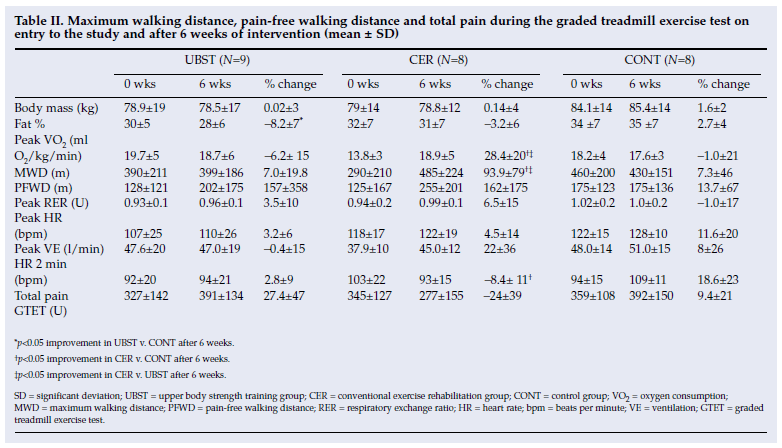
OBJECTIVE: To compare the effect of two training programmes and advice to exercise at home on physiological adaptations in patients with peripheral arterial disease (PAD). DESIGN: 30 patients with a typical history of PAD and intermittent claudication were randomised to either an upper body strength training programme (UBST), a dynamic (walking, cycling, circuit) conventional exercise rehabilitation programme (CER), or advice to 'walk as much as possible at home' (CONT). Before and after intervention groups performed a standard graded treadmill exercise test (GTET) and a 6-minute walk test (SMWT) to determine peak physiological parameters and walking distances. Maximal walking distance (MWD), pain-free walking distance (PFWD), peak oxygen uptake (VO2) , heart rate and perceived pain were measured. RESULTS: MWD on the GTET increased significantly in the CER group compared with the CONT and UBST groups (93.9±79% v. 7.0±19.8% v. 7.3±46%; CER v. UBST v. CONT p=0.003). Similarly, peak VO2 increased with CER compared with the CONT and UBST groups (28.4±20 v. -6.2±15 v. -1.0±21%; CER v. UBST v. CONT p=0.004). During the SMWT the CER and UBST groups improved in PFWD compared with the CONT group (37±47% v. 27±71% v. -30±29%; CER v. UBST v. CONT p=0.03), and perceived pain decreased in the CER group compared with the UBST group (-24±39% v. 27±48%; CER v. UBST p=0.01). CONCLUSION: CER improves physiological parameters and walking distances more than UBST does. CER is effective within 6 weeks. Verbal encouragement to exercise is an ineffective form of management.
SAMJ: South African Medical Journal