Association of tuberculosis active case finding with knowledge, attitudes, stigma and health-seeking behaviour among patients in Eswatini
BACKGROUND. Tuberculosis (TB) poses a significant global public health challenge, with >10 million new infections reported annually, making it one of the top 10 causes of death worldwide. Eswatini has one of the world's highest TB incidence rates, with an estimated rate of 398 cases per 100 000 population in 2019, as reported by the World Health Organization. In Eswatini, despite the implementation of TB active case finding (ACF) interventions aimed at improving TB case detection and reducing community transmission, there is limited empirical evidence on their association with improved knowledge, attitudes and health-seeking behaviour. This study seeks to address this gap to inform future advocacy, communication and social mobilisation strategies for enhanced TB control and prevention. OBJECTIVE. To assess the association of TB ACF and improved knowledge, attitudes, perceptions of stigma and discrimination and health-seeking behaviours among individuals diagnosed with TB. METHODS. The study employed a cross-sectional design from April to May 2023 to review Eswatini TB patients from treatment registers at 14 selected TB basic management units. The TB treatment register was used to determine the entry point of TB patients into care. Those exposed to the ACF programme were located by the TB champions (community volunteers engaged to conduct TB ACF) (n=208), while the unexposed were drawn from outpatients (n=204). The scores for overall knowledge, attitude and health-seeking behaviour were transformed into binary categories based on the calculated median scores. Descriptive statistics were used to summarise participant characteristics, and a multinomial logistic regression model was applied to determine significant risk factors. RESULTS. A total of 412 TB patients (mean (standard deviation) age 42.21 (4.9) years) were included in the study, and 260 (63%) displayed knowledge about TB. Among the patients, 268 (65%) reported that they had not felt stigmatised, 147 (36%) had sought care early (within 2 weeks) and 297 (72%) exhibited good health-seeking behaviour. Exposure to ACF was associated with higher odds of TB knowledge (adjusted odds ratio (aOR) 6.85; 95% confidence interval (CI) 4.21 - 11.14; p<0.001) and higher odds of seeking care within 2 weeks of symptom onset (aOR 6.84; 95% CI 4.06 - 11.52; p<0.001). CONCLUSION. Generally, patients found through ACF were associated with greater knowledge about TB and favourable health-seeking behaviour. However, there remained a notable proportion of TB patients without adequate knowledge and with suboptimal health-seeking behaviour, who may pose a considerable risk for TB transmission.
tuberculosis; active case finding; knowledge; attitudes; health-seeking behaviour
Association of tuberculosis active case finding with knowledge, attitudes, stigma and health-seeking behaviour among patients in Eswatini
H ChomutareI; C S YahIII, IV; A MusekiwaIII; J SibandaV
IBSc, MPH; Ministry of Health LISTEN Project, Mbabane, Eswatini
IIBSc, MPH; School of Health Systems and Public Health, Faculty of Health Sciences, University of Pretoria, South Africa
IIIMSc, PhD; School of Health Systems and Public Health, Faculty of Health Sciences, University of Pretoria, South Africa
IVMSc, PhD; Faculty of Health Sciences Research Office (HSRO), Faculty of Health Sciences, University of the Witwatersrand, Johannesburg, South Africa
VMPH, PhD; National TB Control Programme, Ministry of Health, Manzini, Eswatini
BACKGROUND. Tuberculosis (TB) poses a significant global public health challenge, with >10 million new infections reported annually, making it one of the top 10 causes of death worldwide. Eswatini has one of the world's highest TB incidence rates, with an estimated rate of 398 cases per 100 000 population in 2019, as reported by the World Health Organization. In Eswatini, despite the implementation of TB active case finding (ACF) interventions aimed at improving TB case detection and reducing community transmission, there is limited empirical evidence on their association with improved knowledge, attitudes and health-seeking behaviour. This study seeks to address this gap to inform future advocacy, communication and social mobilisation strategies for enhanced TB control and prevention.
OBJECTIVE. To assess the association of TB ACF and improved knowledge, attitudes, perceptions of stigma and discrimination and health-seeking behaviours among individuals diagnosed with TB.
METHODS. The study employed a cross-sectional design from April to May 2023 to review Eswatini TB patients from treatment registers at 14 selected TB basic management units. The TB treatment register was used to determine the entry point of TB patients into care. Those exposed to the ACF programme were located by the TB champions (community volunteers engaged to conduct TB ACF) (n=208), while the unexposed were drawn from outpatients (n=204). The scores for overall knowledge, attitude and health-seeking behaviour were transformed into binary categories based on the calculated median scores. Descriptive statistics were used to summarise participant characteristics, and a multinomial logistic regression model was applied to determine significant risk factors.
RESULTS. A total of 412 TB patients (mean (standard deviation) age 42.21 (4.9) years) were included in the study, and 260 (63%) displayed knowledge about TB. Among the patients, 268 (65%) reported that they had not felt stigmatised, 147 (36%) had sought care early (within 2 weeks) and 297 (72%) exhibited good health-seeking behaviour. Exposure to ACF was associated with higher odds of TB knowledge (adjusted odds ratio (aOR) 6.85; 95% confidence interval (CI) 4.21 - 11.14; p<0.001) and higher odds of seeking care within 2 weeks of symptom onset (aOR 6.84; 95% CI 4.06 - 11.52; p<0.001).
CONCLUSION. Generally, patients found through ACF were associated with greater knowledge about TB and favourable health-seeking behaviour. However, there remained a notable proportion of TB patients without adequate knowledge and with suboptimal health-seeking behaviour, who may pose a considerable risk for TB transmission.
Keywords: tuberculosis, active case finding, knowledge, attitudes, health-seeking behaviour
Mycobacterium tuberculosis, the bacteria responsible for tuberculosis (TB), is the deadliest infectious agent globally.[1] In 2018, the disease caused 1.4 million deaths and 10 million new infections worldwide, mostly affecting low- and middle-income countries.[2] Eighty-seven percent of all new cases came from 30 high TB-burden countries; the majority of these nations are either low or lower-middle income countries.[2] The 2019 World Health Organization (WHO) Global Tuberculosis Report highlighted that significant obstacles persist in diagnosing and managing TB.[2] Among these obstacles are issues related to poor knowledge of TB symptoms or of the importance of seeking early treatment.
Eswatini is actively confronting the public health challenge presented by TB. In alignment with the United Nations Sustainable Development Goal (SDG) 3.3 and the End TB Strategy, Eswatini has set ambitious targets intended to eliminate the TB epidemic, in stages, by 2030 and 2035.[3] The country aimed for a 35% reduction in TB-related deaths and a 20% decrease in the TB incidence rate by the year 2020.[3] To meet the 2030 targets, Eswatini is committed to achieving a 90% reduction in TB deaths and an 80% reduction in the TB incidence rate, and eliminating catastrophic costs associated with TB. Looking ahead to 2035, Eswatini aspires to achieve even more substantial reductions: a 95% decrease in TB deaths, a 90% drop in the TB incidence rate, and sustaining 0% catastrophic costs, all in comparison with 2015 levels.[4] Although the country is listed among those that are on track to achieve the WHO's 2035 End TB targets,[5] a 2018 national TB prevalence survey revealed that Eswatini had a prevalence rate of 441 per 100 000 individuals, with a case detection rate of 65%.[6] The National TB Control Programme introduced TB active case finding (ACF) in 2006, aiming to address the gaps in case detection and treatment. ACF refers to the proactive identification of TB cases, rather than waiting for symptomatic individuals to seek care on their own.
The ACF strategy involves systematically screening specific populations or individuals who may be at higher risk for TB, even if they have not yet sought medical attention for their symptoms.[7] The goal of ACF is to detect and diagnose TB cases earlier than they might have been identified through passive case finding, which relies on symptomatic individuals initiating contact with health services.[7] In Eswatini, community health workers (CHWs) were engaged to spearhead the ACF project. These CHWs are referred to as TB champions. The TB champions are trained to conduct TB screening at the household level, ensuring that no potential case goes unnoticed. Their work involves not only identifying people showing signs and symptoms of TB but also educating households about the disease, its transmission, prevention methods and the importance of seeking early treatment. This proactive approach empowers communities with the knowledge to protect themselves, and reduces stigma associated with TB.
An essential part of the TB champions' role is collecting sputum samples from individuals with presumptive TB. These samples are then submitted to the nearest health facility for testing. If a positive TB diagnosis is confirmed, the TB champions facilitate referrals and link the clients to treatment, ensuring that they receive timely and appropriate care. In addition to screening and referral services, TB champions conduct contact tracing for TB index cases. By identifying and assessing individuals who have been in close contact with TB patients, they help to prevent further spread of the disease and ensure that any new cases are quickly detected and managed.
Evidence supports the use of CHWs in effectively combating the TB crisis. These health workers are involved in mobilising affected communities through promoting prevention and treatment services .[8,91 CHWs help reduce the overall incidence, financial burden and severity of TB disease. They achieve this through various means, including reducing societal stigma associated with TB, enhancing community awareness of the disease's symptoms and providing emotional and psychological support.[10,11]
ACF has been demonstrated to significantly increase TB case detection rates in various contexts. For instance, a study in Cambodia found that community-based ACF effectively identified cases that would otherwise have remained undetected, thereby reducing barriers to early diagnosis and treatment.[12] Similarly, research in Eswatini has indicated that household contact tracing, a form of ACF, has been instrumental in intensifying TB case identification among vulnerable populations, particularly children.[13] The systematic approach of ACF not only facilitates early diagnosis but also fosters a supportive environment that can mitigate stigma associated with TB, as seen in studies that emphasise the importance of community engagement in health-seeking behaviour.[14]
Moreover, ACF has been linked to improved health-seeking behaviours among populations traditionally marginalised in healthcare settings. For example, a study in India found that ACF initiatives targeting vulnerable groups led to a reduction in catastrophic costs associated with TB diagnosis, thereby encouraging individuals to seek care.[15] This aligns with findings from Eswatini, where ACF has been associated with increased awareness and reduced stigma, ultimately leading to improved health-seeking behaviours among TB patients.[13] The integration of educational components within ACF programmes has been shown to enhance knowledge and attitudes toward TB, further supporting the notion that informed communities are more likely to engage in health-seeking behaviours.[14]
Stigma and discrimination remain significant barriers to TB care, often deterring individuals from seeking treatment. Studies have indicated that ACF can play a pivotal role in addressing these issues by fostering community dialogue and education, which can help to reshape perceptions about TB.[16] For instance, a systematic review highlighted that ACF not only improves case detection but also contributes to reducing stigma, by normalising discussions around TB within communities.[17] This is particularly relevant in the context of Eswatini, where cultural attitudes towards TB can significantly impact health-seeking behaviour.[18]
ACF for TB has been widely studied and implemented in various contexts, with numerous studies highlighting its potential to improve TB detection rates and treatment outcomes.[19-21] However, despite the extensive literature, there remains a limited understanding of how ACF affects patients' knowledge, attitudes, and health-seeking behaviours, and community stigma, particularly in high-burden settings such as Eswatini. Previous research has primarily focused on clinical outcomes and detection rates, often overlooking the broader social and behavioural impacts.[22] The present study aims to address this gap by exploring the associations between active TB case finding and these critical factors in Eswatini, thus providing a more comprehensive understanding of the intervention's effects.
One of the primary gaps this research seeks to address is the limited understanding of how ACF can directly influence community knowledge and attitudes towards TB. While previous studies have highlighted the importance of knowledge in shaping health-seeking behaviour, there is a lack of comprehensive data on how ACF initiatives can enhance this knowledge specifically in the context of Eswatini. Research has shown that increasing public knowledge about TB can lead to improved health-seeking behaviours, yet the mechanisms through which ACF contributes to this knowledge enhancement remain underexplored.[23] This gap is critical, as understanding these mechanisms can inform the design of more effective ACF strategies that not only identify cases but also educate communities about TB.
Another significant gap is the relationship between ACF and the reduction of stigma and discrimination associated with TB. Stigma remains a pervasive barrier to TB care, often leading to delayed diagnosis and treatment.[24] Although some studies have indicated that community engagement and education can reduce stigma, there is insufficient evidence specifically linking ACF initiatives to measurable reductions in stigma within affected communities.[25] This research in Eswatini aims to fill this gap by examining how ACF can foster an environment that reduces stigma and encourages individuals to seek care without fear of discrimination.
Additionally, the research addresses the need for targeted interventions that consider the unique sociocultural context of Eswatini. While studies have been conducted in various settings, the specific cultural and social dynamics that influence health-seeking behaviour and stigma in Eswatini have not been thoroughly investigated. Previous research has identified various factors influencing stigma and health-seeking behaviour, such as knowledge of TB transmission and treatment.[26,27] However, the applicability of these findings to Eswatini's context remains uncertain, highlighting the need for localised research that can inform culturally sensitive interventions.
Methods
Study setting
The study was conducted in Eswatini, a small, landlocked country in southern Africa with a population of 1.2 million. Eswatini is divided into four administrative regions: Hhohho, Lubombo, Manzini and Shiselweni, which encompass 59 constituencies and 369 chiefdoms. The country has 327 health facilities, with 133 providing TB services. The study took place across all four regions at TB diagnostic sites: Mbabane Government Hospital, Piggs Peak Hospital, Dvokolwako Health Centre, Mkhuzweni Health Centre, RFM Hospital, Mankayane Hospital, Phoncweni Clinic, Hlathikhulu Government Hospital, Nhlangano Health Centre, Matsanjeni Health Centre, Good Shepherd Hospital, Sithobela Health Centre and Siphofaneni Clinic. These sites were selected due to their high volume of TB patients, making them easily accessible for the study.
Study design
This was a cross-sectional, analytical, non-experimental research design using a quantitative approach, conducted between April and May 2023. This study design was employed to investigate knowledge, attitudes, stigma, discrimination and health behaviour among TB patients in selected health facilities. Two groups of TB patients were compared: those exposed to the TB ACF project and those not exposed.
Study population
The study population comprised TB patients registered at selected TB diagnostic sites between October 2022 and February 2023. Eligible participants included those diagnosed with pulmonary TB, whether drug-resistant or drug-susceptible, who were receiving treatment from the designated diagnostic facilities at the time of the study. All participants were aged >18 years. The study excluded TB patients <18 years of age, those with documented mental illnesses or receiving treatment for mental health issues, patients who had completed their TB treatment and individuals from facilities not selected for the study.
Study sampling and sample size
The sample size calculation, conducted using Stata version 17 (Stata, USA), determined that a minimum of 400 participants was needed to detect a significant difference in outcomes between the exposed and unexposed groups, with 200 participants in each group. This calculation was based on a moderate effect size (Cohen's d=0.5), a significance level (á) of 0.05 and a power (1-â) of 0.80. To ensure equal representation across the facilities, the sample was proportionally divided according to the size of each facility, maintaining a 1:1 ratio within each. This approach ensured that the study was adequately powered to detect meaningful differences between the groups while maintaining proportional representation from each facility. Participants were chosen using the simple random sampling method from the TB treatment register. The registers showed the entry point of the TB patients. Once patients were identified from the TB register, the data collectors initiated contact, either through phone calls or in person during hospital visits, to explain the study and invite the patients to participate. During this interaction, patients were provided with detailed information about the study's purpose and procedures, and their rights, ensuring that informed consent was obtained. After confirming eligibility based on criteria such as diagnosis and treatment phase, patients were officially enrolled in the study.
Study measurements
The exposure variables in the study were demographic characteristics, exposure to the TB ACF project and environmental factors. Demographic characteristics were age, gender, educational level, employment status and marital status, providing a comprehensive profile of each participant. Exposure to the TB ACF project was determined by whether the patient had received information or screening from TB champions, indicating direct engagement with targeted TB awareness and diagnostic efforts. Environmental factors included type of housing (formal or informal) and distance from the nearest health facility, both of which could influence the accessibility and likelihood of seeking timely TB treatment. These variables were crucial in analysing the impact on the outcome measures of knowledge, attitudes, stigma and health-seeking behaviour among TB patients.
The outcome variables were measured using structured quantitative instruments. Knowledge of TB disease, causes, treatment and adherence was assessed through a standardised multiple-choice questionnaire with 28 questions, where each correct answer was scored as 1 and each incorrect answer as 0. Participants with scores above the median score of 23 were categorised as knowledgeable.[28-30] Attitudes towards TB disease, treatment and adherence were measured using 9 questions, where desirable attitudes were scored as 1 and undesirable attitudes as 0. Scores were combined, and those scoring at or above the median score (3) were categorised as having a positive attitude, while those below were categorised as having a negative attitude.[28-30] Correct health-seeking behaviour was evaluated using 10 questions, where desired behaviours were scored as 1 and undesired behaviours as 0. Combined scores at or above the median score indicated good health-seeking behaviour, and scores below the median indicated poor health-seeking behaviour.[28-30] Perceived stigma was measured using 9 questions, with experiences of stigma scored as 0 and absence of stigma scored as 1. Total scores were combined, and those at or above the median score were categorised as not experiencing stigma, while those below the median were categorised as experiencing stigma. [28-30]
Data management and statistical analysis
Quantitative data were electronically gathered via the ODK platform and analysed using Stata version 18 (Stata, USA). Sociodemographic characteristics of patients were summarised using descriptive statistics, with means and standard deviations (SDs) reported for normally distributed numerical variables such as age. Multinomial logistic regression was employed to determine factors associated with TB knowledge, attitudes and health-seeking behaviour. Assumptions for multinomial logistic regression were thoroughly checked, including linearity of logits, independence of irrelevant alternatives using the Hausman-McFadden test and multicollinearity using variance inflation factor. Univariable analysis was initially conducted, including all variables with a p-value <0.25, followed by a manual backward elimination stepwise procedure to exclude variables with p-values >0.05. Crude and adjusted odds ratios (ORs), 95% confidence intervals (CIs) and p-values were calculated for each independent variable. Potential interactions were explored by including interaction terms in the model, and evaluated using likelihood ratio tests to ensure robustness and accuracy of the final model.[31]
Ethical approval
The study was approved by the Research Ethics Committee of the University of Pretoria Faculty of Health Sciences (ref. no. 651/2022) and the Eswatini Health and Human Research Review Board (ref. no. EHHRRB001/2023). Given the non-invasive nature of the study, verbal informed consent was considered adequate for study participants, and the consent form was incorporated into the questionnaire.
Results
Sociodemographic characteristics of TB patients in Eswatini
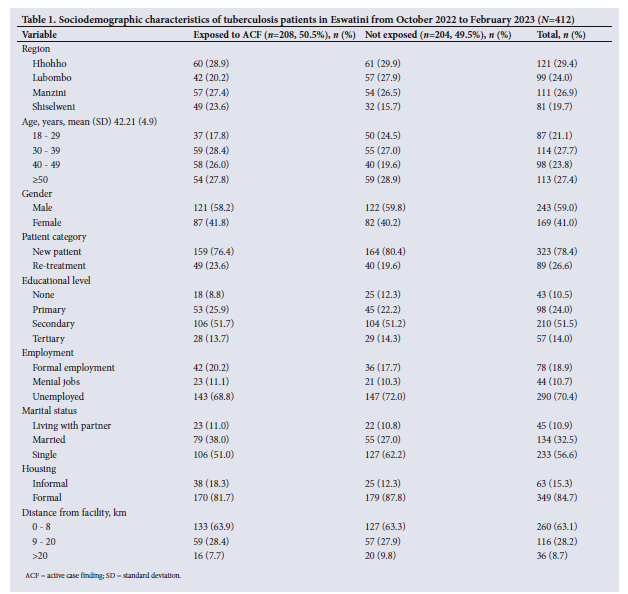
In this study, we included 412 TB patients selected from all four regions of Eswatini. All the patients agreed to be part of the study. Among the participants, slightly over half (208; 50.5%) were exposed to ACF. All sociodemographic characteristics were similar in both the exposed group and the non-exposed group (Table 1).
Knowledge of TB disease
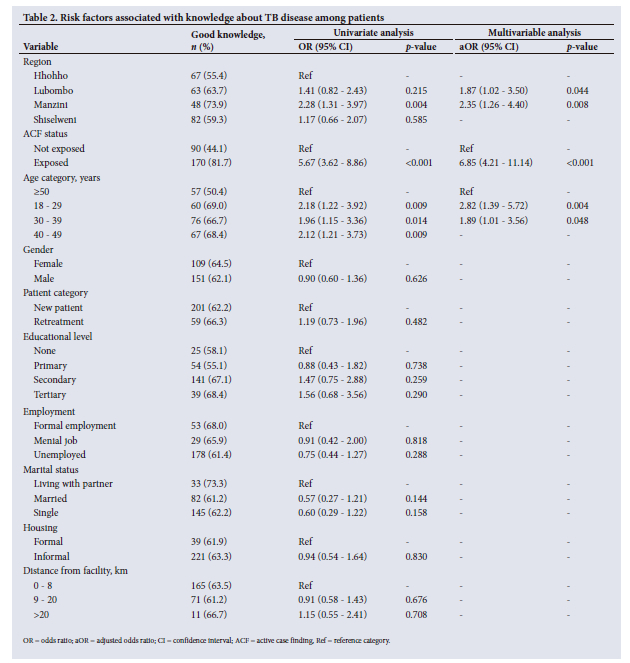
Of the 412 TB patients who took part in the study, 260 (63%) had good knowledge about TB disease. Among the patients who had good TB knowledge, 175 (65.4%) had been exposed to ACF. TB patients from Manzini had an increased odds of good TB knowledge (OR 2.28; 95% CI 1.31 - 3.97) compared with Hhohho; after adjusting for potential confounders, TB patients from Manzini (adjusted OR (aOR) 2.35; 95% CI 1.26 - 4.40) and Lubombo (aOR 1.87; 95% CI 1.02 - 3.50) had higher odds of good TB knowledge compared with Hhohho. Patients who were exposed to ACF had higher odds of good TB knowledge (OR 5.67; 95% CI 3.62 - 8.86) compared with those not exposed to ACF; after adjusting for potential confounders, the association remained statistically significant (aOR 6.85; 95% CI 4.21 - 11.14) (Table 2).
Attitudes toward TB disease and treatment
Of the 412 TB patients who took part in the study, 272 (66%) possessed positive attitudes toward the TB disease and treatment. Compared with patients from Lubombo, TB patients from Hhohho and Shiselweni had higher odds of having positive attitudes (OR 5.05; 95% CI 2.78 - 9.18 and OR 7.19; 95% CI 3.46 - 14.92, respectively); after accounting for potential confounding factors the association remained statistically significant (aOR 4.85; 95% CI 2.59 - 9.09 and aOR 7.49; 95% CI 3.52 - 15.93, respectively). There was no association between TB attitudes and exposure to ACF (Appendix Table S1).
Stigma associated with TB disease
Of the 412 TB patients who took part in the survey, 268 (65%) reported that they had not experienced stigma. The odds of reporting no stigma experience were significantly higher in TB patients from the Shiselweni region (OR 5.72; 95% CI 2.70 - 12.15) compared with those from the Hhohho region, and the association remained statistically significant after adjusting for potential confounders (aOR 5.03; 95% CI 2.27 - 11.15). TB patients exposed to ACF had higher odds of reporting no stigma experience (OR 1.65; 95% CI 1.10 - 2.49); however, the association was not significant after adjusting for confounding factors.
In comparison with TB patients with tertiary education, TB patients with no education, those with only primary education and those with secondary education had higher odds of reporting no experience of stigma: no education OR 4.20; 95% CI 1.71 - 10.33; primary education OR 3.08; 95% CI 1.55 - 6.11; secondary education OR 1.92; 95% CI 1.06 - 3.47. The association remained statistically significant after factoring in potential confounders: no education aOR 4.94; 95% CI 1.64 14.90; primary education aOR 3.32; 95% CI 1.46 - 7.53); secondary education aOR 2.53; 95%
CI 1.27 - 4.98. TB patients employed in menial jobs had higher odds of not experiencing stigma (OR 3.30; 95% CI 1.31 - 8.35) compared with those in formal employment; the association remained significant in the adjusted analysis (aOR 3.39; 95% CI 1.22 - 9.38) (Appendix Table S2).
Time taken to seek care by presumptive TB patients
Of the 412 TB patients who responded, 147 (36%) had sought care early (within 2 weeks of symptoms). TB patients who were exposed to ACF reported higher odds of seeking care early (OR 7.04; 95% CI 4.40 - 11.26) compared with those not exposed to ACF; after adjusted analysis, the association remained statistically significant (aOR 6.84; 95% CI 4.06 - 11.52). TB patients with good TB knowledge reported greater odds of seeking care early (OR 2.67; 95% CI 1.70 - 4.20) compared with those with poor knowledge; however, after adjusted analysis, the association was statistically insignificant. TB patients who reported no stigma experience had greater odds of seeking care early (OR 1.56, 95% CI 1.01 - 2.42) compared with those who had experienced stigma; however, after the adjusted analysis the association was statistically insignificant.
Compared with TB patients who resided >20 km from a health facility, TB patients residing within 0 - 8 km reported higher odds of seeking care early (OR 3.28; 95% CI 1.32 - 8.16; after adjusted analysis aOR 3.75; 95% CI 1.39 - 10.09) (Appendix Table S3).
TB health-seeking behaviour
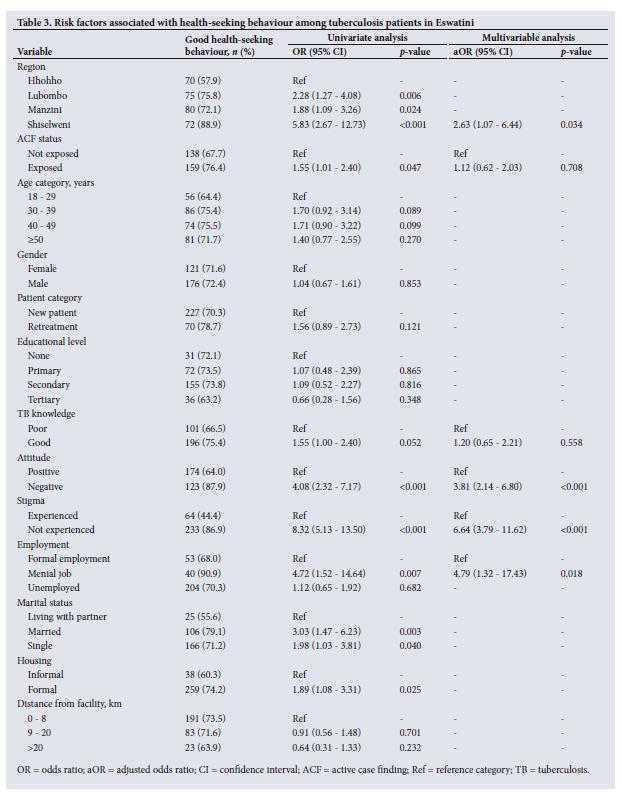
Of the 412 TB patients who responded, 297 (72%) exhibited good health-seeking behaviour. Compared with TB patients from Hhohho, those from Shiselweni (OR 5.83; 95% CI 2.67 - 12.73), Lubombo (OR 2.28; 95% CI 1.27 - 4.08) and Manzini (OR 1.88; 95% CI 1.09 - 3.26) reported greater odds of intended health-seeking behaviour. After accounting for potential confounding factors, only TB patients from Shiselweni had higher odds of demonstrating desired health-seeking behaviour (aOR 2.63; 95% CI 1.07 - 6.44) than those from Hhohho. The odds of reporting intended health-seeking behaviour were higher among TB patients exposed to ACF (OR 1.55, 95% CI 1.01 to 2.40) compared with those not exposed to ACF; however, after adjusted analysis, the association was statistically insignificant. Furthermore, TB patients with negative attitudes towards TB disease had higher odds of reporting intended health-seeking behaviours (OR 3.86; 95% CI 2.42 - 6.15), compared with those with positive attitudes, even after adjusted analysis (aOR 3.81; 95% CI 2.14 - 6.80) (Table 3).
Discussion
This study aimed to explore the association between ACF and improved TB knowledge, attitudes, stigma and health-seeking behaviour among TB patients in Eswatini. This study found that the majority of TB patients were knowledgeable about TB disease, had not experienced stigma associated with TB and exhibited desired health-seeking behaviour. However, although only 37% of TB patients had poor knowledge, this number is significantly high owing to the nature of the TB disease. TB is an infectious and serious disease, and poor TB knowledge among patients increases community transmission.[32] The study also revealed that the majority of TB patients possess negative attitudes towards TB. Furthermore, the study highlighted that presumptive TB clients seek TB care late; this was also reported in a study conducted in Gambia.[33] Negative attitudes towards TB disease and treatment can contribute to poor treatment outcomes or even non-adherence to treatment.[33,34] In the current study, exposure to ACF was found to be associated with good TB knowledge, no experience of stigma, early treatment-seeking practices and desired health-seeking behaviour. [35] However, after adjusting for potential confounding factors, exposure to ACF did not significantly influence health-seeking behaviour and lack of stigma experience. Owing to the effectiveness of the ACF project, we recommend that ACF be integrated into long-term planning, including the creation of TB community volunteer positions within the government public service (as now this is only possible through donor funding).
According to our results, other predictors for TB knowledge were region of residence and age. TB patients from Lubombo and Manzini were more knowledgeable about TB, and older TB patients aged >50 years had less knowledge about TB. Attitudes toward TB and stigma were notably region-specific, and varied with education level and employment status. The current study suggests that psychosocial factors, including experience of stigma and attitudes, along with socioeconomic factors such as employment in menial jobs and marital status, are crucial in influencing health-seeking behaviour. The study lacked a comprehensive examination of how poverty, lack of access to health and social inequalities impact TB knowledge and treatment. Focusing on these aspects in future is crucial, aligning with the objectives of SDGs 1 and 10, which aim to eradicate poverty and reduce inequalities, respectively. An illustrative example from a Zambian study revealed that poverty is associated with delays in seeking healthcare and non-adherence to treatment.[36]
The study did not reveal statistically significant gender differences in TB knowledge and health-seeking behaviour. The authors acknowledge the importance of exploring potential gender-related dynamics for comprehensive public health strategies. Addressing gender differences in TB-related knowledge and health-seeking behaviour is crucial not only for targeted interventions but also to fulfil the broader objective of promoting gender equality, as per SDG 5.
In 2011, the TB programme carried out a knowledge, attitudes and practices survey to assess the understanding, perceptions and health-seeking behaviours of the general population and TB patients in Eswatini.[37] The report highlighted a notable lack of TB knowledge, particularly regarding the causes of TB, with only 40% of participants answering questions correctly.[37] However, this study reported an improvement in TB knowledge over previous studies.
Our findings substantiate and extend current literature in several key areas. The significance of region in influencing TB knowledge and attitudes is echoed by studies indicating regional disparities in healthcare accessibility and educational outreach.[38,39] The role of ACF in enhancing TB knowledge and encouraging early care-seeking is consistent with prior research advocating for ACF as an effective tool for TB control.[40] The negative association between older age and TB knowledge aligns with existing literature, which suggests that older populations may have less access to updated information.[41,42] Interestingly, stigma remains a potential factor affecting both the experience of TB patients and their health-seeking behaviour, a point that continues to receive focus in recent studies.[26] In the context of Eswatini, where cultural and social factors intricately shape community perceptions, deeper exploration is recommended to uncover the root causes and manifestations of TB-related stigma. Cultural beliefs, traditional practices and community dynamics can significantly contribute to the stigmatisation of TB, influencing individuals' willingness to seek timely healthcare, and thereby impeding progress toward the goals outlined in the End TB Strategy. By investigating these cultural and social intricacies, we can identify targeted interventions that address the specific sources of stigma, fostering a more supportive environment for TB patients. The results of the current study showed a significant association between negative attitudes towards TB and good health-seeking behaviour. This might seem counterintuitive, as one would generally expect that negative attitudes would deter individuals from seeking proper care. However, this association could be indicative of a complex underlying context. Negative attitudes could encompass fear, shame, or a sense of urgency. These feelings might actually propel individuals to seek care more quickly, motivated by the desire to treat or hide the condition. This is a departure from the usual understanding that positive attitudes promote health-seeking behaviour, and points to a more subtle relationship.
The study findings can be used to inform the Eswatini National TB Strategic Plan for 2024 - 2028, which has adopted a patient-centred approach. This will allow a more targeted approach to address the determinants of poor TB knowledge and undesirable health-seeking behaviours, in order to achieve target 3.3 of the SGDs. The study did not examine the impact of healthcare infrastructure and accessibility in TB knowledge and treatment. However, the study findings showed that the further clients are from a healthcare facility, the less likely they are to seek early treatment. According to the Eswatini Services Availability and Readiness
Assessment report of 2017, the number of facilities that offer TB testing and treatment services was below target.[42] Expanding the number of TB management units would significantly enhance the accessibility of TB services within underserved communities, thereby maximising the benefits for these populations.
Study limitations
One of the study's strengths lies in its multilayered approach. Analysing a broad range of sociodemographic and psychological factors provides a detailed picture of TB patients in Eswatini. The use of adjusted logistic regression analyses adds depth and reliability to our findings. However, the study is not without limitations. The generalisability of the results may be restricted to the specific context of Eswatini, and some significant findings, such as the unique role of menial jobs, may require further investigation. The lack of qualitative data also limits our understanding of the underlying reasons behind some findings, such as why older age groups have poor TB knowledge, or why certain regions have negative attitudes towards TB. The lack of significant associations in some areas, such as gender and marital status, may indicate potential confounding variables not accounted for in the study. The study relies on self-reported data, which might be subject to inaccuracies or misinterpretations. However, the questionnaire was translated into the local language, and also pretested.
Recommendations
The study's findings have several practical implications for public health policy in Eswatini. Firstly, tailored educational campaigns that target older populations and specific regions with poor TB knowledge are imperative. Secondly, there is a need for continued and possibly expanded community engagement and education through expanding the ACF project. This could significantly enhance both early care-seeking and general TB knowledge. ACF positions could be integrated into the government public service. Thirdly, the role of stigma in health-seeking behaviour suggests a need for programmes that address societal perceptions of TB. Finally, the data indicate that focusing on formal housing and reducing distances to healthcare facilities could accelerate early care-seeking, thereby potentially reducing TB transmission. The distinct regional differences in attitudes and experiences indicate that a 'one-size-fits-all' approach may not be effective, and that region-specific interventions could be more successful.
Conclusion
The study revealed that while the majority of TB patients exhibited good knowledge about the disease, a significant proportion still lacked adequate knowledge, which poses a risk for community transmission. Negative attitudes toward TB disease and treatment were high among patients, which could result in non-adherence to treatment. Late seeking of TB care among presumptive TB clients was noted, which could result in TB transmission and lead to poor treatment outcomes. The study highlights huge gaps in knowledge, attitudes and health-seeking behaviours toward TB in Eswatini. Exposure to ACF was associated with improved TB knowledge, but did not significantly influence health-seeking behaviour or reduce experiences of stigma after adjusting for confounding factors. The study confirms that ACF can contribute to improvements in TB knowledge, but it needs to be integrated into other TB interventions to be more effective. Regional disparities in TB knowledge and attitudes were evident, emphasising the importance of tailored interventions. Notably, the study uncovers a complex relationship between negative attitudes and good health-seeking behaviour, suggesting that negative attitudes might paradoxically motivate individuals to seek care quickly, possibly driven by fear, shame, or urgency. These findings highlight the need for targeted educational campaigns, region-specific strategies and continued efforts to combat TB in Eswatini, while also highlighting the intricate interplay between attitudes and health-seeking behaviour that merits further exploration. However, the study's cross-sectional nature and contextual limitations call for further research to establish causal relationships and to investigate unexplored variables.
Data availability. The data used for this study are available from the authors on request.
Declaration. This research was done in partial fulfilment of the requirements for HC's MPH degree at the University of Pretoria.
Acknowledgements. The authors extend their heartfelt gratitude to the patients who generously participated in this study, sharing their valuable experiences. They also acknowledge the diligent efforts of the data collectors, and express appreciation to the National TB Control Programme for their support and for access to essential resources.
Author contributions. HC and JS conceptualised the study. HC developed the methodology and developed data collection tools. HC and JS performed the investigation and collected data. HC performed data analysis. CY and AM reviewed and edited the manuscript. CY and AM supervised the project.
Funding. None.
Conflicts of interest. None.
References
-
1. World Health Organization. Global tuberculosis report 2020. Geneva: WHO, 2021. https://www.who.int/publications/i/item/9789240037021. (accessed 29 July 2022).
» https://www.who.int/publications/i/item/9789240037021 -
2. World Health Organization. Global tuberculosis report 2019. Geneva: WHO, 2019. https://www.who.int/publications/i/item/9789241565714 (accessed 29 July 2022).
» https://www.who.int/publications/i/item/9789241565714 - 3. Ministry of Health. Eswatini National TB Strategic Plan (2020 - 2024). Mbabane: Eswatini Ministry of Health, 2020.
- 4. Ministry of Health. Eswatini National TB Strategic Plan (2024 - 2028). Mbabane: Government of Eswatini, 2023.
-
5. Cha J, Thwaites GE, Ashton PM. An evaluation of progress towards the 2035 WHO end TB targets in 40 high burden countries. medRxiv 2020:10. http://doi.org/10.1101/2020.10.02.20205393
» http://doi.org/10.1101/2020.10.02.20205393 - 6. National TB Control Programme. National Tuberculosis Prevalence Survey. Mbabane: Eswatini Ministry of Health, 2018.
-
7. World Health Organization. Systematic screening for active tuberculosis: Principles and recommendations. Geneva: WHO, 2013. https://iris.who.int/bitstream/10665/84971/1/9789241548601 (accessed 29 July 2022).
» https://iris.who.int/bitstream/10665/84971/1/9789241548601 -
8. World Health Organization. Community involvement in tuberculosis care and prevention: Towards partnerships for health: Guiding principles and recommendations based on a WHO review. Geneva: WHO, 2008. http://doi.org/10.2471/BLT.08.051045
» http://doi.org/10.2471/BLT.08.051045 -
9. Bhutta ZA, Lassi ZS, Pariyo G, Huicho L. Global experience of community health workers for delivery of health-related millennium development goals: A systematic review, country case studies, and recommendations for integration into national health systems. Global Health Workforce Alliance 2010;1(249):61. http://doi.org/10.13140/RG.2.1.5020.5606
» http://doi.org/10.13140/RG.2.1.5020.5606 -
10. Okeyo IL, Dowse R An illustrated booklet for reinforcing community health worker knowledge of tuberculosis and facilitating patient counselling. Afr J Prim Health Care Fam Med 2018;10(1):1-7. http://doi.org/10.4102/phcfm.v10i1.1630
» http://doi.org/10.4102/phcfm.v10i1.1630 -
11. Clarke M, Dick J, Zwarenstein M, Lombard C, Diwan V Lay health worker intervention with choice of DOT superior to standard TB care for farm dwellers in South Africa: A cluster randomised control trial. Int J Tuberc Lung Dis 2005;9(6):673-679. http://doi.org/10.5588/ijtld.05.0530
» http://doi.org/10.5588/ijtld.05.0530 -
12. Lorent N, Choun K, Thai S, et al. Community-based active tuberculosis case finding in poor urban settlements of Phnom Penh, Cambodia: A feasible and effective strategy. PLoS ONE 2014;9(3):e92754. https://doi.org/10.1371/journal.pone.0092754
» https://doi.org/10.1371/journal.pone.0092754 -
13. Mandalakas A, Ngo K, Ustero P, et al. Butimba: Intensifying the hunt for child TB in Swaziland through household contact tracing. PLoS ONE 2017;12(1):e0169769. https://doi.org/10.1371/journalpone.0169769
» https://doi.org/10.1371/journalpone.0169769 -
14. Sinha A, Renu R, Kar A, et al. Health-seeking behaviour, knowledge, and stigma around tuberculosis: A mixed-method study with specific vulnerable population groups in India. Research Square 2023;epub ahead of print. https://doi.org/10.21203/rs.3.rs-3083635/v1
» https://doi.org/10.21203/rs.3.rs-3083635/v1 -
15. Shewade H, Gupta V, Satyanarayana S, et al. Active case finding among marginalised and vulnerable populations reduces catastrophic costs due to tuberculosis diagnosis. Global Health Action 2018;11(1):1494897. https://doi.org/10.1080/16549716.2018.1494897
» https://doi.org/10.1080/16549716.2018.1494897 -
16. Kigozi G, Engelbrecht M, Heunis C, Rensburg A. Household contact non-attendance of clinical evaluation for tuberculosis: A pilot study in a high burden district in South Africa. BMC Infect Dis 2018;18(1). https://doi.org/10.1186/s12879-018-3010-3
» https://doi.org/10.1186/s12879-018-3010-3 -
17. Bohlbro A, Hvingelby V, Rudolf F, Wejse C, Patsche C. Active case-finding of tuberculosis in general populations and at-risk groups: A systematic review and meta-analysis. Eur Respir J 2021;58(4):2100090. https://doi.org/10.1183/13993003.00090-2021
» https://doi.org/10.1183/13993003.00090-2021 -
18. Bashorun A, Linda C, Omoleke S, et al. Knowledge, attitude and practice towards tuberculosis in gambia: A nation-wide cross-sectional survey. BMC Public Health 2020;20(1):1566. https://doi.org/10.1186/s12889-020-09685-3
» https://doi.org/10.1186/s12889-020-09685-3 -
19. Smith J, Roberts C, Patel V, et al. The impact of community-based active case finding for tuberculosis: A review of outcomes. BMC Glob Public Health 2018:18(1):45-54. https://doi.org/10.1186/s12889-017-4820-9
» https://doi.org/10.1186/s12889-017-4820-9 -
20. Jones L, Brown K, Peterson H. Improving TB case detection through active case finding in hard-to-reach areas. Glob Health Sci Pract 2019:7(3):435-448. https://doi.org/10.9745/GHSP-D-19-00120
» https://doi.org/10.9745/GHSP-D-19-00120 -
21. Lee K, Singh R, Chen H, et al. The impact of active case finding on TB transmission dynamics: A modeling study. PLoS ONE 2020:15(7):e0236015. https://doi.org/10.1371/journal.pone.0236015
» https://doi.org/10.1371/journal.pone.0236015 -
22. Doe P, Williams T, Green E, et al. The social and behavioural impacts of active TB case finding: A scoping review. BMC Infect Dis 2021:21(1):873. https://doi.org/10.1186/s12879-021-06436-5
» https://doi.org/10.1186/s12879-021-06436-5 -
23. Hossain S, Zaman K, Quaiyum A, et al. Factors associated with poor knowledge among adults on tuberculosis in Bangladesh: Results from a nationwide survey. J Health Population and Nutr 2015:34(1):2. https://doi.org/10.1186/s41043-015-0002-4
» https://doi.org/10.1186/s41043-015-0002-4 -
24. Mulyana R, Nursasi A. The intervention strategies to reduce tuberculosis stigma based on community: A systematic review. J Pendidikan Keperawatan Indonesia 2019:5(1):61-70. https://doi.org/10.17509/jpkiv5i1.16371
» https://doi.org/10.17509/jpkiv5i1.16371 -
25. Macintyre K, Bakker MI, Bergson S, et al. Defining the research agenda to measure and reduce tuberculosis stigmas. Int J Tubercul Lung Dis 2017: 21(11):S87-S96. https://doi.org/10.5588/ijtld.17.0151.
» https://doi.org/10.5588/ijtld.17.0151 -
26. Abebe G, Deribew A, Apers L, et al. Knowledge, health seeking behaviour and perceived stigma towards tuberculosis among tuberculosis suspects in a rural community in southwest Ethiopia. PloS ONE 2010;5(10):e13339. https://doi.org/10.1371/journal.pone.0013339
» https://doi.org/10.1371/journal.pone.0013339 -
27. Chen X, Wang W, Hua Q, et al. Persistent discrimination of TB in southeastern China: Results from four repeated population-based surveys during the period of 2006 - 2018. Risk Manage Healthcare Pol 2021;14:2333-2344. https://doi.org/10.2147/rmhp.s311869
» https://doi.org/10.2147/rmhp.s311869 -
28. Konda SG, Melo CA, Giri PA. Knowledge, attitude and practices regarding tuberculosis among new pulmonary tuberculosis patients in a new urban township in India. Int J Med Sci Public Health 2016;5(3):563. http://doi.org/10.5455/ijmsph.2016.03072015147
» http://doi.org/10.5455/ijmsph.2016.03072015147 -
29. Mushtaq MU, Majrooh MA, Ahmad W, et al. Knowledge, attitudes and practices regarding tuberculosis in two districts of Punjab, Pakistan. Int J Tuberc Lung Dis 2010;14(3):303-310. https://doi.org/10.5588/ijtld.09.0313
» https://doi.org/10.5588/ijtld.09.0313 -
30. Bihon A, Zinabu S, Muktar Y, Assefa A. Human and bovine tuberculosis knowledge, attitude and practice (KAP) among cattle owners in Ethiopia. Heliyon 2021;7(3):e06533. https://doi.org/10.1016/j.heliyon.2021
» https://doi.org/10.1016/j.heliyon.2021 -
31. Musekiwa A, Bamogo A, Shisana O, et al. Prevalence of self-reported HIV testing and associated factors among adolescent girls and young women in South Africa: Results from a 2017 nationally representative population-based HIV survey. Public Health Pract 2021;2:100093. http://doi.org/10.1016/j.puhip.2021.100093
» http://doi.org/10.1016/j.puhip.2021.100093 -
32. Makgopa S, Madiba S. Tuberculosis knowledge and delayed health care seeking among newly diagnosed tuberculosis patients in primary health facilities in an urban district, South Africa. Health Serv Insights 2021;14:11786329211054035. http://doi.org/10.1177/11786329211054035
» http://doi.org/10.1177/11786329211054035 -
33. Bashorun AO, Linda C, Omoleke S, et al. Knowledge, attitude and practice towards tuberculosis in Gambia: A nation-wide cross-sectional survey. BMC Public Health 2020;20(1):1566. http://doi.org/10.1186/s12889-020-09339-3
» http://doi.org/10.1186/s12889-020-09339-3 -
34. Adane K, Spigt M, Johanna L, Noortje D, Abera SF, Dinant G-J. Tuberculosis knowledge, attitudes, and practices among northern Ethiopian prisoners: Implications for TB control efforts. PLoS ONE 2017;12(3):e0174692. http://doi.org/10.1371/journal.pone.0174692
» http://doi.org/10.1371/journal.pone.0174692 -
35. Thodika KN, Ghosh Mitra S, Ramaprasad A, Sreeganga SD. Toward strengthening active case finding for ending tuberculosis in India. Int J Health Plann Manage 2021;36(6):2056-2061. http://doi.org/10.1002/hpm.3253
» http://doi.org/10.1002/hpm.3253 -
36. Cremers AL, Gerrets R, Kapata N, et al. Tuberculosis patients' pre-hospital delay and non-compliance with a longstanding DOT programme: A mixed methods study in urban Zambia. BMC Public Health 2016;16(1):1130. http://doi.org/10.1186/s12889-016-2893-2
» http://doi.org/10.1186/s12889-016-2893-2 - 37. Ministry of Health, Swaziland. Knowledge, attitudes and practices about TB and its treatment in Swaziland. Mbabane: Ministry of Health, 2011.
-
38. Cramm JM, Finkenflügel HJ, M0ller V, Nieboer AP. TB treatment initiation and adherence in a South African community influenced more by perceptions than by knowledge of tuberculosis. BMC Public Health 2010;10(1):1-8. http://doi.org/10.1186/1471-2458-10-72
» http://doi.org/10.1186/1471-2458-10-72 -
39. Esmael A, Ali I, Agonafir M, Desale A, Yaregal Z, Desta K. Assessment of patients' knowledge, attitude, and practice regarding pulmonary tuberculosis in eastern Amhara regional state, Ethiopia: Cross-sectional study. Am J Trop Med Hyg 2013;88(4):785. http://doi.org/10.4269/ajtmh.12-0312
» http://doi.org/10.4269/ajtmh.12-0312 -
40. Parija D, Patra T, Kumar A, et al. Impact of awareness drives and community-based active tuberculosis case finding in Odisha, India. Int J Tuberc Lung Dis 2014;18(9):1105-1107. http://doi.org/10.5588/ijtld.13.0804
» http://doi.org/10.5588/ijtld.13.0804 -
41. Junaid SA, Kanma-Okafor OJ, Olufunlayo TF, Odugbemi BA, Ozoh OB. Tuberculosis stigma: Assessing tuberculosis knowledge, attitude and preventive practices in Surulere, Lagos, Nigeria. Ann Afr Med 2021;20(3):184. http://doi.org/10.4103/aam.aam_92_20
» http://doi.org/10.4103/aam.aam_92_20 -
42. Eswatini Ministry of Health. Eswatini services availability and readiness assessment. Mbabane: Government of Eswatini, 2017. https://www.hst.org.za/publications/NonHST%20Publications/Eswatini%20SARA%20March%20(05%2004%202019).pdf (accessed 1 August 2022).
» https://www.hst.org.za/publications/NonHST%20Publications/Eswatini%20SARA%20March%20(05%2004%202019).pdf

Accepted 20 May 2025