Establishing an academic biobank in a resource-challenged environment
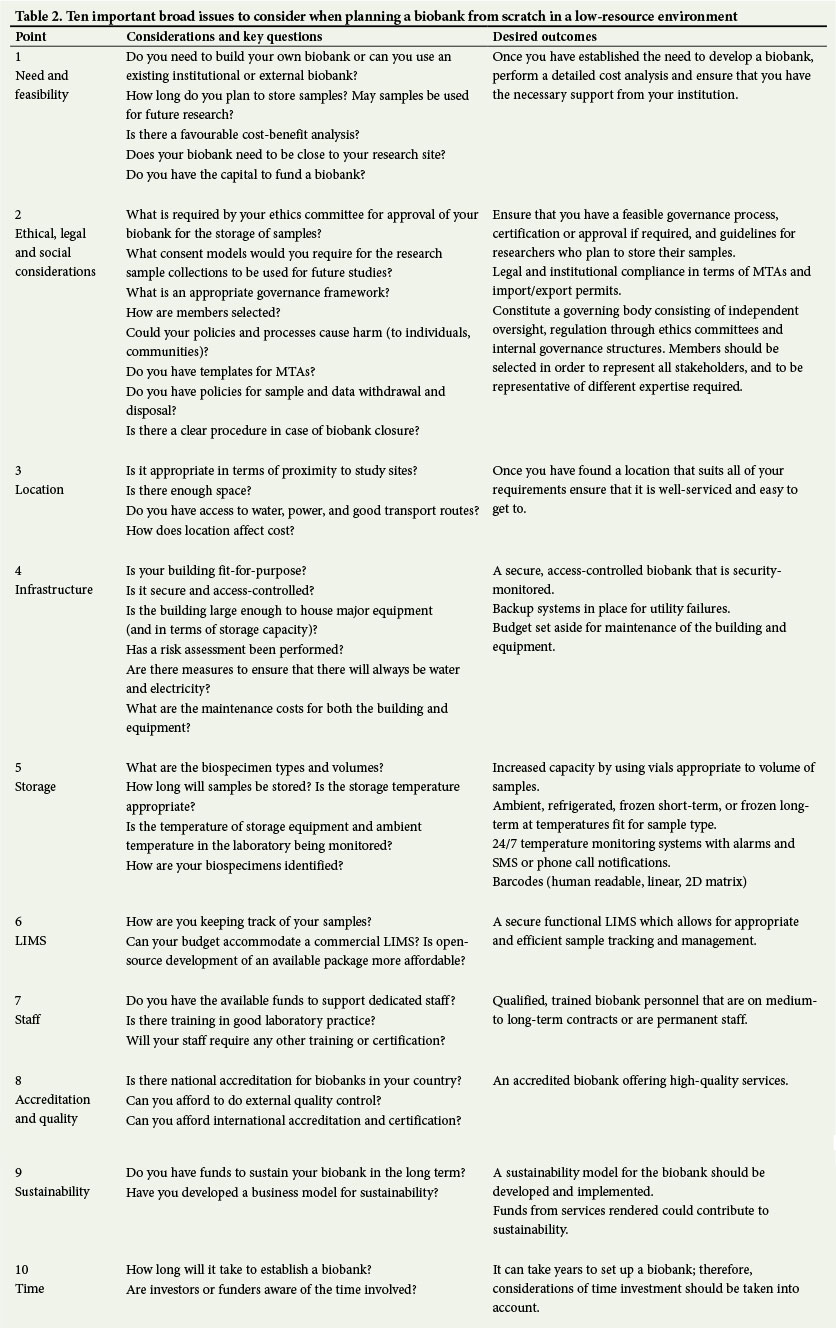
Past practices of informal sample collections and spreadsheets for data and sample management fall short of best-practice models for biobanking, and are neither cost effective nor efficient to adequately serve the needs of large research studies. The biobank of the Sydney Brenner Institute for Molecular Bioscience serves as a bioresource for institutional, national and international research collaborations. It provides high-quality human biospecimens from African populations, secure data and sample curation and storage, as well as monitored sample handling and management processes, to promote both non-communicable and infectious-disease research. Best-practice guidelines have been adapted to align with a low-resource setting and have been instrumental in the development of a quality-management system, including standard operating procedures and a quality-control regimen. Here, we provide a summary of 10 important considerations for initiating and establishing an academic research biobank in a low-resource setting. These include addressing ethical, legal, technical, accreditation and/or certification concerns and financial sustainability.
SAMJ: South African Medical Journal
 Thumbnail
 Thumbnail
 Thumbnail