Early results of starting a fracture liaison service for fragility hip fractures in a regional South African hospital
BACKGROUND. Fragility hip fracture is a rising pandemic, with the burden currently shifting to developing countries. A fracture liaison service (FLS) was implemented in September 2021 in a regional South African (SA) hospital. OBJECTIVE. To describe two groups of patients with surgically treated fragility hip fractures - those before and after implementation of the FLS - in terms of early mortality, refracture and readmission rates. METHODS. Patients aged >50 years who sustained hip fractures between January 2020 and June 2022 were considered; those with high-energy injuries, pathological and periprosthetic fractures were excluded. Associations between treatment group and mortality, readmission and refracture rates within the first year after surgery were investigated. Subgroup analyses were also conducted for specific risk factors. RESULTS. A total of 299 patients (mean (standard deviation) age of 74.5 (11.0) years, 68.2% female) were included, of whom 32.8% (n=98) received bisphosphonates. The overall 30-day, 90-day and 1-year mortality rates were 9.4% (n=28), 17.4% (n=52) and 29.8% (n=89), respectively, while 24.1% (n=72) of patients had unplanned readmissions to hospital, and 2.7% (n=8) refractured within the first year after surgery. No statistical difference in 30-day, 90-day or 1-year mortality rate, refracture incidence or readmission incidence was observed between patient groups. Time to surgery was shorter after the implementation of the FLS (median (interquartile range (IQR)) 30.8 (22.3 - 48.9) hours v. before (median (IQR) 42.5 (23.1 - 70.8) hours, p=0.039). CONCLUSION. An FLS was successfully implemented in a regional SA hospital. Early mortality, refractures and readmission rates were low or comparable with the existing literature, and not affected by treatment within the FLS nor by bisphosphonate initiation. Treatment within the FLS, however, resulted in a decrease in time to surgery.
fragility hip fracture; osteoporosis; fracture liaison service; bisphosphonates
Early results of starting a fracture liaison service for fragility hip fractures in a regional South African hospital
S P OosthuizenI, II; J D JordaanIII, IV; M C BurgerV
IMB ChB; Division of Orthopaedic Surgery, Department of Surgical Sciences, Faculty of Medicine and Health Sciences, Stellenbosch University, Cape Town, South Africa
IIMB ChB; Division of Orthopaedic Surgery, Tygerberg Hospital, Cape Town, South Africa
IIIFC Orth (SA); Division of Orthopaedic Surgery, Department of Surgical Sciences, Faculty of Medicine and Health Sciences, Stellenbosch University, Cape Town, South Africa
IVFC Orth (SA); Division of Orthopaedic Surgery, Tygerberg Hospital, Cape Town, South Africa
VPhD; Division of Orthopaedic Surgery, Department of Surgical Sciences, Faculty of Medicine and Health Sciences, Stellenbosch University, Cape Town, South Africa
BACKGROUND. Fragility hip fracture is a rising pandemic, with the burden currently shifting to developing countries. A fracture liaison service (FLS) was implemented in September 2021 in a regional South African (SA) hospital.
OBJECTIVE. To describe two groups of patients with surgically treated fragility hip fractures - those before and after implementation of the FLS - in terms of early mortality, refracture and readmission rates.
METHODS. Patients aged >50 years who sustained hip fractures between January 2020 and June 2022 were considered; those with high-energy injuries, pathological and periprosthetic fractures were excluded. Associations between treatment group and mortality, readmission and refracture rates within the first year after surgery were investigated. Subgroup analyses were also conducted for specific risk factors.
RESULTS. A total of 299 patients (mean (standard deviation) age of 74.5 (11.0) years, 68.2% female) were included, of whom 32.8% (n=98) received bisphosphonates. The overall 30-day, 90-day and 1-year mortality rates were 9.4% (n=28), 17.4% (n=52) and 29.8% (n=89), respectively, while 24.1% (n=72) of patients had unplanned readmissions to hospital, and 2.7% (n=8) refractured within the first year after surgery. No statistical difference in 30-day, 90-day or 1-year mortality rate, refracture incidence or readmission incidence was observed between patient groups. Time to surgery was shorter after the implementation of the FLS (median (interquartile range (IQR)) 30.8 (22.3 - 48.9) hours v. before (median (IQR) 42.5 (23.1 - 70.8) hours, p=0.039).
CONCLUSION. An FLS was successfully implemented in a regional SA hospital. Early mortality, refractures and readmission rates were low or comparable with the existing literature, and not affected by treatment within the FLS nor by bisphosphonate initiation. Treatment within the FLS, however, resulted in a decrease in time to surgery.
Keywords: fragility hip fracture, osteoporosis, fracture liaison service, bisphosphonates
Fragility hip fracture (FFH) is the most devastating consequence of osteoporosis, due to the resultant morbidity, mortality and economic impact.[1,2] While it is truly a global pandemic, the burden is now shifting to developing countries, mostly in Asia and sub-Saharan Africa (SSA). This is primarily due to ageing populations and changes in secular trends.[3-6] Although important advances have been made in SSA since the turn of the millennium pertaining to research and preventive strategies, significant challenges remain within the context of a quadruple disease burden.[6-8]
Fracture liaison services (FLSs), created in 2003 by McLellan et al.,[9] have gained popularity and have been endorsed by the International Osteoporosis Foundation's 'Capture the fracture' campaign.[10] They have proven efficacy in the comprehensive management of FFHs, especially in combination with anti-osteoporotic medications such as bisphosphonates.[11-14] Bisphosphonate treatment after FFH offers a good safety profile and leads to a reduction in refractures and all-cause mortality.[12,15-21]
An FLS was implemented in a regional South African (SA) hospital serving a predominantly rural community. This study aimed to describe the patient population before and after the implementation of an FLS in terms of three main outcomes: mortality, refracture and unplanned readmission within the first year after surgery. Secondary objectives included describing differences between patients treated with bisphosphonates v. those treated without bisphosphonates, and evaluating potential risk factors for mortality at 1 year following surgery.
Methods
Study design
A retrospective cohort study was conducted that considered all patients with FFH treated surgically in a regional hospital in the Western Cape Province, SA, between January 2020 and June 2022. This period includes 20 months prior to and 10 months following FLS introduction.
Study setting and participants
This single-centre study was conducted in a regional hospital responsible for serving public sector patients in three districts in the Western Cape. The hospital's orthopaedic department manages orthopaedic trauma, emergencies and general elective orthopaedic conditions, including arthroplasty, but does not have any subspecialty units.
In September 2021, an FLS was implemented for patients sustaining osteoporotic fractures. This FLS is based on four pillars: (i) identification of patients at risk; (ii) evaluation for secondary causes of osteoporosis; (iii) initiation of intravenous bisphosphonates, vitamin D and calcium supplementation; and (iv) ensuring co-management and follow-up with endocrine and medical units for continuation of care. An FFH is diagnostic of osteoporosis and is an indication to start antiresorptive medication,[22] and therefore all patients with FFH qualified for osteoporosis treatment as part of the FLS. The role of the orthopaedic department was to treat the presenting injury on its merit, identify and diagnose osteoporosis, perform initial biochemistry and blood investigations and initiate medical treatment. The patients were then referred to the regional hospital's medical outpatients' department and an endocrinology unit at a tertiary academic institution for the follow-up management of osteoporosis.
All patients undergoing hip fracture surgery from January 2020 until June 2022 were evaluated for inclusion. Patients <50 years of age, with pathological or periprosthetic fractures, chronic fractures, or high-energy mechanisms, or patients with incomplete data were excluded from the study. Demographic and clinical data were obtained from provincial electronic databases, patient records and mortality rates confirmed by the Department of Home Affairs.
The patient cohort was divided into two groups (pre FLS era and FLS era), depending on whether they were treated before (January 2020 - August 2021) or after (September 2021 - June 2022) implementation of the FLS. They were also divided into bisphosphonate and non-bisphosphonate groups based on whether or not they were initiated on bisphosphonates. All surgeries were performed by a senior specialist, or a trainee (registrar or medical officer) under specialist supervision. No procedures were performed after hours or without specialist oversight.
The primary outcome measures were 30-day, 90-day and 1-year mortality rates, and secondary outcome measures were 30-day and 1-year unplanned readmission rates, as well as 1-year refracture rates post surgery. An unplanned readmission was defined as any unforeseen readmission to the hospital, and included complications such as fracture-related infections, prosthetic dislocations and any and all other medical and surgical reasons for admission. Elective procedures and planned readmissions were excluded from this definition.
Statistical analysis
Data were analysed using Statistica version 14 (TIBCO, USA). Continuous data were evaluated for normality, and reported as mean (standard deviation (SD)) or median (interquartile range (IQR)), depending on distribution. Categorical data were summarised as frequencies and counts. A comparative analysis on demographic and baseline clinical variables was performed between patient groups (pre-FLS era v. FLS era; bisphosphonates v. non-bisphosphonates) to evaluate the presence of potential confounding variables using an independent f-test for continuous variables, or χ22
Subgroup analyses were performed including fracture type (intracapsular v. extracapsular hip fractures), age groups (50 - 65, 65 - 80, >80 years), different American Society of Anesthesiologists (ASA) classes, and genders using χ2
Ethical clearance
A waiver of informed consent was granted by the Health Research Ethics Committee of Stellenbosch Univerity (ref. no. N22/11/142) due to the minimal risk involved and the retrospective nature of the study.
Results
General characteristics
During the 2.5-year study period, 360 patients aged >50 years received hip fracture surgery, and were considered for inclusion. Of these, 61 were excluded, due to having high-energy fractures (n=29), pathological fractures (n=13), periprosthetic fractures (n=3), chronic fractures (n=4), or incomplete data (n=12). A total of 299 patients were therefore included in the study.
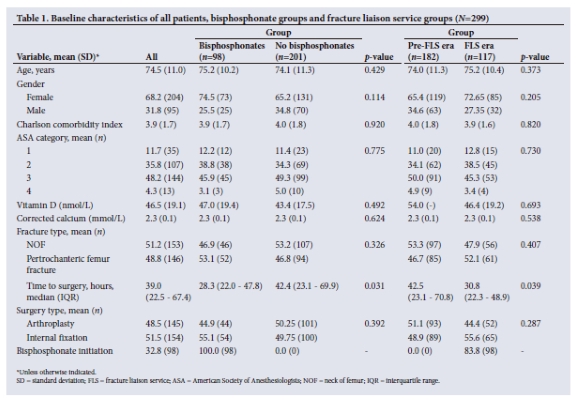
Baseline variables were similarly distributed between all study groups (Table 1). The majority (73.2%, n=219) of patients were referred from district hospitals and clinics; only about a quarter of patients (26.8%, n=80) were inhabitants of the town, referred via the hospital's emergency centre. The mean (SD) age was 74.5 (11.0) years (95% CI 73.2 - 75.7), with 68.2% female (n=204) and 31.8% male (n=95). The mean age of females was 75.8 (11.4) years, and the mean age of males was 71.6 (9.3) years. A total of 51.2% (n=153) of fractures were intracapsular (neck-of-femur fractures), while 48.8% (n=146) were extracapsular (pertrochanteric femur fractures). The surgeries performed included 145 (48.5%) hip replacements (arthroplasty) and 154 (51.5%) internal fixations. The median (IQR) time from diagnosis to surgery was 39.0 (22.5 - 67.4) hours, ranging between 4 and 330 hours. More than half (52.5%, n=157) of patients had severe systemic disease according to the ASA. During the study period, a total of 98 patients (32.8%) were initiated on bisphosphonate therapy. These all occurred after the implementation of the FLS, representing an increase from 0% to 83.8%. Patients in the two cohorts were similar with regard to known risk factors, including age and comorbidity status.
Time to surgery was shorter after the implementation of the FLS (median (IQR) 30.8 (22.3 - 48.9) hours) v. before (42.5 (23.1 - 70.8) hours, p=0.039). Consequently, time to surgery was also shorter in the bisphosphonate group (median (IQR) 28.3 (22.0 - 47.8) hours) than the non-bisphosphonate group (median (IQR) 42.4 (23.1 - 69.9) hours, p=0.031) (Table 1).
Clinical characteristics
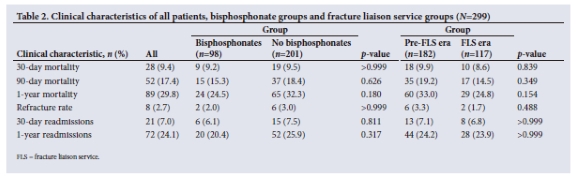
The overall 30-day, 90-day and 1-year all-cause mortality rates were 9.4% (n=28), 17.4% (n=52) and 29.8% (n=89), respectively. Secondary fractures occurred in 2.7% of patients (n=8) within the first year after surgery. The 30-day and 1-year unplanned readmissions to hospital were 7.0% (n=21) and 24.1% (n=72), respectively. Neither the initiation of bisphosphonates nor treatment within the FLS context had a statistically significant effect on mortality, readmissions or refractures in this study population during the first year post surgery (Table 2).
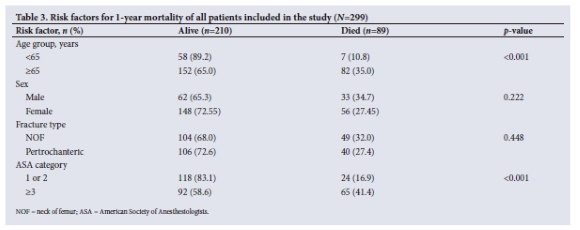
Mortality at 1 year was similar (p=0.222) in males (34.7%) and females (27.5%), and between neck of femur fractures v. pertrochanteric fractures (32.0% v. 27.4%, p=0.448). Mortality rates were lower in patients aged <65 years than those >65 years (10.8% v. 35.0%, p<0.001), and in those with ASA classification 1 or 2 v. >3 (16.9% v. 41.4%, p<0.001) (Table 3).
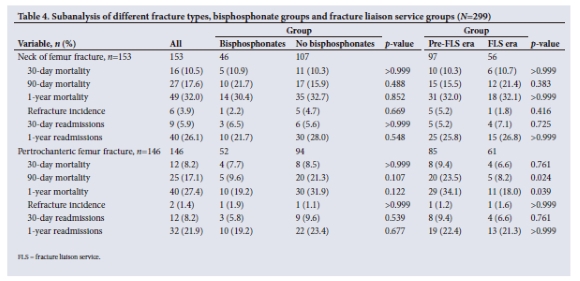
Subanalyses were performed for different fracture types (neck of femur v. pertrochanteric), age groups, ASA categories and gender. In the extracapsular (pertrochanteric) femur fracture group, a lower all-cause mortality rate was observed during the FLS era at 90 days (8.2% v. 23.5%, p=0.024) and 1 year (18.0% v. 34.1%, p=0.039) (Table 4). For patients aged 65 - 80 years, lower all-cause mortality was observed at 90 days in the group treated with bisphosphonates compared with no bisphosphonates (6.7% v. 20.2%, p=0.048) (appendix Table S1; https://coding.samedical.org/file/2369). No further statistically significant associations were observed in the sub-analyses (appendix Tables S1 - S3).
Discussion
Standards for the management of FFH are well established internationally.[23-25] There are limited management guidelines originating from Africa.[1,26,27] These guidelines and treatment goals include surgery within 48 hours of admission, specialist surgical supervision, orthopaedic-geriatric comanagement and the evaluation for and treatment of osteoporosis. The 'quadruple disease burden' faced in SSA poses a significant challenge to meeting these goals.[6] Moreover, SA healthcare is currently based on an unbalanced two-tiered medical system, where only ~16% of the population have private medical insurance. The orthopaedic surgeon density per 100 000 uninsured population is 0.36, compared with the private sector at 8.3, and World Health Organization target of >5.[28,29] Access to appropriate care is therefore often limited in public hospitals.[29,30] Even when certain standards are met, the evaluation and management of osteoporosis and orthopaedic-geriatric comanagement are notoriously neglected, both locally and internationally.[1,29,31-34]
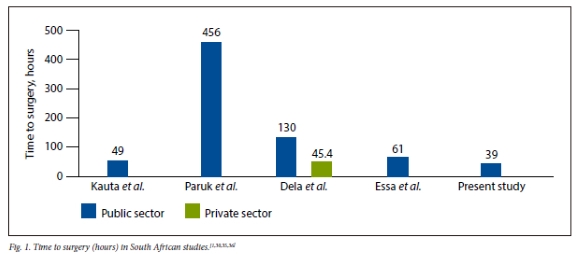
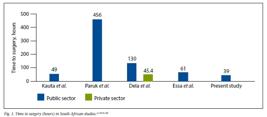
In the current study, the median time to surgery following an FFH was 39.0 hours, which compares favourably with other local research,[1,35,36] and was, surprisingly, even quicker than what was reported from private sector hospitals in the 2022 study by Dela et al.[30] (Fig. 1). It is worth noting that after implementation of the FLS, the time from diagnosis to surgery further improved from 42.5 hours to 30.8 hours. While the FLS did not include implementation of an accelerated time to surgery, it is tempting to speculate that the introduction of an FLS might have led to behavioural changes in the orthopaedic department due to an improved understanding of 'priority' of these patients. The time to surgery was calculated from the time that a diagnosis was made to the 'cutting time' in theatre, meaning that in the 73.2% of patients who were referred from outside facilities, this time included ambulance transport.
During the FLS era, 83.8% of FFH patients were initiated on bisphosphonate therapy, calcium and vitamin D supplementation, and referred to internal medicine and endocrine specialist units for continuation of multidisciplinary care, representing a marked improvement from the era before the FLS.
The 30-day, 90-day and 1-year all-cause mortality rates were 9.4%, 17.4% and 29.8%, respectively. Differences observed in 1-year mortality between the FLS period and the pre-FLS period, or in the bisphosphonate cohort v. non-bisphosphonate cohort, did not reach statistical significance in our study. The minor differences observed during the subanalyses, although interesting to note, should be interpreted with caution, as the authors are unaware of any prior literature suggesting superior efficacy of bisphosphonates or FLS for specific fracture types or age groups. These findings, however, raise interesting questions that future studies may investigate.
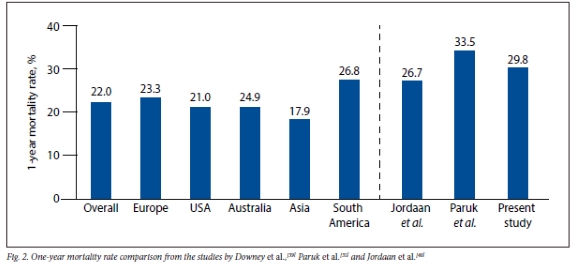
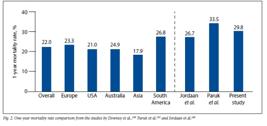
While international mortality rates are reported to have largely stayed constant over a period of three to four decades,[37,38] a large systematic review in 2019 by Downey et al.[39] suggests that 1-year mortality may now be slowly declining globally, but remains >20% in most countries outside of Asia. Other SA studies have reported 1-year mortality rates of 33.5%[35] and 26.7%,[40] although the latter was limited to fractures treated with arthroplasty (Fig. 2).
Unplanned hospital readmission is an undesirable complication associated with worse outcomes, including higher 1-year mortality. [41] In the present study, readmission occurred at a frequency of 7.0% at 30 days, and 24.1% within the first year. These figures compare favourably with previous literature. Data from the USA suggest a rate of 11.5% at 30 days,[42] and a recent Swedish study reported a 1-year readmission rate of 39%.[43] Both these studies were large-scale, based on national hip fracture registries.
Refractures within the first year occurred in 2.7% (n=8) of patients in the present study. This was lower than in a Spanish study that reported a 4.1% first-year refracture rate,[12] as well as in the landmark Horizon trial by Lyles et al.,[15] which reported 8.6% in the bisphosphonate group and 13.9% in the placebo group. Of note, the latter study had a longer follow-up and did not report the 1-year refracture specifically. It is possible that some patients in the present study may have sustained secondary fractures, and either never presented, or presented to health facilities outside the province. However, these numbers are likely very low.
The low refracture and unplanned readmission rates may reflect good perioperative care, a population with inherent resilience and/or social support structures, or difficulties in accessing health facilities. The last, however, is a less likely explanation, as the low refracture and readmission rates are not offset by higher-than-average mortality rates. As expected, older age and a higher ASA score are reported as risk factors for mortality at 1 year following surgery.
Study strengths and weaknesses
This study contributes to a growing body of evidence surrounding FFH in SSA. To the authors' best knowledge, it is the first local study to specifically evaluate outcomes within an FLS, and as the incidence will continue to increase, it may assist in informing health policy-makers and clinicians. It also serves as an example to other local hospitals setting up an FLS, showing that it can be successfully done at a regional level.
This study has several limitations. No data were collected on coronavirus infections, even though the study coincided almost perfectly with the COVID-19 pandemic and its sequential waves in SA. The effects thereof, although not underestimated, are difficult to quantify. It is known that FFH patients infected with COVID had higher 30-day mortality rates, but there was no increased mortality in uninfected FFH patients during the pandemic.[44,45] There is an element that is system and time specific: the lower trauma burden during the same period could have facilitated a lower ratio of patients to health providers in an orthopaedic unit, leading to more efficient perioperative care.
The retrospective nature of the study has inherent limitations, especially considering data collection. Of note, good record-keeping, availability of multiple electronic databases and collaboration with the Department of Home Affairs greatly facilitated both collection and verification of accurate data. The sample size was relatively small (n=299), and the follow-up was only 1 year. In addition, imbalances in study groups are common limitations in retrospective cohort studies. In this study, however, all baseline characteristics were balanced across study groups.
Patients were sampled from a single centre in a single province, which means that the ethnic composition of patients may not reflect that of the whole country. Caution should be taken when generalising these results to the rest of SA, or other countries, as it is known that there is a geographical and ethnic influence on incidence as well as outcomes after FFH.[6]
Given the small proportion of patients who died within 1 year (29.8%), taken together with the relatively small total cohort size, the study was powered to detect only large differences between groups. Therefore, future local studies should attempt to follow patients for longer periods or potentially include multiple sites, to increase the overall sample size and allow for the detection of risk factors for mortality in a SA context.
Conclusion
Successful implementation of an FLS in a regional SA hospital did not translate to significant reduction in early mortality, refractures or readmissions. However, it resulted in a marked increase in bisphosphonate initiation, and a reduction in time to surgery.
Data availability. The data used for this study are available from the authors on request.
Declaration. This study was done in partial fulfillment of SPO's MMed (Orthopaedic Surgery) degree at Stellenbosch University.
Acknowledgements. Dr Gerhard Thiart - Worcester Provincial Hospital orthopaedic department.
Author contributions. SPO: design of study protocol, data collection, writing of manuscript. MCB: study design, data analysis, supervision, editing. JDJ: study conceptualisation, supervision, editing.
Funding. None.
Conflicts of interest. None.
References
-
1. Kauta N, Held M, Dlamini S, et al. The management of fragility fractures of the hip: A quality assessment project. S Afr Orthopaed J 2017;16(31-45). https://doi.org/10.17159/2309-8309/2017/v16n3a5
» https://doi.org/10.17159/2309-8309/2017/v16n3a5 -
2. Paruk F, Tsabasvi M, Kalla AA. Osteoporosis in Africa - where are we now. Clin Rheumatol 2021;40(9)3419-3428. https://doi.org/10.1007/s10067-020-05335-6
» https://doi.org/10.1007/s10067-020-05335-6 -
3. Hawley S, Dela S, Burton A, et al. Incidence and number of fragility fractures of the hip in South Africa: Estimated projections from 2020 to 2050. Osteoporosis Int 2022;33(12):2575-2583. https://doi.org/10.1007/S00198-022-06525-5
» https://doi.org/10.1007/S00198-022-06525-5 -
4. Cooper C, Campion G, Melton LJ III. Hip fractures in the elderly: A world-wide projection. Osteoporosis Int 1992;2(6):285-289. https://doi.org/10.1007/BF01623184
» https://doi.org/10.1007/BF01623184 -
5. Gullberg B, Johnell O, Kanis JA. World-wide projections for hip fracture. Osteoporosis Int 1997;7(5):407-413. https://doi.org/10.1007/PL00004148
» https://doi.org/10.1007/PL00004148 -
6. Dela SS, Paruk F, Brown SL, et al. Ethnic and gender-specific incidence rates for hip fractures in South Africa: A multi-centre study. Bone 2020;133:115253. https://doi.org/10.1016/j.bone.2020.115253
» https://doi.org/10.1016/j.bone.2020.115253 -
7. Johansson H, Dela SS, Cassim B, et al FRAX-based fracture probabilities in South Africa. Arch Osteoporos 2021;16(1):51. https://doi.org/10.1007/s11657-021-00905-w
» https://doi.org/10.1007/s11657-021-00905-w -
8. Kebaetse M, Nkhwa S, Mogodi M, et al. A country-specific FRAX model for Botswana. Arch Osteoporos 2021;16(1):90. https://doi.org/10.1007/S11657-021-00965-Y
» https://doi.org/10.1007/S11657-021-00965-Y -
9. McLellan AR, Gallacher SJ, Fraser M, McQuillian C. The fracture liaison service: Success of a program for the evaluation and management of patients with osteoporotic fractures. Osteoporosis Int 2003;14(12):1028-1034. https://doi.org/10.1007/S00198-003-1507-Z
» https://doi.org/10.1007/S00198-003-1507-Z -
10. Akesson K, Marsh D, Mitchell PJ, et al. Capture the fracture: A best practice framework and global campaign to break the fragility fracture cycle. Osteoporosis Int 2013;24(8):2135-2152. https://doi.org/10.1007/S00198-013-2348-Z
» https://doi.org/10.1007/S00198-013-2348-Z -
11. Yan C, Chen Y, Cao J, et al. The effectiveness of fracture liaison services in patients with hip fractures: A systematic review and meta-analysis of randomised controlled trials. Heliyon 2023;9(10):E20838. https://doi.org/10.1016/J.HELIYON.2023.E20838
» https://doi.org/10.1016/J.HELIYON.2023.E20838 -
12. González-Quevedo D, Bautista-Enrique D, Pérez-del-Río V, et al. Fracture liaison service and mortality in elderly hip fracture patients: A prospective cohort study. Osteoporosis Int 2020;31(1):77-84. https://doi.org/10.1007/s00198-019-05153-w
» https://doi.org/10.1007/s00198-019-05153-w -
13. Wang CC, Liu HC, Lee MT, Huang WT. Effects of fracture liaison service on outcomes of patients with hip fracture in rural area of an Asian country. Geriatr Orthop Surg Rehabil 2023;14:21514593231204783. https://doi.org/10.1177/21514593231204783
» https://doi.org/10.1177/21514593231204783 -
14. Nakayama A, Major G, Holliday E, et al. Evidence of effectiveness of a fracture liaison service to reduce the re-fracture rate. Osteoporos Int 2016;27(3):873-879. https://doi.org/10.1007/S00198-015-3443-0
» https://doi.org/10.1007/S00198-015-3443-0 -
15. Lyles KW, Colón-Emeric CS, Magaziner JS, et al Zoledronic acid and clinical fractures and mortality after hip fracture. New Engl J Med 2007;357(18):1799-1809. https://doi.org/10.1056/NEJMOA074941
» https://doi.org/10.1056/NEJMOA074941 -
16. Kim TY, Ha YC, Kang BJ, et al. Does early administration of bisphosphonate affect fracture healing in patients with intertrochanteric fractures? J Bone Joint Surg Br 2012;94(7):956-960. https://doi.org/10.1302/0301-620X.94B7.29079
» https://doi.org/10.1302/0301-620X.94B7.29079 -
17. Cobden A, Cobden SB, Camurcu Y, et al. Effects ofpostoperative osteoporosis treatment on subsequent fracture and the 5-year survival rates after hemiarthroplasty for hip fracture. Arch Osteoporos 2019;14(1):100. https://doi.org/10.1007/s11657-019-0657-3
» https://doi.org/10.1007/s11657-019-0657-3 -
18. Wang P, Li Y, Zhuang H, et al Anti-osteoporosis medications associated with decreased mortality after hip fracture. Orthop Surg 2019;11(5):777-783. https://doi.org/10.1111/OS.12517
» https://doi.org/10.1111/OS.12517 -
19. Cengiz Ö, Polat G, Karademir G, et al. Effects of zoledronate on mortality and morbidity after surgical treatment of hip fractures. Adv Orthop 2016;2016(1):3703482. https://doi.org/10.1155/2016/3703482
» https://doi.org/10.1155/2016/3703482 -
20. Beaupre LA, Morrish DW, Hanley DA, et al. Oral bisphosphonates are associated with reduced mortality after hip fracture. Osteoporos Int 2011;22(3):983-991. https://doi.org/10.1007/S00198-010-1411-2
» https://doi.org/10.1007/S00198-010-1411-2 -
21. Bolland MJ, Grey AB, Gamble GD, Reid IR. Effect of osteoporosis treatment on mortality: A meta-analysis. J Clin Endocrinol Metab 2010;95(3):1174-1181. https://doi.org/10.1210/JC.2009-0852
» https://doi.org/10.1210/JC.2009-0852 -
22. Compston JE, McClung MR, Leslie WD. Osteoporosis. Lancet 2019;393(10169):364-376. https://doi.org/10.1016/S0140-6736(18)32112-3
» https://doi.org/10.1016/S0140-6736(18)32112-3 -
23. Roberts KC, Brox WT, Jevsevar DS, Sevarino K. Management of hip fractures in the elderly. J Am Acad Orthopaed Surg 2015;23(2):131-137. https://doi.org/10.5435/jaaos-d-14-00432
» https://doi.org/10.5435/jaaos-d-14-00432 -
24. National Institute for Health and Care Excellence. Hip fracture: Management. London: NICE, 2011. https://www.nice.org.uk/guidance/cg124 (accessed 21 August 2025).
» https://www.nice.org.uk/guidance/cg124 -
25. Compston J, Cooper A, Cooper C, et al. UK clinical guideline for the prevention and treatment of osteoporosis. Arch Osteoporos 2017;12(1):43. https://doi.org/10.1007/S11657-017-0324-5
» https://doi.org/10.1007/S11657-017-0324-5 -
26. Cassim B, Lipschitz S, Paruk F, Tipping B. Recommendations for the acute and long-term medical management of low-trauma hip fractures. J Endocrinol Metab Diabetes S Afr 2013;18(1):21-32. https://doi.org/10.1080/22201009.2013.10872302
» https://doi.org/10.1080/22201009.2013.10872302 -
27. Hough S, Ascott-Evans BH, Brown SL, et al. NOFSA Guideline for the Diagnosis and Management of Osteoporosis. J Endocrinol Metab Diabetes S Afr 2010;15(3):107-108. https://doi.org/10.1080/22201009.2010.10872239
» https://doi.org/10.1080/22201009.2010.10872239 -
28. Dell AJ, Gray S, Fraser R, et al. Orthopaedic surgeon density in South Africa. World J Surg 2018;42(12):3849-3855. https://doi.org/10.1007/S00268-018-4709-4
» https://doi.org/10.1007/S00268-018-4709-4 -
29. Weil YA, Bernstein BP, Maqungo S, et al. Hip fracture care and national systems in Israel and South Africa. OTA Internat 2020;3(1):e065. https://doi.org/10.1097/oi9.0000000000000065
» https://doi.org/10.1097/oi9.0000000000000065 -
30. Dela SS, Paruk F, Conradie M, et al. Access to care for low trauma hip fractures in South Africa. Arch Osteoporos 2022;17(1):15. https://doi.org/10.1007/S11657-022-01057-1
» https://doi.org/10.1007/S11657-022-01057-1 -
31. Kim SC, Kim MS, Sanfélix-Gimeno G, et al. Use of osteoporosis medications after hospitalisation for hip fracture: A cross-national study. Am J Med 2015;128(5):519-526. https://doi.org/10.1016/j.amjmed.2015.01.014
» https://doi.org/10.1016/j.amjmed.2015.01.014 -
32. Solomon DH, Johnston SS, Boytsov NN, et al. Osteoporosis medication uses after hip fracture in US patients between 2002 and 2011. J Bone Min Res 2014;29(9):1929-1937. https://doi.org/10.1002/
» https://doi.org/10.1002/ -
33. Johansen A, Sahota O, Dockery F, et al. Call to action: A five nations consensus on the use of intravenous zoledronate after hip fracture. Age Ageing 2023;52(9):afad172. https://doi.org/10.1093/AGEING/AFAD172
» https://doi.org/10.1093/AGEING/AFAD172 -
34. Ross BJ, Lee OC, Harris MB, et al. Rates of osteoporosis management and secondary preventative treatment after primary fragility fractures. JBJS Open Access 2021;6(2):e20. https://doi.org/10.2106/JBJS.OA.20.00142
» https://doi.org/10.2106/JBJS.OA.20.00142 -
35. Paruk F, Matthews G, Gregson CL, Cassim B. Hip fractures in South Africa: Mortality outcomes over 12 months post-fracture. Arch Osteoporos 2020;15(1):76. https://doi.org/10.1007/s11657-020-00741-4
» https://doi.org/10.1007/s11657-020-00741-4 -
36. Essa S, Venter S, Jordaan JD. The effect of a post-anaesthesia high-care unit (PAHCU) admission on mobilisation, length of stay and in-hospital mortality post-surgery in low energy neck of femur fracture patients. Eur J Orthopaed Surg Traumatol 2024;34(3):1389-1396. https://doi.org/10.1007/s00590-023-03799-1
» https://doi.org/10.1007/s00590-023-03799-1 -
37. Haleem S, Lutchman L, Mayahi R, et al. Mortality following hip fracture: Trends and geographical variations over the last 40 years. Injury 2002;39(10):1157-1163. https://doi.org/10.1016/J.INJURY.2008.03.022
» https://doi.org/10.1016/J.INJURY.2008.03.022 -
38. Mundi S, Pindiprolu B, Simunovic N, Bhandari M. Similar mortality rates in hip fracture patients over the past 31 years. Acta Orthop 2014;85(1):54-59. https://doi.org/10.3109/17453674.2013.878831
» https://doi.org/10.3109/17453674.2013.878831 -
39. Downey C, Kelly M, Quinlan JF. Changing trends in the mortality rate at 1-year post hip fracture -a systematic review. World J Orthop 2019;10(3):166-175. https://doi.org/10.5312/WJO.V10.I3.166
» https://doi.org/10.5312/WJO.V10.I3.166 -
40. Jordaan JD, Burger MC, Jakoet S, et al. Mortality rates in femoral neck fractures treated with arthroplasty in South Africa. Geriatr Orthop Surg Rehabil 2022;13: 21514593221117309. https://doi.org/10.1177/21514593221117309
» https://doi.org/10.1177/21514593221117309 -
41. Kates SL, Behrend C, Mendelson DA, et al. Hospital readmission after hip fracture. Arch Orthop Trauma Surg 2015;135(3):329-337. https://doi.org/10.1007/s00402-014-2141-2
» https://doi.org/10.1007/s00402-014-2141-2 -
42. Okike K, Chan PH, Paxton EW. Effect of surgeon and hospital volume on morbidity and mortality after hip fracture. J Bone Joint Surg 2017;99(18):1547-1553. https://doi.org/10.2106/JBJS.16.01133
» https://doi.org/10.2106/JBJS.16.01133 -
43. Meyer AC, Eklund H, Hedström M, Modig K. The ASA score predicts infections, cardiovascular complications, and hospital readmissions after hip fracture - a nationwide cohort study. Osteoporosis Int 2021;32(11):2185-2192. https://doi.org/10.1007/S00198-021-05956-W
» https://doi.org/10.1007/S00198-021-05956-W -
44. Ding L, Wei J, Wang B. The impact of COVID-19 on the prevalence, mortality, and associated risk factors for mortality in patients with hip fractures: A meta-analysis. J Am Med Dir Assoc 2023;24(6):846-854. https://doi.org/10.1016/j.jamda.2023.03.011
» https://doi.org/10.1016/j.jamda.2023.03.011 -
45. Konda SR, Esper GW, Meltzer-Bruhn AT, et al. Hip fracture care during COVID-19: Evolution through the pandemic. Cureus 2023;15(7):e42696. https://doi.org/10.7759/cureus.42696
» https://doi.org/10.7759/cureus.42696

Accepted 4 June 2025