Genetic testing for Duchenne/Becker muscular dystrophy in Johannesburg, South Africa
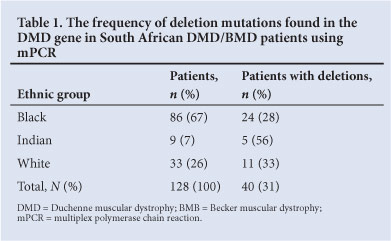
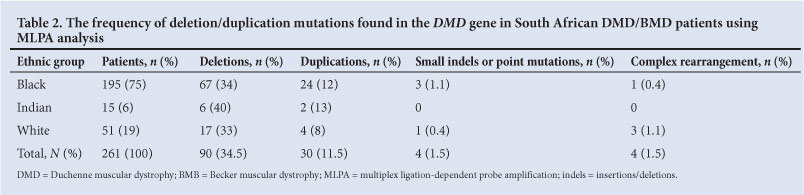
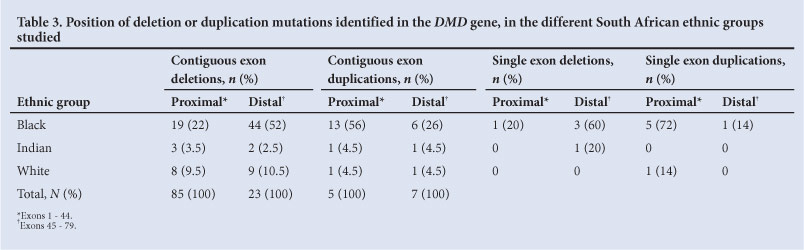
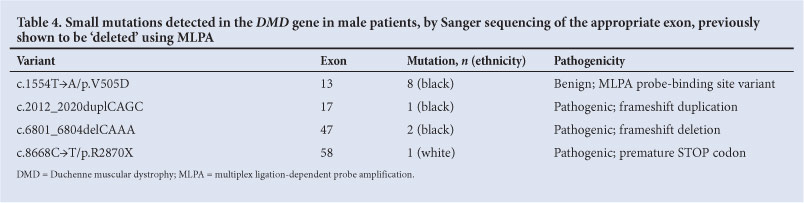
BACKGROUND: Genetic testing for Duchenne/Becker muscular dystrophy (DMD/BMD) mutations initially involved multiplex polymerase chain reaction (mPCR), which targeted two mutation hotspots in the gene and detected deletions in affected males. A newer technology, multiplex ligation-dependent probe amplification (MLPA), was introduced for diagnostic testing in 2007. OBJECTIVES: To evaluate MLPA relative to mPCR as a technique for DMD/BMD diagnostic testing and to establish whether the mutation profile in affected individuals differs between different South African ethnic groups. METHODS: From January 2000 - May 2007, genetic diagnostic testing for DMD/BMD was undertaken in 128 male patients using mPCR. From May 2007 onwards, MLPA replaced this technique and 261 males were investigated. MLPA is a kit-based technology available from MRC-Holland. RESULTS: Of the 128 and 261 probands tested using mPCR and MLPA, respectively, 31% and 34% were found to carry a deletion mutation. Further, MLPA could detect duplication mutations (11.5%), complex rearrangements (1.5%) and small mutations (1.5%). In black patients, deletion mutations were found to cluster in the 3' region of the gene. No population-specific pathogenic mutations were found. CONCLUSIONS: The mutation detection rate for mPCR and MLPA is similar for deletion mutations, but MLPA proved to be a better diagnostic approach as it could detect other types of mutations as well, including duplications, complex rearrangements and small mutations. MLPA could also diagnose mutation status in at-risk female relatives, which is not possible with mPCR.
SAMJ: South African Medical Journal