
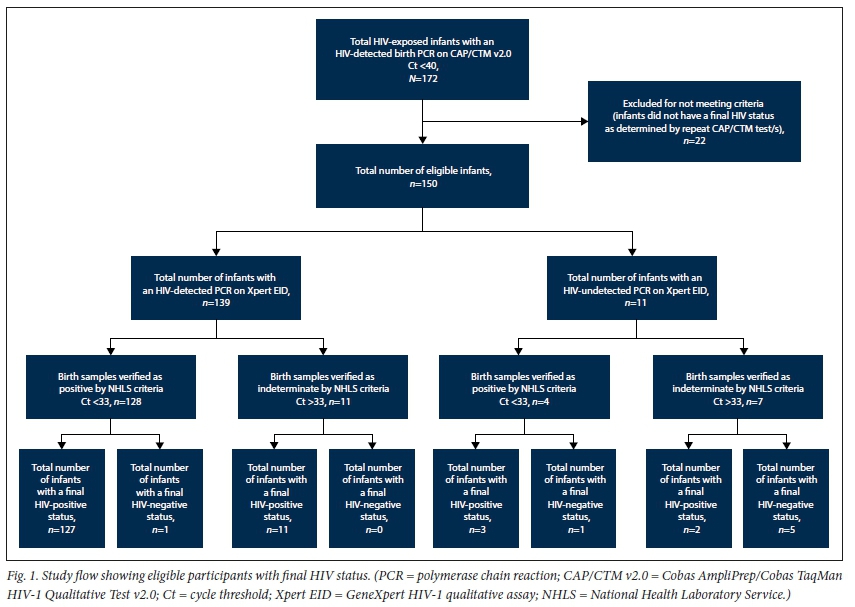
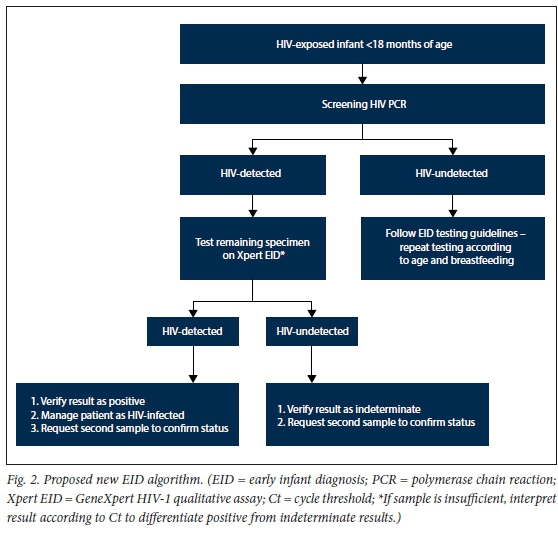
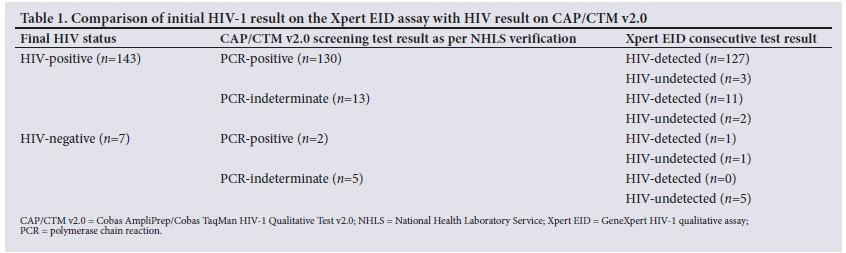
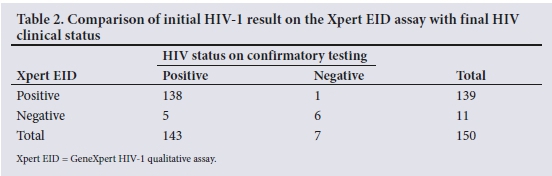
BACKGROUND. The proportion of HIV-exposed infants and young children infected with HIV in South Africa (SA) has declined markedly over the past decade as a result of the country's comprehensive prevention of mother-to-child transmission programme. This decrease has in turn reduced the positive predictive value (PPV) of diagnostic assays, necessitating review of early infant diagnosis (EID) algorithms to ensure improved accuracy. OBJECTIVES. To evaluate the performance of the GeneXpert HIV-1 qualitative assay (Xpert EID) as a consecutive test for infants with an 'HIV-detected' polymerase chain reaction screening test at birth. METHODS. We retrospectively analysed a longitudinal cohort of HIV-exposed infants on whom birth testing was performed, using whole-blood ethylenediaminetetra-acetic acid samples, from four tertiary sites in Gauteng Province between June 2014 and December 2019. Birth samples from all infants with a Cobas AmpliPrep/Cobas TaqMan HIV-1 Qualitative Test v2.0 (CAP/CTM v2.0) HIV-detected screening test, a concurrent Xpert EID test and a subsequent confirmatory CAP/CTM v2.0 test on a separate specimen were included. Performance of the Xpert EID in predicting final HIV status was determined as proportions with 95% confidence intervals (CIs). A comparison of indeterminate CAP/CTM v2.0 results, as per National Health Laboratory Service resulting practice, with discordant CAP/CTM v2.0 v. Xpert EID results was performed. RESULTS. Of 150 infants who met the inclusion criteria, 6 (3.9%) had an Xpert EID result discordant with final HIV status: 5 (3.3%) were false negatives and 1 (0.7%) was false positive. As a consecutive test, the Xpert EID yielded a sensitivity of 96.5% (95% CI 92 - 98.9), specificity of 85.7% (95% CI 42.1 - 99.6), PPV of 99.3% (95% CI 95.7 - 99.9), negative predictive value of 54.5% (95% CI 32.5 - 74.9) and overall accuracy of 96.1% (95% CI 91.5 - 98.5). Using discordant CAP/CTM v2.0/Xpert EID results as criteria to verify indeterminate results instead of current practice would have reduced the number of indeterminate screening results by 42.1%, from 18 (12.6%) to 11 (7.2%), without increasing the false-positive rate. CONCLUSIONS. Addition of the Xpert EID as a consecutive test for specimens with an HIV-detected PCR screening result has the potential to improve the PPV and reduce the indeterminate rate, thereby reducing diagnostic challenges and time to final status, in SA's EID programme.
Research • SAMJ, S. Afr. med. j. 111
(9)
• • https://doi.org/10.7196/SAMJ.2021.v111i9.15564 linkcopy
 Evaluating the performance of the GeneXpert HIV-1 qualitative assay as a consecutive test for a new early infant diagnosis algorithm in South Africa
- ,
- ,
- ,
- ,
- ,
- ,
- ,
- ,
About the authors
person
A Mukendi
school
University of the WitwatersrandFaculty of Health SciencesSchool of Pathology
Johannesburg
South AfricaNational Institute for Communicable DiseasesCentre for HIV and STIs
Johannesburg
South Africa
About the authors
person
T Kufa
school
National Institute for Communicable DiseasesCentre for HIV and STIs
Johannesburg
South AfricaUniversity of the WitwatersrandFaculty of Health SciencesSchool of Public Health
Johannesburg
South Africa
About the authors
person
T Murray
school
National Institute for Communicable DiseasesNational Health Laboratory Service,
Johannesburg
South AfricaWits Health ConsortiumPaediatric HIV Diagnostics
Johannesburg
South Africa
About the authors
person
M Burke
school
Rahima Moosa Mother and Child HospitalEmpilweni Services and Research Unit
Johannesburg
South AfricaUniversity of the WitwatersrandFaculty of Health SciencesSchool of Clinical MedicineDepartment of Paediatrics and Child Health
Johannesburg
South Africa
About the authors
person
R Strehlau
school
Rahima Moosa Mother and Child HospitalEmpilweni Services and Research Unit
Johannesburg
South AfricaUniversity of the WitwatersrandFaculty of Health SciencesSchool of Clinical MedicineDepartment of Paediatrics and Child Health
Johannesburg
South Africa
About the authors
person
K-G Technau
school
Rahima Moosa Mother and Child HospitalEmpilweni Services and Research Unit
Johannesburg
South AfricaUniversity of the WitwatersrandFaculty of Health SciencesSchool of Clinical MedicineDepartment of Paediatrics and Child Health
Johannesburg
South Africa
About the authors
person
C T Tiemessen
school
University of the WitwatersrandFaculty of Health SciencesSchool of Pathology
Johannesburg
South AfricaCentre for HIV and STIsNational Institute for Communicable DiseasesNational Health Laboratory Service
Johannesburg
South Africa
About the authors
person
G G Sherman
school
National Institute for Communicable DiseasesCentre for HIV and STIs
Johannesburg
South AfricaRahima Moosa Mother and Child HospitalEmpilweni Services and Research Unit
Johannesburg
South Africa
About the authors
person
A H Mazanderani
school
University of the WitwatersrandFaculty of Health SciencesSchool of Clinical MedicineDepartment of Paediatrics and Child Health
Johannesburg
South AfricaCentre for HIV and STIsNational Institute for Communicable Diseases
Johannesburg
South Africa
SCImago Institutions Rankings
University of the Witwatersrand, Faculty of Health Sciences, School of Pathology, Johannesburg, South AfricaUniversity of the WitwatersrandSouth AfricaJohannesburg, South AfricaUniversity of the Witwatersrand, Faculty of Health Sciences, School of Pathology, Johannesburg, South Africa
National Institute for Communicable Diseases, Centre for HIV and STIs, Johannesburg, South AfricaNational Institute for Communicable DiseasesSouth AfricaJohannesburg, South AfricaNational Institute for Communicable Diseases, Centre for HIV and STIs, Johannesburg, South Africa
National Institute for Communicable Diseases, Centre for HIV and STIs, Johannesburg, South AfricaNational Institute for Communicable DiseasesSouth AfricaJohannesburg, South AfricaNational Institute for Communicable Diseases, Centre for HIV and STIs, Johannesburg, South Africa
University of the Witwatersrand, Faculty of Health Sciences, School of Public Health, Johannesburg, South AfricaUniversity of the WitwatersrandSouth AfricaJohannesburg, South AfricaUniversity of the Witwatersrand, Faculty of Health Sciences, School of Public Health, Johannesburg, South Africa
National Institute for Communicable Diseases, National Health Laboratory Service,, Johannesburg, South AfricaNational Institute for Communicable DiseasesSouth AfricaJohannesburg, South AfricaNational Institute for Communicable Diseases, National Health Laboratory Service,, Johannesburg, South Africa
Wits Health Consortium, Paediatric HIV Diagnostics, Johannesburg, South AfricaWits Health ConsortiumSouth AfricaJohannesburg, South AfricaWits Health Consortium, Paediatric HIV Diagnostics, Johannesburg, South Africa
Rahima Moosa Mother and Child Hospital, Empilweni Services and Research Unit, Johannesburg, South AfricaRahima Moosa Mother and Child HospitalSouth AfricaJohannesburg, South AfricaRahima Moosa Mother and Child Hospital, Empilweni Services and Research Unit, Johannesburg, South Africa
University of the Witwatersrand, Faculty of Health Sciences, School of Clinical Medicine, Department of Paediatrics and Child Health, Johannesburg, South AfricaUniversity of the WitwatersrandSouth AfricaJohannesburg, South AfricaUniversity of the Witwatersrand, Faculty of Health Sciences, School of Clinical Medicine, Department of Paediatrics and Child Health, Johannesburg, South Africa
University of the Witwatersrand, Faculty of Health Sciences, School of Pathology, Johannesburg, South AfricaUniversity of the WitwatersrandSouth AfricaJohannesburg, South AfricaUniversity of the Witwatersrand, Faculty of Health Sciences, School of Pathology, Johannesburg, South Africa
Centre for HIV and STIs, National Institute for Communicable Diseases, National Health Laboratory Service, Johannesburg, South AfricaCentre for HIV and STIsSouth AfricaJohannesburg, South AfricaCentre for HIV and STIs, National Institute for Communicable Diseases, National Health Laboratory Service, Johannesburg, South Africa
National Institute for Communicable Diseases, Centre for HIV and STIs, Johannesburg, South AfricaNational Institute for Communicable DiseasesSouth AfricaJohannesburg, South AfricaNational Institute for Communicable Diseases, Centre for HIV and STIs, Johannesburg, South Africa
Rahima Moosa Mother and Child Hospital, Empilweni Services and Research Unit, Johannesburg, South AfricaRahima Moosa Mother and Child HospitalSouth AfricaJohannesburg, South AfricaRahima Moosa Mother and Child Hospital, Empilweni Services and Research Unit, Johannesburg, South Africa
University of the Witwatersrand, Faculty of Health Sciences, School of Clinical Medicine, Department of Paediatrics and Child Health, Johannesburg, South AfricaUniversity of the WitwatersrandSouth AfricaJohannesburg, South AfricaUniversity of the Witwatersrand, Faculty of Health Sciences, School of Clinical Medicine, Department of Paediatrics and Child Health, Johannesburg, South Africa
Figures | Tables
 Thumbnail
 Thumbnail
imageFig. 1open_in_new
imageopen_in_new
How to cite
location_on
South African Medical Association
South African Medical Association, Block F, Castle Walk Corporate Park, Nossob Street, Erasmuskloof Ext. 3, Pretoria, Gauteng, ZA, 0181, Tel: +27 12 481 2069 -
E-mail: publishing@samedical.org
rss_feed
Stay informed of issues for this journal through your RSS reader
PDF version for download
Related articles
Lista de links para artigos relacionados. Os links abrem em nova aba.
Versões e tradução automática
Escolha a versão original do texto ou utilize um serviço de tradução automática.
Versão original do texto
Como citar
Escolha um formato para exportar ou selecione um estilo de citação. O conteúdo abaixo pode ser atualizado após a seleção.