Referral pathways for aneurysmal subarachnoid haemorrhage in KwaZulu-Natal Province, South Africa: Mapping access to neurosurgical care
BACKGROUND. Aneurysmal subarachnoid haemorrhage (aSAH) presents unique challenges within the African healthcare context. The reported incidence of aSAH in sub-Saharan Africa remains limited, creating the impression of a low disease burden in regions such as KwaZulu-Natal Province (KZN), South Africa. However, this perceived low incidence may reflect underdiagnosis, limited access to neuroimaging and gaps in referral pathways rather than a true epidemiological rarity. OBJECTIVES. To document the referral pathways, minimum detected incidence and seasonal presentation of patients with aSAH in KZN. METHODS. This retrospective chart review included 445 patients diagnosed with aSAH from 11 health districts across KZN and Eastern Cape provinces who presented to a quaternary hospital in KZN between 2012 and 2021. Data collected comprised patient demographics (age and sex), time from ictus to presentation, and referral hospitals, which were categorised according to their respective health districts. Spearman's rank correlation was used to assess the association between time to presentation and distance across health districts. Poisson regression analysis was performed to examine the relationship between health districts and the seasonal presentation of aSAH. RESULTS. Most referrals originated from regional hospitals (66%). The patients' ages ranged from 34 to 57 years, with a male-to-female ratio of 1:2. The cohort was predominantly black African, and 38% had hypertension as a comorbidity. The overall incidence of aSAH was 3.43 per 100 000 population. The time from ictus to presentation ranged from 2 to 14 days, and 23.6% of patients were HIV positive across the health districts. The annual highest minimum detected incidences were recorded in 2013 and 2018. OR Tambo district represented the farthest referral distance to the quaternary hospital. No significant correlation was observed between distance and time-based outcomes, including admission-to-endovascular treatment time (p=0.903) and length of stay (p=0.238). The rate of aSAH presentation was significantly higher in spring compared with autumn (incidence rate ratio 1.34, 95% confidence interval 1.03 - 1.74, p=0.030). CONCLUSION. The observed low incidence of aSAH in this setting likely reflects systemic factors, including under-reporting, a critical shortage of neurosurgical specialists and limited availability of definitive care services.
aneurysmal subarachnoid haemorrhage; referral pathway; seasonal presentation; KwaZulu-Natal
Referral pathways for aneurysmal subarachnoid haemorrhage in KwaZulu-Natal Province, South Africa: Mapping access to neurosurgical care
P M AtibaI, II; R HarrichandparsadIII, IV; L LazarusI
IPhD; Department of Clinical Anatomy, School of Medicine, University of KwaZulu-Natal, Durban, South Africa
IIPhD; Anatomy Programme, College of Health Sciences, Bowen University, Iwo, Nigeria
IIIFC Neurosurg (SA), PhD; Department of Neurosurgery, Inkosi Albert Luthuli Central Hospital, Durban, South Africa
IVFC Neurosurg (SA), PhD; Department of Neurosurgery, School of Clinical Medicine, Nelson R. Mandela School of Medicine, University of KwaZulu-Natal, Durban, South Africa
BACKGROUND. Aneurysmal subarachnoid haemorrhage (aSAH) presents unique challenges within the African healthcare context. The reported incidence of aSAH in sub-Saharan Africa remains limited, creating the impression of a low disease burden in regions such as KwaZulu-Natal Province (KZN), South Africa. However, this perceived low incidence may reflect underdiagnosis, limited access to neuroimaging and gaps in referral pathways rather than a true epidemiological rarity.
OBJECTIVES. To document the referral pathways, minimum detected incidence and seasonal presentation of patients with aSAH in KZN.
METHODS. This retrospective chart review included 445 patients diagnosed with aSAH from 11 health districts across KZN and Eastern Cape provinces who presented to a quaternary hospital in KZN between 2012 and 2021. Data collected comprised patient demographics (age and sex), time from ictus to presentation, and referral hospitals, which were categorised according to their respective health districts. Spearman's rank correlation was used to assess the association between time to presentation and distance across health districts. Poisson regression analysis was performed to examine the relationship between health districts and the seasonal presentation of aSAH.
RESULTS. Most referrals originated from regional hospitals (66%). The patients' ages ranged from 34 to 57 years, with a male-to-female ratio of 1:2. The cohort was predominantly black African, and 38% had hypertension as a comorbidity. The overall incidence of aSAH was 3.43 per 100 000 population. The time from ictus to presentation ranged from 2 to 14 days, and 23.6% of patients were HIV positive across the health districts. The annual highest minimum detected incidences were recorded in 2013 and 2018. OR Tambo district represented the farthest referral distance to the quaternary hospital. No significant correlation was observed between distance and time-based outcomes, including admission-to-endovascular treatment time (p=0.903) and length of stay (p=0.238). The rate of aSAH presentation was significantly higher in spring compared with autumn (incidence rate ratio 1.34, 95% confidence interval 1.03 - 1.74, p=0.030).
CONCLUSION. The observed low incidence of aSAH in this setting likely reflects systemic factors, including under-reporting, a critical shortage of neurosurgical specialists and limited availability of definitive care services.
Keywords: aneurysmal subarachnoid haemorrhage, referral pathway, seasonal presentation, KwaZulu-Natal
Aneurysmal subarachnoid haemorrhage (aSAH) presents unique challenges within the African healthcare system. Epidemiological data remain scarce across most of sub-Saharan Africa; however, in Nigeria, the incidence has been estimated at ~4.1 cases per 100 000 population, although this figure probably under-represents the true burden owing to limited access to neuroimaging.[1] Women account for ~54.5% of reported cases, with a mean age of ~55 years.[1] Hypertension, smoking and HIV infection - present in nearly half of South African (SA) patients - are the main risk factors associated with aSAH.[1,2] In African cohorts, aneurysms are most commonly located in the anterior circulation (38.4%), with fewer occurring in the posterior circulation (3.6%).[1]
Across Africa, treatment approaches for aSAH vary considerably. In urban centres of sub-Saharan Africa, endovascular interventions such as coiling are increasingly being adopted, whereas surgical clipping remains the preferred option in many settings owing to its lower cost.[1,2] In resource-limited areas, conservative management predominates, with mortality rates as high as 40%.[3] Diagnostic modalities typically include computed tomography (CT) and lumbar puncture, while access to magnetic resonance imaging (MRI) and angiography remains limited.[4] Outcomes following endovascular management vary, with favourable modified Rankin Scale (mRS) scores reported in 73 - 82% of cases, mortality rates ranging from 8.3 - 44.4%, and complications such as hydrocephalus and vasospasm occurring frequently.[1,3,5] Although a recent study has examined endovascular management of aSAH in KZN, there remains a lack of data on the referral pathways.[2] Despite SA's high burden of haemorrhagic stroke, information on the national prevalence of aSAH is scarce.[3] In KZN, key factors influencing the epidemiology of aSAH include restricted access to care, under-reporting and an unfavourable patient-to-neurosurgeon ratio.[2,4]
KZN is one of nine provinces of SA. It is the second most populous province, with ~12.4 million residents, 52.4% of whom are female.[6] The racial composition, according to official SA government data, is 84.8% black African, 9.3% Indian/Asian, 4.1% white and 1.5% coloured.[6] The province is divided into 11 health districts, each containing tertiary, regional and district hospitals. The central hospital serves as a referral centre, receiving patients from all district, regional and tertiary hospitals.[2] Furthermore, SA has four distinct seasons, viz. autumn, winter, spring and summer. While studies have investigated the impact of seasonal variation on aSAH incidence, findings differ across geographical locations.[7] This study aimed to document the referral pathways, the minimum detected incidence and the seasonal patterns of patients presenting with aSAH in KZN.
Methods
This retrospective cohort study reviewed medical records of patients with aSAH who presented to Inkosi Albert Luthuli Central Hospital (IALCH), a quaternary referral centre in KZN, SA, over a 10-year period (2012 - 2021). Patients initially diagnosed with aSAH at hospitals across 11 health districts in KZN and Eastern Cape Province were referred to IALCH for further evaluation and treatment. The diagnosis of aSAH was confirmed through clinical assessment and radiological imaging, as previously described by Harrichandparsad et al.[2] Endovascular treatment records were maintained and retrieved using the facility's electronic medical record system.
The compiled dataset included de-identified patient information such as sex, age, time from ictus to hospital presentation and referring hospitals, categorised by health district. Previously published data[2] also evaluated additional variables, including age at aSAH onset, sex, ethnicity, level of referring healthcare facility (district, regional, or tertiary), area of residence (rural v. urban), vascular risk factors, symptoms on admission, World Federation of Neurological Societies grade at presentation, serum sodium and potassium levels at presentation, co-infection with HIV, modified Fisher grade on initial CT scan, aneurysm location, and morphometric measurements obtained by digital subtraction angiogram.[2]
According to the 2022 SA census, population sizes across the 11 health districts in KZN ranged from 563 893 to 4 239 901, while the OR Tambo health district in the Eastern Cape had a population of 1 501 702.[8] The census-derived population was used as a stable reference denominator for comparative purposes.
This study was not designed as a population-based surveillance analysis but rather to evaluate patterns of referral to a centralised neurosurgical service. District population figures derived from the most recent national census were therefore used as stable reference denominators to enable geographical comparison of case capture across districts. These values were not intended to represent time-specific population changes but to contextualise the relative burden managed within the referral network.
Some data were missing owing to problems with record retrieval. The analyses were therefore based on the available case data, and no multiple imputation was performed because the missing data was attributable to document variability rather than systemic exclusion or a missing-data mechanism.
The incidence of aSAH for each health district was the number of aSAH cases divided by the total population of each health district × 100 000. In addition, we estimated the annual number of patients with aSAH over the 10-year period. Geographical distances from each health district to the quaternary hospital were calculated using Geographic Information System tools to assess time-based outcomes, including time from admission to endovascular treatment (EVT) and overall length of hospital stay, allowing correlation analysis between mean distance and treatment times. Finally, we investigated seasonal patterns in the presentation of aSAH across the health districts. The four seasons in SA are autumn (March - May), winter (June - August), spring (September - November) and summer (December - February).[7]
Statistical analysis
Owing to the referral-based nature of the data set (rather than a defined population registry), all analyses were descriptive and exploratory. Incidence estimates were therefore expressed as referral-based case detection rates to provide context for service utilisation and geographical distribution; these should not be interpreted as true population incidence.
Data were assessed for normality using the Shapiro-Wilk test and found to be non-normally distributed. Categorical variables - including racial distribution, sex, referral hospital category, Glasgow Coma Scale (GCS) score at admission, HIV status, mRS at discharge, and mRS at last follow-up - were summarised as frequencies and percentages stratified by health district. Median age at presentation and ictus-to-presentation interval were reported as medians with interquartile ranges.
Differences in complication rates (hydrocephalus, vasospasm, meningitis and intraoperative complications) and comorbidity prevalence (hypertension, diabetes and smoking) across health districts were evaluated using the χ2
Seasonal variation in aSAH presentations was explored using Poisson regression on pooled monthly case counts aggregated by season, with health district as the predictor. No exposure offset was included owing to the absence of reliable time-varying population denominators; the model therefore assessed relative differences in presentation counts rather than true incidence rates. Model assumptions (independence and equidispersion) were verified, and no significant overdispersion was detected. Given the exploratory and hypothesis-generating intent of the seasonal analysis, results reflect temporal patterns in case mix presenting to the referral pathway rather than population risk.
All variables were extracted from routinely collected clinical and radiological records. Variable definitions (e.g. ictus-to-presentation interval, referral category, seasonal grouping) were standardised prior to analysis to ensure consistency. Owing to the retrospective design, data completeness varied across districts, and analyses were restricted to available fields. Because of the limited number of districts, results were aggregated at district level without formal multilevel modelling to account for clustering. Statistical comparisons were interpreted descriptively, and no correction for multiple testing was applied, consistent with the exploratory nature of the study.
All statistical analyses were performed using R statistical software version 4.3.2 (R Foundation for Statistical Computing, Austria).
Ethical approval
The study received institutional ethical approval (ref. no. BE480/15) from the Biomedical Research Ethics Committee of the University of KwaZulu-Natal.
Results
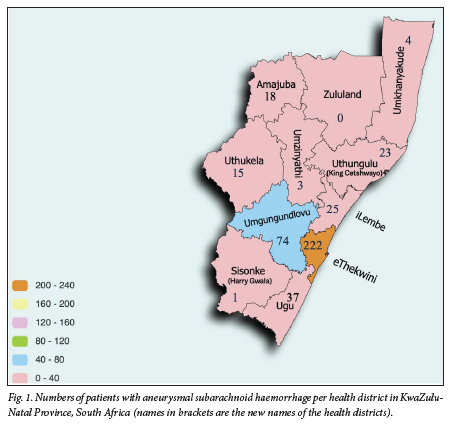
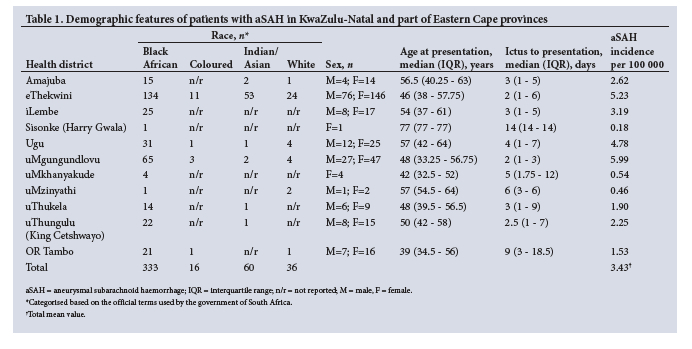
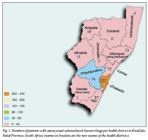
A total of 445 patients with aSAH were assessed over a 10-year period. The sample was distributed across 10 health districts in KZN (Fig. 1) and one district in the Eastern Cape. The racial distribution was black African «=333, coloured «=16, Indian/Asian «=60 and white «=36. Sex distribution and median age at presentation for each health district are presented in Table 1.
The median number of days from ictus to presentation varied across districts: Amajuba (n=3), eThekwini (2), iLembe (3), Sisonke (Harry Gwala) (14), Ugu (4), uMgungundlovu (2), uMkhanyakude (2), uMzinyathi (6), uThukela (3), uThungulu (King Cetshwayo) (2.50) and OR Tambo (9). Across the KZN and Eastern Cape health districts, the mean minimum detected incidence of aSAH was 3.43 per 100 000 population, with individual districts demonstrating incidence rates ranging from 0.18 to 5.99 per 100 000 (Table 1).
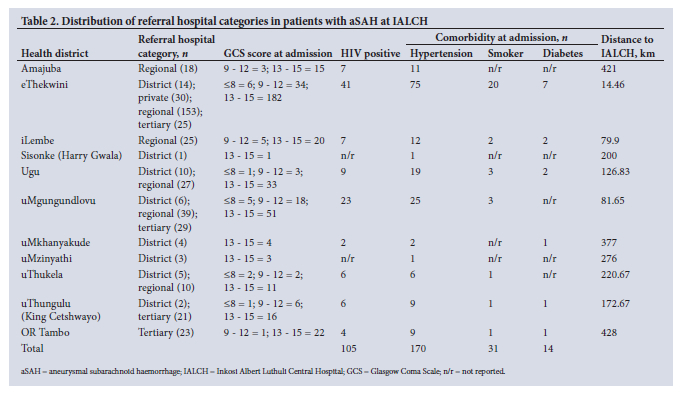
Low GCS scores <8 were observed in eThekwini (6), Ugu (1), uMgungundlovu (5), uThukela (2) and uThungulu (King Cetshwayo) (1). The highest number (41) of HIV-positive statuses was seen in eThekwini, while the lowest (2) was seen in uMkhanyakude. The most frequent comorbidity at admission was hypertension (n=170, p=0.16) and the least common was diabetes (n=14). The farthest health district distance from IALCH was OR Tambo, and the closest was eThekwini. The referral hospitals were categorised into district, private, regional and tertiary. GCS status at admission, positive HIV status, comorbidities at admission (hypertension, smoking and diabetes) and distance from referral hospitals to IALCH are shown in Table 2.
Complications and clinical outcomes
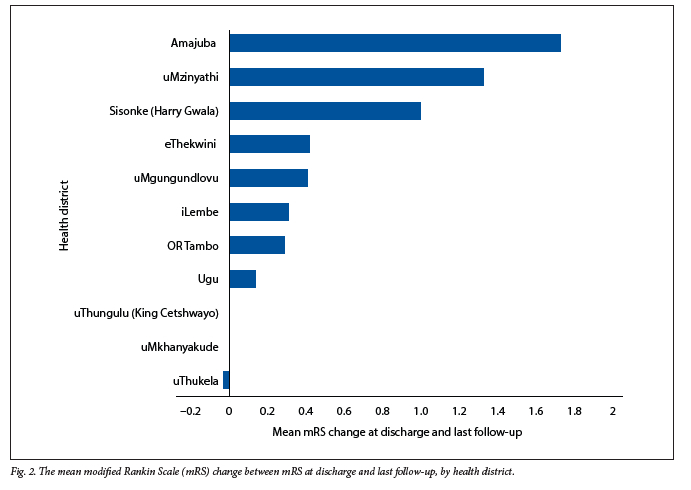
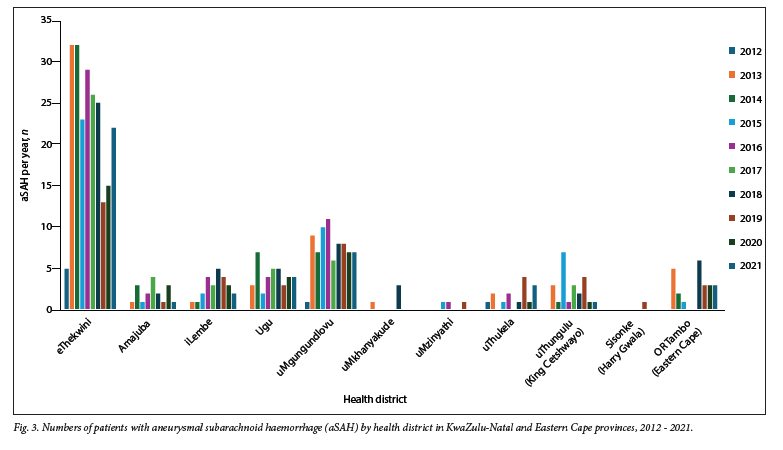
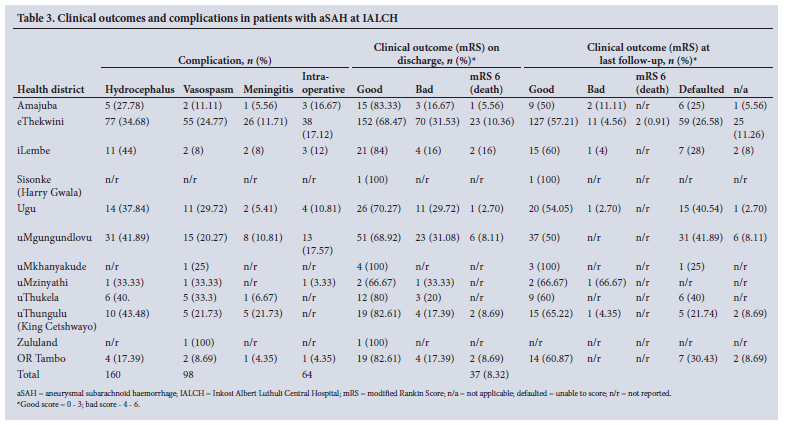
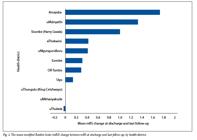
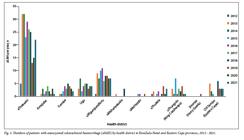
Complications among patients with aSAH included hydrocephalus, meningitis, vasospasm and intra-operative complications. However, their distribution across health districts was not statistically significant (p=0.47). At discharge, eThekwini reported the highest proportion of good outcomes (34.16%), while Sisonke (Harry Gwala) had the lowest (0.22%) based on mRS scores of 0 - 3. Overall mortality was 8.32% (Table 3). Between discharge and last follow-up, a positive improvement in mRS scores was observed only in the uThukela district. No change was noted in the uMkhanyakude and uThungulu (King Cetshwayo) districts, and no improvement was seen in the remaining districts (p=0.08) (Fig. 2). New cases of aSAH were recorded annually in eThekwini and uMgungundlovu from 2012 to 2021. The highest number of cases (n=57) occurred in 2013 and 2018, whereas the lowest (n=7) was observed in in 2012 (Fig. 3).
Time-based outcome
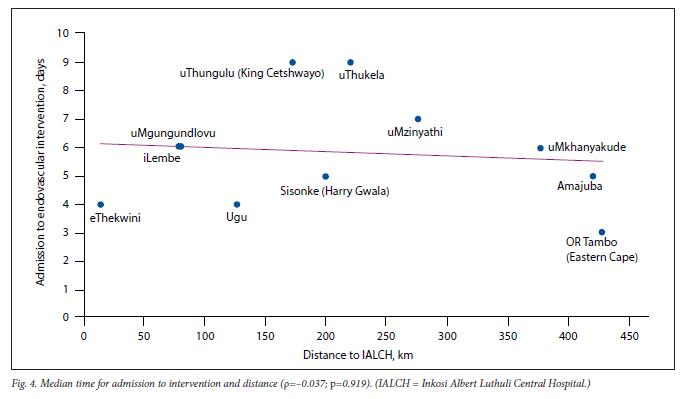
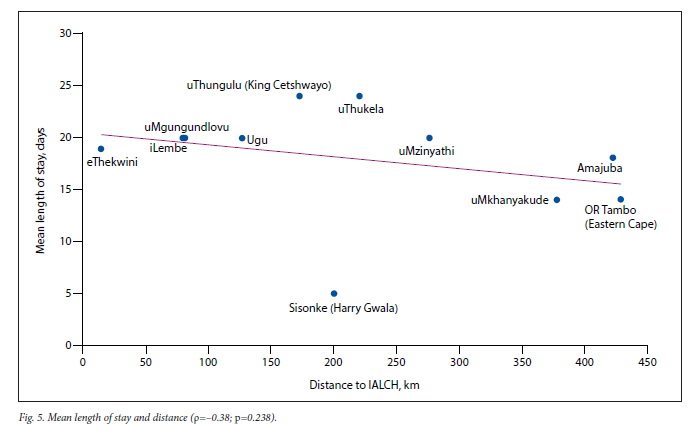
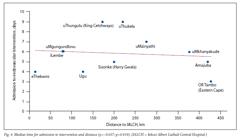
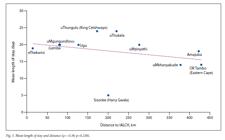
There was no significant correlation (p=-0.037; p=0.903) between a district's mean distance from the neurosurgical centre and the median time it took for patients to receive EVT (Fig. 4). There was no significant correlation (p=-0.38; p=0.238) between median length of stay and distance (Fig. 5).
Seasonal presentation
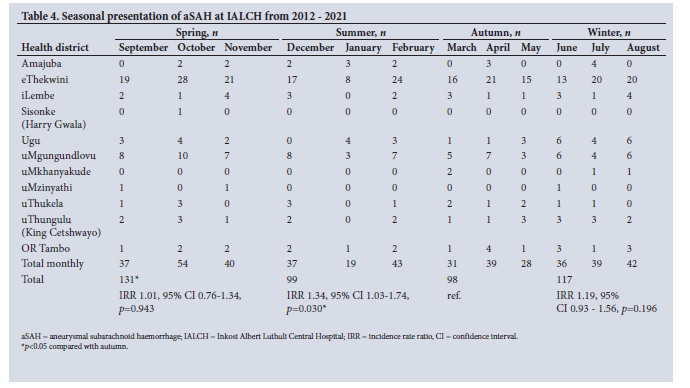
Regarding seasonal variation, the highest proportion of aSAH presentations occurred in spring (29.44%), followed by winter (26.29%) and summer (22.25%), with the lowest proportion recorded in autumn (22.02%). Monthly incidence peaked in October (n=54) and was lowest in January (n=19) (Table 4).
The seasonal influence on the minimum detected incidence of monthly aSAH across KZN was evaluated using Poisson regression, with autumn designated as the reference category. Spring showed a significantly higher incidence of aSAH, with a presentation rate 1.34 times that of autumn (incidence rate ratio (IRR) 1.34; 95% confidence interval (CI) 1.03 - 1.7, p=0.030). In contrast, the minimum detected incidence rates in summer (IRR 1.01, 95% CI 0.76 - 1.34, p=0.943) and winter (IRR 1.19, 95% CI 0.93 - 1.56, p 0.196) did not differ significantly from autumn (Table 4).
Discussion
There are notable variations in the presentation of aSAH across health districts in KZN Province. Overall, however, the presentation includes a male-to-female ratio of 1:2, an ethnic distribution of 75% black African, 13% Indian/Asian, 8% white and 4% coloured, a median age range of 34 - 57 years, time from ictus to presentation ranging from 2 to 14 days, and district-level mortality rates ranging from 2.70 to 10.36%.
The overall minimum detected incidence of aSAH in KZN was 3.43 per 100 000 population, with the highest district-level incidence observed in uMgungundlovu health district (5.9 per 100 000) (Table 1). Incidence rates of aSAH vary considerably across geographical regions. Reported population-based estimates include 4.1 per 100 000 in Nigeria,[9] 4.2 in South and Central America,[10] 4 - 9 in Europe[11] and 8 - 10 in the USA.[12] Higher incidences have been documented in Finland (8 - 30) and Japan (21.6).[13,14] These regional differences are influenced by multiple factors, including genetic and familial predisposition, female sex, increasing age and hypertension.[15] To date, no incidence data for aSAH have been documented for other provinces in SA.
The peak annual incidence of aSAH across health districts occurred in the following years: 2013 (eThekwini), 2014 (eThekwini, Ugu), 2015 (uThungulu (King Cetshwayo)), 2016 (uMgungundlovu), 2017 (Amajuba) and 2018 (iLembe and OR Tambo). Several studies have suggested that seasonal variation may influence the incidence of aSAH.[16,17] Hospital referral-based literature from Morocco, Japan, USA, Cyprus, Germany and France have reported peak incidences in spring and troughs in summer.[16-21] In our cohort, aSAH incidence similarly peaked during the spring (29.44%) and was lowest in autumn (22.02%).
These variations are thought to be related to temperature changes, with transitions from cold to warm and back to cold - from autumn to spring - being associated with an increase in aSAH.[19,21] During cold temperatures, peripheral vasoconstriction can lead to elevated blood and pulse pressures, which in turn increase intracranial aneurysmal wall tension and the risk of transmural rupture.[17,20,22] Other meteorological factors including humidity, insolation and atmospheric pressure may also influence incidence.[17,21,22] However, McDonald et al.[16] reported no significant monthly or temperature-related effect on the occurrence of aSAH in the USA. It must be noted that potential confounders, such as year-to-year variation, referral patterns and reporting artefacts, can influence seasonal consistency across years.[16] However, assessment of year-to-year consistency was not performed in our study owing to small annual counts per season or district. Still, it would strengthen causal interpretation if replicated in larger or population-based data.
Regarding the association between distance and median time to receive EVT, no correlation was observed between the travel distances of patients from various health districts and their access to EVT at neurological centres (Fig. 3). Similarly, there was no significant correlation between median length of stay and distance (p=0.238). Notably, despite the considerable geographical distances from neurological centres, patients' access to interventional services does not appear to be substantially hindered by infrastructural limitations. However, there remains potential for improvement in transport services within KZN and other provinces of SA.[23,24] In 2020, SA had ~180 neurosurgeons distributed across seven academic-affiliated training centres.[25,26] Currently, only six consultant neurosurgeons are affiliated with public hospitals in KZN, a province with a population of ~12 million people. Socioeconomic disparities in access to neurosurgical services probably contribute to the observed regional variation in the incidence of aSAH. One crucial factor that may account for these differences is the burden of hypertension,[3] which remains high in SA, with KZN recognised as one of the epicentres of the disease.[27] Inequities in both disease burden and access to specialist care may partially explain the relatively low minimum detected incidence of aSAH reported in this study and across the African continent.[2]
This study has several limitations. Firstly, the low number of aSAH cases from rural referrals may reflect underdiagnosis or limited access to diagnostic and neurosurgical services. Secondly, the absence of a comprehensive, up-to-date record of neurosurgeons working in the public sector across SA restricts a precise evaluation of neurosurgical staffing levels.
We also note that the estimates do not adjust for intercensal population changes and should therefore be interpreted cautiously, and that this current scientific setting reflects health-system capture of aSAH cases presenting to the quaternary centre rather than the true community incidence.
As this was a single-centre, quaternary hospital-based study, the findings reflect only patients who were successfully referred for specialised neurosurgical assessment and intervention. Patients who were not diagnosed, were managed at peripheral facilities, died prior to referral, or were unable to access advanced imaging or transfer services may not have been captured. This introduces potential referral and underascertainment bias, likely resulting in an underestimation of the true burden of aSAH in the province. The results should therefore be interpreted as representing patterns of access to neurosurgical care rather than population-level disease incidence.
The investigation did not find a way to control for confounders such as the fact that regional differences exist in vascular risk factors, diagnostic resources, or pre-hospital mortality; these data were not collected systematically.
Future research should be expanded to include additional provinces to allow for a more robust national estimate of aSAH incidence. Furthermore, establishing an improved, open-access registry of neurosurgical practitioners and trainees in the public sector would enhance surveillance, workforce planning and research capacity nationwide.
Conclusion
The minimum detected incidence of aSAH in KZN province was 3.43 per 100 000 population. This relatively low detected incidence is probably influenced by the shortage of qualified neurosurgeons (resulting in low patient-to-neurosurgeon ratios), under-reporting of aSAH cases and limited access to appropriate care. The present study highlights important disparities in access to neurosurgical care rather than providing a representative estimate of population-level disease incidence.
Data availability. Data are available on request to the corresponding author.
Declaration. None.
Acknowledgements. The authors acknowledge the expertise of Profs Olusegun Aroba and Shaun Ramroop in the statistical analysis and validation of this manuscript.
Author contributions. PMA: study conceptualisation, study design, data curation and analysis, manuscript writing and editing. RH: study conceptualisation, study design, manuscript editing, supervision. LL: study conceptualisation, study design, manuscript writing and editing, supervision.
Funding. This study was supported in part by the National Research Foundation (NRF), South Africa, with grant no. SRUG2204133296. The opinions, findings, conclusions, or recommendations are those of the authors; the NRF accepts no liability whatsoever in this regard.
Conflicts of interest. None.
References
-
1. Gams Massi D, Pazeu MD, Motah M, et al Spontaneous subarachnoid hemorrhage in a referral health Centre in Central Africa. eNeurologicalSci 2024;36:100518. https://dolorg/10.1016/j.ensci.2024.100518
» https://dolorg/10.1016/j.ensci.2024.100518 -
2. Harrichandparsad R, Bhigjee AI, Royston D, Olivier S. Endovascular management and long-term outcomes of aneurysmal subarachnoid hemorrhage among a large cohort of patients managed at a specialist hospital in KwaZulu-Natal, South Africa from 2012 to 2021. World Neurosurg 2025;202:124386. https://doi.org/10.1016/j.wneu.2025.124386
» https://doi.org/10.1016/j.wneu.2025.124386 -
3. Okyere J, Ayebeng C, Owusu BA, Dickson KS. Prevalence and factors associated with hypertension among older people living with HIV in South Africa. BMC Public Health 2022;22(1):1684. https://doi.org/10.1186/s12889-022-14091-y
» https://doi.org/10.1186/s12889-022-14091-y -
4. Tétinou F, Kanmounye US, Sadler S, et al. Cerebral aneurysms in Africa: A scoping review. Interdiscip Neurosurg 2021;26:101291. https://doi.org/10.1016/j.inat.2021.101291
» https://doi.org/10.1016/j.inat.2021.101291 -
5. Dokponou YCH, Kotecha J, Bandyopadhyay S, et al. Continental survey of access to diagnostic tools and endovascular management of aneurysmal subarachnoid hemorrhage in Africa. Front Surg 2021;8:690714. https://doi.org/10.3389/fsurg.2021.690714
» https://doi.org/10.3389/fsurg.2021.690714 -
6. Clarke H, Nefale T, Mngomezulu V. Endovascular management of intracranial aneurysms at Chris Hani Baragwanath Academic Hospital. SA J Radiol 2023;27(1):2634. https://doi.org/10.4102/sajr.v27i1.2634
» https://doi.org/10.4102/sajr.v27i1.2634 -
7. Faropoulos K, Kyriakou G, Kafhtsa A, Papavasilopoulou A, Grzeczinski A, Artemiadis A. The bleeding weather: Association of environmental changes with intracranial aneurysms' rupture. Acta Neurochir 2025;167(1):86. https://doi.org/10.1007/s00701-025-06494-8
» https://doi.org/10.1007/s00701-025-06494-8 -
8. Statistics South Africa. Census 2022: KwaZulu-Natal (KZN) and Eastern Cape (EC). Health Districts. Pretoria: Stats SA, 2022. https://census.statssa.gov.za/#/province/5/2 (accessed 10 November 2025).
» https://census.statssa.gov.za/#/province/5/2 -
9. Okon M, Adebobola NI, Julius S, et al Stroke incidence and case fatality rate in an urban population. J Stroke Cerebrovasc Dis 2015;24(4):771-777. https://doi.org/10.1016/j.jstrokecerebrovasdis.2014.11.004
» https://doi.org/10.1016/j.jstrokecerebrovasdis.2014.11.004 -
10. De Rooij NK, Linn FH, van der Plas JA, Algra A, Rinkel GJ. Incidence of subarachnoid haemorrhage: A systematic review with emphasis on region, age, gender and time trends. J Neurol Neurosurg Psychiatry 2007;78(12):1365-1372. https://doi.org/10.1136/jnnp.2007.117655
» https://doi.org/10.1136/jnnp.2007.117655 -
11. Heuschmann PU, Di Carlo A, et al Incidence of stroke in Europe at the beginning of the 21st century. Stroke 2009;40(5):1557-1563. https://doi.org/10.1161/STROKEAHA.108.535088
» https://doi.org/10.1161/STROKEAHA.108.535088 -
12. Bekelis K, Missios S, MacKenzie TA, et al Predicting inpatient complications from cerebral aneurysm clipping: The Nationwide Inpatient Sample 2005-2009. J Neurosurg 2014;120(3):591-598. https://doi.org/10.3171/2013.8.JNS13228
» https://doi.org/10.3171/2013.8.JNS13228 -
13. Hamada J, Morioka M, Yano S, Kai Y, Ushio Y. Incidence and early prognosis of aneurysmal subarachnoid hemorrhage in Kumamoto Prefecture, Japan. Neurosurg 2004;54(1):31-38. https://doi.org/10.1227/01.neu.0000097196.55204.0b
» https://doi.org/10.1227/01.neu.0000097196.55204.0b -
14. Rautalin I, Krishnamurthi RV, Anderson CS, et al. Demographic disparities in the incidence and case fatality of subarachnoid haemorrhage: An 18-year nationwide study from New Zealand. Lancet Reg Health West Pac 2024;52:101199. https://doi.org/10.1016/j.lanwpc.2024.101199
» https://doi.org/10.1016/j.lanwpc.2024.101199 -
15. Ma J, Zheng Y, Li P, et al Risk factors for the rupture of intracranial aneurysms: A systematic review and meta-analysis. Front Neurol 2023;14:1268438. https://doi.org/10.3389/fneur.2023.1268438
» https://doi.org/10.3389/fneur.2023.1268438 -
16. McDonald RJ, McDonald JS, Bida JP, Kallmes DF, Cloft HJ. Subarachnoid hemorrhage incidence in the United States does not vary with season or temperature. AJNR Am J Neuroradiol 2012;33(9):1663-1668. https://doi.org/10.3174/ajnr.A3059
» https://doi.org/10.3174/ajnr.A3059 -
17. Sayore CM, Ouambi LI, Bechri H, et al Influence of seasonal factors on the incidence of ruptured intracranial aneurysms: Moroccan fifteen years' experience. Interdiscip Neurosurg 2021;26:101344. https://doi.org/10.1016/j.inat.2021.101344
» https://doi.org/10.1016/j.inat.2021.101344 -
18. Lejeune JP, Vinchon M, Amouyel P, Escartin T, Escartin D, Christiaens JL. Association of occurrence of aneurysmal bleeding with meteorologic variations in the north of France. Stroke 1994;25(2):338-341. https://doi.org/10.1161/01.str.25.2.338
» https://doi.org/10.1161/01.str.25.2.338 -
19. Inagawa T. Seasonal variation in the incidence of aneurysmal subarachnoid hemorrhage in hospital- and community-based studies. J Neurosurg 2002;96(3):497-509. https://doi.org/10.3171/jns.2002.96.3.0497
» https://doi.org/10.3171/jns.2002.96.3.0497 -
20. Beseoglu K, Hänggi D, Stummer W, Steiger HJ. Dependence of subarachnoid hemorrhage on climate conditions: A systematic meteorological analysis from the Düsseldorf metropolitan area. Neurosurg 2008;62(5):1033-1039. https://doi.org/10.1227/01.neu.0000325864.91584.c7
» https://doi.org/10.1227/01.neu.0000325864.91584.c7 -
21. Gill RS, Hambridge HL, Schneider EB, Hanff T, Tamargo RJ, Nyquist P. Falling temperature and colder weather are associated with an increased risk of aneurysmal subarachnoid hemorrhage. World Neurosurg 2013;79(1):136-142. https://doi.org/10.1016/j.wneu.2012.06.020
» https://doi.org/10.1016/j.wneu.2012.06.020 -
22. Han MH, Kim J, Choi KS, et al Monthly variations in aneurysmal subarachnoid hemorrhage incidence and mortality: Correlation with weather and pollution. PLoS ONE 2017;12(10):e0186973. https://doi.org/10.1371/journal.pone.0186973
» https://doi.org/10.1371/journal.pone.0186973 -
23. Ngcobo N, Akinradewo O, Mokoena P. Evaluating the measures to promote sustainable transport infrastructure: A case of city of Johannesburg, South Africa. J Eng 2024;2024(1):6372226. https://doi.org/10.1155/je/6372226
» https://doi.org/10.1155/je/6372226 -
24. Habiyaremye A, Thobela MT, Saba CS. Transport infrastructure investments and economic transformation in South Africa: The case of integrated public transport network in the Gauteng Province. Transp Res Interdiscip Persp 2025;34:101637. https://doi.org/10.1016/j.trip.2025.101637
» https://doi.org/10.1016/j.trip.2025.101637 -
25. Dada OE, Karekezi C, Mbangtang CB, et al State of neurosurgical education in Africa: A narrative review. World Neurosurg 2021;151:172-181. https://doi.org/10.1016/j.wneu.2021.05.086
» https://doi.org/10.1016/j.wneu.2021.05.086 -
26. Ukachukwu AK, Still MEH, Seas A, et al Fulfilling the specialist neurosurgical workforce needs in Africa: A systematic review and projection toward 2030. J Neurosurg 2022;138(4):1102-1113. https://doi.org/10.3171/2022.2.JNS211984
» https://doi.org/10.3171/2022.2.JNS211984 -
27. Madela S, Harriman NW, Sewpaul R, et al. Individual and area-level socioeconomic correlates of hypertension prevalence, awareness, treatment, and control in uMgungundlovu, KwaZulu-Natal, South Africa. BMC Public Health 2023;23(1):417. https://doi.org/10.1186/s12889-023-15247-0
» https://doi.org/10.1186/s12889-023-15247-0

Accepted 12 March 2026