Skin scar characteristics in prediction of severe intraperitoneal adhesions in women undergoing repeat caesarean section
BACKGROUND. Caesarean section (CS) is the most performed abdominal procedure and is known to be associated with the development of intraperitoneal adhesions. These adhesions may lead to difficult repeat surgery and complications such as haemorrhage, and bladder and bowel injury. Determining which women are at risk for adhesions could help with triaging those who may be at risk for a complicated repeat surgery. Scar characteristics have been proposed as preoperative prediction tools for adhesions. OBJECTIVES. To assess whether abdominal scar characteristics correctly predict intraperitoneal adhesions in women undergoing repeat CS. METHODS. In this prospective blinded observational study at Nelson Mandela Academic Hospital, in Eastern Cape Province of South Africa, 419 women were enrolled. We assessed whether we could use skin scar characteristics to predict the presence of intraperitoneal adhesions at repeat CS. Women who met the inclusion criteria were approached in the third trimester, and the previous CS scar was examined. The characteristic features of the scar were described and documented, while the findings were blinded to the surgeon who was carrying out the CS. The surgeon was instructed to describe the types of intraperitoneal adhesions and their characteristics in theatre, documenting them on the questionnaire. RESULTS. Adhesions were present in 53.5% of the 419 women enrolled. Women with dense adhesions were older, and had more previous CSs, longer incision-to-delivery time and more blood loss. The type of incision did not predict adhesions. Depressed scars were more likely to be associated with dense adhesions (p<0.0001). Using a depressed scar as a predictor had a sensitivity of 21.4% (95% confidence interval (CI) 17.5 - 25.36), and a specificity of 96.4% (CI 94.63 - 98.19), meaning it missed most participants with adhesions but had an excellent ability to identify those without adhesions. It had a positive predictive value of 87.3% (CI 84.08 - 90.46) and negative predictive value of 50.2% (CI 46.68 - 58.24). CONCLUSION. Although abdominal scar characteristics have low sensitivity in predicting dense intraperitoneal adhesions, they have excellent specificity. The abdominal scar can therefore be used by surgeons to identify patients who are unlikely to have dense intraperitoneal adhesions. This would be particularly useful in district hospitals for triaging patients with previous CS who can be operated on safely, while referring others to level 2 or 3 hospitals.
caesarean section; adhesions; prediction; skin scar characteristics
Skin scar characteristics in prediction of severe intraperitoneal adhesions in women undergoing repeat caesarean section
M MayibenyeI; G A B BugaII; M MdakaIII; M NanjohIV
IMB ChB, FCOG; Department of Obstetrics and Gynaecology, Faculty of Medicine and Health Sciences, Walter Sisulu University, Mthatha, South Africa
IIMMed (Obstetrics and Gynaecology), PhD; Department of Obstetrics and Gynaecology, Faculty of Medicine and Health Sciences, Walter Sisulu University, Mthatha, South Africa
IIIMB ChB, MD; Department of Obstetrics and Gynaecology, Faculty of Medicine and Health Sciences, Walter Sisulu University, Mthatha, South Africa
IVΒ Physiology (Hons), MPH; Department of Public Health, Faculty of Medicine and Health Sciences, Walter Sisulu University, Mthatha, South Africa
BACKGROUND. Caesarean section (CS) is the most performed abdominal procedure and is known to be associated with the development of intraperitoneal adhesions. These adhesions may lead to difficult repeat surgery and complications such as haemorrhage, and bladder and bowel injury. Determining which women are at risk for adhesions could help with triaging those who may be at risk for a complicated repeat surgery. Scar characteristics have been proposed as preoperative prediction tools for adhesions.
OBJECTIVES. To assess whether abdominal scar characteristics correctly predict intraperitoneal adhesions in women undergoing repeat CS.
METHODS. In this prospective blinded observational study at Nelson Mandela Academic Hospital, in Eastern Cape Province of South Africa, 419 women were enrolled. We assessed whether we could use skin scar characteristics to predict the presence of intraperitoneal adhesions at repeat CS. Women who met the inclusion criteria were approached in the third trimester, and the previous CS scar was examined. The characteristic features of the scar were described and documented, while the findings were blinded to the surgeon who was carrying out the CS. The surgeon was instructed to describe the types of intraperitoneal adhesions and their characteristics in theatre, documenting them on the questionnaire.
RESULTS. Adhesions were present in 53.5% of the 419 women enrolled. Women with dense adhesions were older, and had more previous CSs, longer incision-to-delivery time and more blood loss. The type of incision did not predict adhesions. Depressed scars were more likely to be associated with dense adhesions (p<0.0001). Using a depressed scar as a predictor had a sensitivity of 21.4% (95% confidence interval (CI) 17.5 - 25.36), and a specificity of 96.4% (CI 94.63 - 98.19), meaning it missed most participants with adhesions but had an excellent ability to identify those without adhesions. It had a positive predictive value of 87.3% (CI 84.08 - 90.46) and negative predictive value of 50.2% (CI 46.68 - 58.24).
CONCLUSION. Although abdominal scar characteristics have low sensitivity in predicting dense intraperitoneal adhesions, they have excellent specificity. The abdominal scar can therefore be used by surgeons to identify patients who are unlikely to have dense intraperitoneal adhesions. This would be particularly useful in district hospitals for triaging patients with previous CS who can be operated on safely, while referring others to level 2 or 3 hospitals.
Keywords: caesarean section, adhesions, prediction, skin scar characteristics
Caesarean section (CS) is the most performed abdominal surgery. However, there are associated complications, which include intrabdominal adhesion formation. The incidence of intraperitoneal adhesion formation after CS is estimated to be between 24 and 83%.[1-3] The presence of adhesions increases the risk of delayed delivery, bleeding, and bowel and bladder injury.[4]
Identifying which women may be at risk for dense intraperitoneal adhesions may be important. If one could identify which women were at risk, it would allow for triage and planning of a repeat CS. This would be particularly valuable in low- to middle-income countries, where surgeries are often performed in rural areas with inadequate support.
Several non-invasive methods have been investigated for the prediction of intraperitoneal adhesions following surgery. These include abdominal scar characteristics, including the type of skin incision, the number of incisions and features of the scar.[5-10]
Recently, Mayibenye et al.[11] published a study on preoperative prediction of intraperitoneal adhesions in women undergoing repeat CS using the same participants. They used a sonographic sliding sign and found that it had high sensitivity and specificity. Scar characteristics can be used alone or as a combination with other non-invasive predictive methods such as the sliding sign. In the present study, we aimed to prospectively evaluate whether the presence of abdominal scar characteristics could predict the presence of dense intraperitoneal adhesions at repeat CS.
Methods
Study cohort and design
This prospective observational study was conducted at Nelson Mandela Academic Hospital (NMAH), a referral hospital serving >3 million people in the north-eastern part of Eastern Cape Province, South Africa (SA). Consecutive pregnant women scheduled for a repeat CS who were >18 years of age and signed informed consent were included. Women who needed an urgent delivery where there was no time for preoperative assessment were not included. The preoperative assessment of skin scar characteristics was performed by MM, who did not perform any of the CSs.
The scar type was classified as Pfannenstiel or midline incision, or both. Scar characteristics were assessed using the modified SCAR scale,[12] which included scar spread, erythema, dyspigmentation, hyper- or hypopigmentation, suture marks and hypertrophy and/or atrophy and overall impression. Scar spread was classified as 0 if there was no, to near-invisible spread, 1 if there was a pencil thin line, 2 if there was mild spread noticeable on close inspection, 3 if there was moderate spread with obvious scarring and 4 if there was severe spread. The scar was assessed for hyper- or hypopigmentation (0: absent; 1: present), track marks where sutures passed (0: absent; 1: present) and hypertrophy or keloid formation (0: none; 1: palpable but barely visible; 2: clearly visible hypertrophy; 3: marked hypertrophy or keloid formation).
All surgeons were trained to describe adhesions, which were classified using a method described by Tulandi and Lyell.[13] Adhesions were described by severity and site. We used a points system, and scores from multiple sites: between uterus and bladder, between uterus and abdominal fascia, between uterus and omentum, and between omentum and abdominal fascia. Adhesions from other pelvic structures that interfere with delivery were additive. Adhesions were described as either filmy or dense. The area of incision covered by adhesions was divided into <3 cm, 3 - 6 cm and >6 cm.
Women with filmy adhesions and no adhesions were compared with women with dense adhesions.
Surgeons were blinded to the preoperative assessment. Time from skin incision to incision of the uterus, time from skin incision to delivery of the baby, and overall surgical time were collected. Perinatal outcomes included 5-minute Apgar scores, birthweight and birth injuries. Data on adhesiolysis, bowel and/or bladder injuries, intraoperative bleeding and/or the need for hysterectomy were collected. Charts were reviewed for short-term complications such as haemorrhage, wound haematoma, wound infection and deep-vein thrombosis. Data were collected on data sheets and then transferred into Excel, cleaned, checked and then exported into Statistical Package for the Social Sciences (SPSS) software for data analysis.
Statistical methods
Based on previous studies by Nuamah et al.[14] and Moro et al.,[15] the prevalence of intraperitoneal adhesions post CS was ~50% following >1 previous CSs. Using an alpha error of 0.05 at 80% power with 95% confidence levels (CIs), the estimated sample size was 384.[16] We increased the sample size by 10% to account for dropouts and loss to follow-up. The final sample size was 419.
Categorical variables were expressed as frequencies and proportions. Univariate analyses were performed for categorical variables using χ2t-test or the Mann-Whitney U-test as appropriate. The sensitivity, specificity, positive (PPV) and negative (NPV) predictive values, and positive and negative likelihood ratios (LR+ and LR-) were calculated. Odds ratios (ORs) were calculated to assess the odds of finding adhesions at repeat CS in patients with normal and abnormal scar characteristics. For multivariable analysis, forward conditional logistic regression was used, with intraperitoneal adhesions as the dependent variable, and age, number of CSs and abdominal scar characteristics as independent variables. Age and the number of CSs were included as continuous variables, while all other variables were categorical. The level of significance was set at p<0.05 for all comparisons. For multivariable analysis, forward conditional logistic regression was used to identify the predictive performance of bivariate significant variables in the prediction of intraperitoneal adhesions.
Ethical approval
Prospective ethical clearance (ref. no. 061/2021) was obtained from the Ethics and Biosafety Committee of the Faculty of Health Sciences, Walter Sisulu University. Permission to conduct the research was also granted by the Eastern Cape Department of Health.
Results
Population characteristics
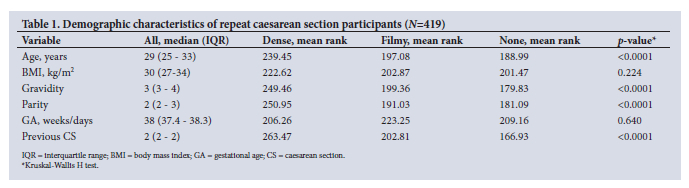
A total of 440 women were approached, and 419 were included: 20 did not consent, and 1 woman was excluded because she was aged <18 years. Baseline characteristics are presented in Table 1. A total of 50% of the women were obese. Women were more likely to have dense intraperitoneal adhesions if they were older and had had >2 previous CSs.
Adhesions were present in 53.5% (n=224) and absent in 46.5% (n=195). Of all participants, 39.38% (n=165) had dense adhesions, and 14.1% (n=59) had filmy adhesions. Of the 224 patients with adhesions, 98.2% (n=220) had adhesions between the anterior abdominal wall and the uterus, while 74.1% (n=166) involved the bladder and anterior abdominal wall. Omental-uterine adhesions were found in 17.9% (n=40). Only 2 (0.9%) had adhesions between the bowel and the uterus. Multi-site adhesions were observed in 171 (76.3%) women, with 140 of these women (82.0%) having adhesions at two sites, 29 (17.0%) at three sites, and two (1.2%) at all four intraperitoneal sites, which refer to the uterus, bladder, bowel and omentum, as per Tulandi and Lyell's'131 classification of intra-abdominal adhesions. The incision-to-delivery time was significantly longer in women with dense adhesions, and estimated blood loss during surgery was greater. The incision-to-delivery times were 31.8 minutes, 19.5 minutes and 12.2 minutes for dense adhesions, filmy adhesions, or no intraperitoneal adhesions, respectively. Estimated blood loss during surgery was 297 mL, 172 mL and 147 mL for dense adhesions, filmy adhesions, or no adhesions, respectively.
There were no differences in 5-minute APGAR scores between the groups.
In terms of the experience level of the surgeons, in 392 repeat CSs the surgeon was an experienced registrar, and in 27 the surgeon was an experienced medical officer (those waiting to join the registrar programme).
Scar characteristics
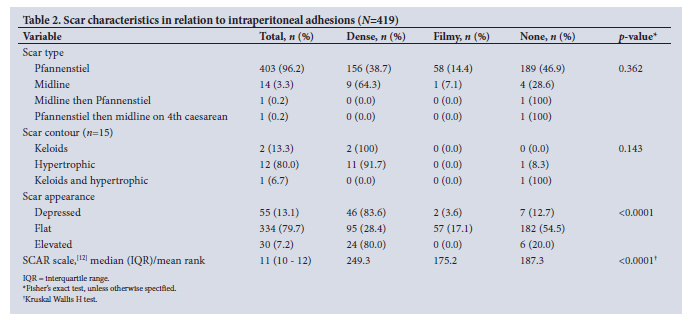
Most women (96.2%; 403/419) had a previous Pfannenstiel abdominal scar. Of these, 38.7% (n=156) had dense intraperitoneal adhesions and 14.4% (n=58) had filmy adhesions. Fourteen women had a midline sub-umbilical abdominal scar; of these, 69.2% (n=9/13) had dense intraperitoneal adhesions and 7.7% (n=1) had filmy adhesions. Four participants had both a Pfannenstiel and a midline sub-umbilical abdominal scar, and no intraperitoneal adhesions. There were no statistically significant differences between the type of scar and presence of adhesions (p=0.362).
Two women had keloids, 12 had hypertrophy and one had both. There were no statistically significant differences between the presence of adhesions and/or keloid and scar contour (p=0.143). Most women (79.7%, 334/419) had a flat scar, 13.1% (55/419) had a depressed scar and 7.2% (30/419) had an elevated scar. Participants with depressed scar were more likely to have dense intraperitoneal adhesions (p<0.0001). Women with a higher SCAR scale value were more likely to have dense intraperitoneal adhesions, compared with those with a lower SCAR scale value (Table 2).
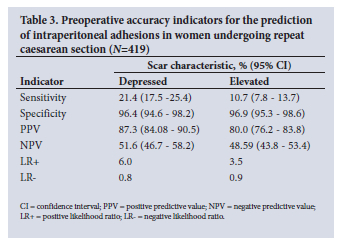
A depressed scar had a predictive sensitivity of 21.4% (CI 17.5 - 25.36), and a specificity of 96.4% (CI 94.63 - 98.19), meaning it did not identify most participants with adhesions but had an excellent ability to identify those without adhesions. It had a PPV of 87.3% (CI 84.08 - 90.46) and NPV of 50.2% (CI 46.68 - 58.24). The PPV showed that 87.3% of women suspected to have adhesions based on depressed scar had intraperitoneal adhesions, i.e. the probability of having adhesions was 87.3% when there was a depressed scar. However, based on the NPV, participants assessed as having no adhesions (no depressed scar) had a lower probability of truly not having adhesions. The LR+ was 5.97 and LR- 0.82 (Table 3). An LR+ >5 shows that a depressed scar is moderately (value between 5 and 10) useful in determining the probability of having adhesions. An LR- closer to 1 shows that it should not be used independently to determine the absence of adhesions.
The presence of an elevated scar had a sensitivity of 10.7% (CI 7.75 - 13.68) and specificity of 96.9% for intra-abdominal adhesions. This means it only detected 10.7% of participants with intraperitoneal adhesions, and 89.3% with adhesions were not detected. Nonetheless, it correctly identified almost all participants without adhesions; only 3.1% without adhesions were incorrectly identified as having adhesions. The PPV was 80% (CI 76.17 - 83.83) and the NPV was 48.6% (CI 43.80 - 53.37). Therefore, among those women who had elevated scars, the probability of having adhesions was 80%, while for those without elevated scars, the probability of not having adhesions was 48.6% (low probability). The presence of elevated scar had an LR+ of 3.48 and an LR- of 0.92. An LR+ >3 shows that it could sometimes be useful (value between 2 and 4.9) in determining the probability of having adhesions. An LR- closer to 1 shows that this sign will only produce a very small shift in post-test probability and therefore will not help to determine the absence of intraperitoneal adhesions.
Discussion
The proportion of women with intra-abdominal adhesions found in this study is on the higher side, although still within the range found following CS by others.[16,17] The results of this study cannot be applied to the general population alone, but they can be used in combination with other predictive methods such as the sonographic sliding sign, especially in black women.[11] SA is a diverse nation comprising different racial and ethnic groups, and scar healing is known to vary across groups. For instance, keloid formation is uncommon among white patients, while it is common in black patients. As almost all participants in the present study were black Africans, the application of our results to other races should be done with caution. More studies are needed to generalise the results.
Of the 419 women in this study who had repeat CS at NMAH, 53.5% had intraperitoneal adhesions, comprising 14.1% who had filmy adhesions and 39.4% who had dense adhesions. Studies show that the incidence of adhesions in 335 women who were scheduled for CS at Korle-Bu Teaching Hospital in Ghana was 38%,[14] which is slightly lower than that found in the present study. However, the incidence of intraperitoneal adhesions following CS in our study is consistent with the incidence of 24 - 46% reported in the literature, which is lower than the 55 - 100% reported following abdominal or gynaecological operations.[18] Several reasons have been advanced to explain why the incidence of intraperitoneal adhesions is higher after abdominal and gynaecological operations than following a CS. One reason is that during CSs, only the anterior surface of the uterus and the utero-vesical pouch are involved, whereas in abdominal and gynaecological operations, the pouch of Douglas and the back of the uterus are often involved as well, thus leading to more intraperitoneal adhesions.[17] Indeed, in the present study, most adhesions involved the uterus and the anterior abdominal wall, as well as the bladder, with only 17.9% omental adhesions, and with only 2 patients having small bowel adhesions. Another reason advanced to explain the lower incidence of intraperitoneal adhesions following CS compared with other abdominal operations may be the fact that there is less oxidative stress and less risk of hypoxic conditions during CS due to the increased cardiac output, increased red cell mass and increased uterine blood flow during pregnancy, compared with the non-pregnant state. Tissue hypoxia, inflammation and oxidative stress are fundamental in the pathogenesis of postoperative adhesions.[14,15]
The median (IQR) age of the women who participated in this study was 29 (25 - 33) years. The women who had dense intraperitoneal adhesions were significantly older and had a higher number of previous CSs (>2) than those with filmy or no adhesions (p<0.0001). In Ghana, it was also found that women with intraperitoneal adhesions were significantly older than those without adhesions.[18] This finding is probably due to older women having a higher parity and a greater number of previous CSs.[19,20] It is known that the incidence of adhesions following CS increases with each repeat CS, to reach ~83% with the fourth CS. In the present study, parity was significantly higher among women who had dense intraperitoneal adhesions compared with those with filmy or no adhesions (p<0.0001). In addition, the women who had dense intraperitoneal adhesions also had a greater number of previous CSs than those who had filmy or no adhesions, and this difference was also statistically significant (p<0.0001).
In the present study, 50% of the women had a body mass index (BMI) >30 kg/m2[21] Although women with dense intraperitoneal adhesions had a higher BMI than those with filmy or no adhesions, this difference was not statistically significant (p>0.05).
Çim et al .[22] also investigated whether abdominal scar characteristics can predict the incidence and severity of intra-abdominal adhesions found at repeat caesarean delivery. In their study of 107 women, they found adhesions in 43% of the women (16% filmy adhesions and 27% dense adhesions). As depressed abdominal scar correlated with the incidence and severity of intra-abdominal adhesions in the present study, our findings are comparable with Çim et al.'s[22] results.
Recently, it has also been reported that depressed and hypopigmented scars may be associated with pelvic adhesions.[23] In a prospective study conducted in Quebec, Canada, to evaluate post-surgical adhesions in 429 women of different races with or without keloids, it was found that keloids, which were significantly more common in African Americans and in Asians, were associated with more dense adhesions.[24] These findings are contrary to the findings of the current study, where keloids were not associated with dense adhesions.
A large majority of women in our study (96.2%; n=403) had a Pfannenstiel skin scar. Only 13 (3.3%) women had a midline sub-umbilical scar, and there were no women with other transverse abdominal scars. Of the women with a Pfannenstiel abdominal scar, 38.7% (n=156) had dense intraperitoneal adhesions, 14.4% had filmy adhesions and 46.9% had no adhesions. There were no statistically significant differences between the women based on the type of abdominal scar (p=0.362). In contrast, a retrospective study carried out in a rural hospital in Tanzania found that intraperitoneal adhesions were more frequent in women who had midline sub-umbilical abdominal incisions than those who had transverse abdominal incisions.[18]
Only two of the study participants had keloids of the abdominal scar, 12 had hypertrophy of the scar and one had a combination of keloid and scar hypertrophy. No statistically significant relationship was found between intraperitoneal adhesions and scar contour. In contrast, in a prospective study in 429 women of different races with or without keloids, it was found that women with keloids were more likely to have dense intraperitoneal adhesions than women without keloids.[24] Similarly, Tulandi et al.[24] evaluated 100 women with previous abdominopelvic surgery and found that those who had a palpable scar (hypertrophic or keloid) were more likely to have pelvic adhesions.[24] More recently, Taylan et al.[7] in New York, USA, evaluated 143 pregnant women with a history of previous abdominal surgery, and found that abdominal scar scoring parameters were significantly increased in women with intra-abdominal adhesions, although the total abdominal scar score, adhesion score and symptom score were not significantly correlated.[7]
Although keloids are generally more common among black and Asian women than white women,[24] in our study population, consisting of mostly black women, keloids were surprisingly rare. These varying results from the literature suggest that the contour of the abdominal scar alone is not sufficient for the preoperative prediction of dense intraperitoneal adhesions.
Of the different methods used to classify skin scars, the method chosen for this study was the SCAR scale.[12] Of the women who participated in the study, 79.7% (n=334) had a flat scar, 13.1% (n=55) had a depressed scar and 7.2% (n=30) had an elevated scar. Participants with depressed scar were more likely to have dense intraperitoneal adhesions compared with participants with a flat scar (p<0.0001). Participants with a higher SCAR scale value for the abdominal scar were more likely to have dense intraperitoneal adhesions compared with those with a lower SCAR scale value.
Salim et al.[5] in Dublin, Ireland, carried out a study to investigate whether abdominal scar characteristics could predict the incidence and severity of intra-abdominal adhesions in 107 women, and found adhesions in 43% of the women (16% filmy adhesions and 27% dense adhesions). Only a depressed scar correlated with the incidence and severity of intra-abdominal adhesions.[5] El-Agwany[23] and Çim et al.[22] reported similar findings. The findings of the present study confirm that a depressed scar is predictive of dense intraperitoneal adhesions, but the absence of a depressed scar is not a good predictor of intraperitoneal adhesions.
Study strengths and limitations
Strengths of the study are the large sample size, and the fact that surgeons were blinded to the findings of the preoperative assessment. A limitation is that it was only carried out at a single centre, limiting its generalisability.
Clinical implications
A depressed scar from a previous CS is predictive of a finding of intraoperative dense adhesion.
This can influence the patient counselling consent process where a depressed scar is present, to include explaining the risk of visceral injury. Finding a depressed scar can guide the type of skin incision used, such as a midline incision rather than transverse incision, to avoid bladder injury. This will improve surgical expertise for the index CS.
Research implications
Assessing scar characteristics is an easy method to learn for medical officers and registrars. A study should be done to assess whether it can be used to triage women undergoing repeat CS in district hospitals.
Conclusion
Although abdominal scar characteristics have low sensitivity in predicting dense intraperitoneal adhesions, they have an excellent specificity. The abdominal scar can therefore be used by surgeons to identify patients who are unlikely to have dense intraperitoneal adhesions. This could be particularly useful in district hospitals for triaging patients with previous CS into those who can be operated on safely, v. those who should be referred to level 2 or 3 hospitals.
Data availability. All data used in this study are available from the corresponding author on request.
Declaration. This research was conducted for a mini dissertation submitted in partial fulfilment of the requirements for MM's MMed in obstetrics and gynaecology at Walter Sisulu University.
Acknowledgements. We thank the women and staff at the NMAH, the site where the study took place.
Author contributions. MM - conceptualisation, methodology, analysis, investigation, writing of all drafts. GB - supervision, writing, review and editing. MMd - co-supervision. MN - data analysis and interpretation. All authors have approved this manuscript.
Funding. None.
Conflicts of interest. None.
References
-
1. Awonuga AO, Fletcher NM, Saed GM, Diamond MP. Postoperative adhesion development following caesarean section and open intra-abdominal gynaecological operations: A review. Reprod Sci 2011;18(2):1166-1185. https://doi.org/10.1177/1933719111414206
» https://doi.org/10.1177/1933719111414206 -
2. Shi Z, Ma L, Yang Y, et al. Adhesion formation after previous caesarean section - a meta-analysis and systematic review. BJOG 2011;118(4):410-422. https://doi.org/10.1111/j.1471-0528.2010.02808.x
» https://doi.org/10.1111/j.1471-0528.2010.02808.x -
3. Hesselman S, Hogberg U, Rassjo E-B, et al. Abdominal adhesions in gynaecologic surgery after caesarean section: A longitudinal population-based register study. BJOG 2018;125(5):597-603. https://doi.org/10.1111/1471-0528.14708
» https://doi.org/10.1111/1471-0528.14708 -
4. Poole JH. Adhesions following caesarean delivery: Review of their occurrence, consequences and preventative management using adhesion barriers. Women's Health 2013;9(5):467-477. https://doi.org/10.2217/WHE.13.45
» https://doi.org/10.2217/WHE.13.45 -
5. Salim R, Kadan Y, Nachum Z, et al. Abdominal scar characteristics as a predictor of intra-abdominal adhesions at repeat caesarean delivery. Fertil Steril 2008;90(6):2324-2327. https://doi.org/10.1016/j.fertnstert.2007.10.037
» https://doi.org/10.1016/j.fertnstert.2007.10.037 -
6. Stocker LJ, Glazebrook JE, Cheong YC. Are skin scar characteristics associated with the degree of pelvic adhesions at laparoscopy? Fertil Steril 2008;101(2):501-505. https://doi.org/10.1016/j.fertnstert.2013.10.026
» https://doi.org/10.1016/j.fertnstert.2013.10.026 -
7. Taylan E, Akdemir A, Ergenoglu AM, et al. Can we predict the presence and severity of intraabdominal adhesions before caesarean delivery? Gynecol Obstet Invest 2017;82(6):521-526. https://doi.org/10.1159/000454767
» https://doi.org/10.1159/000454767 -
8. Pergialoitis V, Frountzas M, Siotos C, et al. Cesarean wound scar characteristics for the prediction of pelvic adhesions: A meta-analysis of observational studies. J Matern Fetal Neonatal Med 2017;30(4):486-491. https://doi.org/10.1080/14767058.2016.1176135
» https://doi.org/10.1080/14767058.2016.1176135 -
9. Kahyaoglu I, Kayikcioglu F, Kinay T, Mollamahmutoglu L. Abdominal scar characetristics: Do they predict intra-abdominal adhesions with repeat caesarean deliveries. J Obstet Gynaecol Res 2014;40(6):1643-1648. https://doi.org/10.11111/jog.12429
» https://doi.org/10.11111/jog.12429 -
10. Khalaf M, Abdel-Reheem F, El-Nashar I, et al. Cesarean skin scar characteristics for preoperative prediction of intra-abdominal adhesions at repeat caesarean delivery; a prospective cohort study. Ann Gynecol Obstet 2020;4(1):72-76. https://doi.org/10.36959/468/469
» https://doi.org/10.36959/468/469 -
11. Mayibenye M, Buga GAB, Mdaka ML, Nanjoh MK. Transabdominal sonographic sliding signs for preoperative prediction of dense intra-abdominal adhesions in women undergoing repeat Cesarean delivery. Ultrasound Obstetr Gynecol 2024;64(6):792-798. https://doi.org/10.1002/uog.29133
» https://doi.org/10.1002/uog.29133 -
12. Kantor J. Reliability and photographic equivalency of the scar cosmesis assessment and rating (SCAR) scale, an outcome measure of postoperative scars. JAMA Dermatol 2017;153(1):55-60. https://doi.org/10.1001/jamadermatol.2016.3757
» https://doi.org/10.1001/jamadermatol.2016.3757 -
13. Tulandi T, Lyell DJ. Classification of intra-abdominal adhesions after caesarean delivery. Gynecol Surg 2013;10(1):25-29.https://doi.org/10.1007/s10397-012-0765-1
» https://doi.org/10.1007/s10397-012-0765-1 -
14. Nuamah MA, Browne JL, Ory AV, et al. Prevalence of adhesions and associated postoperative complications after caesarean section in Ghana: A prospective cohort study. Reproductive Health 2017;14(1):143. https://doi.org/10.1186/s12978-017-0388-0
» https://doi.org/10.1186/s12978-017-0388-0 -
15. Moro F, Mavrelos D, Pateman K, Holland T, Hoo WL, Jurkovic D. Prevalence of pelvic adhesions on ultrasound examination in women with a history of Cesarean section. Ultrasound Obstetr Gynecol 2015;45(2):223-228. https://doi.org/10.1002/uog.14628
» https://doi.org/10.1002/uog.14628 -
16. Pourhoseingholi MA, Vahedi M, Rahimzadeh M. Sample size calculation in medical studies. Gastroenterol Hepatol Bed Bench 2013;6(1):14-17. https://doi.org/10.22037/ghfbb.v6i1.332
» https://doi.org/10.22037/ghfbb.v6i1.332 -
17. Awonuga AO, Belotte J, Abuanzeh S, et al. Advances in the pathogenesis of adhesion development: the role of oxidative stress. Reproduct Sci 2014;21(7):823-836. https://doi.org/10.1177/1933719114522550
» https://doi.org/10.1177/1933719114522550 -
18. Okabayashi K, AshrafianH, Zacharakis E, et al. Adhesions after abdominal surgery: A systematic review of the incidence, distribution and severity. Surg Today 2014;44(3):405-420. http://www.ohri.ca/programs/clinicalepidemiology/oxford.asp
» http://www.ohri.ca/programs/clinicalepidemiology/oxford.asp -
19. Mooij R, Mwampagatwa IH, van Dillen J, Stekelenburg J. Association between surgical technique, adhesions and morbidity in women with repeat caesarean section: A retrospective study in a rural hospital in Western Tanzania. BMC Pregnancy Childbirth 2020;20(1):582. https://doi.org/10.1186/s12884-020-03229-8
» https://doi.org/10.1186/s12884-020-03229-8 -
20. Morales KJ, Gordon MC, Bates GW Jr. Postcesarean delivery adhesions associated with delayed delivery of infant. Am J Obstet Gynecol 2007;196(5):461.e1-e6. https://doi.org/10.1016/j.ajog.2006.12.017
» https://doi.org/10.1016/j.ajog.2006.12.017 -
21. Kinay T, Ucok BS, Ramoglu S, Tapisiz O, Erkaya S, Koc S. Maternal obesity and intra-abdominal adhesion formation at caesarean delivery. J Matern Fetal Neonat Med 2022;35(12):2241-2246. https://doi.org/10.1080/14767058.2020.1783231
» https://doi.org/10.1080/14767058.2020.1783231 -
22. Çim N, Elci E, Elci GG, et al. Are the skin scar characteristics and closure of the parietal peritoneum associated with pelvic adhesions? Turk J Obstet Gynecol 2018;15(1):28-32. https://doi.org/10.4274/tjod.55491
» https://doi.org/10.4274/tjod.55491 -
23. El-Agwany AS. Pfannenstiel incision scar characteristics: Relation to pelvic adhesion after caesarean section. Gynecol Surg 2016;13(4):525-527. https://doi.org/10.1007/s10397-016-0979-8
» https://doi.org/10.1007/s10397-016-0979-8 -
24. Tulandi T, Al-Sannan B, Akbar G, et al. Prospective study of intraabdominal adhesions among women of different races with or without keloids. Am J Obstet Gynecol 2011;204(2):132.e1-e4. https://doi.org/10.1016/j.ajog.2010.09.005
» https://doi.org/10.1016/j.ajog.2010.09.005

Accepted 23 October 2025