A cool ECG
The electrocardiographic changes of hypothermia are discussed in this case of a man who was brought to an emergency centre with altered mental status. The main ECG signs are a shivering artefact baseline, J waves, and PR-, QRS- and QT-interval prolongation.
CLINICAL UPDATE
A cool ECG
S Lahri
MB ChB, FCEM (SA); Khayelitsha Hospital, Cape Town, South Africa
ABSTRACTThe electrocardiographic changes of hypothermia are discussed in this case of a man who was brought to an emergency centre with altered mental status. The main ECG signs are a shivering artefact baseline, J waves, and PR-, QRS- and QT-interval prolongation.
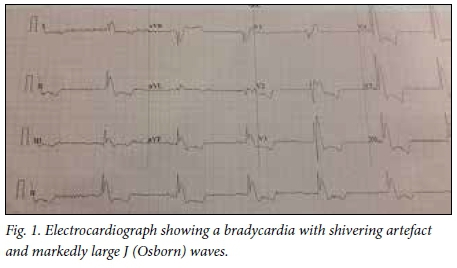
A 35-year-old man was brought to an emergency centre by emergency medical services after being 'found down' at the side of the road in the middle of the night. He was unable to provide a history at the time and was confused. His blood glucose level was 6 mmol/L and his blood pressure 90/60 mmHg. His core body temperature was measured at 28oC. His electrocardiograph is shown in Fig. 1.
The ECG shows a bradycardia with shivering artefact and markedly large J (Osborn) waves. Pathophysiologically, J (Osborn) waves are thought to be caused by differences in action potential characteristics between the epicardial and endocardial layers of the heart.[1] They can also be observed in conditions such as benign early repolarisation or hypercalcaemia, in patients with a pericardial effusion of acute onset, and in patients with other intracranial pathology not limited to injury, such as a subarachnoid haemorrhage. The shivering artefact is not specific to hypothermia and may be seen in other patients who may have a tremor.
Other electrocardiographic manifestations of hypothermia include PR-, QRS- and QT-interval prolongation, as well as atrial and ventricular dysrhythmias. The ECG in hypothermia may also mimic a myocardial infarction and conceal the typical ECG findings in hyperkalaemia.
Acknowledgements. None.
Author contributions. Sole author.
Funding. None.
Conflicts of interest. None.
References
-
1. Antzelevitch C, Yan GX, Ackerman MJ, et al. J-wave syndromes expert consensus conference report: Emerging concepts and gaps in knowledge. J Arrhythm 2016;32(5):315-339. https://doi.org/10.1016%2Fj.joa.2016.07.002
» https://doi.org/10.1016%2Fj.joa.2016.07.002