Microbiological analysis of complicated urinary tract infections in a specialised urology unit in KwaZulu-Natal Province, South Africa, 2021 - 2023
BACKGROUND. Complicated urinary tract infections (cUTIs) are a growing burden in urological patients, particularly those with prior catheterisation or surgical procedures. Appropriate empirical antimicrobial therapy is an essential component in the management of these patients; therefore, treatment guidelines need to be reviewed periodically. OBJECTIVES. To evaluate the microbiological causes and antimicrobial resistance (AMR) patterns of cUTIs in a specialised urology department in KwaZulu-Natal Province, South Africa. METHOD. A retrospective study was conducted on all positive urine cultures of patients attending a urology clinic and ward from 1 January 2021 to 31 December 2023. Samples were processed according to standard operating procedures. RESULTS. A total of 820 specimens were analysed in this study. Escherichia coli was the most common causative agent of cUTIs, accounting for 47% of all isolates, followed by Klebsiella spp. (15%). Enterococcus spp. was the most prevalent Gram-positive uropathogen. Notably, high resistance patterns were observed, with ciprofloxacin resistance rates of 79.4% in E. coli and 50.8% in Klebsiella spp. Extended-spectrum beta-lactamase-producing bacteria were detected in 43.3% of E. coli and 40.2% of Klebsiella spp. isolates, while carbapenem resistance was detected in 15.3% of Klebsiella spp. CONCLUSION. Our study shows the importance of antibiotic surveillance to guide empirical antimicrobial therapy based on local microbiological data. Owing to the increase in resistance of common uropathogens to commonly used antimicrobials, we advocate revised guidelines for the empirical treatment of cUTIs.
antimicrobial resistance; complicated urinary tract infection; Escherichia coli; multidrug-resistant organism; urology department
Microbiological analysis of complicated urinary tract infections in a specialised urology unit in KwaZulu-Natal Province, South Africa, 2021 - 2023
S KonarI, II; M Pye HanIII; Y MahabeerIV, V; K Swe Swe-HanVI, VII
IMB ChB, DTM&H; Department of Medical Microbiology, Inkosi Albert Luthuli Central Hospital Laboratory, National Health Laboratory Service, Durban, South Africa
IIMB ChB, DTM&H; Department of Medical Microbiology, School of Pathology, Faculty of Health Sciences, University of KwaZulu-Natal, Durban, South Africa
IIIMB ChB; Department of Urology, St Aidans Hospital, Durban, South Africa
IVMB ChB, FC Path (Micro); Department of Medical Microbiology, Inkosi Albert Luthuli Central Hospital Laboratory, National Health Laboratory Service, Durban, South Africa
VMB ChB, FC Path (Micro). Department of Medical Microbiology, School of Pathology, Faculty of Health Sciences, University of KwaZulu-Natal, Durban, South Africa
VIFCPath (Micro), PhD (Med Micro); Department of Medical Microbiology, Inkosi Albert Luthuli Central Hospital Laboratory, National Health Laboratory Service, Durban, South Africa
VIIFCPath (Micro), PhD (Med Micro); Department of Medical Microbiology, School of Pathology, Faculty of Health Sciences, University of KwaZulu-Natal, Durban, South Africa
BACKGROUND. Complicated urinary tract infections (cUTIs) are a growing burden in urological patients, particularly those with prior catheterisation or surgical procedures. Appropriate empirical antimicrobial therapy is an essential component in the management of these patients; therefore, treatment guidelines need to be reviewed periodically.
OBJECTIVES. To evaluate the microbiological causes and antimicrobial resistance (AMR) patterns of cUTIs in a specialised urology department in KwaZulu-Natal Province, South Africa.
METHOD. A retrospective study was conducted on all positive urine cultures of patients attending a urology clinic and ward from 1 January 2021 to 31 December 2023. Samples were processed according to standard operating procedures.
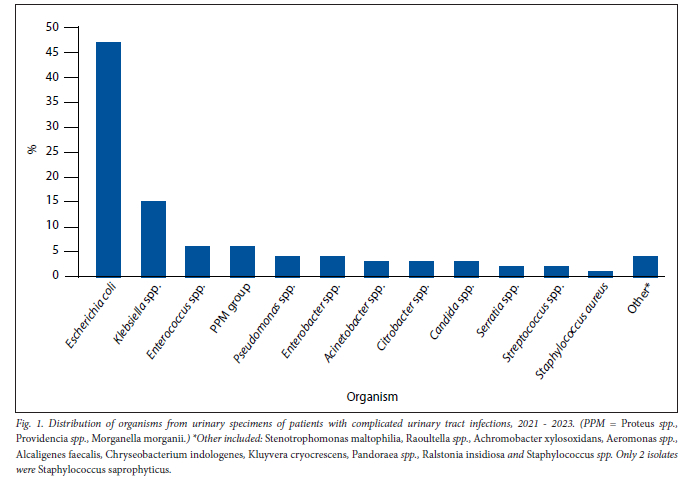
RESULTS. A total of 820 specimens were analysed in this study. Escherichia coli was the most common causative agent of cUTIs, accounting for 47% of all isolates, followed by Klebsiella spp. (15%). Enterococcus spp. was the most prevalent Gram-positive uropathogen. Notably, high resistance patterns were observed, with ciprofloxacin resistance rates of 79.4% in E. coli and 50.8% in Klebsiella spp. Extended-spectrum beta-lactamase-producing bacteria were detected in 43.3% of E. coli and 40.2% of Klebsiella spp. isolates, while carbapenem resistance was detected in 15.3% of Klebsiella spp.
CONCLUSION. Our study shows the importance of antibiotic surveillance to guide empirical antimicrobial therapy based on local microbiological data. Owing to the increase in resistance of common uropathogens to commonly used antimicrobials, we advocate revised guidelines for the empirical treatment of cUTIs.
Keywords: antimicrobial resistance, complicated urinary tract infection, Escherichia coli, multidrug-resistant organism, urology department
In 2019, the global burden of urinary tract infections (UTIs) was >400 million, resulting in 200 000 deaths.[1] These infections can be classified as uncomplicated, where there are no functional or structural abnormalities, or complicated, where these abnormalities are present or where the patient has underlying comorbidities.[2] Complicated urinary tract infections (cUTIs) are a common reason for hospital attendance and admission. In the USA, cUTIs accounted for >100 000 admissions in 2000. However, data on the true prevalence of these infections globally are lacking.[3] In Uganda, the prevalence of UTIs in patients attending a hospital was found to be 32%.[4]
The most common organism causing cUTI is uropathogenic Escherichia coli, followed by Klebsiella pneumoniae, Pseudomonas aeruginosa, Enterococcus spp. and Staphylococcus spp.[5] Nosocomial pathogens, such as P. aeruginosa, are common in healthcare-associated infection, while Enterobacterales, particularly E. coli, are the predominant causative agents in urological patients.[6,7] However, non-E. coli pathogens, including Klebsiella spp. and Enterococcus spp., are frequently isolated, especially from immunocompromised patients or those with pre-existing urinary catheters.[8] Notably, these pathogens exhibit high resistance rates, with extended-spectrum beta-lactamase (ESBL)-producing bacteria and multidrug-resistant organisms increasingly reported.[9,10]
Management of cUTIs requires early and targeted antibiotic therapy to improve outcomes, as delays in initiating appropriate treatment in septic patients are linked to higher mortality.[11] This highlights the importance of understanding local microbiological causes and resistance profiles to develop appropriate empirical treatment protocols. Current national treatment guidelines for cUTIs in South Africa (SA) advocate the use of fluoroquinolones with gentamicin or ceftriaxone as alternative agents for pyelonephritis.[12] However, a lack of local susceptibility data for uropathogens causing cUTIs, especially in the context of urology patients, is evident.
The purpose of this study was to identify the microbiological causes of cUTIs and analyse antimicrobial resistance trends in a specialised urology department in KwaZulu-Natal Province, SA. The findings aim to inform the optimisation of current empirical treatment protocols, contributing to improved patient outcomes and better stewardship of antibiotic use.
Methods
Setting
Urine samples from the urology department at St Aidan's hospital in Durban, SA, were analysed. All patients who seek urological services here need to be referred from other healthcare facilities. General outpatients are not seen in this hospital.
Study design and data collection
A retrospective, descriptive study was conducted on all positive urine cultures of patients attending the urology clinic and ward from 1 January 2021 to 31 December 2023. All patients who attended the urology department were considered to have a cUTI, as this is a specialist urology hospital where patients with uncomplicated infections are not seen. Urine specimens were analysed by the National Health Laboratory Service (NHLS) according to the standard operating procedures. Laboratory number, age, gender, type of urine specimen, clinical history, organism and antimicrobial susceptibility were extracted from the laboratory information system. Data were deduplicated. Urinary samples from the same patient were removed if they had the same organism, same resistance patterns and if they were taken within 21 days of the first sample. Patient details were removed for confidentiality.
Urine samples with a single organism of >1052>3 organisms were isolated were considered contaminated and were excluded from the study.
Antibiotics were selectively reported by the pathologist in accordance with Clinical and Laboratory Standards Institute guidelines.[13-15] ESBL-producing organisms were defined as those isolates that were resistant to third-generation cephalosporins, i.e. ceftriaxone, cefotaxime and ceftazidime. Carbapenem-resistant Enterobacterales (CRE) was defined as those isolates that were resistant to any of the carbapenems: ertapenem, imipenem or meropenem. Detection of specific carbapenemases was not conducted.
Data analysis
Statistical analyses were conducted using the Kruskal-Wallis equality-of-populations rank test for continuous data, and the z-column proportional test and χ2P<0.05 was considered statistically significant. Data were analysed using the Statistical Package for Social Sciences (SPSS) version 29 for Windows (IBM Corp, USA), with appropriate tests applied based on data type.
Ethical considerations
Ethics approval was granted by the University of KwaZulu-Natal Biomedical Research Ethics Committee (ref. no. BE085/12).
Results
Population characteristics
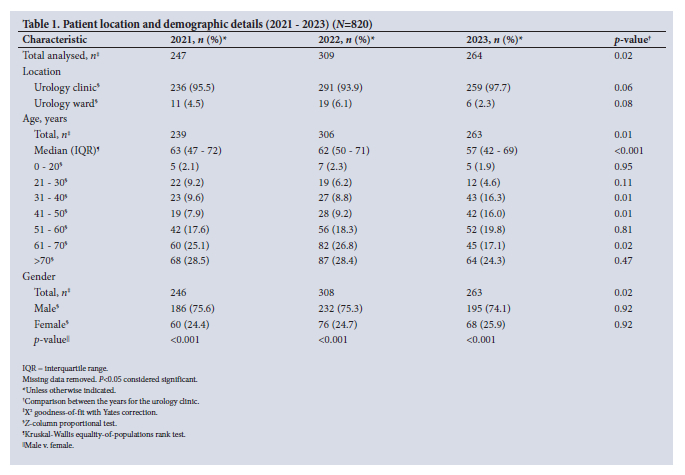
Over a 3-year period, a total of 820 specimens were analysed. Of these, 96% of patients (783/822) were seen in the urology clinic rather than the ward. Some of the indications for urine sample collection included but were not limited to the following: recurrent UTI; preoperative urine microscopy; culture and sensitivity prior to endoscopic procedure within the urinary tract; urosepsis work-up; vesicoureteric reflux; evidence of pyuria; and presence of urine calculi. The median age of the group was 48.5 years (range 13 - 86 years). Seventy-five percent (613/820) of the total study population was male. Although there was no difference in the number of samples collected per year over the study period, there were significantly more people in the age categories 31 - 40 years and 41 - 50 years (p=0.01 in both categories) (Table 1).
Causative agents
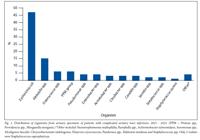
The most common uropathogen identified was E. coli (383/820; 47%), followed by Klebsiella spp. (122/820; 15%). Proteus spp., Providencia spp. and Morganella morganii accounted for 6% (51/820) of the total isolates. Among the Gram-positive organisms, Enterococcus spp. accounted for 6% (51/820) of the total isolates, with Enterococcus faecalis accounting for >90% of these (47/51) (Fig. 1).
Trend of aetiological agents from 2021 to 2023
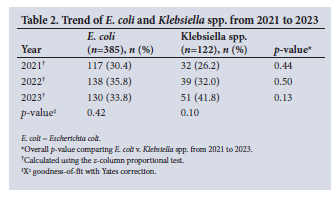
The two most common organisms were used for this analysis. Over the 3 years, there was an increase in the number of Klebsiella spp. identified from urine specimens of patients with cUTIs. However, this was not statistically significant (Table 2).
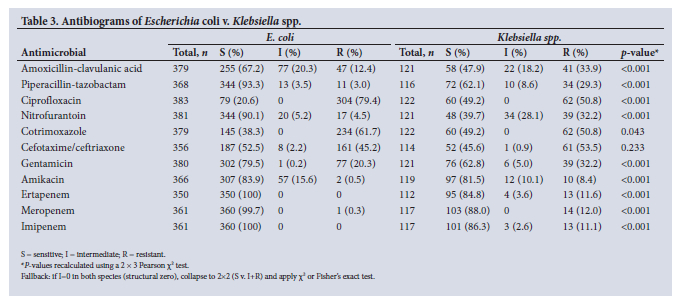
The antibiogram for E. coli and Klebsiella spp. is shown in Table 3. The overall susceptibility rates of E. coli were 100% for ertapenem and imipenem, 99.7% for meropenem, 93.3% for piperacillin-tazobactam, 90.1% for nitrofurantoin, 83.9% for amikacin, 79.5% for gentamicin, 67.2% for amoxicillin-clavulanic acid, 52.5% for ceftriaxone, 38.3% for cotrimoxazole and 20.6% for ciprofloxacin.
The overall susceptibility rates for Klebsiella spp. were 88.0% for meropenem, 86.3% for imipenem, 84.8% for ertapenem, 81.5% for amikacin, 62.8% for gentamicin, 62.1% for piperacillin-tazobactam, 49.2% for ciprofloxacin and cotrimoxazole, 47.9% for amoxicillin-clavulanic acid, 45.6% for ceftriaxone and 39.7% for nitrofurantoin.
E. coli was significantly associated with ciprofloxacin resistance compared with Klebsiella spp. (p<0.001). Almost all antimicrobials showed significantly greater resistance in Klebsiella spp. than E. coli. These were amoxicillin-clavulanic acid (p<0.001), piperacillin-tazobactam (p<0.001), nitrofurantoin (p<0.001), gentamicin (p=0.04) and the carbapenems (p<0.001). E. coli had a greater susceptibility to carbapenems (imipenem, meropenem and ertapenem) of >98%, as compared with Klebsiella spp. with a susceptibility of 84 - 88%.
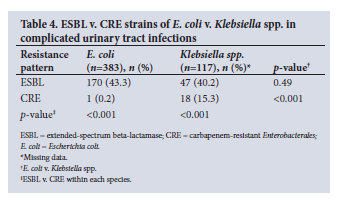
Table 4 shows a total of 217 extended-spectrum beta-lactamase (ESBL) and 19 CRE isolates identified. The ESBL rates for both organisms were similar: 43% and 40%, respectively. However, a significantly higher proportion of Klebsiella spp. (15.3%) was CRE compared with E. coli.
Discussion
In this study, cUTI was studied over a 3-year period at a specialist urology service in Durban, SA. Significantly higher numbers of samples were received from male patients, and from patients aged between 31 and 40 years, and 41 and 50 years old. E. coli was the most common cause of cUTIs, followed by Klebsiella spp. High resistance rates were observed for ciprofloxacin, currently recommended as a treatment option for cUTI. This was significantly higher in E. coli compared with Klebsiella spp. However, lower resistance rates to nitrofurantoin, used for treating uncomplicated cystitis, were observed in E. coli compared with Klebsiella spp.
Our study found significantly more male than female patients over the 3-year period. This is in keeping with Italian and Romanian studies of urology outpatients.[16,17] However, many other studies report a predominance of females.[1,18] Due to the anatomical structure of the male genitalia, males are less susceptible to UTIs. The causes of UTI in males are multifactorial; however, further research is needed to identify the risk factors.
E. coli was the most common uropathogen identified in this study, followed by Klebsiella spp. A systematic review of UTIs in sub-Saharan Africa found a similar prevalence of E. coli UTIs.[19] In India, a retrospective study conducted in a urology hospital showed similar rates of 55% and 18.8% for E. coli and Klebsiella spp., respectively.[10] In another study, E. coli and Klebsiella spp. were isolated in ~50% and 27% of cases, respectively.[1] A study on bacterial uropathogens conducted in a SA tertiary hospital highlighted similar findings, with E. coli at 53% followed by Klebsiella spp. at 14%.[7]
Enterococcus is the leading Gram-positive bacterial uropathogen seen in the literature.[8,20] Compared with a local study, our study had twice as many enterococcal infections.[7] The difference in prevalence of Enterococcus spp. contributing to UTIs can be attributed to gender, clinical characteristics, biofilm formation and other virulence factors.[8]
Our study demonstrated an alarming rate of ciprofloxacin-resistant E. coli isolates. A study conducted in Spain demonstrated lower rates of fluoroquinolone resistance of 37.2% in patients with complicated community-acquired UTIs.[20] Other studies have shown higher resistance rates for ciprofloxacin of 50%, while an Indian study showed similar resistance of 70% in E. coli.[10,20] The recommendation is that if fluoroquinolone resistance exceeds 10%, then it should not be used empirically for community-acquired cUTIs.[21]
Over the 3-year period, 15% of Klebsiella spp. were carbapenem-resistant. This was slightly higher than the findings in two other studies, one conducted in Lebanon[22] and the other in Romania,[17] with carbapenem resistance rates of 6.6% and 12%, respectively. Furthermore, an epidemiological study in south-west Nigeria showed that 20.8% of uropathogens were carbapenem-resistant, which is similar to our study.[23]
Increasing antimicrobial resistance (AMR) results in limited antimicrobial options available for treatment. The National Institute for Communicable Diseases in SA has released their latest surveillance report for AMR; however, this only includes uncomplicated community-acquired uropathogens. There is a Table 2. Trend of E. coli and Klebsiella spp. from 2021 to 2023 gap in local surveillance data conducted on AMR in patients with cUTIs. The present study highlights the need to consider revision of current treatment protocols, particularly in patients with urological problems, owing to the high rates of fluoroquinolone resistance seen in our setting (KwaZulu-Natal Province, SA). In a specialised urological clinic or ward that services patients with cUTIs, fluoroquinolones will need to be used with caution, and close follow-up of susceptibility results is essential. Gentamicin may still be a good option for inpatient use, as is currently recommended, because only 20% resistance was seen in E. coli. Approximately 40% of E. coli and Klebsiella spp. were resistant to 3rd-generation cephalosporins, therefore these should also be used with careful follow-up of susceptibility data. Low resistance rates were noted with nitrofurantoin, and this drug may be a consideration, noting the limitations of its utility. Piperacillin-tazobactam susceptibility was high among E. coli isolates. This may be a reasonable intravenous alternative for inpatients with ESBL-producing E. coli, as it is a carbapenem-sparing option that may reduce the prevalence of CRE.[24,25]
Study limitations
Our study is limited to urology patients who may have a different antimicrobial susceptibility profile to other patients with cUTI, and results cannot be generalised to other categories of patients. This study was conducted at only one study site, and organisms may have variable resistance patterns geographically. Owing to the retrospective nature of the study, some antimicrobial data were missing. In addition, clinical and prior antimicrobial data were not available, which would have added more value.
Conclusion
Complicated UTIs pose a significant burden on healthcare owing to increasing AMR, with the added challenge of limited antimicrobial options available. Our study demonstrated increased resistance to ciprofloxacin and 3rd-generation cephalosporins, the currently recommended antimicrobials for the treatment of cUTIs. Apart from the high ESBL prevalence among the uropathogens detected in this study, the CRE prevalence of 15% in Klebsiella spp. is of great concern. Enhanced surveillance and appropriate empirical antimicrobial therapy based on local microbiological data are essential. In light of the increase in resistance patterns to commonly used antimicrobials, we advocate revision of local antimicrobial guidelines for cUTIs.
Data availability. Data are available from the author on request.
Declaration. None.
Acknowledgements. The authors would like to thank the microbiology staff who were directly involved in sample processing during this study period. We would also like to thank Mr Deepak Singh for his contributions with the statistical analysis.
Author contributions. SK was involved in conceptualisation, methodology, data collection, analysis and writing the original draft. The rest of the authors listed contributed equally.
Funding. None.
Conflicts of interest. None.
References
-
1. Yang X, Chen H, Zheng Y, et al. Disease burden and long-term trends of urinary tract infections: A worldwide report. Front Public Health 2022;10:888205. https://doi.org/10.3389/fpubh.2022.888205
» https://doi.org/10.3389/fpubh.2022.888205 -
2. Flores-Mireles AL, Walker JN, Caparon M, Hultgren SJ. Urinary tract infections: Epidemiology, mechanisms of infection and treatment options. Nat Rev Microbiol 2015;13(5):269-284. https://doi.org/10.1038/nrmicro3432
» https://doi.org/10.1038/nrmicro3432 -
3. Vallejo-Torres L, Pujol M, Shaw E, et al. Cost of hospitalised patients due to complicated urinary tract infections: A retrospective observational study in countries with high prevalence of multidrug-resistant Gram-negative bacteria: The COMBACTE-MAGNET, RESCUING study. BMJ Open 2018;8(4):e020251. https://doi.org/10.1136/bmjopen-2017-020251
» https://doi.org/10.1136/bmjopen-2017-020251 -
4. Odoki M, Almustapha Aliero A, Tibyangye J, et al. Prevalence of bacterial urinary tract infections and associated factors among patients attending hospitals in Bushenyi district, Uganda. Int J Microbiol 2019;2019(1):4246780. https://doi.org/10.1155/2019/4246780
» https://doi.org/10.1155/2019/4246780 -
5. Tandogdu Z, Bartoletti R, Cai T, et al. Antimicrobial resistance in urosepsis: Outcomes from the multinational, multicenter global prevalence of infections in urology (GPIU) Study 2003 to 2013. World J Urol 2016;34:1193-1200. https://doi.org/10.1007/s00345-015-1722-1
» https://doi.org/10.1007/s00345-015-1722-1 -
6. Medina-Polo J, Naber KG, Bjerklund Johansen TE. Healthcare-associated urinary tract infections in urology. GMS Infect Dis 2021;9:Doc05. https://doi.org/10.3205/id000074
» https://doi.org/10.3205/id000074 -
7. Naidoo A, Kajee A, Mvelase NR, Swe-Han KS. Antimicrobial susceptibility of bacterial uropathogens in a South African regional hospital. Afr J Lab Med 2023;12(1):a1920. https://doi.org/10.4102/ajlm.v12i1.1920
» https://doi.org/10.4102/ajlm.v12i1.1920 -
8. Codelia-Anjum A, Lerner LB, Elterman D, et al. Enterococcal urinary tract infections: A review of the pathogenicity, epidemiology, and treatment. Antibiotics 2023;12(4):778. https://doi.org/10.3390/antibiotics12040778
» https://doi.org/10.3390/antibiotics12040778 -
9. Levison ME, Kaye D. Treatment of complicated urinary tract infections with an emphasis on drug-resistant gram-negative uropathogens. Curr Infect Dis Rep 2013;15(2):109-115. https://doi.org/10.1007/s11908-013-0315-7
» https://doi.org/10.1007/s11908-013-0315-7 -
10. Ahmad M, Kumar P, Sultan A, et al. Prevalence of community acquired uropathogens and their antimicrobial susceptibility in patients from the urology unit of a tertiary care medical center. J Pure Appl Microbiol 2020;14(3):2009-2015. https://doi.org/10.22207/JPAM.14.3.40
» https://doi.org/10.22207/JPAM.14.3.40 -
11. DasGupta R, Sullivan R, French G, O'Brien T. Evidence-based prescription of antibiotics in urology: A 5-year review of microbiology. BJU Int 2009;104(6):760-764. https://doi.org/10.1111/j.1464-410X.2009.08779.x
» https://doi.org/10.1111/j.1464-410X.2009.08779.x - 12. National Department of Health, South Africa. Essential drugs programme. Hospital level (Adults) Standard Treatment Guidelines and Essential Medicines List. 5th ed. Pretoria: NDoH, 2019.
- 13. Clinical and Laboratory Standards Institute. Performance standards for antimicrobial susceptibility testing. 31st ed. CLSI supplement M100. Malvern: CLSI, 2021.
- 14. Clinical and Laboratory Standards Institute. Performance standards for antimicrobial susceptibility testing. 32nd ed. CLSI supplement M100. Malvern: CLSI, 2022.
- 15. Clinical and Laboratory Standards Institute. Performance standards for antimicrobial susceptibility testing. 33rd ed. CLSI supplement M100. Malvern: CLSI, 2023.
-
16. Ferri C, Marchetti F, Nickel JC, Naber KG. Prevalence and clinical management of complicated urinary tract infections in Italy: A prospective multicenter epidemiological study in urological outpatients. J Chemother 2005;17(6):601-606. https://doi.org/10.1179/joc.2005.17.6.601
» https://doi.org/10.1179/joc.2005.17.6.601 -
17. Guliciuc M, Porav-Hodade D, Mihailov R, et al. Exploring the dynamic role of bacterial etiology in complicated urinary tract infections. Medicina 2023;59(9):1686. https://doi.org/10.3390/medicina59091686
» https://doi.org/10.3390/medicina59091686 -
18. Pardeshi P. Prevalence of urinary tract infections and current scenario of antibiotic susceptibility pattern of bacteria causing UTI. Indian J Microbiol Res 2018;5(3):334-338. https://doi.org/10.18231/2394-5478.2018.0070
» https://doi.org/10.18231/2394-5478.2018.0070 -
19. Mwang'onde BJ, Mchami JI. The aetiology and prevalence of urinary tract infections in sub-Saharan Africa: A systematic review. J Health Biological Sci 2022;10(1):1-7. https://doi.org/10.12662/2317-3076jhbs.v10i1.4501.p1-7.2022
» https://doi.org/10.12662/2317-3076jhbs.v10i1.4501.p1-7.2022 -
20. Artero A, López-Cruz I, Piles L, et al Fluoroquinolones are useful as directed treatment for complicated UTI in a setting with a high prevalence of quinolone-resistant microorganisms. Antibiotics 2023;12(1):183. https://doi.org/10.3390/antibiotics12010183
» https://doi.org/10.3390/antibiotics12010183 -
21. Gupta K, Hooton TM, Naber KG. International Clinical Practice Guidelines for the treatment of acute uncomplicated cystitis and pyelonephritis in women: A 2010 update by the Infectious Diseases Society of America and the European Society for Microbiology and Infectious Diseases. Clin Infect Dis 2011;52(5):e103-e120. https://doi.org/10.1093/cid/ciq257
» https://doi.org/10.1093/cid/ciq257 -
22. Shmoury AH, Hanna W, Zakhour J, Zahreddine NH, Kanj SS. Epidemiology and microbiology of catheter-associated urinary tract infections: A 14-year surveillance study at a tertiary care center in Lebanon. J Infect Pub Health 2024;17(5):825-832. https://doi.org/10.1016/j.jiph.2024.03.022
» https://doi.org/10.1016/j.jiph.2024.03.022 -
23. Adesanya OA, Igwe HA. Carbapenem-resistant Enterobacteriaceae (CRE) and Gram-negative bacterial infections in south-west Nigeria: A retrospective epidemiological surveillance study. AIMS Pub Health 2020;7(4):804-815. https://doi.org/10.3934/publichealth.2020062
» https://doi.org/10.3934/publichealth.2020062 -
24. Sharara SL, Amoah J, Pana ZD, Simner PJ, Cosgrove SE, Tamma PD. Is piperacillin-tazobactam effective for the treatment of pyelonephritis caused by extended-spectrum ß-lactamase-producing organisms? Clin Infect Dis 2020;71(8):e331-e337. https://doi.org/10.1093/cid/ciz1205
» https://doi.org/10.1093/cid/ciz1205 -
25. Sutton SP, Reinert JP. Evaluation of the efficacy of piperacillin/tazobactam in extended-spectrum beta-lactamase-producing enterobacteriaceae urinary tract infections: A systematic review of the literature. Ann Pharmacother 2024;59(7):648-656. https://doi.org/10.1177/10600280241291604
» https://doi.org/10.1177/10600280241291604

Accepted 2 October 2025