Dilated cardiomyopathy and potentially deadly digoxin
Dilated cardiomyopathy (DCM) is a relatively common condition in sub-Saharan Africa, accounting for a substantial portion of patients admitted for heart failure. In the Heart of Soweto study it was the most common cardiovascular disease.1
The first paper2
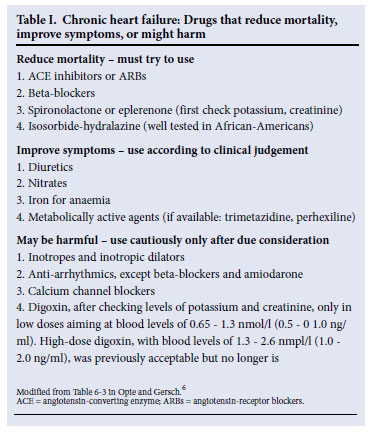
The 1997 DIG trial is often quoted in support of the use of digoxin.45Table I.
Heart failure with sinus rhythm - swings in digoxin use
Digitalis has gone through four phases.5
Currently use is declining again for several reasons. Firstly, there are major disagreements about the ideal dose and blood levels.54et al.5
Fourthly, and most tellingly, digoxin is not even considered safe as a last measure in patients with advanced heart failure referred for transplant evaluation.6p<0.001).
These many problems have relegated digoxin to an optional extra in the management of heart failure, given if at all in lower doses than previously, with the aim of achieving symptomatic rather than mortality benefit.
Heart failure and atrial fibrillation
In the second report in this issue,37p=0.005). Digoxin alone was associated with worse survival, similar to that of patients without any rate control treatment. There appears to be only one very small study (N=14) focusing on beta-blockade added to digoxin in the treatment of atrial fibrillation in idiopathic cardiomyopathy.87
Doses and blood levels of digoxin
These are reviewed elsewhere.6
Persuasive data come from a retrospective analysis of the large DIG trial on 3 782 heart failure patients followed up for 3 years.910
The next higher tertile of digoxin levels in the DIG trial (1.2 - 1.4 nmol/l) had no effect on mortality, whereas the tertile with the previously accepted higher levels (1.6 nmol/l or more) was associated with a mortality increase of 12%.9
The practical message - a turnaround level
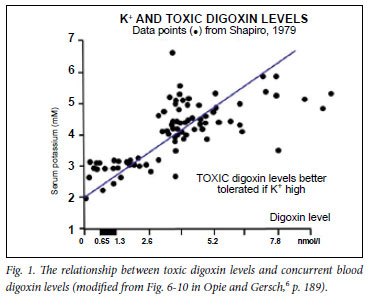
Digoxin therefore has bidirectional effects on mortality, with the 'turnaround' level being about 1.3 nmol/l,10Fig. 1) and certainly no higher. Although this conclusion is based on imperfect data and is strictly speaking only hypothesis generating,11Fig. 1).
Digoxin cautions before use
Serum potassium and blood digoxin levels should be measured. However, potassium and creatinine levels are not reported in the accompanying study.3
• Hypokalaemia predisposes to toxicity, and potassium must always be checked simultaneously with the digoxin level (Fig. 1).
• Renal failure. Digoxin is excreted by the kidneys, so the plasma creatinine must be checked before use. A high circulating level means that caution is necessary and that digoxin, if used at all, should be at an even lower dose.
Digoxin contraindications
Contraindications to digoxin are many and serious.5
• The risk of digitalis toxicity is the major contraindication, pending a full history of digitalis dosage, blood tests for renal failure, and measurement of serum digoxin and potassium. Digoxin has a blood half-life of 36 hours, so toxicity is not readily reversed and requires digoxin antibodies, not widely available.
• Hypertrophic obstructive cardiomyopathy (hypertrophic sub-aortic stenosis, asymmetrical septalhypertrophy ) is a contraindication (unless there is atrial fibrillation and severe myocardial failure), because the inotropic effect can worsen outflow obstruction.
• In some cases of Wolff-Parkinson-White syndrome with atrial fibrillation, digitalisation may accelerate anterograde conduction over the bypass tract to precipitate ventricular tachycardia or ventricular fibrillation.
• Atrioventricular (AV) nodal heart block when significant. Intermittent complete heart block or second-degree AV block or sick sinus syndrome may be worsened by digitalis, especially if there is a history of Stokes-Adams attacks or when conduction is likely to be unstable, as in recent acute myocardial infarction with heart failure or acute myocarditis.
• Heart failure with preserved ejection fraction (diastolic dysfunction), seen most notably with concentric ventricular hypertrophy as in hypertension or aortic stenosis, and associated with the paradox of a normal or high ejection fraction, does not respond to digitalis.
• Fear of breast cancer. The digoxin molecule has similarities to the oestrogen receptor. Hence digoxin may bind to this receptor with the theoretical risk of increased breast cancer. This fear is confirmed in two large recent Danish studies making use of Danish population databases,12,13 both of which show an increased risk of breast cancer with digoxin use in women.
Conclusion
Before using digoxin, be fully convinced that this potentially lethal drug is essential. Why use digoxin for heart failure? Why use a drug with a narrow band of truly safe and effective blood levels? Why use a drug that has no positive hard outcome data in the modern era? Note that blood levels that were previously acceptable are now regarded as toxic. Also note that the patient on digoxin needs their potassium and creatinine levels to be monitored. Finally, it is safe to say that digoxin is a drug that would never be passed by the Food and Drug Administration if it was submitted for registration today. Put simply, digoxin is a dangerous drug, its use perhaps being excusable in earlier years when little was known about its dangers and we did not yet have today's effective therapy for heart failure. The new prospective trials that would have been crucial have not been carried out. It is no wonder that increased mortality was associated with digoxin use in the second of the two studies in this issue of the SAMJ.
Lionel H Opie
Department of Medicine
University of Cape Town
References
- 1. Sliwa K, Wilkinson D, Hansen C, et al. Spectrum of heart disease and risk factors in a black urban population in South Africa (the Heart of Soweto Study): a cohort study. Lancet 2008;371:915-922.
- 2. Ntusi NBA, Wonkam A, Shaboodien G, Badri M, Mayosi BM. Frequency and clinical genetics of familial dilated cardiomyopathy in Cape Town: Implications for the evaluation of patients with unexplained cardiomyopathy S Afr Med J 2011;101:394-398.
- 3. Ntusi NBA, Badri M, Gumedze F, Wonkam A, Mayosi BM. Clinical characteristics and outcomes of familial and idiopathic dilated cardiomyopathy in Cape Town: A comparative study of 120 cases over 14 years. S Afr Med J 2011;101:399-404.
- 5. Fauchier L, Grimard C, Nonin P, et al. Comparison of beta blocker and digoxin alone and in combination for management of patients with atrial fibrillation and heart failure. Am J Cardiol 2009;103:248-254.
- 6. Poole-Wilson P, Opie LH. Acute and chronic heart failure: positive inotropes, vasodilators and digoxin. In: Opie LH, Gersch BJ, eds. Drugs for the Heart. 7th ed. Philadelphia: Elsevier Saunders, 2009: 160-197.
- 7. Georgiopoulou VV, Kalogeropoulos AP, Giamouzis G, et al. Digoxin therapy does not improve outcomes in patients with advanced heart failure on contemporary medical therapy. Circ Heart Fail 2009;2:90-97.
- 8. Agarwal AK, Venugopalan P. Beneficial effect of carvedilol on heart rate response to exercise in digitalised patients with heart failure in atrial fibrillation due to idiopathic dilated cardiomyopathy. Eur J Heart Fail 2001;3:437-440.
- 9. Ahmed A, Pitt B, Rahimtoola SH, et al. Effects of low serum concentrations on mortality and hospitalization in heart failure: a propensity-matched study of the DIG trial. Int J Cardiol 2008; 123:138-146.
- 10. Rathore SS, Curtis JP, Wang Y, Bristow MR, Krumholz HM. Association of serum digoxin concentrations and outcomes in patients with heart failure. JAMA 2003;289:871-878.
- 11. Eichhorn EJ, Gheorghiade M. Digoxin - new perspectives on an old drug. N Engl J Med 2002;347:1394-1395.
- 12. Biggar RJ, Wohlfahrt J, Oudin A, et al. Digoxin use and the risk of breast cancer in women. J Clin Oncol 2011; Mar 21. [Epub ahead of print]
- 13. Ahren TP, Lash TL, Sørensen HT, et al. Digoxin treatment is associated with an increased incidence of breast cancer: a population-based case-control study. Breast Cancer Res 2008;10:R102.