Side-by-side Foley catheter balloons for labour induction: A randomised controlled trial
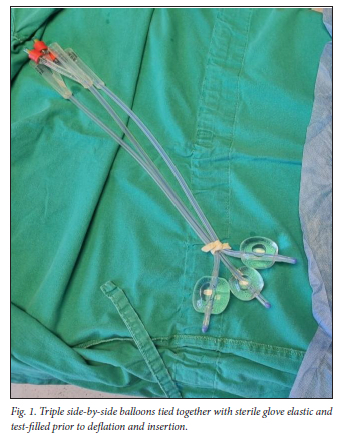
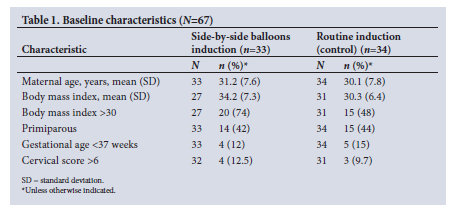
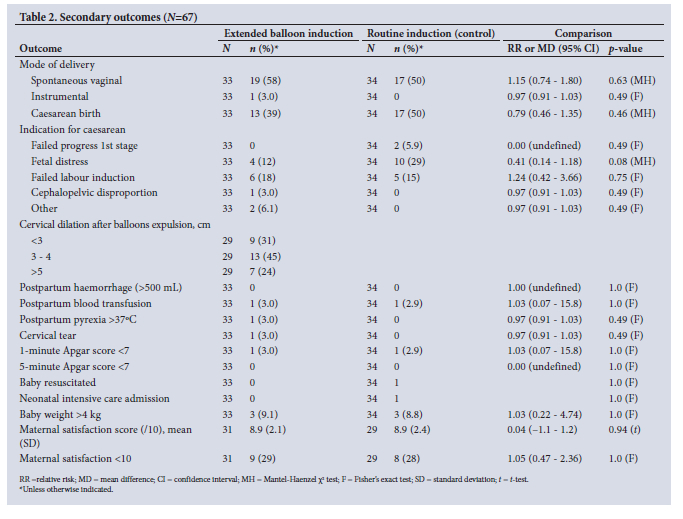
BACKGROUND. Labour induction rates are increasing globally. The off-label Foley catheter balloon inserted trans-cervically is as effective as pharmacological agents, with fewer adverse neonatal outcomes, but the Foley balloon is usually expelled before labour is established. A novel side-by-side Foley catheter procedure has been proposed to prevent premature expulsion of the balloons. OBJECTIVES. To compare the side-by-side Foley catheters with routine labour induction methods. METHODS. This was an open-label, randomised controlled trial. Participants who had consented and were due for labour induction were allocated by randomly ordered envelopes to labour induction with side-by-side Foley balloons or routine care (single Foley balloon, oral misoprostol solution, oxytocin and/or amniotomy). Data were analysed using Epi Info software. RESULTS. Altogether 67 participants (33 in the side-by-side balloons group, 34 in the routine induction group) were enrolled between 5 April and 6 June 2025 at Frere and Cecilia Makiwane hospitals, KuGompo City, South Africa. The rate of the primary efficacy outcome for side-by-side balloons in vaginal birth without the use of a uterotonic was 11/33 (33%). The rate in the routine induction group (1/34, 2.9%) was not suitable for comparison because routine induction options included initial use of misoprostol. The rate in the side-by-side group was greater than that found in published data for single Foley ballon labour induction (59/495 (12%), risk ratio 2.8, 95% confidence interval 1.6 - 4.8, p=0.002). Seven (24%) mothers reached 5 cm cervical dilation with the balloons in place. There were no statistically significant differences in the secondary outcomes, and few adverse events: Apgar scores <7 at 1 and 5 minutes (1 and 0 respectively in each group), and postpartum haemorrhage (none recorded). Caesarean births occurred in 29% and 50%, respectively, and caesarean for fetal distress in 12% and 29%, respectively. Participant satisfaction was high (mean score 8.9/10 in both groups). Owing to the small sample size, modest differences may not have been detectable. The mean body mass index was >30 in both groups. CONCLUSION. This study suggests that the novel side-by-side balloons procedure shows promise as a safe and effective method of labour induction in terms of achieving vaginal birth without the use of pharmacological uterotonics. This method may be considered as an alternative, particularly in low-resourced settings with limited facilities for fetal monitoring. A larger randomised controlled trial is needed to validate or refute these findings.
labour induction; Foley catheter; uterotonics; randomised controlled trial; fetal distress
 Thumbnail