Side-by-side Foley catheter balloons for labour induction: A randomised controlled trial
BACKGROUND. Labour induction rates are increasing globally. The off-label Foley catheter balloon inserted trans-cervically is as effective as pharmacological agents, with fewer adverse neonatal outcomes, but the Foley balloon is usually expelled before labour is established. A novel side-by-side Foley catheter procedure has been proposed to prevent premature expulsion of the balloons. OBJECTIVES. To compare the side-by-side Foley catheters with routine labour induction methods. METHODS. This was an open-label, randomised controlled trial. Participants who had consented and were due for labour induction were allocated by randomly ordered envelopes to labour induction with side-by-side Foley balloons or routine care (single Foley balloon, oral misoprostol solution, oxytocin and/or amniotomy). Data were analysed using Epi Info software. RESULTS. Altogether 67 participants (33 in the side-by-side balloons group, 34 in the routine induction group) were enrolled between 5 April and 6 June 2025 at Frere and Cecilia Makiwane hospitals, KuGompo City, South Africa. The rate of the primary efficacy outcome for side-by-side balloons in vaginal birth without the use of a uterotonic was 11/33 (33%). The rate in the routine induction group (1/34, 2.9%) was not suitable for comparison because routine induction options included initial use of misoprostol. The rate in the side-by-side group was greater than that found in published data for single Foley ballon labour induction (59/495 (12%), risk ratio 2.8, 95% confidence interval 1.6 - 4.8, p=0.002). Seven (24%) mothers reached 5 cm cervical dilation with the balloons in place. There were no statistically significant differences in the secondary outcomes, and few adverse events: Apgar scores <7 at 1 and 5 minutes (1 and 0 respectively in each group), and postpartum haemorrhage (none recorded). Caesarean births occurred in 29% and 50%, respectively, and caesarean for fetal distress in 12% and 29%, respectively. Participant satisfaction was high (mean score 8.9/10 in both groups). Owing to the small sample size, modest differences may not have been detectable. The mean body mass index was >30 in both groups. CONCLUSION. This study suggests that the novel side-by-side balloons procedure shows promise as a safe and effective method of labour induction in terms of achieving vaginal birth without the use of pharmacological uterotonics. This method may be considered as an alternative, particularly in low-resourced settings with limited facilities for fetal monitoring. A larger randomised controlled trial is needed to validate or refute these findings.
labour induction; Foley catheter; uterotonics; randomised controlled trial; fetal distress
Side-by-side Foley catheter balloons for labour induction: A randomised controlled trial
R C DalmacioI; S C MpehleI; M Singata-MadlikiII; G J HofmeyrIII, IV
IMMed (O&G); Department of Obstetrics and Gynaecology, Faculty of Medicine and Health Sciences, iYunivesithi Walter Sisulu, KuGompo City, South Africa
IIPhD; Effective Care Research Unit, iYunivesithi Walter Sisulu, Mthatha, and University of the Witwatersrand, Johannesburg, South Africa
IIIDSc; Effective Care Research Unit, iYunivesithi Walter Sisulu, Mthatha, and University of the Witwatersrand, Johannesburg, South Africa
IVDSc; Department of Obstetrics and Gynaecology, Faculty of Medicine, University of Botswana, Gaborone, Botswana
BACKGROUND. Labour induction rates are increasing globally. The off-label Foley catheter balloon inserted trans-cervically is as effective as pharmacological agents, with fewer adverse neonatal outcomes, but the Foley balloon is usually expelled before labour is established. A novel side-by-side Foley catheter procedure has been proposed to prevent premature expulsion of the balloons.
OBJECTIVES. To compare the side-by-side Foley catheters with routine labour induction methods.
METHODS. This was an open-label, randomised controlled trial. Participants who had consented and were due for labour induction were allocated by randomly ordered envelopes to labour induction with side-by-side Foley balloons or routine care (single Foley balloon, oral misoprostol solution, oxytocin and/or amniotomy). Data were analysed using Epi Info software.
RESULTS. Altogether 67 participants (33 in the side-by-side balloons group, 34 in the routine induction group) were enrolled between 5 April and 6 June 2025 at Frere and Cecilia Makiwane hospitals, KuGompo City, South Africa. The rate of the primary efficacy outcome for side-by-side balloons in vaginal birth without the use of a uterotonic was 11/33 (33%). The rate in the routine induction group (1/34, 2.9%) was not suitable for comparison because routine induction options included initial use of misoprostol. The rate in the side-by-side group was greater than that found in published data for single Foley ballon labour induction (59/495 (12%), risk ratio 2.8, 95% confidence interval 1.6 - 4.8, p=0.002). Seven (24%) mothers reached 5 cm cervical dilation with the balloons in place. There were no statistically significant differences in the secondary outcomes, and few adverse events: Apgar scores <7 at 1 and 5 minutes (1 and 0 respectively in each group), and postpartum haemorrhage (none recorded). Caesarean births occurred in 29% and 50%, respectively, and caesarean for fetal distress in 12% and 29%, respectively. Participant satisfaction was high (mean score 8.9/10 in both groups). Owing to the small sample size, modest differences may not have been detectable. The mean body mass index was >30 in both groups.
CONCLUSION. This study suggests that the novel side-by-side balloons procedure shows promise as a safe and effective method of labour induction in terms of achieving vaginal birth without the use of pharmacological uterotonics. This method may be considered as an alternative, particularly in low-resourced settings with limited facilities for fetal monitoring. A larger randomised controlled trial is needed to validate or refute these findings.
Keywords: labour induction, Foley catheter, uterotonics, randomised controlled trial, fetal distress
Induction of labour (IOL) is often necessary to avoid unfavourable maternal or fetal outcomes. Its use is increasing globally: ~20% of births overall, 33% in the UK,[1] 4.4% in Africa[2] and 13.3% at a South African (SA) regional hospital.[3] Rates are likely to increase further with trends towards routine labour induction at 39 weeks' gestation.[4] The influential ARRIVE randomised controlled trial found that induction of labour at 39 weeks 0 days - 39 weeks 6 days of gestation, with singleton gestations and vertex presentations without other indications for induction was associated with significantly decreased incidence of hypertensive disorders in pregnancy, caesarean birth, meconium-stained amniotic fluid and neonatal respiratory problems, compared with expectant management until 40 weeks 5 days.[5]
Methods available for IOL include pharmacological and mechanical options. Pharmacological methods include prostaglandins and their analogues, and oxytocin. The mechanical methods include insertion of a single Foley catheter into the endocervical canal and inflation of the balloon with sterile saline. Extra-amniotic saline infusion includes saline infused via the Foley catheter. Hygroscopic dilators are either synthetic or made from the root of a seaweed (Laminaria digitata or Laminaria japonica).[6]
Recent evidence shows that balloon labour induction is as effective as pharmacological methods, with less risk of uterine hyperstimulation and adverse neonatal outcomes.[7] Although purpose-designed balloons for labour induction do exist, a standard Foley urinary catheter is most commonly repurposed for the procedure.[8] The advantage of improvisation of Foley catheters is that they are inexpensive and widely available. The disadvantage is that the Foley catheter has not been through a systematic approval process to determine the best technique for its use, and does not have manufacturer instructions related to induction of labour. Clinicians have improvised and developed local protocols, often without systematic evaluation of alternative methods.[9]
Multiple strategies have been investigated to enhance the effectiveness of balloon induction. These include: increasing the duration of balloon insertion from the arbitrary 24 hours to 48 hours;[10] weighted traction or thigh strapping;[11] comparing single with double balloon (Cook balloon, one above and one below the cervix);[12] and comparing balloon dilatation volumes by overinflating the 30 mL Foley balloon with 60 - 80 mL fluid.[13] To avoid the use of pharmacological agents once a cervix is too dilated to retain a single Foley catheter, we proposed a novel side-by-side balloons induction method using three Foley catheters adjacent to each other.[14,15]
Our hypothesis was that use of side-by-side balloons could achieve vaginal birth without the use of uterotonics, which is rare with single-balloon labour induction.
Methods
This was a prospective, open-label, randomised clinical trial. The aim was to compare outcomes following labour induction with the novel side-by-side Foley balloons method compared with current standard methods of labour induction.
The study was conducted at the two major hospitals in Buffalo City municipality, KuGompo City, SA: Frere Hospital, a level 3 hospital, and Cecilia Makiwane Hospital, a level 2 hospital. They are tertiary and regional hospitals, respectively, for the central region of the Eastern Cape Province, with a population of 2 - 3 million people. Participants were recruited from the various antenatal wards within the institutions. Inclusion criteria were patients with an obstetric indication for initiating IOL who were: aged >18 years; able to provide written consent; without serious morbidity; with intact membranes; with a cervix assessed clinically by digital examination as able to accommodate side-by-side catheters; nulliparous or multiparous; gestation >34 weeks; a singleton pregnancy; and cephalic presentation. Exclusion criteria were: suspected cephalopelvic disproportion; previous caesarean birth; tumour occupying the pelvis; vaginal delivery contraindicated in conditions such as major placenta praevia, cord presentation and prolapse, invasive cancer of the cervix, or genital infection; very urgent labour induction indications, e.g. eclampsia or pre-eclampsia with severe features; regular contractions; malpresentation; poor biophysical profiles and Doppler studies; previous myomectomy; and prior single balloon insertion for >48 hours.
Potential participants were provided with information about the trial. The aims, methods, benefits and potential hazards of the study were explained. They were informed that their participation was voluntary and that they were allowed to withdraw at any time. Care would not be affected if a participant decided to withdraw from the study. Written informed consent was obtained after counselling. No study-related activity was performed prior to consent.
Baseline data were recorded prior to enrolment. Participants were randomised to either the side-by-side balloons (intervention) or standard induction protocol (control) groups by writing the participant's name in a study register then opening the next in a consecutively numbered series of opaque envelopes with allocation cards in a computer-generated random sequence. There was no blinding of participants and caregivers owing to the nature of the interventions. If the side-by-side balloons method was selected, balloons were inserted into the participant's cervix under sterile conditions. The control group received routine labour induction protocols that included the options of single balloon, oral misprostol solution 25 - 50 μg 2-hourly, amniotomy and/or oxytocin infusion.
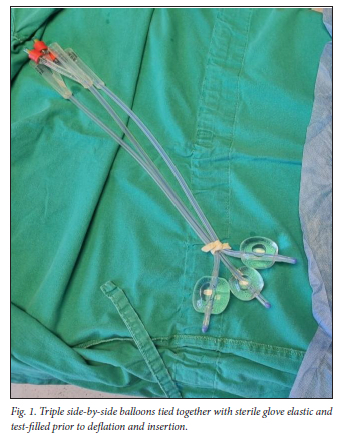
The side-by-side-balloons catheter was prepared prior to insertion on a sterile surface, using sterile surgical gloves. Size 16, 18 or 22 catheters with 30 mL balloons were used. The catheters were tied together 1 cm proximal to the balloons, with a tie made from a sterile surgical glove to ensure that they were at the same level during inflation (Fig. 1). The balloons were inflated to ensure that the tie was not too tight, then deflated. They were inserted under sterile conditions with a speculum. The cervix was cleaned with a disinfectant, and the catheters were inserted using a swab-holding forceps. Each balloon was filled with 60 - 80 mL normal saline. The external end of the catheters was taped together symmetrically and attached with string to a plastic bottle containing 250 mL of water, which was then suspended over the far end of the bed for the duration of the induction, except when the patient was mobile, such as when visiting the bathroom. This is the routine traction method in our service for single Foley catheter labour induction, though randomised trials have not shown benefit (other than earlier expulsion) for either weighted traction or thigh strapping.[16] The catheter remained in place until spontaneous expulsion, or 48 hours after insertion. Any severe adverse events that had occurred would have been reported to the chair of the university ethics committee, who would have advised stopping the trial if there were safety concerns.
Baseline and outcome data were recorded in a data collection sheet.
The primary efficacy outcome for side-by-side balloons labour induction was vaginal birth without the use of misoprostol or oxytocin. Secondary outcomes included: achieving active labour of 5 cm cervical dilation; mode of birth; indication for assisted vaginal or caesarean birth; birthweight; Apgar scores; infection; and postpartum haemorrhage.
Data analysis
Data were entered onto an Excel (Microsoft, USA) spreadsheet and analysed using Epi Info (Centers for Disease Control and Prevention, USA) software. Categorical variables were expressed as proportions (%) and compared using risk ratios (RRs) with 95% confidence intervals (CIs) and the χ2t-test.
The sample size was calculated using Epi Info software. This exploratory study was powered to detect only large differences. To show an increase in the primary outcome from 20% to 60% with 95% certainty and 80% power, we required at least 24 participants in each group (48 in total).
Ethical considerations
Ethical approval was obtained from the Walter Sisulu University Health Sciences Research Ethics Committee (ref. no. 226/2024), as well as the Cecilia Makiwane and Frere Hospital research ethics committees. Each participant was allocated an identification number on the data collection sheet, and participant details were kept confidential. All records were kept under lock and key and on a password-protected computer in the possession of the researcher. Participation was voluntary and could be withdrawn at any time without giving a reason. Not participating or withdrawing would not prejudice care to the participant.
Results
Between 5 April and 6 June 2025, 67 participants were enrolled: 33 into the side-by-side balloons induction group and 34 into the routine induction group.
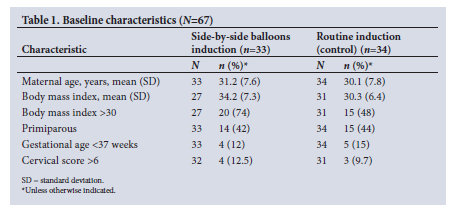
A large proportion of the participants (74% and 48%, respectively) were obese, with a mean body mass index >30 in both arms of the study (Table 1).
Primiparous participants were evenly distributed between the groups (42% side-by-side balloons, 44% routine care), and most participants were at at least 37 weeks of gestation.
Most participants had a cervical score <6.
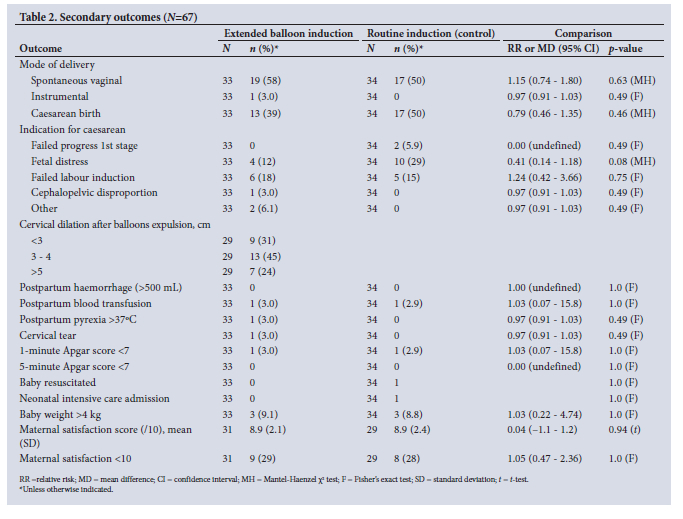
The primary efficacy outcome for the side-by-side balloons group was vaginal birth without use of a uterotonic agent (Table 2). The control group was not suitable as a comparator owing to variable methods of routine labour induction. With single Foley labour induction, progression to labour without augmentation is rare.[17] A large, randomised trial of single Foley labour induction found the rate of labour progression without oxytocin augmentation to be 59/495 (12%),[17] significantly less than in the side-by-side group (RR 2.8, 95% CI 1.6 - 4.8, p=0.002).
There were slightly fewer caesarean births in the side-by-side balloons induction group. However, this was not statistically significant (39% v. 50%, RR 0.79, 95% CI 0.46 - 1.35, p=0.46). There was one participant in the side-by-side balloons induction group who required assistance via instrumental delivery.
The main indications for caesarean births were failed progress of labour in the first stage, fetal distress, failed induction and cephalopelvic disproportion. Fetal distress was somewhat less frequent in the side-by-side balloons group, but the difference was not statistically significant (12% v. 29%, RR 0.41, 95% CI 0.14 - 1.18, p=0.08). Other indications were similar between groups.
After expulsion of the side-by-side catheter, 45% of participants had cervical dilation 3 -4 cm, and 24% had reached the active phase of labour (5 cm). Just under a third (31%) remained <3 cm dilated.
There were frequent delays in the labour induction process of up to a few days between initiation of labour induction and labour augmentation, owing to lack of bed availability in the labour wards. For this reason, the induction to birth times were uninformative (extended balloon induction n=33, mean (SD) 73 (55) hours v. standard induction n=30, 54 (47) hours, p=0.14).
No participants were diagnosed with postpartum haemorrhage. One participant in each group required red cell transfusion. Pyrexia >37°C occurred in one participant in the side-by-side balloons group, and no cause was found. One cervical tear occurred in the side-by-side catheter group.
One neonate in each group had an Apgar score <7 at 1 minute. One of these was a baby in the routine care group with undiagnosed hydrocephalus who required oxygen, suction and stimulation. In the routine care group, one baby required admission into the neonatal intensive care unit.
In each group, three babies weighed >4 kg.
Participants were equally satisfied with both methods. Satisfaction was graded from 1 to 10. Two-thirds of participants in both groups had satisfaction scores of 10 (completely satisfied).
Discussion
One-third of participants in the side-by-side balloons group gave birth vaginally without the use of uterotonics. This is somewhat lower than the proportion in a previous uncontrolled observational study of side-by-side Foley balloons in which 60% gave birth vaginally without uterotonics.[15] Based on published data, single Foley balloon labour induction rarely progresses to labour without augmentation.[18] The current study was underpowered for meaningful comparison of secondary outcomes. The somewhat fewer caesarean births for fetal distress (12% v. 29%) are in keeping with the robust evidence from systematic review showing less fetal compromise with mechanical rather than pharmacological labour induction.[7] Overdiagnosis of fetal distress in both groups by junior staff may have contributed to the relatively high caesarean rates. The demonstrated safety of balloon labour induction has prompted research confirming its safety for out-of-hospital labour induction.'19-
Safety is a key factor in low-resourced settings such as SA, where lack of equipment and staff limit the availability of intensive fetal monitoring during labour. For this reason, it is not unusual for healthcare providers to opt for caesarean birth rather than labour induction, further driving the escalating caesarean rates. The avoidance of artificial amniotomy is also advantageous in settings with high risk of vertical transmission of viral infections. Another potential advantage is for vaginal birth after caesarean, when oxytocin augmentation is risky and misoprostol is contraindicated.
Study limitations
Allocation of the control group to routine labour induction according to local policy rather than a research-driven uniform method, and the limited sample size, are limitations of this study.
Conclusion
The study found that labour induction with side-by-side catheters was associated with vaginal birth in ~60% of cases, and vaginal birth without uterotonics in approximately one-third of cases.
Larger trials are needed to obtain more robust data. Current evidence suggests that this is a promising method for labour induction, particularly when it is considered important to avoid the use of uterotonics and amniotomy.
Trial registration. SANCTR DOH-27-042025-8834, 5 April 2025.
Data availability. Data are available from the authors on reasonable request, subject to an ethics-approved protocol.
Declaration. This study was the subject of RCD's MMed (O&G) dissertation at iYunversithi Walter Sisulu.
Acknowledgements. We thank the participants and the clinical staff at Frere and Cecilia Makiwane hospitals for their contributions to this study.
Author contributions. RCD wrote the first draft of the protocol and the report and was the principal investigator of the trial. SCM, MS-M and GJH contributed to conceptualisation and supervision. All authors contributed to and approved the final manuscript.
Funding. Funding for this study was provided by the first author. Equipment needed for the induction process was acquired from the hospital resources, as the procedure was part of routine care. No further funding was necessary.
Conflicts of interest. GJH has received a UK MRC grant to develop a purpose-designed balloon for extended labour induction/augmentation. The other authors declare no conflicts of interest.
References
-
1. Weeks AD, Espenhahn S, Crowe S. The UK maternity crisis: Analysing the underlying causes to find solutions. BJOG 2025;132(12):1713-1715. https://doi.org/10.1111/1471-0528.18326
» https://doi.org/10.1111/1471-0528.18326 -
2. Vogel JP, Souza JP, Gülmezoglu AM. Patterns and outcomes of induction of labour in Africa and Asia: A secondary analysis of the WHO Global Survey on Maternal and Neonatal Health. PLoS ONE 2013;8(6):e65612. https://doi.org/10.1371/journal.pone.0065612
» https://doi.org/10.1371/journal.pone.0065612 -
3. Benedict MOA, Brits H. Induction of labour practices at Botshabelo District Hospital: Assessing the institutional guidelines. J Public Health Afr 2022;13(2):2153. https://doi.org/10.4081/jphia.2022.2153
» https://doi.org/10.4081/jphia.2022.2153 -
4. Berghella V, Bellussi F, Schoen CN. Evidence-based labor management: Induction of labor (part 2). Am J Obstet Gynecol MFM 2020;2(3):100136. https://doi.org/10.1016/j.ajogmf.2020.100136
» https://doi.org/10.1016/j.ajogmf.2020.100136 -
5. Grobman WA, Rice MM, Reddy UM, et al. Labor induction versus expectant management in low risk nulliparous women. N Engl J Med 2018;379(6):513-523. https://doi.org/10.1056/NEJMoa1800566
» https://doi.org/10.1056/NEJMoa1800566 -
6. De Vaan MDT, Ten Eikelder ML, Jozwiak M, et al. Mechanical methods for induction of labour. Cochrane Database Syst Rev 2023;3(3):CD001233. https://doi.org/10.1002/14651858.CD001233.pub4.
» https://doi.org/10.1002/14651858.CD001233.pub4 -
7. Khan H, Buaki-Sogo MA, Barlow P, et al. Efficacy of pharmacological and mechanical cervical priming methods for induction of labour and their applicability for outpatient management: A systematic review of randomised controlled trials. Eur J Obstet Gynecol Reprod Biol 2023;287:80-92. https://doi.org/10.1016/j.ejogrb.2023.05.037
» https://doi.org/10.1016/j.ejogrb.2023.05.037 -
8. De Vaan MDT, Biel D, Bloemenkamp KWM, et al. Induction of labor with Foley catheter and risk of subsequent preterm birth: Follow-up study of two randomised controlled trials (Probaat-1 and -2). Ultrasound Obstet Gynaecol 2021;57(2):292-297. https://doi.org/10.1002/uog.23117
» https://doi.org/10.1002/uog.23117 -
9. Hofmeyr GJ, Singata-Madliki M, Ripa SD, Weeks AD. Achieving equitable access to obstetric devices through innovation, improvisation and off-label use. BJOG 2025;132(13):1903-1909. https://doi.org/10.1111/1471-0528.70058
» https://doi.org/10.1111/1471-0528.70058 -
10. Wickramasingh RPTB, Senanayake H, de Silva C. Intrauterine Foley catheter for 48 versus 24 hours for cervical ripening: A randomised controlled trial. Int J Gynaecol Obstet 2020;149(2):225-230. https://doi.org/10.1002/ijgo.13109
» https://doi.org/10.1002/ijgo.13109 -
11. Melamed N, Baschat A, Yinon Y, et al. FIGO (International Federation of Gynaecology and Obstetrics) initiative on fetal growth: Best practice advice for screening, diagnosis and management of fetal growth restriction. Int J Gynaecol Obstet 2021;152(S1):3-57. https://doi.org/10.1002/ijgo.13522
» https://doi.org/10.1002/ijgo.13522 -
12. Solt I, Frank Wolf M, Ben-Haroush S, Kaminskyi S, Ophir E, Bornstein J. Foley catheter versus cervical double balloon for labor induction: A prospective randomised study. J Matern Fetal Neonatal Med 2021;34(7):1034-1041. https://doi.org/10.1080/14767058.2019.1623776
» https://doi.org/10.1080/14767058.2019.1623776 -
13. Schoen CN, Saccone G, Backley S, et al. Increased single-balloon Foley catheter volume for induction of labor and time to delivery: A systematic review and meta-analysis. Acta Obstet Gynaecol Scand 2018;97(9):1051-1060. https://doi.org/10.1111/aogs.13353
» https://doi.org/10.1111/aogs.13353 -
14. Hofmeyr GJ, Dalmacio R. Novel side by side Foley catheter balloons for 'extended labour induction': Concept, simulation study and clinical application. Eur J Obstet Gynecol Reprod Biol 2021;266:133-137. https://doi.org/10.1016/j.ejogrb.2021.09.032
» https://doi.org/10.1016/j.ejogrb.2021.09.032 -
15. Matshitsa L, Mercy-Nkuba N, Hofmeyr GJ. Extended balloon labour induction: A single arm proof of concept trial. Eur J Obstet Gynecol Reprod Biol 2023;19:100226. https://doi.org/10.1016/j.eurox.2023.100226
» https://doi.org/10.1016/j.eurox.2023.100226 -
16. Schoen CN, Saccone G, Berghella V, Baker EG. Traction vs no traction in Foley catheter use for induction of labor: A systematic review and meta-analysis of randomised trials. Am J Obstet Gynecol 2022;4(4):100610. https://doi.org/10.1016/j.ajogmf.2022.100610
» https://doi.org/10.1016/j.ajogmf.2022.100610 -
17. Gu N, Ru T, Wang Z, et al. Foley catheter for induction of labor at term: An open-label, randomised controlled trial. PLoS ONE 2015;10(8):e0136856. https://doi.org/10.1371/journal.pone.0136856
» https://doi.org/10.1371/journal.pone.0136856 -
18. Sciscione AC, McCullough H, Manley JS, Shlossman PA, Pollock M, Colmorgen GH. A prospective, randomised comparison of Foley catheter insertion versus intracervical prostaglandin E2 gel for preinduction cervical ripening. Am J Obstet Gynecol 1999;180(1 Pt 1):55-60. https://doi.org/10.1016/s0002-9378(99)70149-3
» https://doi.org/10.1016/s0002-9378(99)70149-3 -
19. Chan F, Patabendige M, Wise MR, et al. Inpatient vaginal dinoprostone vs outpatient balloon catheters for cervical ripening in induction of labor: An individual participant data meta-analysis of randomised controlled trials. Acta Obstet Gynecol Scand 2025;104(6):1041-1055. https://doi.org/10.1111/aogs.15092
» https://doi.org/10.1111/aogs.15092

Accepted 12 March 2026