Delay in commencing treatment for MDR TB at a specialised TB treatment centre in KwaZulu-Natal
BACKGROUND: According to the National Department of Health (NDoH) guidelines, patients diagnosed with multidrug-resistant tuberculosis (MDR TB) must be referred to a specialised treatment centre for initiation of effective therapy. MDR TB is difficult to diagnose and the centralised referral model is beset with challenges that contribute to treatment delays, increased patient morbidity and mortality, and MDR TB nosocomial transmission. Culture and drug sensitivity testing (DST) takes 8 weeks or longer to obtain results while line probe assays (LPAs) can give a result in hours. LPAs and the GeneXpert MTB/Rif (GX) are ground-breaking discoveries for TB diagnosis. However, they are not easily accessible or available to those needing it, so culture and sensitivity testing remains the gold standard for diagnosis. AIM: This study aimed to assess the delay in the initiation of MDR TB treatment and profiled the patients being referred to a specialised drug-resistant treatment centre in KwaZulu-Natal. RESULTS: Of all the patients, 75% referred showed a mean delay of 12.4 weeks from the date of sputum collection for culture and drug sensitivity testing to the start of treatment. Most of the patients were symptomatic for TB and HIV-positive. DISCUSSION: Our findings suggest that current policy on the initiation of effective treatment needs urgent revision. Staff should be appropriately trained in LPA and GX technology to reduce delays in initiating treatment for MDR TB. The NDoH's plans for rapid diagnosis and reducing the treatment burden on centralised MDR TB management facilities are in the early phases of implementation and will take years to achieve favourable and significant outcomes. CONCLUSION: There is a significant delay in initiating definitive management for MDR TB
Delay in commencing treatment for MDR TB at a specialised TB treatment centre in KwaZulu-Natal
R NarasimoolooI; A RossII
IMB BS. Department of Family Medicine, University of KwaZulu-Natal and Medical Research Council TB Unit, Durban
IIMB ChB. MFamMed. Department of Family Medicine, University of KwaZulu-Natal and Medical Research Council TB Unit, Durban
BACKGROUND: According to the National Department of Health (NDoH) guidelines, patients diagnosed with multidrug-resistant tuberculosis (MDR TB) must be referred to a specialised treatment centre for initiation of effective therapy. MDR TB is difficult to diagnose and the centralised referral model is beset with challenges that contribute to treatment delays, increased patient morbidity and mortality, and MDR TB nosocomial transmission. Culture and drug sensitivity testing (DST) takes 8 weeks or longer to obtain results while line probe assays (LPAs) can give a result in hours. LPAs and the GeneXpert MTB/Rif (GX) are ground-breaking discoveries for TB diagnosis. However, they are not easily accessible or available to those needing it, so culture and sensitivity testing remains the gold standard for diagnosis.
AIM: This study aimed to assess the delay in the initiation of MDR TB treatment and profiled the patients being referred to a specialised drug-resistant treatment centre in KwaZulu-Natal.
RESULTS: Of all the patients, 75% referred showed a mean delay of 12.4 weeks from the date of sputum collection for culture and drug sensitivity testing to the start of treatment. Most of the patients were symptomatic for TB and HIV-positive.
DISCUSSION: Our findings suggest that current policy on the initiation of effective treatment needs urgent revision. Staff should be appropriately trained in LPA and GX technology to reduce delays in initiating treatment for MDR TB. The NDoH's plans for rapid diagnosis and reducing the treatment burden on centralised MDR TB management facilities are in the early phases of implementation and will take years to achieve favourable and significant outcomes.
CONCLUSION: There is a significant delay in initiating definitive management for MDR TB.
South Africa has the highest incidence and mortality rates of tuberculosis (TB) in the world.1213332334
Methods
The study hospital is a centralised treatment and referral centre for MDR TB in KwaZulu-Natal. The referral prerequisite is confirmation of MDR TB by culture and DST. Although LPAs are used, this has not been integrated into the NDoH treatment guidelines, and therefore a culture and DST is still the gold standard for diagnosis.3,5,6 Patients referred with results using tests other than culture and DST are assessed, and treatment is only initiated with confirmed results.3
We included all patients referred to the hospital in 2010 with a DST result confirming MDR pulmonary TB that qualified for treatment. Patients who presented with extrapulmonary MDR TB, mono- or polyresistant TB (not to isoniazid and rifampicin) and who did not present with results, were excluded. On average during 2010, 100 patients per month were initiated on treatment.
A sample size of 200, representing 20% of the study population, was chosen. All the charts of patients initiated on treatment in 2 random months were analysed. Data from patient records and the hospital database were gathered on a data collation sheet and entered on a Microsoft Excel spreadsheet and analysed using the SPSS programme.
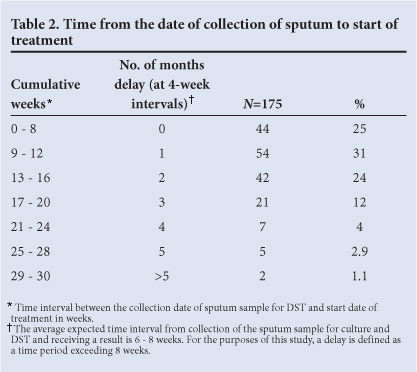
Descriptive analysis involved mean, standard deviation and range in normally distributed quantitative variables. As this was a descriptive study, no hypothesis was tested. The time interval (in weeks) between the collection of the sputum sample for culture and DST and the start of treatment was calculated. A delay was defined as the interval between sending sputum for DST testing and initiation of effective treatment exceeding 8 weeks; an acceptable range is between 6 and 8 weeks.3,5
Ethical approval was obtained from the Biomedical Research Ethics Committee of the University of KwaZulu-Natal and the Research Ethics Committee of the hospital where the study was conducted.
Results
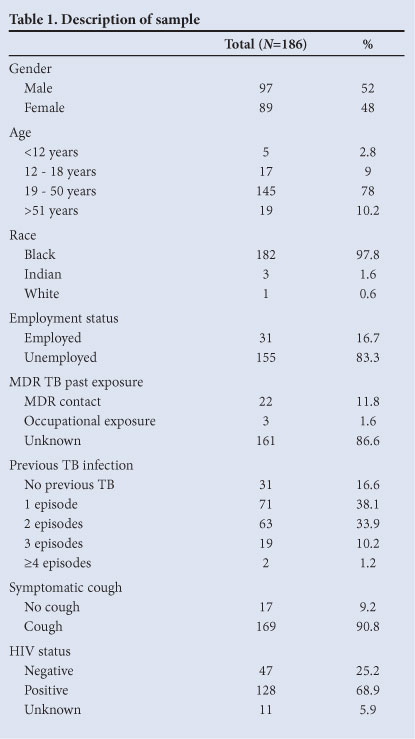
In total, 1 158 patients were referred to the study hospital in 2010; 207 patient charts were reviewed of which 21 were excluded because they did not meet the inclusion criteria. Most patients were black, aged between 19 and 50 years, with an almost equal representation of men and women. Patients were mostly unemployed and symptomatic for TB with at least one previous TB episode. MDR TB contact history was poorly documented (Table 1). Of the patients, 69% were HIV-positive, on antiretroviral therapy (ART) (75%) with CD4 counts <250 (59%); 74 (40%) were managed as inpatients, 101 (54%) as outpatients, and 11 (6%) were placed on the surveillance programme. This programme applies to patients referred with confirmatory DST results but who were not considered to have active MDR TB disease. Patients from the eThekwini municipality comprised 47%, while 63% were from neighbouring districts; 111 (59.7%) were on standard TB regimens at the time of referral, while 75 (40.3%) were not on treatment. The mean delay from the date of collection of the sputum sample for culture and DST to initiation of treatment was 12.36 weeks (range 3 - 30 weeks) (Table 2).
Discussion
We aimed to investigate the time from the collection of sputum samples for DST to the initiation of effective therapy. A similar study in Cape Town showed an average of 5 - 6 weeks' delay in initiation of treatment for patients with MDR TB.7889310,11 As part of the solution, the NDoH has suggested a decentralised model of MDR TB management; this may help to reduce the number of days between diagnosis and treatment initiation by increasing the number of treatment centres for referral, which will in turn reduce the transmission of disease.44
The World Health Organization (WHO) endorsed the use of LPAs for detecting TB and MDR TB, which decreases time to diagnosis from weeks to a day, and which requires highly trained technical staff.6128812
MDR TB is compounded by the current policy of only treating MDR TB based on DST, regardless of the results from the GX. This policy completely negates the advantages of using the GX to diagnose MDR TB. Although documentation was poor, 22 patients (11.8%) gave a history of a known MDR TB contact. There were 31 patients (16%) with primary MDR TB (i.e. no previous TB history), with an incidence of 55% in women and 45% in men. The high number of primary MDR TB patients in the sample is of concern, as it is much higher than the 1.8% of the MDR TB population estimated by the NDoH. Ours is a small sample but, if representative, it warrants further investigation. Based on this finding, healthcare workers must ensure that all high-risk patients presenting with TB are screened for MDR TB as per NDoH guidelines.3213
Conclusion
There is a significant time delay in the initiation of effective treatment for patients with MDR TB. Most of the patients who presented to the clinic were coughing, thereby fuelling the spread of community-transmitted MDR TB. LPAs and the GX are groundbreaking discoveries for TB diagnosis; however, they are not yet easily accessible or available to those in need of it. In view of the findings from this study, current policy on the initiation of effective treatment based on these results will need to be revised urgently. In addition, all staff should receive appropriate training if the newer technology is to reduce delays in initiation of treatment for MDR TB. The NDoH's proposed plans for rapid diagnosis and reducing the treatment burden on centralised MDR TB management facilities are all in the early phases of implementation, and it will take many more years to achieve a favourable and significant outcome.
Acknowledgements
We thank Doctors Cindy Narasimooloo, Laura Campbell and I Master, and Mrs Veronica Raman, Mr Sashin Moodliar and Ms Tonya Esterhuizen, for their inputs.
References
-
1. World Health Organization. Anti-tuberculosis Drug Resistance in the World. Report No. 4, 2008. WHO/HTM/TB/2008.394. http://www.who.int/tb/publications/2008/drs_report4_26feb08. pdf (accessed 11 March 2011).
» http://www.who.int/tb/publications/2008/drs_report4_26feb08. pdf -
2. World Health Organization. Multidrug and Extensively Drug-resistant TB: Global Report on Surveillance and Response. (2010). http://whqHbdoc.who.int/publications/2010/9789241599191_en_pdf (accessed 11 March 2011).
» http://whqHbdoc.who.int/publications/2010/9789241599191_en_pdf - 3. National Department of Health. Management of Drug Resistant Tuberculosis. National Policy Guidelines. Pretoria: NDoH, 2010.
-
4. National Department of Health. Multidrug-resistant Tuberculosis. A Policy Framework on Decentralized and Deinstitutionalized Management for South Africa. Pretoria: NDoH, 2011. http://www.doh.gov.za/docs/policy/2011/policy_TB.pdf (accessed 22 December 2011).
» http://www.doh.gov.za/docs/policy/2011/policy_TB.pdf -
5. Loddenkemper R, Hauer B. Drug-resistant tuberculosis: a worldwide epidemic poses a new challenge. Dtsch Arztebl Int 2010; 107(1-2):9-10. [http://dx.doi.org/10.3238/arztebl.2010.0010].
» http://dx.doi.org/10.3238/arztebl.2010.0010 -
6. World Health Organization. Molecular Line Probe Assays for Rapid Screening of Patients at Risk of Multidrug-resistant Tuberculosis. A Policy Statement. June, 2008. http://www.who.int/tb/laboratory/lpa_policy.pdf (accessed 22 December 2011).
» http://www.who.int/tb/laboratory/lpa_policy.pdf - 7. Bamford CM, Taljaard JJ. Potential for nosocomial transmission of multidrug-resistant tuberculosis (MDR TB) in a South African hospital SAfr Med J 2010;100(7):438-441.
- 8. Institute of Medicine (IOM). The Emerging Threat of Drug-resistant Tuberculosis in Southern Africa: Global and local Challenges and Solutions (Summary of a joint workshop). Washington, DC: National Academy Press, 2011.
- 9. Johnson R, Warren G, van der Spuy N, et al. Drug-resistant tuberculosis epidemic in the Western Cape driven by a virulent Beijing genotype strain. Int J Tuberc Lung Dis 2010;14:119-121.
-
10. Chern JPS, Chen DR, Wen T. Delayed treatment of diagnosed pulmonary tuberculosis in Taiwan. BMC Public Health 2008;8:236 [http://dx.doi.org/10.1186/1471-2458-8-236].
» http://dx.doi.org/10.1186/1471-2458-8-236 -
11. Farah MG, Rygh JH, Steen TW, Selmer R, Heldal E, Bjune G. Patient and health systems delays in the start of tuberculosis treatment in Norway. BMC Infect Dis 2006;6:33 [http://dx.doi.org/10.1186/1471-2334-6-33].
» http://dx.doi.org/10.1186/1471-2334-6-33 -
12. National Health Laboratory Service. Gene Expert Implementation. http://www.nhls.ac.za/?page=genexpert_implementation&id=69 (accessed 4 January 2012).
» http://www.nhls.ac.za/?page=genexpert_implementation&id=69 - 13. National Department of Health. South African HIV ART Guidelines. Pretoria: NDoH, 2010.