Impact of the international Rugby Board's experimental iaw variations on the incidence and nature of match injuries in southern hemisphere professional rugby union
OBJECTIVE: To examine the epidemiology of match injuries in southern hemisphere professional rugby union and assess the impact of the International Rugby Board (IRB) Experimental Law Variations. SETTING: One-season whole population prospective cohort. SUBJECTS: Twenty-seven teams (813 players) taking part in the 2008 Super 14 and Vodacom Cup competitions. OUTCOME MEASURES: Incidence, severity, location, type and cause of injury. RESULTS: The incidence in the Super 14 competition (96.3 injuries/1 000 player-match hours; 95% confidence interval (CI) 69.0 - 111.7) was significantly higher (p=0.003) than that in the Vodacom Cup (71.2; CI 60.0 - 84.5); injury severity was significantly lower (p<0.001) in the Super 14 (mean 13.4 days; median 5) than the Vodacom Cup (mean 21.2; median 12). There were no significant differences between the two competitions in type or location of injury: lower limb muscle/ tendon (Super 14: 27.8%; Vodacom Cup: 25.7%) and joint (non-bone)/ligament (Super 14: 18.8%; Vodacom Cup: 24.3%) were the most common injuries. Injury causation was similar for the two competitions but there were significantly fewer ruck/maul (p=0.001) and more tackled (p=0.010) injuries in Super 14 compared with English Premiership rugby and fewer collision (p=0.002) and more tackling (p<0.001) injuries compared with Rugby World Cup. In the Vodacom Cup, there were significantly more tackling (p<0.001) injuries compared with Rugby World Cup. CONCLUSION: The incidence, nature and causes of injuries in southern hemisphere professional club rugby played under IRB Experimental Law Variations were similar to those for professional club rugby in the northern hemisphere and Rugby World Cup played under the previous Laws of Rugby.
Impact of the international Rugby Board's experimental iaw variations on the incidence and nature of match injuries in southern hemisphere professional rugby union
Colin W FullerI; Martin RafteryII; Clint ReadheadIII; Stephen G R TargettIV; Michael G MolloyV
IPhD. Centre for Sports Medicine, University of Nottingham, Nottingham, UK
IIMB. Australian Rugby Union, Sydney, Australia
IIIBSc. South African Rugby Union, Newlands, Cape Town
IVMB. New Zealand Rugby Union, Wellington, New Zealand
VMB. International Rugby Board, Dublin, Ireland
OBJECTIVE: To examine the epidemiology of match injuries in southern hemisphere professional rugby union and assess the impact of the International Rugby Board (IRB) Experimental Law Variations.
SETTING: One-season whole population prospective cohort.
SUBJECTS: Twenty-seven teams (813 players) taking part in the 2008 Super 14 and Vodacom Cup competitions.
OUTCOME MEASURES: Incidence, severity, location, type and cause of injury.
RESULTS: The incidence in the Super 14 competition (96.3 injuries/1 000 player-match hours; 95% confidence interval (CI) 69.0 - 111.7) was significantly higher (p=0.003) than that in the Vodacom Cup (71.2; CI 60.0 - 84.5); injury severity was significantly lower (p<0.001) in the Super 14 (mean 13.4 days; median 5) than the Vodacom Cup (mean 21.2; median 12). There were no significant differences between the two competitions in type or location of injury: lower limb muscle/ tendon (Super 14: 27.8%; Vodacom Cup: 25.7%) and joint (non-bone)/ligament (Super 14: 18.8%; Vodacom Cup: 24.3%) were the most common injuries. Injury causation was similar for the two competitions but there were significantly fewer ruck/maul (p=0.001) and more tackled (p=0.010) injuries in Super 14 compared with English Premiership rugby and fewer collision (p=0.002) and more tackling (p<0.001) injuries compared with Rugby World Cup. In the Vodacom Cup, there were significantly more tackling (p<0.001) injuries compared with Rugby World Cup.
CONCLUSION: The incidence, nature and causes of injuries in southern hemisphere professional club rugby played under IRB Experimental Law Variations were similar to those for professional club rugby in the northern hemisphere and Rugby World Cup played under the previous Laws of Rugby.
Rugby union is a contact team sport played throughout the world by adults and children of all ages. The popularity of the sport is due to the physical nature of the game and also its ability to offer roles for athletes of all shapes and sizes (IRB, 2008).1 1
Additionally, it is essential that the risk of injury to players is also monitored as part of the ELV evaluation process because of the high incidence of match injuries in rugby union. For international rugby, incidence of injury was recorded as 98 missed-match and medical treatment injuries/1 000 playermatch hours at RWC 2003,2 3 4 5 6 7
Methods
Players from the 14 teams (Australia: 4; New Zealand: 5; South Africa: 5) involved in the 2008 Super 14, and 13 of the 14 teams involved in the 2008 Vodacom Cup in South Africa, took part in the study. In total, 813 players (Super 14: 441; Vodacom Cup: 372) were included. The two competitions took place concurrently over the period February - May 2008; all proposed ELVs were implemented during the Vodacom Cup, and a limited number during the Super 14 competition.8
Lineout:
• no restrictions on the number of players in the lineout (Vodacom Cup)
• players may pre-grip and lift lineout jumpers (Super 14 and Vodacom Cup)
Tackle/post-tackle:
• players on their feet may play the ball with their hands (Vodacom Cup)
Maul:
• defending players may pull down a maul (Vodacom Cup).
A detailed manual describing the aims, definitions and procedures for the study, and containing injury report forms, was prepared and distributed to the medical staff of each participating team before the start of the two competitions. Definitions and procedures described in the manual were consistent with the consensus statement for injury surveillance studies in rugby union.7
Players' baseline information (age in years, free-standing stature in cm, body mass in kg and normal playing position) and consent for data to be included in the study were collected prior to the start of the competitions. An injury was defined as 'any injury sustained during a Super 14 or Vodacom Cup match that prevented the player from taking a full part in all training activities planned for that day and/or match play for more than one day following the day of injury'. Injuries were classified by location, type, Orchard Code9
Data analysis
A sample size calculation indicated that match exposures of 2 400 player-hours in each competition would be sufficient to identify a 33% difference in the incidence of time-loss injuries between the competitions with 90% power and 95% confidence. Players' baseline data were reported as means (standard deviation); incidences as injuries/1 000 player-match hours (95% confidence interval (CI)); distributions as percentages (95% CI); and severities as mean and median values and grouped within the categories of minimal (2 - 3 days), mild (4 - 7 days), moderate (8 - 28 days) and severe (>28 days), as defined in the rugby consensus statement.7 t-test for anthropometric measurements, z-values for the rate ratio of injury incidence, z-values for difference in proportions, and the Mann-Whitney test for injury severity.10 p<0.01. Wherever possible, data collected in this study were compared with the equivalent results published for the English Premiership4 3
Results
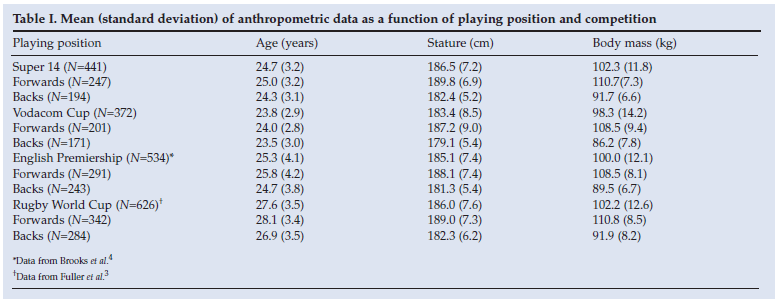
Table I shows the mean age, stature and body mass of the players in the two competitions, together with equivalent data for the English Premiership and Rugby World Cup. Super 14 players were significantly older (forwards: p<0.001; backs: p=0.019), taller (forwards: p<0.001; backs: p<0.001) and heavier (forwards: p=0.007; backs: p<0.001) than Vodacom Cup players. Compared with English Premiership players, Super 14 players were younger (p=0.012), taller (p=0.003) and heavier (p=0.003), whereas Vodacom Cup players were younger (p<0.001), shorter (p<0.001) and lighter (p<0.001). Compared with RWC players, Super 14 players were younger (p<0.001) but were similar in stature (p=0.280) and body mass (p=0.889), whereas Vodacom Cup players were significantly (p<0.001) younger, lighter and shorter.
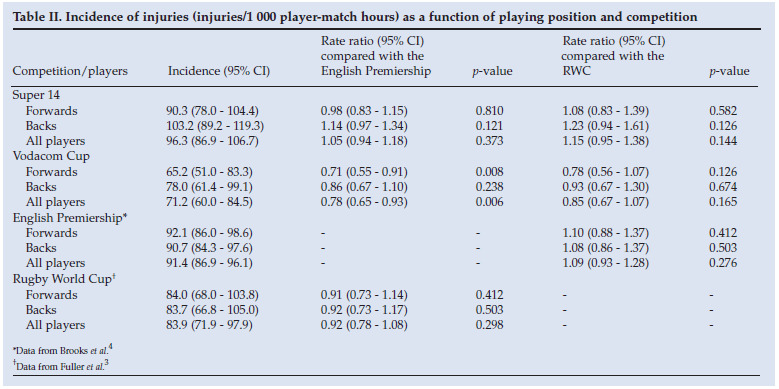
Included in the study were 280 team-games (Super 14: 188; Vodacom Cup: 92), which equated to 5 600 player-match hours (Super 14: 3 760; Vodacom Cup: 1 840). This exposure resulted in 493 time-loss injuries (Super 14: 362; Vodacom Cup: 131) and 179 missed-match injuries (Super 14: 105; Vodacom Cup: 74); no fatal or catastrophic spinal injuries were recorded during either competition. Table II summarises the incidences of injuries for both competitions and the English Premiership and Rugby World Cup. Although the overall incidence of injury in the Super 14 competition was significantly higher (p=0.003) than in the Vodacom Cup, there were no significant differences between the competitions when forwards and backs were compared separately. The incidence of missed-match injuries was lower in the Super 14 competition (27.9 (95% CI: 23.2 -33.8) injuries/1 000 player-match hours) compared with the Vodacom Cup (40.2 (95% CI: 32.0 - 50.5)) but the difference was not significant (p=0.016). There were no significant differences in the incidence of injury for the Super 14 competition compared with the English Premiership and Rugby World Cup; but for the Vodacom Cup, the overall incidence of injury was significantly lower than that observed in the English Premiership, which was the result of the significantly lower incidence of injury observed for forwards in the Vodacom Cup.
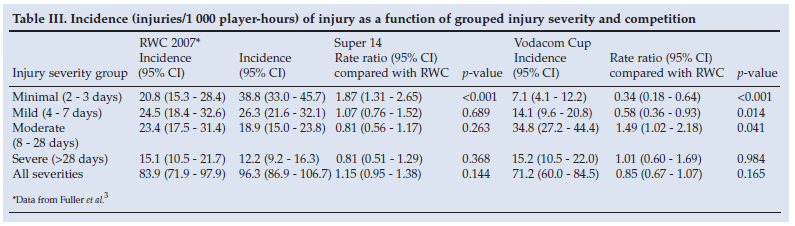
There was a significant difference in the severity of injuries between the two competitions (Super 14: mean 13.4, median 5; Vodacom Cup: mean 21.2, median 12; p<0.001). The incidences of injury as a function of grouped severity for the two competitions and the RWC are shown in Table III; equivalent data were not available for the English Premiership. Compared with the RWC, the incidence of minimal injuries was significantly higher in the Super 14 and significantly lower in the Vodacom Cup.
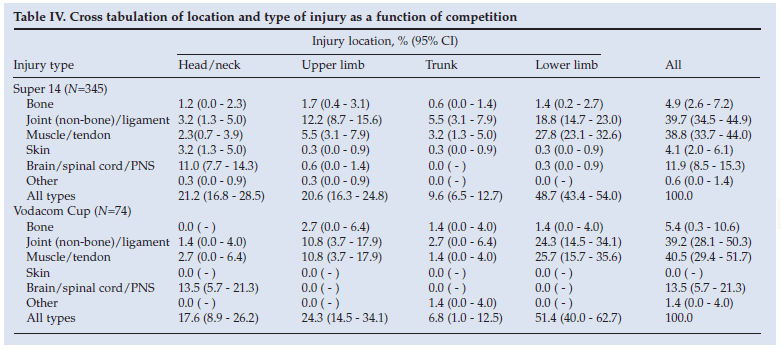
Table IV provides a cross-tabulation of the location and type of injuries for both competitions; there were no significant differences in the nature of the injuries sustained between the two competitions or in comparison with the English Premiership or the RWC. The most common injuries in both competitions were lower limb muscle/tendon (Super 14: 27.8%; Vodacom Cup: 25.7%; p=0.708) and lower limb joint (non-bone)/ligament (Super 14: 18.8%; Vodacom Cup: 24.3%; p=0.285). The five most commonly reported injuries across the two competitions were concussion (9.7%), ankle ligament (8.7%), quadriceps haematoma (5.9%), knee ligament (5.4%) and hamstring muscle strain (4.7%) injuries.
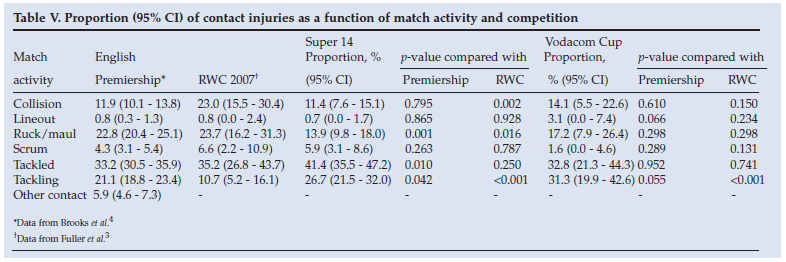
Table V shows the distributions of injuries as a function of the type of contact event causing the injuries in both competitions, the English Premiership and the RWC. There were no significant differences between the two competitions. Compared with the English Premiership, there were significantly fewer ruck/maul (p=0.001) and more tackle (p=0.010) injuries in the Super 14. Compared with the RWC, there were significantly fewer collision (p=0.002) and more tackling (p<0.001) injuries in the Super 14, and more tackling (p<0.001) injuries in the Vodacom Cup.
Discussion
The Super 14 competition comprises the leading professional club rugby players from Australia, New Zealand and South Africa, and it represents a similar standard of play to the Premiership in England; the Vodacom Cup involves the second tier of professional players in South Africa. Although there were significant differences in players' anthropometric measurements between the two competitions and compared with the English Premiership and RWC, the differences in absolute terms were small when compared, for example, with the differences between these players and elite 18-year-old South African rugby players11 p<0.001; body mass: 84.9 kg, p<0.001). For the purposes of this study, the players from both competitions were regarded as being of similar stature and body mass to players from the English Premiership and Rugby World Cup.
Previous studies of southern hemisphere professional rugby teams used different definitions of injury from the present study, which followed the recommendations of the rugby consensus statement;7 5 et al.6 4 3
Injuries reported in the Vodacom Cup were significantly more severe than those reported in the Super 14 competition; this was mainly due to the higher incidences of minimal and mild injuries reported by Super 14 teams compared with Vodacom Cup teams. Comparisons of injury severity with previous Super 12 studies were not possible, as mean and median severity values were not published for either study.5,6 The severity values reported in the present study, however, compare closely with the mean values of 18 and 15 days reported for the English Premiership4 3 3
There were no significant differences in the nature of injuries sustained in the Super 14 and Vodacom Cup competitions, with the highest proportions of injuries in both competitions being lower limb muscle/tendon and joint (non-bone)/ligament injuries. It was not possible to compare the present results with previous studies of Super 12 competitions, as diagnoses for match and training injuries were grouped together in both the earlier studies. There were, however, no significant differences in the nature of injuries in either competition compared with equivalent results reported for the English Premiership4 3 4 3 12
The Super 14 and Vodacom Cup competitions covered by the present study were played under the ELVs8 1
The authors acknowledge the invaluable contribution made by medical staff at all the rugby clubs in recording match injuries during this study.
References
- 1. International Rugby Board. Playing Charter and Laws of the Game - Rugby Union. Dublin: International Rugby Board, 2008.
- 2. Best JP, McIntosh AS, Savage TN. Rugby World Cup 2003 injury surveillance project. Br J Sports Med 2005; 39: 812-817.
- 3. Fuller CW, Laborde F, Leather RJ, Molloy MG. International Rugby Board Rugby World Cup 2007 injury surveillance study. Br J Sports Med 2008; 42: 452-459.
- 4. Brooks JHM, Fuller CW, Kemp SPT, Reddin DB. Epidemiology of injuries in English professional rugby union: Part 1 - Match injuries. Br J Sports Med 2005; 39: 757-766.
- 5. Targett SGR. Injuries in professional rugby union. Clin J Sports Med 1998; 8: 280-285.
- 6. Holtzhausen LJ, Schwellnus MP, Jakoet I, Pretorius AL. The incidence and nature of injuries in South African rugby players in the rugby Super 12 competition. S Afr Med J 2006; 96: 1260-1265.
- 7. Fuller CW, Molloy MG, Bagate C, et al. Consensus statement on injury definitions and data collection procedures for studies of injuries in rugby union. Clin J Sports Med 2007a; 17: 177-181.
-
8. International Rugby Board. Super 14 kicks off latest ELV test. www.irb.com/newsmedia/mediazone/pressrelease/newsid=2022256.html (accessed 15 September 2008).
» www.irb.com/newsmedia/mediazone/pressrelease/newsid=2022256.html -
9. Orchard J. Orchard Sports Injury Classification System (OSICS). http://www.injuryupdate.com.au/research/OSICS8.pdf. (accessed 3 June 2008).
» http://www.injuryupdate.com.au/research/OSICS8.pdf - 10. Kirkwood BR, Sterne JAC. Essential Medical Statistics. Oxford: Blackwell Science, 2003.
- 11. Durandt J, du Toit S, Borresen J, et al. Fitness and body composition profiling of elite junior South African rugby players. S Afr J Sports Med 2006; 18: 38-45.
- 12. Fuller CW, Brooks JHM, Cancea RJ, Hall J, Kemp SPT. Contact events in rugby union and their propensity to cause injury. Br J Sports Med 2007b; 41: 862-867.