Pitfalls of administering drugs via nasogastric tubes
SAMJ FORUM
CLINICAL PRACTICE
Pitfalls of administering drugs via nasogastric tubes
Eric Decloedt; Gary Maartens
Crushing tablets and opening capsules before administration via nasogastric or enteral feeding tubes is a widespread practice. A survey of nursing homes in the UK reported that more than 80% crush tablets on at least a weekly basis, and 40% of nurses crush tablets on every drug round.1 2 2
This article highlights the problems associated with administering drugs via nasogastric or enteral feeding tubes, and suggests ways of improving the safety of this practice.
Altered absorption
Enteric-coated tablets protect the active ingredient against degradation by gastric acid, and crushing these tablets will reduce the bioavailability of the drug. For example, omeprazole is a lipophilic weak base that is unstable at a low pH and is formulated in a gelatin capsule containing small entericcoated granules that release the drug at a pH of >6.3 3
Erratic drug concentrations may be caused by crushing controlled-release drug formulations. Decreased bioavailability of a sustained-release formulation of theophylline, which is likely to reduce efficacy, was observed when it was crushed and administered via nasogastric tube.4 5 6
Drug-enteral feed interaction
Flushing crushed tablets down the nasogastric tube with enteral feeds is a common nursing practice that may cause sub-therapeutic concentrations if the administered drug binds to the feed. Serum concentrations of phenytoin are reduced by 72% when it is administered with enteral feeds.7 8 9
Mechanics of crushing - interactions and hypersensitivity
Crushing different medications in the same receptacle should be avoided owing to possible drug interactions. For example, the bioavailability of tetracycline is decreased when it is crushed together with iron supplements because of formation of poorly soluble tetracycline-iron chelates.10
It is important to clean the pestle and mortar properly before crushing tablets for the next patient to prevent hypersensitivity reactions, which may be triggered after exposure to a small amount of the drug allergen.
Binding to the nasogastric tube
Nasogastric tubes are made of polyvinyl chloride, and certain drugs (e.g. phenytoin11 12 13 1412
Tube occlusion
Administering crushed medication via a nasogastric tube may occlude the tube. Bulk-forming laxatives, such as ispaghula, form a semi-solid mass that may occlude the tube.9 15 15
Rate of gastric emptying
Gastric emptying may be delayed in critically ill or postoperative patients who require nasogastric tubes. Delayed gastric emptying will reduce the bioavailability of drugs that are either crushed and administered via nasogastric tube or taken orally. Paracetamol16 17
Medico-legal implications
Drugs are registered to be administered as particular formulations, and altering the formulation before administration renders their use off-label. Consequently the manufacturer will assume no responsibility for any harm caused to the patient by crushing tablets.1 18,19 fluconazole,20 21 2223 1
Guidelines for safer practices
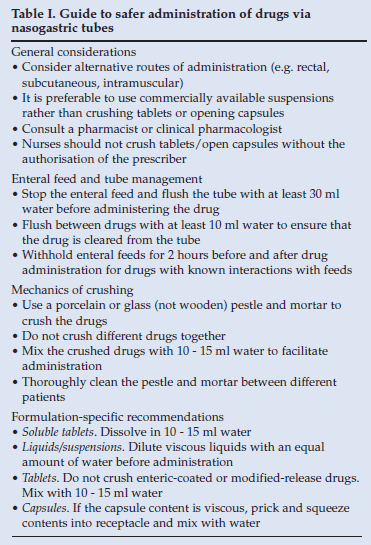
Table I lists safer practices for administering drugs to patients with nasogastric or enteral feeding tubes.
References
- 1. Wright D. Medication administration in nursing homes. Nurs Stand 2002; 16(42): 33-38.
-
2. Haywood A, Nissen L, Gardiner E. Crushing and altering medications in Queensland hospitals. Davey A, ed. Annual Conference of the Australasian Pharmaceutical Science Association (APSA), 3 - 5 December 2006. Adelaide: APSA, 2006. http://hdl.handle.net/10072/14752 (accessed 4 January 2009).
» http://hdl.handle.net/10072/14752 - 3. Larson C, Cavuto NJ, Flockhart DA, Weinberg RB. Bioavailability and efficacy of omeprazole given orally and by nasogastric tube. Dig Dis Sci 1996; 41(3): 475-479.
- 4. Berkovitch M, Dafni O, Leiboviz A, Mayan H, Habut B, Segal R. Therapeutic drug monitoring of theophylline in frail elderly patients: oral compared with nasogastric tube administration. Ther Drug Monit 2002; 24(5): 594-597.
- 5. Lepage RM. Pharmacokinetics and Pharmacodynamics of Crushed and Intact Nifedipine Prolonged-Action (AdalatRTM PA) Tablets in Healthy Male Volunteers. Ottawa: National Library of Canada, 2001.
- 6. Schier JG, Howland MA, Hoffman RS, Nelson LS. Fatality from administration of labetalol and crushed extended-release nifedipine. Ann Pharmacother 2003;37(10): 1420-1423.
- 7. Bauer LA. Interference of oral phenytoin absorption by continuous nasogastric feedings. Neurology 1982; 32(5): 570-572.
- 8. Mueller BA, Brierton DG, Abel SR, Bowman L. Effect of enteral feeding with Ensure on oral bioavailabilities of ofloxacin and ciprofloxacin. Antimicrob Agents Chemother 1994; 38(9): 2101-2105.
- 9. Beckwith MC, Feddema SS, Barton RG, Graves C. A guide to drug therapy in patients with enteral feeding tubes: dosage form selection and administration methods. Hosp Pharm 2004; 39(3): 225-237.
- 10. Baxter K, Davis M, Driver S, Hatwal C, Lee R, Marshall A. Stockley's Drug Interaction. 8th ed. London: Pharmaceutical Press, 2008.
- 11. Cacek AT, DeVito JM, Koonce JR. In vitro evaluation of nasogastric administration methods for phenytoin. Am J Hosp Pharm 1986; 43(3): 689-692.
- 12. Clark-Schmidt AL, Garnett WR, Lowe DR, Karnes HT. Loss of carbamazepine suspension through nasogastric feeding tubes. Am J Hosp Pharm 1990; 47(9): 2034-2037.
- 13. Manessis A, Lascher S, Bukberg P, et al. Quantifying amount of adsorption of levothyroxine by percutaneous endoscopic gastrostomy tubes. JPEN J Parenter Enteral Nutr 2008; 32(2): 197-200.
- 14. Kotake T, Takada M, Goto T, Komamura K, Kamakura S, Morishita H. Serum amiodarone and desethylamiodarone concentrations following nasogastric versus oral administration. J Clin Pharm Ther 2006; 31(3): 237-243.
- 15. Thomson FC, Naysmith MR, Lindsay A. Managing drug therapy in patients receiving enteral and parenteral nutrition. Hospital Pharmacist 2000; 7(6): 155-164.
- 16. Elfant AB, Levine SM, Peikin SR, et al. Bioavailability of medication delivered via nasogastric tube is decreased in the immediate postoperative period. Am J Surg 1995; 169(4): 430-432.
- 17. Gosgnach M, Aymard G, Huraux C, Fleron MH, Coriat P, Diquet B. Atenolol administration via a nasogastric tube after abdominal surgery: an unreliable route. Anesth Analg 2005; 100(1): 137-140.
- 18. Peloquin CA, Durbin D, Childs J, Sterling TR, Weiner M. Stability of antituberculosis drugs mixed in food. Clin Infect Dis 2007; 45(4): 521.
-
19. Felton CP. Tips for administering TB medication to children and adults who are unable to swallow pills. Jan 2005. http://www.vdh.virginia.gov/epidemiology/DiseasePrevention/Programs/Tuberculosis/blast/January2005.htm#Tips (accessed 22 October 2008).
» http://www.vdh.virginia.gov/epidemiology/DiseasePrevention/Programs/Tuberculosis/blast/January2005.htm#Tips - 20. Rosemurgy AS, Markowsky S, Goode SE, Plastino K, Kearney RE. Bioavailability of fluconazole in surgical intensive care unit patients: a study comparing routes of administration. J Trauma 1995; 39(3): 445-447.
- 21. Beringer P, Nguyen M, Hoem N, et al. Absolute bioavailability and pharmacokinetics of linezolid in hospitalized patients given enteral feedings. Antimicrob Agents Chemother 2005; 49(9): 3676-3681.
- 22. Burkhardt O, Stass H, Thuss U, Borner K, Welte T. Effects of enteral feeding on the oral bioavailability of moxifloxacin in healthy volunteers. Clin Pharmacokinet 2005; 44(9): 969-976.
- 23. Haw C, Stubbs J, Dickens G. An observational study of medication administration errors in old-age psychiatric inpatients. Int J Qual Health Care 2007; 19(4): 210-216.